
 EN (English)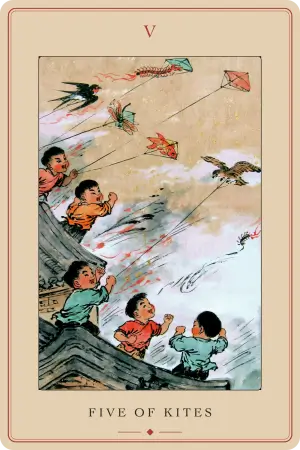


Minor Arcana ·
Six of Kites
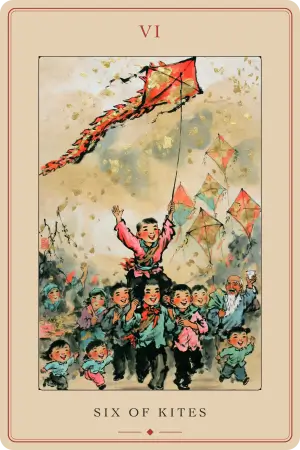
Victory the whole lane can see: the winner of the district kite fight carried on shoulders, dragon still aloft on a long lead.
Card at a glance
- Numerology
- 6
- Element
- Fire
- Astrology
- Jupiter in Leo, 2nd decan · Aug 2–11
- Kabbalistic path
- Tiphereth (Beauty)
- Timing
- Late summer · Leo season
- Yes / No
- Upright yes · Reversed no
Upright
victory
public recognition
reward
self-confidence
leadership
momentum
shared triumph
good news
Reversed
delayed recognition
hollow victory
arrogance
self-doubt
fear of success
envy
stalled momentum
premature celebration
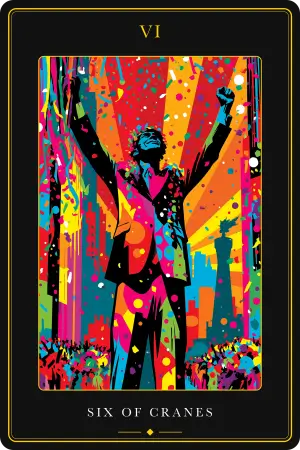
Six of Kites in each deck
Every deck reimagines the same archetype. Compare the art, then open a deck to read its full interpretation.
Imagery and symbolism
In the Tarot of Beijing the Six of Kites is a victory procession through the hutong. The district kite fight is over, the boy who won is carried on shoulders down the market lane, and his great dragon kite still flies overhead on a long lead like a banner. This time even the losers are cheering. The classic card of triumph and public recognition becomes a scene where the glory belongs to a whole street.
The boy raised on shoulders is the victor returning to applause. He is lifted not by his own effort but by the crowd's, the deck's way of saying that recognition is always something others give. His raised hand still holds the spool, because even in triumph the work is not laid down.
The red-and-gold dragon kite overhead replaces the laurel wreath and the raised wand of the older decks. It flies high on its lead, visible to the whole lane, an achievement made public. The dragon is the emperor of kites, hardest of all to build and fly, so its flight signals that this was no easy contest.
The long taut string is the card's quiet warning and its true axis. Victory stays aloft only while someone keeps hold of it, and the connection between the hand below and the glory above must not be dropped in the excitement. Around the winner a crowd cheers: children running, neighbors clapping, an old man raising his cup in a toast. That the defeated flyers cheer too, their own kites already climbing back into the sky behind the procession, shows a victory won fairly in open rivalry, leaving no poison in the lane.
Gold flecks scatter across the kraft-paper sky, falling like confetti and like luck itself. The deck's gold leaf is densest on this card, marking a day when fortune and effort meet. The vermilion of the boy's jacket and the dragon's body is the color of celebration and the fire of the Kites suit, will made visible. As on every card of the deck, a small red seal stamps the corner: this victory is signed and witnessed.
Core meaning
The Six of Kites is Beijing's Six of Wands, the card of earned triumph, and the deck states its whole argument in the procession: recognition is a relationship, given by others and shared back to them. Where the canonical card shows a single rider elevated above a crowd, this one shows a winner held up by the very people he flew against, and losers who cheer because the contest was fair.
After real trials the goal is reached. The strings crossed, sawed, and tangled, and yours held. Now comes reward and praise that arrive publicly, the whole lane seeing whose banner is overhead. Much skill and patience have been invested, and it is time to be carried a little way on other people's shoulders.
The deck adds a footnote the older cards leave implicit. The shoulder-ride lasts one lane's length, and tomorrow the sky is open to everyone again. The dragon stays aloft only while someone minds the wind, so today's momentum is fuel for the next flight rather than a pension. Enjoy the procession, keep one hand on the string, then land the kite properly and rest before the next fight.
Upright meaning
Upright, the card is a public, acknowledged win after honest struggle. Something you worked toward is ready to be seen, and it will be seen. Allow yourself to be celebrated and do not wriggle down from the shoulders before the lane ends. In this deck even the losers are cheering, and refusing their cheer insults them as much as gloating would. Raise the kite high enough for everyone to see, hand the spool to a child for a moment, thank whoever taught you to fly, and keep hold of the string.
In love. A bond that has come through its own kite fight and now flies for the whole lane to see. It promises pride in each other and often a public step: the relationship acknowledged before family and neighbors, a proposal, a wedding procession through the hutong. Respect and mutual admiration are the string that keeps this dragon aloft, each partner genuinely cheering the other's victories.
In career. Effort crowned with a visible result in front of the whole workshop. The project completed, the exam passed, the promotion announced where colleagues can hear it. It points strongly to teamwork, since the winner is carried on many shoulders, and it confirms leadership that lifts others. Accept the recognition without shrinking from it; it was earned string by string.
In finances. The day the wager on your own kite pays off. Returns on what was invested, a raise, a bonus, a prize, or a deal closed in front of witnesses. The string let out in spring comes back wound with gain in autumn, and money arrives with honor attached. Keep a grip on the spool while the crowd cheers.
In health. Victories of the body honestly won: the regimen kept, the plateau broken, recovery confirmed and now visible to others. Energy runs high and confidence straightens the back. It favors active, even competitive practice, races and group sessions in the park at dawn, where the cheer of others multiplies your own effort.
Reversed meaning
Reversed, the card shows the procession without the kite. The crowd was promised a winner, but the string snapped or the wind died. It points to recognition withheld, obstacles just before success, or a victory that brings no inner satisfaction. Plans that flew beautifully in trial runs fail on the day of the fight. The fault runs in two opposite directions, and the reading turns on which one is yours.
Some hide from the sky out of shame: insecure, afraid of open competition, flying only in empty fields at dawn and landing the moment anyone stops to watch. Others cannot come down from the shoulders, demanding the procession daily and mistaking yesterday's cheer for a permanent salary. Both have forgotten that the kite is flown for the sky first and the crowd second.
In love. A relationship that looks festive from the street but has stopped flying. It can mean inequality, one partner always carried and the other always carrying, or a bond kept up more for the crowd's applause than for its own sake. Jealousy of each other's successes may have crept in. Celebrate each other honestly and do the quiet string-work that keeps love aloft when no one is watching.
In career. The flyer whose kite came down just before the judges looked up. Credit taken by another, a lack of support, or unfriendly rivalry where strings are cut rather than crossed fairly. It can also mark coasting on one old victory, retelling the day of the dragon kite while the sky fills with other people's work. Mend the kite honestly, then fly again.
In finances. The prize kite comes down before the fair is over. Gains celebrated before they were banked, winnings spent while the kite was still in the air, or a deal that unravels at the last moment. Avoid risky wagers made to impress the lane, guard your spending, and remember that a quietly landed kite can be flown again tomorrow.
In health. The wind going out of the body's sails: dropping energy, slipping discipline, exhaustion from flying too hard for too long. It can also mean exercising for the crowd rather than for health, comparing your body with every other kite in the sky. Fatigue is a signal to reassess, not to push harder. Rest the burned fingers and measure success against your own past.
Historical notes
The Six of Wands took its familiar form in the 1909 Rider-Waite-Smith deck, illustrated by Pamela Colman Smith under Arthur Edward Waite. It shows a rider on a white horse moving through a crowd, a laurel wreath on the rider's head and a second wreath tied to a raised wand, with the surrounding figures holding their own wands aloft. The laurel comes from Greco-Roman practice, where it crowned victors of athletic, poetic, and military contests, and the crowd makes the card's point that success is validated by the community that witnesses it.
Smith's staging carries a subtler note. The horse is oddly draped, its legs hidden under a heavy cloth so that it reads like a stage horse or a costume worked by two actors, and it wears no reins, a trait it shares only with the horse on The Sun. Readers have long taken this as a question about whether the triumph is genuine or a pageant put on for the audience.
Older patterns handled the card differently. The Tarot de Marseille shows six batons crossed into a lattice with flowers breaking through, triumph rendered as structure rather than scene. The fifteenth-century Sola Busca deck, which influenced Smith, gave the card a surreal figure among floating tree-people under a blood-red moon; Smith dropped that imagery but kept its innovation of fully illustrated pip cards. Crowley and Frieda Harris named their Thoth version "Victory," showing six wands topped with lotuses, Set-creatures, and solar disks against Leo's orange and Jupiter's violet.
The Tarot of Beijing keeps the meaning and moves the stage. The rider becomes a boy carried on shoulders, the laurel and raised wand become a dragon kite on a long lead, and the Roman triumph becomes a hutong procession where the defeated flyers cheer and send their own kites back up.
Correspondences
Number. Six, the number of harmony and balance restored after struggle. In the arc of the Kites suit this is exact: the Five was the tangle above the hutong, five boys' glass-coated strings sawing and crossing, and the Six settles that noisy rivalry into an outcome the whole lane can celebrate. Six is also the number of community and care, which is why this victory is carried at shoulder height rather than won alone on a hill.
Astrology. Jupiter in the second decan of Leo, roughly August 2 to August 11. Leo supplies the pride and the drive to be seen, the dragon kite built to draw every eye. Jupiter, the great benefactor, supplies the luck in the wind and the generosity that lets the victory enlarge those around it rather than diminish them: the winner is carried, the losers cheer, and the gold falls on everyone in the lane.
Element. Fire, in this deck the fire of the Kites suit, will and ambition carried on the wind. Not the fire of the hearth but of the festival, energy focused into action and crowned with success.
Kabbalah. All sixes belong to Tiphereth, the sphere of Beauty at the center of the Tree of Life, the point of equilibrium and the seat of the Sun. Here it is the beauty of a will purified of the petty squabbles below and briefly aligned with a higher purpose, though the sphere is a plateau and the energy must travel on.
Psychological perspective
The person of this card is a champion of the lane: someone who enters the kite fight knowing the strings are glass-coated and enters anyway. They set ambitious goals, do not back down when rival strings rise against theirs, and carry a strong will to win. Their rarer gift is winning in a way that makes even the losers cheer. They wear their victories lightly and visibly, like a dragon on a long lead that everyone can see and that shades no one, and the crowd lifts them willingly because their joy is contagious rather than because they demanded it.
The shadow moves in two directions. One kind avoids the fight altogether, fearing competition and public loss, flying only at dawn in empty fields and landing the moment anyone watches. The other kind cannot leave the shoulders, mistaking one day's cheer for a permanent salary, envious of every higher kite, quick to dispute whose string was cut unfairly. Both have forgotten that the kite is flown for the sky first, and for opposite reasons both have stopped flying well.
Six of Kites across decks
Rider-Waite-Smith. The canonical Six of Wands shows a laurel-crowned rider on a white horse moving through a cheering crowd, a wreath tied to the raised wand. The Six of Kites keeps the public triumph but lowers the rider onto the shoulders of the lane and trades the laurel for a dragon kite flown on a visible lead.
Tarot de Marseille. The Marseille card renders victory as geometry, six batons crossed into a flowering lattice with no human figures. Beijing keeps the sense of a stable outcome after conflict but returns it to a crowded, particular scene.
Crowley-Thoth. Crowley titled the card "Victory" and painted it as six wands with lotuses, Set-creatures, and solar disks against Leo orange and Jupiter violet, the resolution of the Five's "Strife." The Beijing card carries the same Jupiter-in-Leo signature into the color of the procession: vermilion jacket, red-and-gold dragon, gold falling like luck.
Modern reframings. Recent decks often turn the card inward, as when The Wild Unknown shows a butterfly rising from a tangle of dark branches, victory as private liberation. The Tarot of Beijing goes the other way, insisting the triumph is social, and adds its own footnote that the shoulder-ride lasts one lane and the sky reopens to everyone tomorrow.
In combination and context
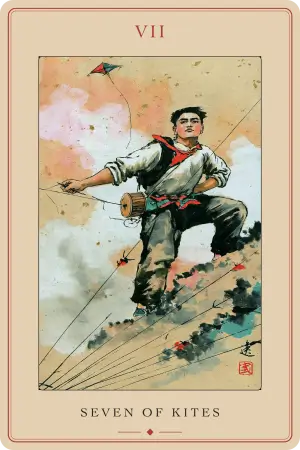
The Six of Kites pulls a spread toward recognition, reward, and momentum, and its neighbors show whether that momentum is earned and shared or borrowed and premature. It sits in a clear sequence in its own suit. After the crossed strings of the Five it is the settled win; a step later the Seven of this suit is the winner defending the position everyone now wants, and the Nine is the flyer wounded but unbeaten, watchful in a hard wind.
With supportive cards the victory reads straight: money arriving with honor, a launch the whole market can see, a partnership acknowledged before family. Beside darker company the deck's warnings sharpen. With cards of bondage or deceit the recognition can curdle into a trophy sought for the ego boost it gives, the partner valued as status rather than person. With cards of collapse the triumph may rest on a hubristic foundation, a victory celebrated too early and too loudly, the string slipping from the hand while the crowd still cheers.
When the card keeps returning, treat it less as a prize than as an instruction. Let yourself be seen for the thing you did well, notice who holds your shoulders, and keep minding the wind so the next kite has somewhere to rise.
Questions for reflection
- Whose victory are you flying for right now, the sky's or the crowd's, and how would today look different if you flew for the sky first?
- When you last won something in front of others, did you keep one hand on the string, or did you let the momentum carry you past the end of the lane?
- Look at who cheered your last success and who went quiet. What does that weave tell you about the people around you?
The general meaning follows the Rider-Waite-Smith reading — the reference used across Tarot Academy. Open a specific deck above for its own interpretation.
Frequently asked questions
Explore the Tarot
Latest Posts
Discover the ancient wisdom of tarot cards and unlock the mysteries of your spiritual journey. Our blog is your gateway to understanding the rich symbolism, meanings, and practical applications of tarot reading.




















































