
 EN (English)


Minor Arcana ·
Seven of Kites
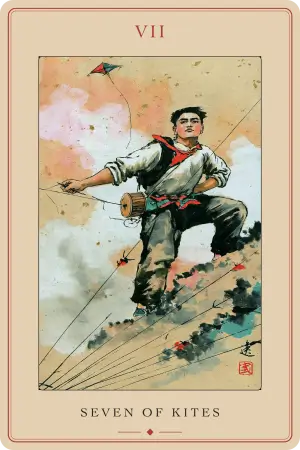
Defended height: a lone flyer holds his kite over the old city wall while six sharpened strings rise to cut it.
Card at a glance
- Numerology
- 7
- Element
- Fire (the wind-fed fire of Kites)
- Astrology
- Mars in Leo · third decan (August 12–22)
- Kabbalistic path
- Netzach (Victory)
- Timing
- Late summer · Leo season
- Yes / No
- Upright yes · Reversed no
Upright
defense
high ground
vigilance
endurance
standing alone
the earned position
persistence
refusal to yield
Reversed
exhaustion
surrender
overload
retreat
lost ground
scattered defense
burnout
Seven of Kites in each deck
Every deck reimagines the same archetype. Compare the art, then open a deck to read its full interpretation.
Imagery and symbolism
In the Tarot of Beijing the Seven of Wands is a kite fight on the old city wall. A lone flyer stands on the ramparts above the hutongs, the spool braced against his hip, while six sharpened strings rise against his kite from below. In the kite fights of the lanes, strings were dusted with ground glass to saw through a rival's line, so every crossing string in the picture is a live attack and every second aloft is a contest.
The wall is the high ground, position earned rather than granted. A flyer on the wall commands more wind than the ones launching from the lanes, and the wall itself remembers dynasties, so it stands for everything built slowly that can be lost quickly. The spool braced against the hip shows the right way to hold under long strain, not with the fingers alone but with the whole body. Willpower here is posture rather than spasm.
His kite, still steady above the tangle, is the achievement itself: the project, the reputation, the idea already high. The six strings from below are enemies' intentions and not their faces, because this card shows the attack, never the attackers. The set of his shoulders carries the ache of defense, the honest cost the card refuses to hide. One or two accents of vermilion, the kite and the tassel on the spool, burn against the grey wash of sky and brick, the fire of the suit of Kites kept alive in the wind that tests it. In the corner a red seal sits like the flyer himself, small, fixed, and going nowhere.
Core meaning
The Seven of Kites is the card of defended height. You are the flyer whose kite is already high, and now the moment after success asks you to hold it against pressure from many sides at once. Rivals, critics, or plain circumstance contest what you raised, and the card confirms that you hold the advantage as long as you do not step down: you climbed first, your string is strong, the position is defensible.
Where the canonical Seven of Wands is a young man swinging one staff against six on a bare cliff, Beijing keeps the same lopsided fight, one against six, and moves it into the tradition of the hutong kite duel. The suit of Kites is this deck's suit of Fire, will and ambition that stay alight only while someone holds the string. Six, the number before, was the victory parade carried through the market lane. Seven is the morning after, when everyone who cheered comes to take the title for themselves. Every achievement becomes a position to defend, and the card treats that not as injustice but as the natural weather of ambition.
Upright meaning
Upright, the card tells you the position is worth holding and can be held. Do not come down from the wall. Brace the spool against your hip and watch every string that crosses yours, because vigilance now is worth more than force. Defend your ideas without apologizing for having launched them, and study your rivals the way a kite fighter reads the wind, with attention rather than hatred. Consistency and a firm grip outlast any single attack.
In love. The bond is the kite flown together, real and high and visible, and the crossing strings are everything that saws at it: disapproving relatives, old flames, distance, gossip along the lane. Name the pressures honestly and face them as a pair. It can also mean defending your own dignity inside the bond, holding your own string while flying beside another.
In career. Your role, project, or idea now draws challenges from colleagues who want the assignment and critics who doubt the plan. The card shows an uneven fight and still gives the defender the advantage, because the defender stands on real results. Answer criticism with the work itself and do not surrender responsibilities you carry well. This contested season converts your place from something granted into something owned.
In finances. Your finances are the kite already aloft, and the sharpened strings are competitors, rising costs, and people who think your money should be theirs. The position is defensible with the same daily attention that earning took. Check the contracts, question the fees, and refuse pressure to spend or lend against your judgment. The tension is that of a taut string, not a breaking one.
In health. This is the body of the flyer on the wall: endurance, grip, and strength that comes from holding rather than bursting. It favors staying power built by long walks and stances held to the trembling point, and it marks a season of defending physical gains against busy weeks and tired evenings. Motivation must be guarded daily, like the string itself.
Reversed meaning
Reversed, the flyer stands at dusk with trembling arms, wondering whether the kite is still worth the fight. New strings seem to rise faster than old ones can be cut away, and the height that once felt like advantage now feels like exposure. It can mean a lost kite fight: a project surrendered, a position given up under pressure, or the quiet decision to stop competing at all. Climbing down before the wind throws you down is not surrender. Even the best flyers wind in their kites at nightfall. Reassess which contests deserve your string and which are only noise over the hutong, then repair the kite and rest the hands before flying again.
In love. So much strength has gone into guarding the relationship that little is left for the tenderness the guarding was for. Conflicts repeat like kite fights at the same corner every evening, one partner grips too hard, and the string chafes. Put the spool down and look at each other instead of at the enemies. Some threats to the bond are imaginary, and gentleness now defends more than vigilance.
In career. This is burnout on the wall. Overload and endless turf battles pull productivity down exactly where the fighting is fiercest, and the strategy of total defense has failed. Some duties should have been shared and some criticisms accepted. Reassess which parts of the role are your kite and which are strings you grabbed in the heat of the fight. If the answer is to leave, leave walking, with the spool wound and the kite under your arm.
In finances. The spool is slipping from tired hands. Concessions get made under pressure, assets sell cheaply out of fatigue, and stress about money begins to cost money through anxious decisions. Often the threat is smaller than it looks from the wall, so review the actual numbers instead of the feeling of siege. Consolidate and simplify if you must, but do it deliberately rather than in a panic.
In health. The flyer's body after too many fights: overtrained, undertended, held together by stubbornness, until small strains become long injuries. Or the grip has failed entirely and the regimen is abandoned at the first crossing string. Either way the wall must be left for a while. Rest is repair, not retreat. Measure your body against its own last season, not against the six kites around it.
Historical notes
The Seven of Wands began as a pip card in the Tarot de Marseille, titled Le Sept de Bâton, where seven batons interlock in three crossed pairs bisected by a single central vertical wand. Early European cartomancy read it positively, as the assured success of a creative or commercial venture, yielding keywords of profit, advantage, and competitive struggle. The central unbroken wand stood for the individual will cutting through the crossing of external circumstance.
The scenic card arrived in 1909 with the Rider-Waite-Smith deck, where Pamela Colman Smith drew a young man on a craggy height brandishing a staff while six others thrust up from below. He wears a green tunic against a clear yellow sky, holds the higher ground, and defends what he built, giving rise to the modern reading of the card as a solitary stand against the pressure of the crowd. Her figure famously wears two different shoes, a detail readers take as unpreparedness, nonconformity, or an uneven inner footing.
Aleister Crowley's Thoth deck titled the card Valour and returned to geometry, thrusting a crude uneven club through six refined wands of the Adept to show an army thrown into disorder. Victory in that state, he wrote, is won by individual valour, a soldier's battle. The Tarot of Beijing keeps this lineage of the outnumbered defender and resets it on the city wall, trading cliff and club for the spool, the glass-coated string, and the kite that must stay aloft while six others try to cut it down.
Correspondences
Number. Seven, in numerology the number of testing and inner reserves. Six was the victory parade, and seven is the morning after, when the win becomes a position to defend. The card holds six strings against one, so seven kites fill the sky and the test is built into the count itself. Seven hands out no victories. It asks what you are made of and waits for the answer.
Astrology. The third decan of Leo, from August 12 to 22, ruled by Mars. Leo gives the flyer his height and his pride of place on the wall, the earned right to be seen. Mars supplies the fighting grip, the quick eye for a rival's line and the stamina in the arms. Mars works here through defense rather than aggression: the flyer does not attack the six kites below, he simply refuses to let them cut his.
Element. Fire, in this deck the wind-fed fire of the Kites, will and ambition that stay alight only while someone holds the string. It shows the courage and endurance of fire under pressure, the way a kite reveals its build only in a hard wind.
Kabbalah. The sevens sit on Netzach, the sphere of Victory or Firmness, the seventh emanation and the first to fall below the harmony of the Sun. In the suit of Wands this is Netzach in the world of Atziluth, the instinctive drive for victory carried on archetypal fire, a win that is seized and defended rather than granted.
Psychological perspective
The person of this card holds the wall. They climbed early, worked for their height, and know exactly what it cost, so they do not give it away. Competition sharpens them rather than frightening them, and they can stand alone against many without self-pity, treating solitude at the top as a fair price. Their confidence is earned and their grip is strong, and they will defend a principle long after the polite have gone home.
The reversed shadow is the flyer whose arms have given out. Every wind in the city seems to blow against them, new rivals appear faster than old ones retreat, and worn down by constant defense they either avoid every contest or fight scattered skirmishes that spend strength without protecting anything. Doubt gnaws: perhaps the kite was never that good, perhaps the height was luck. What this state needs is not more courage but rest, repair, and an honest count of which strings are worth holding.
The Seven of Kites across decks
Rider-Waite-Smith. The canonical Seven of Wands sets a young man on a cliff, green-clad against a yellow sky, swinging a single staff at six raised from below, with his famous mismatched shoes reading as haste or nonconformity. The Seven of Kites keeps the one-against-six defense and the earned high ground, but arms the fight with glass-coated string and puts a spool where the staff was.
Tarot de Marseille. The Marseille pip is pure geometry, six batons crossed around a single upright wand that stands for the individual will. Beijing keeps that idea of one line held straight through crossing pressure and gives it a body, the flyer whose taut string runs unbroken to the kite above the tangle.
Crowley-Thoth. Crowley's card, Valour, drives a crude club through the Adept's six refined wands to show energy thrown into disorder, a battle won only by raw individual courage. The Beijing card meets the same lesson on the wall: refined strategy matters less than the will to keep holding when outnumbered.
Modern reframings. Recent decks reread the card as boundary defense, protecting a fragile flame from the weather, or holding ground against political and social pressure. The Tarot of Beijing belongs to that movement, recasting the defended position as a kite fight over the hutongs where respect goes to the one whose string holds.
In combination and context
The Seven of Kites pulls a spread toward contested height and the work of holding a position. Beside cards of recent triumph it reads as the morning after the parade, the win now needing defense. Following the Six of its suit it makes the sequence explicit: first the victory carried through the lane, then the crowd that comes to take the title.
Neighbors decide whether the fight is worth it. Alongside cards of drive and momentum the defender becomes almost unmovable, the earned position married to sheer will. Beside cards of rest, departure, or exhaustion the card tips toward its reversed reading, the flyer who should wind in the string and come down before the wind does it for him. In love spreads the surrounding cards show whether the crossing strings are real rivals or imagined ones, and whether the couple still wants to fly the kite they raised together.
When the card keeps returning, treat it not as an outside enemy pressing on you but as a question about your own grip: which contests deserve your string, and which are only the sky being busy. Fighting everything is the fastest way off the wall.
Questions for reflection
- Which of the strings rising against you are real attacks, and which are only the sky being busy over the lane?
- What did it cost you to climb this high, and are you defending the position from your foundations or only from irritation?
- If your arms are aching, is it time to hold the wall or to wind in the kite by choice and rest before flying again?
The general meaning follows the Rider-Waite-Smith reading — the reference used across Tarot Academy. Open a specific deck above for its own interpretation.
Frequently asked questions
Explore the Tarot
Latest Posts
Discover the ancient wisdom of tarot cards and unlock the mysteries of your spiritual journey. Our blog is your gateway to understanding the rich symbolism, meanings, and practical applications of tarot reading.




















































