
 EN (English)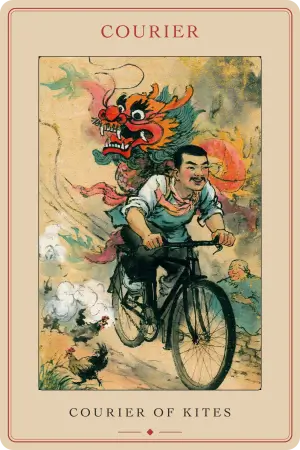


Minor Arcana ·
Matron of Kites
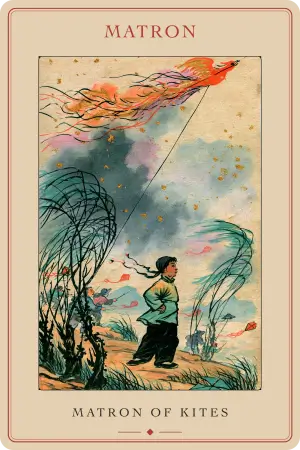
Fire held to one steady grip: a woman planted on a windswept hill whose phoenix kite flies high while every other kite around her comes down.
Card at a glance
- Numerology
- Matron (Queen of Wands)
- Element
- Water of Fire
- Astrology
- 21° Pisces to 20° Aries · First House · Aries
- Kabbalistic path
- Binah in Atziluth (Water of Fire)
- Timing
- Spring · Vernal Equinox · Mar 11 to Apr 10
- Yes / No
- Upright yes · Reversed no
Upright
self-confidence
leadership
passion
charisma
independence
creative fire
warmth
steadiness in the storm
Reversed
domination
arrogance
jealousy
abuse of power
burnout
short temper
controlling
lost vitality
Matron of Kites in each deck
Every deck reimagines the same archetype. Compare the art, then open a deck to read its full interpretation.
Imagery and symbolism
In the Tarot of Beijing the Queen of Wands is the Matron of Kites, a stout woman standing on a windswept rise above the lake in the wind that has brought down every other kite in the district. She has no throne. Her throne is her stance. She stands planted like a gatepost, one hand on her hip, and that posture is the whole argument of the card. Authority in this deck is not granted, it is held, against real weather.
High above her flies her phoenix kite, vermilion and gold, wings streaming like flame across the storm clouds. The phoenix does the work of the wand and the sunflower at once. It is fire given a body, will given wings, the feminine sovereign of birds in Chinese tradition. It rides the gale steady while the sky churns grey around it, her influence made visible, and a single taut string runs from the phoenix down to her hands. All that fire answers to one calm grip.
The wind is drawn rather than implied. Willows and reeds bend nearly horizontal, her black headscarf ribbon streams like a banner, the hillside grasses lie flattened. The wind is the same for everyone on this hill, which is the point. In the background other flyers struggle, small red diamond kites dipping and tumbling and dragging their owners across the slope while the neighbours hold their hats and take notes. Their difficulty is not mocked. It measures her mastery, because what downs their kites lifts hers.
Her teal jacket carries a wash of warm yellow-orange across the chest, as if the phoenix's fire were reflected back on her. In the deck's muted black, grey, and teal, she and her kite are the two warm points on the card, joined by the string. Gold leaf drifts through the storm sky like sparks, gathering most densely around the phoenix where will burns brightest. Her gaze is lifted and level, following the line into the sky, confident not in the outcome but in her own hands. A small red seal sits in the corner as on every card of the deck, the maker's quiet signature under the storm.
Core meaning
The Matron of Kites is Beijing's Queen of Wands, the fire of the suit in its radiant, self-possessed form. The Golden Dawn called this figure the Water of Fire, the receptive feeling nature of a Queen paired with the will and ambition of the Kites suit. Water on Fire does not cancel out. It makes steam, pressure that rises and holds, a phoenix flying in storm weather under one hand.
The deck states her whole meaning in one image. On a hill where the gale has grounded everyone else, she keeps her kite up. Conditions that scatter other people are exactly the conditions in which she holds. Her strength is not loud, it is load-bearing, the confidence of someone who has been handed rough weather and made altitude out of it. This is not power she inherited. In the suit of Wands confidence is earned, and she has flown small kites in easy winds long enough to have earned the phoenix.
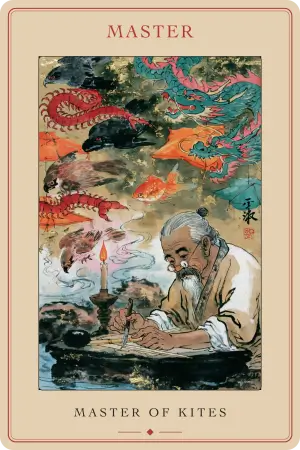
Where the Courier of Kites races through the hutongs half-flying himself and the Master of Kites directs the sky from his workbench, the Matron stands out in the weather and simply holds the line. She draws people by presence rather than pursuit, the self-realised centre of attention on a hill full of struggling flyers. The card asks you to become this energy or to recognise someone who already is: the person whose grip stays firm and never white-knuckled while the wind argues, and who the whole hillside quietly starts imitating.
Upright meaning
Upright, the Matron of Kites marks a period when your creative fire is at its peak and your character shows. She embodies enterprise and effective leadership, a strong will and abundant energy put to work. Stride through life the way she stands on that hill: feet planted, spool braced, eyes on your own kite and not on the ones falling around you. Plan your line and manage your energy, because a gale rewards the flyer who lets out string deliberately rather than frantically. Now is the time to voice your opinions and take charge. The neighbours are already holding their hats and taking notes.
In love. A passionate, independent connection with intense magnetic pull, two flyers on the same hill each holding their own spool. Both partners keep their own projects, and the bond stays strong precisely because neither asks the other to come down. She loves her own strength, and her fire draws admirers the way the phoenix draws every eye on the lakeshore. The same hands that brace against the gale are the ones that mend a torn wing by lamplight, so passion here comes with real care.
In career. Confidence, momentum, and visible success. In a leadership role she shows resilience and motivates a team, hers being the kite everyone checks their own against. The card points to an upcoming chance for advancement or a high-profile project, the district contest coming with your phoenix ready. In business she reads as an entrepreneurial spirit in active ascent, a founder with the nerve to launch in weather competitors avoid and the drive to scale what she starts. Your inner fire leads directly to prosperity.
In finances. Confident leadership and financial independence, stability earned in weather that grounded everyone else. She funds her ambitions from her own spool and knows exactly how much string she has and where the wind is going. The card favours starting a venture or pushing an existing one higher, and putting money into a project that expands your wealth the way a good flyer trades line for altitude. The potential is high, but the phoenix does not fly itself. Determination keeps it up.
In health. Physical vitality and presence. Plans to change your appearance come from wanting to feel more alive, to stand in the wind and enjoy your own strength. This is an active phase for the body: a new sport, morning practice among the tai chi rows, a drastic haircut and a straighter back. You are seeking vigour to match your internal fire, a body that can brace against the gale and grin doing it.
Reversed meaning
Reversed, the Matron of Kites is the same woman refusing to reel in as the storm turns dangerous. It reads as despotism, abuse of power, or burning too much line at once, the desire to dominate the whole sky and control every string on the hill. At the other pole it is a flyer who has lost the wind entirely: vitality gone, the great kite folded in a corner gathering dust. Reassess before you cause harm. Not every crossing line is a challenge, and sometimes you must simply bring the kite down with dignity and wait for a better wind.
In love. Tyranny or exaggerated ambition in the relationship. Someone tries to hold both spools, dictating the terms and flying the partner's kite for them, and that usually comes from insecurity rather than strength. Emotion and passion run out of control, and the partnership becomes constant, exhausting drama: every conversation a string-fight, every silence a grounded kite. Keeping your independence does not require cutting your partner's line. Step down off the hill and deal with them at eye level.
In career. Severe stress, overload, or leadership that has outrun its skill, a spool manager promoted past their wind. Impulsive decisions and no strategy leave projects stalled, or the fire has simply gone out and the great kite stays furled behind the door because lifting it feels like too much. In business it is too many kites launched at once and not enough hands, crossed strings sawing each other through. Step back, read the whole sky, and re-rig the approach before the next launch.
In finances. Uncontrolled energy and arrogance with money, line paid out into a storm with no plan for reeling it back. It warns of reckless spending, the whole spool run out with no wrap kept in reserve, and difficulty both earning and preserving what you have. Assets get misused and clear opportunities missed while you argue with the wind. Take active hold of your accounts now, both hands on the spool, and manage your resources realistically.
In health. Overexertion or neglect. You push to extremes, holding the line long past your arms' honest limit, or you abandon the body entirely, the kite of the body left furled in a damp corner. Underneath is often insecurity about your own attractiveness and a lack of basic self-respect. Stop measuring yourself against an impossible paper phoenix. Seek a trainer or a nutritionist the way a wise flyer takes a cracked spar to the old kite maker, and build a sustainable approach.
Historical notes
In the Golden Dawn system this figure carries the formal title Queen of the Thrones of Flame and rules the heavens from 21 degrees Pisces to 20 degrees Aries, a span that joins the watery emotional depths of late Pisces to the pioneering fire of early Aries. She was defined as the Water of Fire and placed on the third Sephira, Binah, the Supernal Mother who gives form to raw force, manifesting that mothering energy within Atziluth, the highest world and the realm of Archetypal Fire. Her mandate was to ground formless ambition into a warmth that heats the hearth rather than burning down the house.
The older Tarot de Marseille pictured her as the Reyne de Bâtons, looking downward with both hands at her waist and the base of a heavy golden wand resting in her lap, a figure who speaks softly while holding a big stick and whose power needs no display. The Rider-Waite-Smith deck of 1909, drawn by Pamela Colman Smith for A.E. Waite, gave her the imagery most readers know: a throne carved with facing lions, a blooming sunflower in one hand, a sprouting wand in the other, and a black cat seated at her feet as a sign of shadow integrated without shame. Crowley and Lady Frieda Harris then intensified her in the Thoth deck, her hair turned to actual fire and a winged leopard at her hand, radiating calm inside what they called Shakti fire.
The Tarot of Beijing keeps the Water of Fire architecture and moves her out of the throne room. The stone throne becomes a stance on a windy hill, the wand and the sunflower become a single phoenix kite, and the lions and the cat give way to the drawn wind itself and the neighbours whose kites cannot hold. What survives is the function the card always described: fire mastered by a feminine hand, radiant, protective, and secure enough not to need a display.
Correspondences
Rank. Matron, this deck's Queen, the receptive and form-giving rank of the court. Where the Ace is the first spark and the moving ranks carry it through quest and speed, the Queen holds the element steady and radiates it, mastery expressed as presence rather than motion.
Astrology. The card governs the third decan of Pisces and the first two decans of Aries, roughly 21 degrees Pisces to 20 degrees Aries, or Mar 11 to Apr 10. That span crosses the Vernal Equinox at 0 degrees Aries, the hinge of spring and, in occult astrology, the rare double-Mars point where one planet rules two decans in sequence. Her core identity is Aries: brave, willful, assured, intolerant of delay. Her natural home is the First House of self-identity and self-expression, the planted stance on the hill visible to the whole district.
Element. Water of Fire. The receptive feeling nature of a Queen combines with the Fire of the Kites suit to make steam under pressure, a dynamic force that rises and holds. The heat is real, but a calm hand governs it.
Kabbalah. All Queens sit on Binah, Understanding, the Supernal Mother who captures and gives shape to raw force. As Queen of the Fire suit she works within Atziluth, the world of pure emanation, acting as the mother of the Fire element and providing the boundaries that keep the spark from consuming what it warms.
Elemental dignity. As the watery aspect of a fire suit, she stabilises volatile Wands cards near her and lends warmth to the cooler suits, turning raw ambition into something that can be held and directed.
Psychological perspective
Psychologically the Matron of Kites is confidence understood as an achievement rather than a birthright. Because the Kites suit is about growth, her self-assurance is something she built, having outlived the fear of rejection and the anxiety of other people's judgment to stand in the wind as herself. That is the meaning under the drawn gale. On a hill where everyone shares the same weather, the difference between a downed kite and a flying phoenix is who kept a firm, unhurried grip on the string.
She pairs the radiant, extroverted energy of fire with the inward, feeling nature of a Queen, and the result is warmth that leads. She keeps clear plans, understands her own aspirations, and manages her emotions the way a good flyer manages tension on a line, firm and never clenched. She takes calculated risks, launching in weather others call impossible because she has measured that weather first. Her intuition is sharp and her talent real, the phoenix on her string always one she painted herself.
The shadow is what happens when the balance of Water and Fire collapses. Bright confidence curdles into demanding vanity and the urge to dominate the whole sky. Deep watery feeling turns to irrational grudges held for years, a hot-tempered fury that turns on a friend without clear cause. The opposite failure is quieter: a person who dims their own light to appease others, hiding their fire and dramatising every downed kite as a catastrophe. The card's steady demand is to hold your own line without either cutting other people's or letting your spool spin out of a tired hand.
Matron of Kites across decks
Rider-Waite-Smith. Pamela Colman Smith's Queen sits front-on in a commanding, open-legged stance on a throne of facing lions, a blooming sunflower in her left hand and a sprouting wand in her right, a black cat alert at her feet. Every element speaks of fire mastered and shadow owned. The Matron of Kites keeps that sovereignty and trades the seated pose for a standing one, the sunflower and wand for a phoenix kite, and the cat for the wind that grounds every kite but hers.
Tarot de Marseille. The Reyne de Bâtons is quieter, looking down with the base of a heavy wand resting in her lap, a woman of overwhelming personality who does not need to flaunt secure power. Beijing keeps that composed, load-bearing authority and hands it a gale to prove itself against.
Crowley-Thoth. Crowley and Harris show the Queen of Wands inflamed, her hair becoming fire that bleeds into the flames around her throne, one hand on a winged leopard, calm inside the blaze. Her attribution matches the Beijing card exactly, Water of Fire from Pisces into Aries, though the deck renders that doubled charge as a phoenix riding a storm rather than a body wreathed in flame.
Modern reframings. Contemporary readers cast her as the fiercely independent woman who needs no external validation and treats herself as her own Sun, the archetype of recovering from rejection with the head held high. The Tarot of Beijing gives that same figure a hill, a storm, and a district of struggling neighbours, so her independence reads as something demonstrated in public weather rather than merely asserted.
In combination and context
The Matron of Kites pulls a spread toward confident leadership, creative fire, and independence, and the cards around her show whether that fire warms or scorches. Beside the Master of Kites, this deck's King of Wands, she completes the mature fire of the suit, the maker and the radiant beacon side by side, and in a relationship question the pair reads as a power couple who amplify each other rather than drain. With the swift Eight of Wands her visions arrive at speed, a sudden influx of energy, travel, or news, though the same combination in a romance can flag fast, uncommitted heat rather than a lasting bond.
Her fire endangers by turn. Alongside the Devil her passion corrupts into hedonism, bondage, or a manipulative dynamic, an empire that ends up controlling its builder, and in occult tradition that pairing was read as female sexuality bent to heavy influence in the background. Read as the other woman in a fidelity question, she is the alluring, slightly dangerous alternative to domestic routine, the fiery presence a straying partner is weighing. In a question about how someone sees the querent, she often marks a magnetic independence so strong that an avoidant partner keeps their distance, respecting the fire without trusting they can match it.
When she keeps returning, treat her as an instruction to own your power and lead by lifting other kites rather than cutting their strings, with one caution the card is strict about. The Matron never lowers her phoenix to make the other flyers comfortable, and that is her gift right up to the moment it becomes the urge to dominate the whole hillside. Hold your own altitude, and leave the neighbours theirs.
Questions for reflection
- Where in your life are you the one still flying when the weather has grounded everyone else, and what does your grip on that string cost you?
- Is your fire currently warming the courtyard, or has the urge to be the highest kite started cutting the strings around you?
- What weather did you actually measure before your last bold launch, and what would change if you planned the line instead of yanking it?
The general meaning follows the Rider-Waite-Smith reading — the reference used across Tarot Academy. Open a specific deck above for its own interpretation.
Frequently asked questions
Explore the Tarot
Latest Posts
Discover the ancient wisdom of tarot cards and unlock the mysteries of your spiritual journey. Our blog is your gateway to understanding the rich symbolism, meanings, and practical applications of tarot reading.




















































