
 EN (English)



Minor Arcana · Pentacles (Earth)
Eight of Pentacles
The Rider-Waite craftsman at his bench, carving pentacles one by one toward mastery.
Card at a glance
- Numerology
- Eight
- Element
- Earth
- Astrology
- Sun in Virgo (first decan)
- Kabbalistic path
- Hod (Splendour)
- Timing
- Late summer, Virgo season
- Yes / No
- Upright yes, conditional on effort · Reversed no
Upright
Apprenticeship
Skill development
Mastery
Diligence
Focus
Craftsmanship
Dedication
Repetition
Reversed
Perfectionism
Burnout
Cutting corners
Lack of ambition
Sloppy work
Monotony
Sunk cost
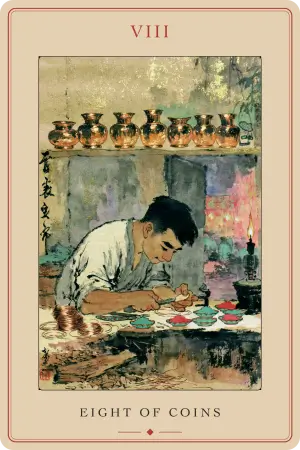
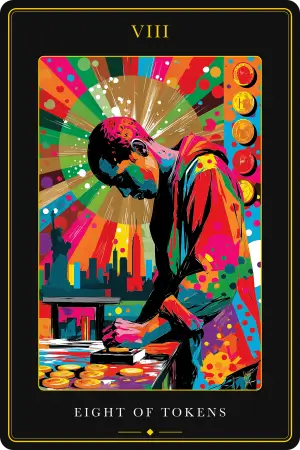
Eight of Pentacles in each deck
Every deck reimagines the same archetype. Compare the art, then open a deck to read its full interpretation.
Imagery and symbolism
The Rider-Waite-Smith image gives the card its familiar scene: a young craftsman on a plain wooden bench, bent over a golden coin with a hammer and small chisel, carving a five-pointed star into its face. His tunic is red and blue, colours esoteric readers take as the fire of passion joined to the water of feeling, the two brought together to make the stable earth of the suit.
The coins around him mark the passage of time. Six finished pentacles hang on a wooden post at his side, work already done and fit to admire. One coin sits under his chisel as the present task, and one waits at his feet as raw material still to come. Once a coin is finished he begins the next, so the picture reads as continuous improvement rather than a single finish line.
Two details this deck leans on soften the usual reading of isolation. A tree trunk stands nearby for growth won through sustained effort, and green plants further off carry life and renewal. The town in the background is not only the distraction he has turned from; it is the community his work serves. His solitude and complete absorption read as inner balance and freedom from distraction, and the clear lines and solid forms of the whole scene suggest a steady foundation to build on.
Core meaning
The Eight of Pentacles is the card of the apprentice and the master in training. In this deck the weight falls on continuous refinement: the craftsman relies on nothing but his own skill, and each finished pentacle sends him back to the bench for the next. Mastery here is the shift from a first rough grasp of something to deep, worked-in knowledge, and the reward sits as much in the process as in the pay or the finished object.
On the Tree of Life the number eight belongs to Hod, the sphere of intellect, logic, and structured thought. In the earth suit of Pentacles that mental energy is grounded in matter, so the card reads as the mind applied to a physical craft, breaking a large goal into small tasks and working through them with care. Where the Major Arcana deals in sudden change, this card moves at the pace of patient accumulation.
Upright meaning
Upright, the Eight of Pentacles points to skill development, apprenticeship, and diligent effort. It favours going back to study, retraining, or committing to a daily discipline, and it promises that security and standing will match the work put in. This is not a card of windfalls; the mastery of the craft becomes the salary. It asks you to take pride in small details and to refuse shortcuts.
In love. The deck reads this as an active building phase: planning to live together, starting a family, or organising a shared life on a solid footing. Both partners are willing to invest patience and attention, down to the small everyday things, and to value long-term trust over fleeting passion.
In career. A strong sign for anyone learning a trade or deepening one they already have. As the card of the master craftsman it shows discipline turning into professional growth, and it confirms that your competence is noticed and valued by colleagues and supervisors. High standards and steady focus build a lasting reputation.
In finances. Money grows through sustained effort and careful management rather than luck. The energy already put into your work is about to bear fruit, though the diligence that got you here has to continue. It rewards staying organised, watching the details, and investing in training that raises your efficiency.
In health. The card supports routine and steady self-care: consistent activity, a disciplined approach to nutrition, and comfort in familiar body routines. Careful tracking and small daily choices bring real results over time, and it reads as mastery of your own physical condition rather than a dramatic overhaul.
Reversed meaning
Reversed, the Eight of Pentacles turns in one of two directions. The milder shadow is apathy: sloppy workmanship, cut corners, low ambition, or a project taken on well beyond your current skill. It is the student who will not study and the worker who phones it in.
The harder shadow is the modern one, burnout and toxic productivity. The craftsman becomes so fixed on carving pentacles that he loses the town, his health, and the people around him. The work stops being an absorbing pursuit and turns into armour against feeling inadequate. The reversed card asks a blunt question: are you working to grow, or working to prove you deserve to exist? It also warns of paralysing perfectionism, where huge effort goes in yet nothing is ever good enough.
In love. Monotony, detachment, or a sense that the effort invested is not paying off. One partner may be buried in work and unavailable, or afraid to take on responsibility, letting problems slide by unaddressed.
In career. A halt in learning, a feeling of being stuck at one skill level, or fixation on small details that costs the chance to advance. It can also mean leaning too hard on others' recognition, or grinding on until persistence tips into burnout.
In finances. Lost focus and thin discipline, effort spent in the wrong direction, and returns that fail to match the labour going in. Watch for procrastination, neglected study, and busywork that drains resources without the outcome you wanted.
In health. Imbalance and lost control over diet or exercise on one side, plain stagnation and neglected routines on the other. Either way it is a call to reassess your self-care and take responsibility for your physical state.
Historical notes
In the older Tarot de Marseille tradition of 17th and 18th-century France, the pip cards carried no scene. The Eight of Deniers showed two columns of four coins woven through with floral motifs, and readers drew its meaning from number rather than picture. They linked the eights to the trumps Justice (VIII) and The Moon (XVIII), both cards of measurement and discernment, so the card spoke of evaluation and inventory: assessing what you have gathered and sorting what is useful.
The narrative image most people know arrived with the Rider-Waite-Smith deck, drawn by Pamela Colman Smith under Arthur Edward Waite. Smith gave the abstract coins a human story, the solitary craftsman at his bench, and moved the emphasis toward incremental mastery and dedicated focus. The Golden Dawn had already set the esoteric scaffolding, naming the card the Lord of Prudence and tying it to the Sun in Virgo.
Correspondences
Number. Eight, which numerology reads as balance, order, and discipline, and ties to karma, the idea that effort eventually returns to its source. On the Tree of Life it belongs to Hod, the sphere of Splendour, where intellect and structured thought are grounded in the material world.
Astrology. The Sun in the first decan of Virgo (roughly 0 to 9 degrees, late August to early September). The Sun's core vitality meets Virgo's methodical, service-minded nature, so the ego finds its satisfaction in patient, exacting craft. The Golden Dawn titled the card the Lord of Prudence.
Element. Earth, through the suit of Pentacles: the realm of work, body, money, and tangible results.
Kabbalah. The sephirah Hod, ruled on the Tree by Mercury, which lends the card its close attention to detail and its habit of breaking work into repeated, analysable steps.
Elemental dignity. As an Earth card it sits comfortably beside Water cards and steadies restless Fire, while heavy earth company can weigh its patience down into plodding work.
Psychological perspective
Psychologically, the Eight of Pentacles describes the flow state, the absorption in which a repetitive task stops being tedious and turns fascinating. The tarot writer Susan Chang calls it productive myopia, a Zen-like focus so complete that the ego dissolves into the work. Any task, however dull from the outside, becomes interesting once the mind looks closely enough at how it works.
That same absorption carries a shadow. Under Virgo's drive for perfection it can curdle into hyper-criticism and anxiety over tiny flaws. Modern readers flag a subtler risk too: self-improvement used as a hiding place. Constant studying and working can become a socially acceptable way to avoid the messy, unpredictable business of human connection. The card asks whether the diligence is genuine craft or a productive place to hide.
The Eight of Pentacles across decks
The foundational decks each frame the card differently, and setting them beside the Rider-Waite-Smith craftsman sharpens what this deck is doing. In the Tarot de Marseille the Eight of Deniers is an abstract geometric arrangement of coins, read as evaluation and the careful auditing of resources rather than a scene of labour.
Crowley and Harris's Thoth deck drops the human figure and titles the card Prudence, showing a plant with eight disk-centred flowers. The image moves from mechanical work to organic growth: a crop cannot be forced, only nurtured, and if the weeds are left the harvest is strangled. Among modern decks, Kim Krans's Wild Unknown sets a spider at the centre of an intricate web, an architect weaving a structure that needs patience and precision, a reminder to break overwhelming tasks into digestible parts. Chris-Anne's Light Seer's Tarot leans into joyous, energetic abundance and divine timing, warning against holding too tightly to outcomes. Lisa Sterle's Modern Witch Tarot keeps the Rider-Waite dedication but places it in diverse, contemporary hands, stressing control over one's own craft and economic destiny.
In combination and context
The Eight of Pentacles is often weighed against the Three of Pentacles, since both deal with work and skill. The Three is the collaborative, planning stage, the craftsman consulting others and seeking approval. The Eight sits closer to completion and reads as independent execution: no blueprint, no supervisor, just the self-sufficient producer in a flow state. Beside The Hermit, another Virgo card, it doubles down on solitary, inward work, and readers note the two figures often face away from the rest of a spread.
Position shifts it as well. In a past slot it points to the training or apprenticeship that built the present. As advice it says commit to the daily discipline and stop looking for shortcuts. As an outcome it promises earned, steady results rather than luck. In a yes-or-no reading it is a conditional yes upright, possible if you put in the work, and a firm no reversed, a sign to sharpen your skills before proceeding.
Questions for reflection
- What craft or skill am I being asked to commit to, one repetition at a time?
- Is my hard work a genuine pursuit of mastery, or a productive place to hide from something?
- The craftsman's work serves the town behind him. Who does my current effort ultimately serve?
The general meaning follows the Rider-Waite-Smith reading — the reference used across Tarot Academy. Open a specific deck above for its own interpretation.
Frequently asked questions
Explore the Tarot
Latest Posts
Discover the ancient wisdom of tarot cards and unlock the mysteries of your spiritual journey. Our blog is your gateway to understanding the rich symbolism, meanings, and practical applications of tarot reading.




















































