 EN (English)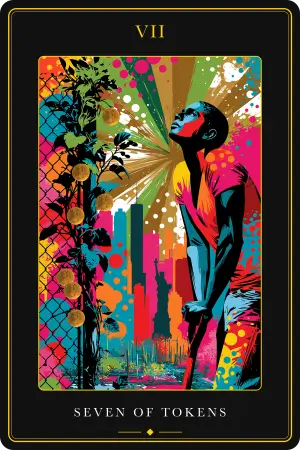


Minor Arcana ·
Eight of Tokens
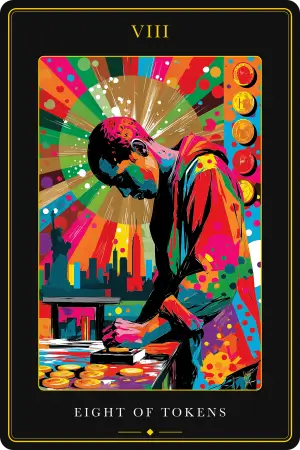
A craftsman pressing subway tokens one at a time while the whole city he keeps running goes unnoticed behind his bowed head.
Card at a glance
- Numerology
- Eight
- Element
- Earth
- Astrology
- Sun in Virgo (first decan)
- Kabbalistic path
- Hod (Splendour)
- Timing
- Late summer · Virgo season
- Yes / No
- Upright yes, conditional on effort · Reversed no
Upright
craft
diligence
repetition
apprenticeship
skill-building
focus
reliability
unglamorous excellence
Reversed
burnout
stagnation
cutting corners
perfectionism
monotony
undervalued effort
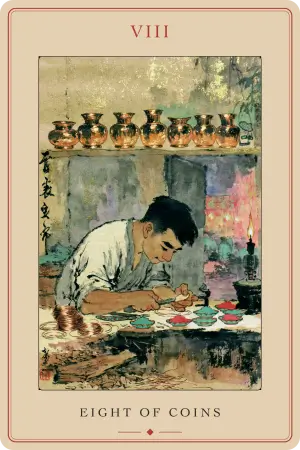
Eight of Tokens in each deck
Every deck reimagines the same archetype. Compare the art, then open a deck to read its full interpretation.
Imagery and symbolism
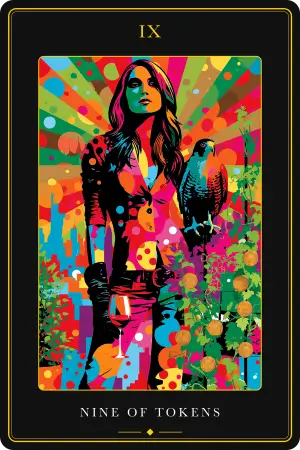
In the Tarot of New York City the Eight of Tokens renames the Pentacles suit for the coin the city actually ran on, the subway token, and rebuilds the old craftsman scene in the deck's pop-art language of saturated color blocks, halftone dot fields, and hard black silhouettes. A craftsman sits bent over his workbench, both hands on a press, stamping tokens one at a time. His posture carries the whole meaning of the card: head bowed, shoulders curved into the task, a body organized entirely around the work in front of it.
Down the right edge runs a strip of finished tokens, displayed like a ledger of completed reps. Each one is a shift survived and a skill sharpened, proof that mastery here is an accumulation rather than a leap. On the bench more tokens lie loose, because the work is never quite finished. In this suit the point is the practice and not the pile. Behind him the skyline waits, the Statue of Liberty and the Empire State Building and the whole silhouette of the city his labor quietly keeps running. He does not look at it. The city is the beneficiary of his craft, not its audience, and the work is done to a private standard.
Two touches make the card the deck's own. Around his bowed head blazes a pop-art sunburst, a halo of rays and halftone dots, the deck's way of saying that in New York the person who gets genuinely good at something is performing a kind of sainthood the city rewards more quietly than it should. His jacket is a riot of color blocks and dots, every neighborhood of the city stitched into one working garment, while his dark silhouette stays the still point in all that noise. The token itself holds the suit's meaning. It is money, but money earned one at a time. It is access, the coin that opens the turnstile. To press tokens is to mint your own passage through the city, fare by fare and rep by rep.
Core meaning
The Eight of Tokens is the craftsman phase: the stretch where you are no longer the newcomer and not yet the name on the door, and the only way across is repetition. Its RWS ancestor, the Eight of Pentacles, is the apprentice who has shut out the town to refine a craft, and the New York deck keeps that meaning while grounding it in the city's working reality. This is the card of the line cook plating the same dish until the motion is automatic, the tailor whose hands know the seam before the eyes do, the coder shipping the unglamorous fixes that make everything else possible.
What the card promises is compounding. Your skills are building, your reputation is quietly forming, and the current grind is investment rather than wasted time. The sixth token comes out cleaner than the first. It can point just as easily to formal training, a certification, an apprenticeship, or the steep part of a learning curve where every day teaches you something. The reward for this labor arrives without fanfare, in a better rate, a better station, doors that start opening on their own, but the deck insists it does arrive for the one who keeps pressing.
Upright meaning
Upright, the Eight of Tokens says stay at the bench. You are deep in the reps and getting visibly better, and the city is watching even when it says nothing. The counsel is to protect your focus hours, treat every small task as practice for the big one, and measure progress against your own last attempt rather than someone else's highlight reel. Take the course, ask the veteran to show you the technique, keep notes on what you fix. Do not chase the shortcut or the title before the skill, because in this city those evaporate and the craft does not.
In love. A relationship built the way mastery is built, through the repetition of small deliberate care: the coffee brought without asking, the argument handled better than the last one, the calendar juggled so two people actually see each other. For newer couples it marks the phase of genuinely learning each other, which is a skill being acquired.
In career. You are past onboarding and deep in skill-building, with a certification underway or a hard project stretching you exactly the right amount. Diligence is being noticed even where it is not announced, and effort in your current role is compounding toward promotion, better rates, or a reputation that precedes you.
In finances. Income earned the honest way, rate by rate and invoice by invoice: the raise that follows the certification, the side craft that starts covering a bill. It favors treating skills as your primary asset and steady accumulation over speculation.
In health. Results minted the only way they reliably are, rep by rep and meal by meal and night of sleep by night of sleep. The gym membership actually used, the technique studied instead of guessed, recovery treated as part of the program.
Reversed meaning
Reversed, the Eight of Tokens is the grind gone hollow. The reps continue but nothing improves: the same shift, the same station, the same commute, and the skill curve went flat months ago. It can point to burnout, so many hours worked that the craft itself has been squeezed out. It can point the opposite way to carelessness, corners cut and tokens stamped crooked because nobody is checking. Sometimes it is perfectionism turned toxic, one detail polished while the deadline and the rent both come due. The first move is to figure out which failure this is before fixing it, because burnout wants rest and stagnation wants a harder problem.
In love. The workbench eating the relationship, or the relationship dying of skipped maintenance: dates canceled for deadlines, the small attentions stopped, one partner carrying all the relational labor and starting to count. Put the relationship back on the schedule with the same seriousness as the job.
In career. The treadmill. Same rate and responsibilities as two years ago, a job that trains you in nothing, or your own drift as standards slip and the craft becomes a shift you merely survive. If the job stopped teaching, extract a new challenge from it or take your skills to a bench that will.
In finances. The earning engine misfiring, most often as underpayment: skills that grew while the rate stayed still, loyalty to a shop that will never raise you. Compare your rate to your current skill and renegotiate, and stop funding training that never converts into income.
In health. The routine dissolved by overtime, or discipline curdled into compulsion: training through pain, rigidity around food, rest experienced as failure. Both are the same broken link between effort and wellbeing, and the repair is the connection and not just the schedule.
Historical notes
The New York deck's craftsman descends directly from the Rider-Waite-Smith Eight of Pentacles of 1909, where Pamela Colman Smith, working under Arthur Edward Waite, drew a young artisan on a wooden bench chiseling a pentagram into a golden coin. Six completed pentacles hang on a post beside him, one rests at his feet, and one is under his chisel, laying out past, present, and future as a continuum of effort. His back is turned to a small town in the distance, the image insisting that excellence requires shutting out distraction and the wish for immediate applause. The New York deck keeps that whole grammar and swaps the chisel and coin for a press and a subway token, and the distant town for the skyline the craftsman keeps running.
Before Smith gave the card its scene, the older Tarot de Marseille showed only an abstract arrangement, the Eight of Deniers as two columns of four coins woven with floral motifs. That tradition read the eight as evaluation and inventory, the careful auditing of resources rather than the making of new ones. The card's esoteric structure was fixed by the Hermetic Order of the Golden Dawn, which titled it 'The Lord of Prudence' and tied it to the first decan of Virgo under the Sun. New York inherits the meaning, the prudence and the diligence, and re-mints it in the currency of a working city.
Correspondences
Number. Eight, the number of balance, order, and material power, the figure of infinity stood upright so effort flows into result and result demands fresh effort. It is karma in its most practical form: you get out of the bench what you put in, token by stamped token. As the third eight of the minor spine it marks the stage where a project stops being an experiment and becomes a discipline.
Astrology. Sun in Virgo, the first decan, spanning roughly August 23 to September 1. Virgo's first decan is the zodiac's craftsman energy, precision and service and an eye for the detail everyone else misses. The Sun's rulership adds the halo blazing behind the craftsman's bowed head, its promise that sustained careful work does not stay invisible forever.
Element. Earth, the suit's element, the world of money, rent, and work made solid. The token is that world reduced to a single object you can hold and count.
Kabbalah. The card sits on Hod, the eighth sphere on the Tree of Life, 'Splendour,' the domain of intellect and structured mental process grounded here in the material world of Assiah. The eights are ruled by Mercury, which shows in the card as hyper-focused attention to detail and the breaking of an overwhelming goal into manageable, repeatable tasks.
Elemental dignity. As an Earth card it strengthens beside other Earth and Water cards and grows tense beside impatient Fire. Near the Hermit it deepens into solitary mastery, near the Five of Pentacles it tips toward grinding without reward.
Psychological perspective
The Eight of Tokens describes a particular inner state, what the esoteric writer Susan Chang called 'productive myopia,' a Zen-like focus where the worker is so entranced by the pursuit of getting it right that the ego dissolves into the work. Any task, however objectively tedious, becomes fascinating once the mind looks closely enough at how it works. The pop-art sunburst around the craftsman's head is that flow state made visible, the reward that lives in the doing rather than the payment.
The shadow is Virgo's own. The same drive for perfection can harden into hyper-criticism, anxiety over minor flaws, and a nit-picking rigidity that stalls the work it was meant to perfect. In the city's dialect the deck names the modern version too: the craft becoming defensive armor, endless reps used to avoid the messier, more vulnerable reality of human connection. The card asks a piercing question underneath all its diligence, whether you are working to grow or working to prove you deserve to exist. The upright answer is craft as devotion. The reversed answer is the industrial machine a person can turn themselves into when the effort stops meaning anything.
The Eight of Tokens across decks
Rider-Waite-Smith. The solitary craftsman on his bench, chiseling pentagrams into coins with his back to the town. This is the direct parent of the New York card, the source of the bench, the strip of finished work, and the isolation from applause.
Tarot de Marseille. The Eight of Deniers, an abstract arrangement of eight coins among floral motifs with no human figure. The reading leans toward evaluation and inventory, the auditing of what has already been gathered rather than the making of more.
Thoth (Crowley-Harris). Titled 'Prudence,' the Eight of Disks drops the human worker for a plant bearing eight disk-centered flowers, shifting the metaphor from mechanical labor to organic cultivation. Its warning is that unweeded growth gets strangled, so prudence means continuous watchful tending.
Contemporary decks. Kim Krans' Wild Unknown sets a diligent spider at the center of an intricate web ringed by eight pentacles, mastery as the patient architecture of one's own survival. Chris-Anne's Light Seer's leans into flow and divine timing. The New York deck sits at that modern end of the line, keeping the bench and the finished strip while trading chisel and coin for press and subway token, and the distant town for the skyline the worker keeps alive.
In combination and context
The Eight of Tokens is often read against its cousin the Three of Pentacles, since both deal with work and craft. The Three is the collaborative, blueprinting stage, the worker consulting others and seeking approval. The Eight is the independent execution that follows, the artisan who needs no architect and works in a self-sufficient flow state. Where the Three plans and synthesizes, the Eight refines and repeats.
Spread position sharpens the reading. Beside the Hermit, the two figures tend to face away from each other, doubling down on solitary self-improvement and, in a love spread, hinting at two people on separate paths of self-discovery. Beside challenging cards like the Five of Pentacles or the Nine of Swords, the card slides toward its shadow, the grind that has become burnout or anxious perfectionism. In a plain yes-or-no reading it is a conditional yes: the outcome is available, but only to the querent willing to put in the labor and the attention to detail. Reversed in that same position it firms into a no, a sign to return to the bench and sharpen the skill before proceeding. Drawn as advice, its instruction is simple and physical: sit down at the bench, do clean work, and trust the count, because in this suit the tokens add up only for the one who keeps pressing them.
Questions for reflection
- What is on your bench right now that deserves your full attention on this one rep, rather than a glance at the six tokens already finished or the pile still to come?
- Where in your work has the connection between effort and meaning quietly snapped, and is the honest fix rest, a harder problem, or a different bench entirely?
- If nobody in this city audits your worth for you, how would you count your own tokens and what would an honest tally show?
The general meaning follows the Rider-Waite-Smith reading — the reference used across Tarot Academy. Open a specific deck above for its own interpretation.
Frequently asked questions
Explore the Tarot
Latest Posts
Discover the ancient wisdom of tarot cards and unlock the mysteries of your spiritual journey. Our blog is your gateway to understanding the rich symbolism, meanings, and practical applications of tarot reading.