
 EN (English)



Minor Arcana ·
Apprentice of Coins
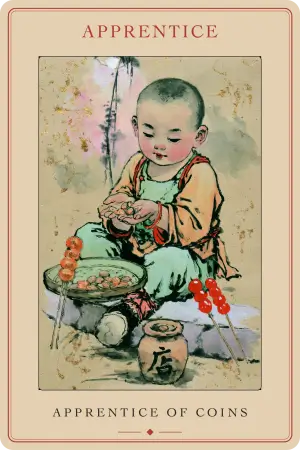
A boy counts the day's tanghulu earnings at dusk, coin by coin, and drops the first one in a jar marked 店.
Card at a glance
- Numerology
- Apprentice of Coins
- Element
- Earth
- Astrology
- Earth of Earth · Taurus, Virgo, Capricorn
- Kabbalistic path
- Malkuth (The Kingdom)
- Timing
- Slow and steady · turned spring soil
- Yes / No
- Yes, with effort · Reversed no
Upright
student
apprenticeship
honest first earnings
patient saving
attention to detail
small beginnings
practical study
diligence
Reversed
procrastination
scattered focus
laziness
unrealistic expectations
poor accounting
stalled learning
material immaturity
missed small chances
Apprentice of Coins in each deck
Every deck reimagines the same archetype. Compare the art, then open a deck to read its full interpretation.
Imagery and symbolism
In the Tarot of Beijing the Page of Pentacles is a small boy at dusk, sitting on a stone step with the day's earnings from his tanghulu tray cupped in both hands. The street sellers have gone home and the lanterns are not yet lit. By the deck's telling he counts coin by coin, twice, then a third time, lips moving. That third count is the card's heart: attention as a form of respect for the material world. Nothing here is greed, only care.
The coins are 铜钱, the square-holed copper cash of the deck's Coin suit, work and body and household reduced to something a child can hold. Their shape carries the suit's cosmology, heaven round and earth square, opportunity cut exactly coin-sized. Beside him the round tray still holds one skewer of unsold tanghulu, his first enterprise, the candied hawthorn glowing vermilion. That vermilion is one of the deck's two accent colors, a small fire of sweetness he has turned, berry by berry, into copper.
At his feet stands the quietest and most important symbol: a clay jar with a single coin already dropped in, labeled in a child's uneven hand with the character 店, meaning shop. The jar is the future written in the present tense. He is building a life that is one coin deep so far. His clothes are patched but clean, with red ties at the collar and wrist for protection and blessing in the folk manner, a sign that someone loves this child even as he learns to fend for himself.
Behind him a pale moon rises through faint blossom branches. The day is over, the light is leaving, and still he sits with his accounts. The warm kraft paper flecked with gold makes the dusk itself seem to hold small coins of light, as if the whole world were quietly seconding his arithmetic. The maker's small red seal sits in the corner, as on every card of the deck, craft answering craft.
Core meaning
The Apprentice of Coins is Beijing's Page of Pentacles, the youngest rank of the Earth suit and the card of the student. Where the canonical Page raises a golden pentacle to eye level and studies how abundance works, this boy counts real takings on a real step, and the lesson is the same made humble: understand the material world before you try to move it. Knowledge in this deck gets put to work the same evening it is gained.
This is the seed planted in fertile soil, the first honest earnings, the business seen at its smallest and truest scale. The card marks the earliest stage of a career, a course of study, or a savings plan, a first modest venture that will grow into something with a roof and a signboard if it is tended. The energy is cautious and unhurried, favoring tried methods over the gamble and the windfall. Success in this suit is built at the pace of an ox-cart, not a kite fight.
As a Page the card is also a messenger, and because it belongs to the Coins it carries earthly news: a formal job offer, an acceptance letter, an approved loan, the practical result of groundwork already laid. Its message is rarely dramatic. It is constructive, and it is the direct yield of an honest day.
Upright meaning
Upright, the card asks for the boy's own quality of attention. Something in your life wants to be counted rather than estimated, tended rather than rushed: a skill, a budget, a project, a habit of the body that is new enough that you have not mastered it yet. There is no shame in small numbers. Handle your small yield the way he handles his, fully and without irony, and drop the first coin in a jar you have taken the trouble to label.
In love. A new feeling that grows the way savings grow, slowly and with a purpose written on it from the start. Affection here is expressed through care and small daily acts: the walked-home evening, the remembered preference. One party in particular is patiently and tangibly earning trust. In this deck the loves that begin at the pace of the Coin suit are the ones that end with a courtyard, a pomegranate tree, and four generations at one table.
In career. The beginning of a professional path: a first job, an apprenticeship, new duties, or formal study aimed squarely at practical skill. You are the young worker every hutong master hopes to take on, the one who watches closely, repeats patiently, and treats the smallest assignment as worth doing exactly right. Careers in this suit are made by small things done reliably. Behind the modest daily diligence stands the labeled jar, a long-term goal funded by every completed day.
In finances. Stability and the start of a long-term plan, the first coin in a jar that already knows its purpose. It is time to keep accounts, to know exactly where money goes, and to set something aside every day without exception. A first paid engagement or a small venture with genuinely solid prospects may soon appear. Keep the focus on execution rather than dreams of scale: the boy sells his skewers first and philosophizes never.
In health. Care of the body as husbandry, built from small countable acts rather than heroic effort. This is a good time to begin a routine and honor it: morning exercise in the park, a steadier regimen of food, sleep, or walking. Recovery capacity is good if the rhythm is kept. Progress is gradual and compounding, the health equivalent of a labeled jar filled one day at a time.
Reversed meaning
Reversed, the tray stands ready but the street is never walked, and the jar exists but the character on it was never written. The eager student becomes the distracted procrastinator, and the fertile soil is left unplanted. The card points to a lack of self-discipline, slow or abandoned learning, and knowledge that never takes root, the person who counts endlessly and never sells, or sells carelessly and never counts. Often the procrastination is not laziness but a paralyzing fear of failure, or unrealistic perfectionism that fixes on the distant goal until the first small step feels impossible.
In love. A bond that never leaves its earliest stage, much careful counting of feelings and no actual spending of them. It warns of unrealistic expectations, or a caution so excessive that hoarding oneself like a pawnbroker starves the relationship of what would let it grow. Watch for the fear of commitment disguised as prudence and for the promise of later, when things are stable, that keeps arriving late.
In career. Lost purpose, thin discipline, or interest that faded once the unglamorous daily texture of the work became clear. It can show the perpetual trainee who studies forever and never takes the tray to the street, or the projects that fail through inattention to small things. The call is strict but kind: return to the step, sit with the day's takings, and count honestly. Attitude toward small work is the whole question.
In finances. A shortage of the patience that builds anything material. The jar is spent before it fills, or never labeled at all. It points to poor accounting, scattered small expenses that quietly consume what diligence gathered, and missed modest chances that would have compounded. In this suit nothing arrives suddenly. Without honest daily counting the shop stays a character on a jar.
In health. The body neglected while everything else is attended to, the worker who counts every coin and never counts hours of sleep. Meals eaten standing at the tray, rest postponed, exercise scheduled for a stabler future that never comes. The obstacle is absent structure rather than absent capacity. Begin the smallest honest routine today, count it daily, and let it compound.
Historical notes
The suit was known for centuries as Coins or Deniers, the money of the medieval merchant class and plain commerce. In 1855 the occultist Eliphas Levi popularized the term pantacles, equating the coins with hermetic talismans used for protection and manifestation. Arthur Edward Waite adopted that shift and used the pentagram inside a circle to lift the suit from mere wealth to the whole material world, the alchemical act of drawing spirit down into physical form.
The modern card arrived with the 1909 Rider-Waite-Smith deck, illustrated by Pamela Colman Smith under Waite's direction. Before it, decks like the Tarot de Marseille drew the Minor Arcana as plain geometric arrangements of suit symbols. Smith gave every card a full allegorical scene, and her Page of Pentacles stands alone in a green field, plowed earth behind him and gentle mountains ahead, holding a single coin aloft in reverent study. Aleister Crowley's Thoth deck, painted by Lady Frieda Harris, retitled the rank the Princess of Disks and drew her as a glowing young woman, often read as pregnant, gestating a new world.
The Tarot of Beijing keeps the archetype and rebuilds its scene from the ground up. The lone youth in a European field becomes a hutong child at dusk. The single raised pentacle becomes a double handful of square-holed copper cash, and the plowed field of promised growth becomes a clay jar marked 店. The card holds the same meaning of grounded first study, told in the vocabulary of a Beijing lane rather than a Golden Dawn landscape.
Correspondences
Number. As a Page the card carries no pip number but the rank of the youngest court, raw potential and the start of the developmental journey. In the Golden Dawn system the Pages, or Princesses, are the Thrones of the Powers of the Four Aces, the physical receptacle that holds all the promise of the Ace of Pentacles.
Astrology. The Pages hold no single zodiac sign. Instead they rule a great quadrant of the sky around the North Pole, and the Page of Pentacles governs the quarter containing Aries, Taurus, and Gemini, anchored by the fixed earth of Taurus. The Beijing card personifies Earth across its three signs at their youngest, freshest stage: the persistence of Taurus, the precise counting instinct of Virgo, and the long patient ambition of Capricorn that writes 店 on a jar and builds toward a distant summit.
Element. Earth of Earth, or Malkuth in Malkuth, the densest and most physical form of elemental energy in the system. Some traditions read the Pages instead as the airy part of their suit, the intellect studying the material world, which is exactly why the Page of Pentacles reads as the student.
Kabbalah. The Pages reside in Malkuth, the Kingdom, the tenth and final sphere and the foundation that holds up the whole Tree of Life. In the formula of the Tetragrammaton the Princess is the Hé final, the Daughter whose destiny is to become the Queen. The Princess of Disks is assigned Tacere, to keep silent, the introspective power of Earth.
Psychological perspective
The person of this arcana is the diligent novice, defined by a close and almost tender attention to detail. They count the takings twice and then a third time, not from distrust of the world but from respect for it. They learn crafts the old hutong way, by watching, repeating, and asking exactly one good question a day, and they carry a beginner's mind that drops the ego and embraces the fundamentals rather than pretending to be further along than they are. Somewhere in their life there is always a jar with a purpose written on it.
The shadow is the reversed card turned inward. The focused student becomes the scattered dreamer seduced by every new idea and bored by the repetition that mastery requires, or the perfectionist so fixed on the distant end that the first step never comes. Over-intellectualizing a physical task is the trap: the plan is grand, the shutters stay closed. In readings of burnout the card counsels the opposite of pressure, a return to the curiosity that started the work, permission to be a joyful beginner again, free of the weight of expected outcomes.
The Apprentice of Coins across decks
Rider-Waite-Smith. The canonical Page of Pentacles stands alone in an open green field, plowed earth behind him, and lifts a single golden coin to eye level in reverent study. The Apprentice of Coins keeps that solitary focus and grounds it further, trading the raised pentacle for a double handful of copper cash counted on a stone step.
Tarot de Marseille. The older French decks drew this rank as an unillustrated arrangement of coins, meaning carried by number and suit alone rather than by scene. Beijing belongs firmly to the illustrated tradition Smith began, telling the whole meaning through one child at dusk.
Crowley-Thoth. Crowley retitled the card the Princess of Disks and painted her as a glowing woman gestating a new world, giving the archetype its strong link to fertility and physical creation. The Beijing boy holds the same idea in a plainer key, the seed of a life saved coin by coin rather than carried in the womb.
Modern reframings. Recent decks tend to render the Page as an apprentice, an intern, or a student researching a new field, moving the card from medieval coinage toward contemporary learning. The Tarot of Beijing sits in that movement, casting the student as a street child whose tanghulu tray holds, in embryo, the whole shape of a shop.
In combination and context
The Apprentice of Coins is the anchor of any spread, the grounding force that pulls the surrounding cards back to the practical and achievable. Whatever emotion or anxiety sits beside him, he asks how the thing could actually be built in the physical world, and at what honest daily pace.
Beside the Five of Pentacles, a card of scarcity and lack, he offers the beginner's step out of the cold, the reminder that a fresh foundation can still be laid one skill at a time. With the Tower he is the quiet student who arrives the day after the collapse with seeds, ready to plant in newly cleared soil. Paired with Justice he points to the formalizing of agreements and the fine print read carefully, and in love that pairing can mean an apology delivered from a sense of fairness rather than deep feeling. Alongside the Six of Swords he supplies the logistics of a move already decided, the saved money and the practical reality of the transition.
When he keeps appearing in a reading, treat him as a demand for grounding. He insists you stop daydreaming or drowning in feeling and return to the body and the mundane, to the day's takings counted honestly on the step before the light is fully gone.
Questions for reflection
- What in your life right now wants to be counted rather than estimated, tended rather than rushed?
- Have you labeled your jar, or are you saving toward a shop whose purpose you never wrote down?
- Where are you announcing the start to others while the tray stays home and the street goes unwalked?
The general meaning follows the Rider-Waite-Smith reading — the reference used across Tarot Academy. Open a specific deck above for its own interpretation.
Frequently asked questions
Explore the Tarot
Latest Posts
Discover the ancient wisdom of tarot cards and unlock the mysteries of your spiritual journey. Our blog is your gateway to understanding the rich symbolism, meanings, and practical applications of tarot reading.




















































