
 EN (English)


Minor Arcana ·
Page of Tokens
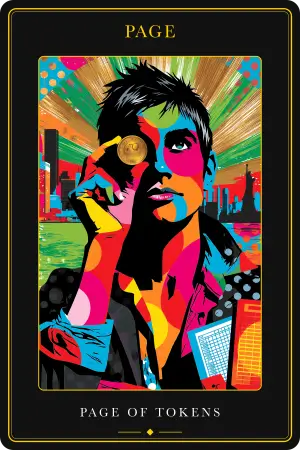
The city's youngest capitalist-in-training, holding a golden subway token up to one eye while a spreadsheet rides under his arm and the whole skyline waits behind him.
Card at a glance
- Numerology
- Page
- Element
- Earth
- Astrology
- Earth · Taurus, Virgo, Capricorn
- Kabbalistic path
- Malkuth (Kingdom), Earth of Earth
- Timing
- Slow and steady, a long-term start
- Yes / No
- Upright yes, with the work · Reversed no
Upright
the student with the spreadsheet
seed money
practical ambition
apprenticeship
study before risk
the five-year plan
diligence
good news about money
Reversed
the plan that never leaves the notebook
procrastination
unfinished course
shiny object chasing
money handled carelessly
short-term thinking
skipped fine print
Page of Tokens in each deck
Every deck reimagines the same archetype. Compare the art, then open a deck to read its full interpretation.
Imagery and symbolism
In the Tarot of New York City the Page of Tokens is a pop-art portrait of the city's youngest capitalist-in-training. A young person holds a golden subway token up to one eye and studies it the way a jeweler studies a stone. That gesture is the whole card. Where the Rider-Waite-Smith Page gazes down at his pentacle, this Page looks through the coin, so the material world becomes a lens. He is not spending the token, he is learning what it is, what it opens, and what it is worth.
His face carries two directions at once. One eye is covered by the coin and the other looks up and out, so close study of money and long-range vision of the future sit in the same expression at the same moment. The token itself is the suit's emblem, the old brass subway coin that grants entry, and for this Page it stands for the first unit of real wealth: the first paycheck, the first saved hundred, held up before it is spent.
Under his arm he carries a spreadsheet, its grid rendered as a bright ledger against his dark jacket. This is the deck's signature detail for the card, the student with the spreadsheet and the five-year plan. The rows and columns are his version of a treasure map, ambition written in numbers rather than fantasy. Behind him the harbor runs green and the skyline stands in black silhouette with the Statue of Liberty on the horizon. He has the whole promise of the city at his back, the towers he intends to work in and maybe one day own a floor of, and the statue that greets every newcomer who arrives with nothing but a plan. The water between him and the skyline is the distance still to cross, real but crossable.
A sunburst of gold and green rays radiates from behind his head, the deck's pop-art halo. Gold is the suit's metal and green is money and growth, and the rays say the fire here is real but it burns steadily rather than wildly, dawn light on a working harbor instead of fireworks. Halftone dot fields and saturated color blocks in hot pink, orange, and cyan break across his face and hands in the deck's collage style. The many colors laid over one figure suggest a self still being assembled from the city's possibilities, and the card treats that unfinished quality as his advantage. His expression is calm and his grip on the token is precise. No anxiety in the pose and no swagger, only attention, and attention held long enough is what the whole suit of Tokens is built on.
Core meaning
The Page of Tokens marks the studying phase of a material ambition. It is the Rider-Waite-Smith Page of Pentacles moved to New York, the archetype of the student and the first practical step toward building something real. In this deck it is the kid who already reads the business section on the F train, the one with the spreadsheet open and the five-year plan sketched out, dreaming about the material life in concrete numbers rather than vague wishes.
In a spread the card points to a beginning that is being prepared properly: a new job or first job, an internship, a course of study, a side business still in the research stage, the first serious attempt to save. Nothing has been built yet, and that is not a failure. This Page understands that in a city where a mistake costs a month's rent, homework done in advance is the cheapest insurance there is. The energy is patient and observant, a little unglamorous: showing up, taking notes, checking the numbers twice. Where the King rests his foot on the coin in mastery, the Page is still learning the mechanics of abundance, working out how the physical universe operates before trying to move it.
Upright meaning
Upright, the Page of Tokens says an opportunity for training, mentorship, or a modest but real first step is either present or arriving, and that you have or can build the discipline to use it. Do the homework before the first dollar moves. Read the lease, the syllabus, the term sheet, all of it. Take the entry-level position if it teaches the trade, because the city rewards people who learned the work from the bottom floor up. Start small and start now, a first deposit, a first class, a first client. The plan is only a plan until something concrete exists.
In love. Upright it can mark the beginning of a relationship with long-term potential, unhurried and a little shy, more reliable than dazzling. This is the person who is early to the date, who remembered the thing you said three weeks ago, who shows care through practical acts: the umbrella brought, the leftovers packed, the errand quietly handled. The romance grows the way the suit grows everything, by consistent small deposits, and the promising person is often the steady one who follows through rather than the loudest one in the room.
In career. It points to a first job, an internship, a probation period, a training program, or new responsibilities that reward careful study. The card describes the best kind of junior energy, reliable and detail-attentive, genuinely curious about how the operation works and willing to do the unglamorous parts well. For someone established, it can signal a deliberate return to student posture, a certification or a skill added because the five-year plan calls for it. Advancement here is earned by demonstrated competence rather than self-promotion.
In finances. This is the beginning of financial literacy, the moment a person stops treating money as weather and starts treating it as a subject to learn. It points to first savings, a first honest budget, a first paycheck or scholarship or seed money that should be planted rather than spent. The card favors small, consistent deposits over dramatic moves, and it often signals that education is the best purchase available right now: the course, the book, the conversation with someone who manages money well. Progress is slow but genuine, and it compounds.
In health. In readings about the body this is the beginner's program taken seriously, the first gym membership actually used, the couch-to-5K along the river, the first honest look at sleep and diet as systems that can be studied and improved. The method is the message: small, consistent, tracked. It favors learning proper form over lifting heavy and gathering real knowledge, a checkup, actual numbers from actual bloodwork, before committing to any regimen. The modest routine kept for six months quietly outperforms the dramatic program abandoned in three weeks.
Reversed meaning
Reversed, the Page of Tokens is the plan that never leaves the notebook. The spreadsheet exists, the five-year plan exists, the vision board might even exist, and nothing has been started. It points to stalled study, an abandoned course, a venture launched on enthusiasm without research, or money handled with the carelessness of someone who has not yet learned what it costs to run out of it in this city. It can be procrastination dressed as preparation, endlessly refining the plan because starting is frightening, or the opposite error, rushing in without reading the fine print out of impatience or pride. Reduce the plan to one concrete step and take it this week: enroll, apply, open the account, make the first call.
In love. It points to a relationship stuck in its own planning stage or undermined by material immaturity, the connection that never advances, months of talk about the future with no concrete step taken. It can be naivety about what building a life together costs, or one partner careless with money in a way that quietly erodes the other's trust. Sometimes it marks a partner unwilling to learn, the same lesson repeating because nothing said is absorbed, care expressed in words and absent in practice. The card asks for one concrete act, the honest conversation or the promise kept on the day it was made.
In career. It shows the learning curve refused, carelessness in the details, the typo in the deliverable, the step skipped, the instructions half-read, or a loss of interest that shows up as lateness and unfinished training. Sometimes it marks a person who considers the entry-level work beneath them and so learns nothing from it, or years in a role without a single new skill added. Re-enter apprentice mode honestly: fix the small errors first, finish the unfinished training, and ask the questions pride has been blocking.
In finances. It warns of financial immaturity, the budget that exists only as a guilty feeling, the savings plan that starts next month every month, money learned about from hype instead of from study. It can point to impulsive spending that cancels every gain, a get-rich scheme substituting for a skill, or the fee missed because the document went unread. Sometimes it shows over-research as avoidance, endless comparison of accounts while the money sits doing nothing. Pull the real numbers, face them, automate one small saving, and buy the education before the asset.
In health. It warns of the health plan that exists only as an intention, the membership paid for and unused, the running shoes boxed, the diet that starts every Monday. It can point to neglect of the basics, sleep traded away, the checkup postponed for a second year, or the opposite failure, a program copied from the internet without any study of one's own body and abandoned at the first injury. The correction is the suit's usual one, scaled down until it is impossible to fail: one appointment booked, one walk taken today, one real meal, form learned before load.
Historical notes
The Page of Tokens inherits its scene from the Rider-Waite-Smith Page of Pentacles, drawn by Pamela Colman Smith in 1909 under A.E. Waite's direction. In that card a solitary youth stands alone in a broad green field, holding a single golden pentacle up to eye level and studying it with reverence. He wears a green tunic with red floral motifs and a red turban, green for growth and the element of Earth, red for a spark of conscious mental activity. The ground is fertile, the earth behind him already plowed, and a gentle mountain range in the distance stands for long-term goals whose slope is accessible rather than punishing.
The suit itself was older than that image. It was known as Coins or Deniers, the money of the medieval merchant class, until the 19th-century occultist Eliphas Levi popularized the term pantacles, talismans, in 1855, equating the coins to hermetic objects of protection and manifestation. Waite adopted that shift and used the pentagram inscribed in a circle to lift the suit from mere wealth to the whole material world. In Aleister Crowley and Frieda Harris's Thoth deck the card is retitled the Princess of Disks, a glowing young woman, often read as pregnant, holding a radiant disk and wearing a winged ram's head, the symbol of Aries and the creative power of the womb.
This deck keeps the archetype whole and moves it to the harbor. The lone youth in the field becomes a pop-art figure against the New York skyline, the golden pentacle becomes a brass subway token held up to one eye, the plowed earth and gentle mountains become the green water and the black silhouette of the towers, and the reverent study of the coin becomes the student with the spreadsheet under his arm. The Statue of Liberty stands where the distant mountains once stood, the promise the whole studious act is performed for.
Correspondences
Rank. Page, the youngest of the court, raw potential and the critical beginning of a developmental journey. Where the King represents mastery over the element, the Page is the conceptual seed planted in fertile soil, the nascent stage of a long-term endeavor marked by a thirst for knowledge and an unhurried approach to progress.
Astrology. As a Page, this card has no single zodiac sign in the Golden Dawn system, ruling instead a wide quadrant of the sky around the North Pole. In this deck it is read as the personification of Earth, carrying the pooled energy of the three earth signs. Taurus gives it patience and appetite for the tangible and a steadiness that is hard to rush or con. Virgo gives it the spreadsheet, analysis and detail and the earnest posture of the apprentice who improves by correction. Capricorn gives it the skyline, the long climb and the ambition that thinks in decades.
Element. Earth, the suit of Tokens, money and rent and work and the physical and financial ground a life stands on. This Page is that element in its youngest and most studious form. In some frameworks the Pages carry the airy part of their suit, which is why the Page of Tokens reads so clearly as a student, the mind applying logic and study to the material world.
Kabbalah. The Pages reside in Malkuth, the Kingdom, the tenth and final sphere on the Tree of Life and the sphere of Earth. The Page of Tokens is Malkuth in Malkuth, Earth of Earth, the most dense and physical manifestation of the element, the ultimate receptacle for the divine potential held in the Ace of Tokens. Its assigned power of Earth is Tacere, to keep silent, which fits its introspective and watchful nature.
Elemental dignity. As Earth of Earth it grounds and steadies its neighbors, and it takes on friction beside impatient or scattering cards that would rush the slow build before the foundation is laid.
Psychological perspective
The Page of Tokens is the young striver of the material city, young in approach if not always in years: the student who works the register and studies the owner, the recent arrival with a budgeting app, a library card, and a plan taped inside the closet door. These are practical dreamers whose ambitions are large but who express them in numbers, timelines, and skills to acquire rather than in fantasy. They read the fine print, ask the extra question at the end of the meeting, and take the unglamorous entry job if it teaches the trade. Give one a task and it comes back done, with two questions about how to do it better. Order and stability matter to them, the paid-off card, the growing account, the certificate on the wall.
The shadow is caution curdled into stalling. Reversed, this is the person whose material life stays theoretical, who talks fluently about the business they will start and the neighborhood where they will buy while the months pass. The research phase never ends because it is safer than the doing phase, and intelligence can make the stagnation harder to see. Under the avoidance there is usually fear, of being a beginner in public, of finding out the plan does not survive contact with the market. What such a person needs is not a better plan but a first completed step, however small, because in this suit a small finished thing rebuilds the appetite for the larger one.
The Page of Tokens across decks
The earth student appears in different settings across the tradition, and this deck's contribution is to move him from the empty field to the working harbor. In the Rider-Waite-Smith deck he is a solitary youth in a green tunic and red turban, standing in a broad field and holding a single golden pentacle up to eye level, absorbed in studying the material world before trying to move it.
Older decks show the rank more plainly. The Tarot de Marseille and its Coins tradition render the court in flatter, heraldic style, the young page of Deniers holding his coin as an emblem of the merchant world rather than an allegory of study. In the Thoth deck Crowley and Harris retitle the card the Princess of Disks, a glowing and often pregnant young woman on a pedestal holding a disk that emits light, wearing a winged ram's head for Aries and the creative power of the womb, the ultimate materialization of the earth element. The Tarot of New York City keeps the archetype whole and swaps the medieval field for the waterfront: the youth becomes a pop-art figure in a halftone jacket, the golden pentacle becomes a subway token held up to one eye, the plowed earth becomes the green harbor, and the distant mountains become the black skyline with the Statue of Liberty on the horizon. Across all of them the posture is the same, close study of a single coin held before it is spent.
In combination and context
The Page of Tokens tends to be the anchor in a spread, the card that demands the querent return to the practical and achievable whatever turbulence surrounds it. Beside the Five of Tokens, a card of scarcity and lack mentality, it turns the story toward rebuilding: you may have lost a great deal, but you retain the ability to learn a new skill and lay a fresh foundation. Beside The Tower it offers real hope, the quiet student who arrives the day after the collapse with seeds, ready to plant in newly cleared soil and build this time on truth rather than illusion. Beside Justice it points to the formalization of agreements, the fine print read and the practical matters aligned with ethical standards, and in romance an apology delivered from a sense of fairness rather than deep feeling.
With maternal cards like The Empress, or paired with the Ace of Tokens, the Page is one of the deck's strongest indicators of pregnancy and new physical creation, the singular coin read as a seed planted in the physical realm. Spread position changes its job. In a yes-or-no reading it is a qualified yes, a 'yes, but' that affirms the potential and then demands the labor: yes to starting the project, yes to learning the skill, but no to overnight miracles or immediate wealth. As advice it asks you to be a beginner on purpose, to ask one good question of someone who has built what you want, to mind the small numbers, and to take the first concrete step before the evening rather than waiting for the whole plan to feel ready.
Questions for reflection
- The Page holds the token up to study it rather than spend it. What in your material life right now, a skill, a budget, an idea for making money, deserves an hour of real research before it deserves a dollar?
- This card is not embarrassed to be at the start. Where are you refusing to be a beginner in public, and what would it cost you to ask the basic question you have been avoiding?
- The skyline is far off across the water, and the Page is fine with that because he is not trying to arrive today. What is the one small, concrete step you could take this week instead of waiting for the whole plan to be perfect?
The general meaning follows the Rider-Waite-Smith reading — the reference used across Tarot Academy. Open a specific deck above for its own interpretation.
Frequently asked questions
Explore the Tarot
Latest Posts
Discover the ancient wisdom of tarot cards and unlock the mysteries of your spiritual journey. Our blog is your gateway to understanding the rich symbolism, meanings, and practical applications of tarot reading.




















































