
 UZ (Ўзбек)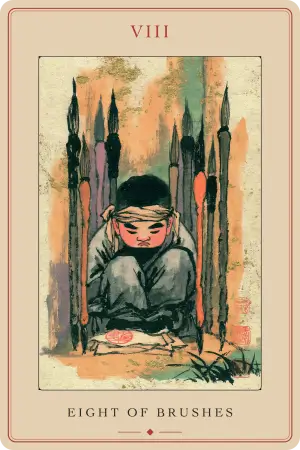


Minor Arcana ·
Nine of Brushes
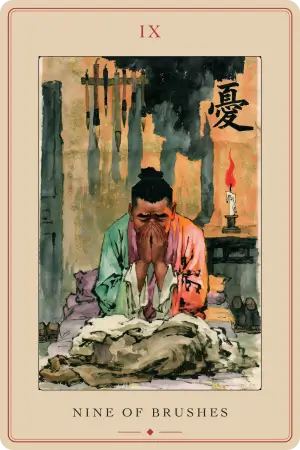
Anxiety at the third watch of the night: a scholar dreads an examination result already posted, while nine brushes cast the shadow of grief on his wall.
Karta haqida qisqacha
- Numerology
- Nine
- Unsur
- Air
- Astrologiya
- Mars in Gemini (second decan)
- Kabbala yo'li
- Yesod (Foundation)
- Vaqt
- Gemini season, late spring
- Ha / Yo'q
- Upright no, Reversed mixed
Upright
anxiety
insomnia
dread of the verdict
catastrophic thinking
guilt
self-condemnation
avoidance
mental torment
Reversed
facing the verdict
relief
waking from the nightmare
release
asking for help
suppression
chronic despair
Har bir to'plamda Nine of Brushes
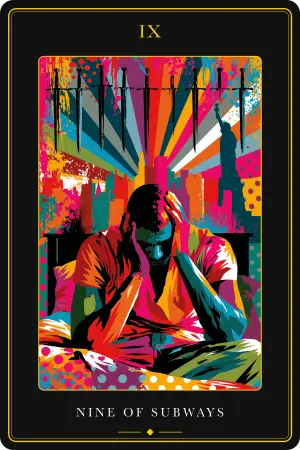
Every deck reimagines the same archetype. Compare the art, then open a deck to read its full interpretation.
Imagery and symbolism
The Tarot of Beijing sets its Nine of Swords inside the imperial examination system, the oldest institution of hope and dread in the city. A scholar sits upright in bed at the third watch of the night, hands pressed over his face. He is neither asleep nor awake, caught in the worst hour, when the mind is loudest and the street is silent.
The unseen list. The examination results were posted at dusk, and he has not gone to look. That empty space where the verdict should be is the card's true subject. The suffering comes from the vacuum, which the imagination fills with disgrace, rather than from anything actually written on the board.
The nine brushes. Nine brushes hang on a wall rack above him. In this deck the brush is the suit of mind, words, and trials, so the scholar's own instruments are what turn against him. Their shadows merge into the strokes of the character 憂, grief, written large on the wall. The grief is not carved, not painted, not sent by anyone. It is a shadow thrown by his own tools, and moving the candle would dissolve it.
The candle. A single vermilion flame is the one warm accent in the picture. It casts the tormenting shadows and it is also the only light in the room, so the mind that manufactures the fear is the same mind that will walk to the board at dawn and read the truth.
The paired shoes. His shoes stand ready beside the bed, pointing at the door. The way out is prepared and nothing physical restrains him. Like the unlocked cell door of the Eight of Brushes before it, the card insists the prison is voluntary.
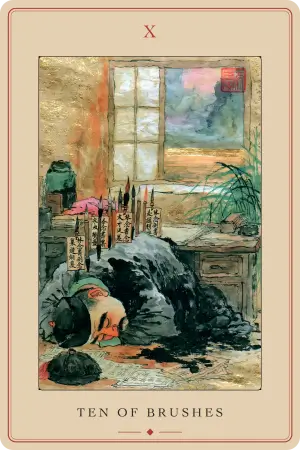
The quilt and the window. A heavy pale quilt lies across his knees like a drift of snow or unread paper, the weight of every page he has written and can no longer change. Beyond the paper window the ink is at its blackest, yet the Ten that follows in this suit carries the first grey-gold line of dawn. The Nine is the last full hour of night, and the deck lets you know it.
Core meaning
The Nine of Brushes is Beijing's nightmare card, the point where the analytical mind turns against itself and grades its owner more harshly than any imperial examiner would. Something has already been decided, a result or an answer or a consequence, but the querent refuses to face it, and in that vacuum the mind writes the worst possible verdict in its own hand.
The deck states the diagnosis through the shadow on the wall. The character 憂 is enormous precisely because it is a shadow, not ink, and verdicts written in actual ink are always smaller. Experienced readers often meet this card with relief, because when it answers a terrifying worry it is saying that the disaster is largely a shadow thrown by your own brushes. The counsel is the walk to the results board: separate what has actually happened from what you have written in the dark, and remember that in this deck the brush is your own instrument, so the hand that wrote grief on the wall can write the next character.
Upright meaning
Upright, you are in the grip of acute fear during a period of stress, insomnia, and mental torment. The suffering is genuine and sleep is genuinely lost, but the cause is largely ink of your own making. The card works as an emergency flare from the subconscious, signaling that avoidance and catastrophic thinking are now costing you more than any verdict could. Its remedy is the same one the astrology prescribes: one decisive act of finding out. Go and look at the board. Do not make decisions at the third watch of the night; wait for the grey-gold line of dawn that this suit always keeps at the edge of the card.
In love. Love at the third watch, lying awake composing the conversation you are afraid to have. You read the shadows instead of asking: the delayed reply, the changed tone, the look you replay until it spells grief on the wall. The relationship may be far healthier than your nights suggest, but avoidance does real damage, because a partner can feel the hidden face and the unasked question. Ask in one sentence what you have been divining from shadows for a month.
In career. The night before, and often the many nights after, a result is posted: the performance review, the interview answer, the promotion list. The verdict exists and you have not gone to look, so your mind holds its own review nightly, always ending in dismissal and disgrace. It often accompanies real overload carried alone until the exhausted mind can no longer tell a true error from an imagined one. Do not resign or confess at midnight. First find out, then decide.
In finances. The unopened bill and the unchecked balance, money anxiety fed by refusal to read the numbers. You calculate debts by candlelight instead of opening the ledger, and the imagined figures are always worse than the posted ones. A loan decision, a tax assessment, an investment result has in fact already been determined and waits only for your attention. The fear of ruin is currently doing more damage than the finances themselves.
In health. The physical cost of the third watch: insomnia, exhaustion, tension in the shoulders and jaw, the racing heart at 3 a.m. Worry writes itself on the body, and the shadows under the eyes are the card's own ink. It is a compassionate push to treat the body as the first casualty of the anxious mind and to seek help rather than pushing through the nights alone.
Reversed meaning
Reversed, the scholar finally lowers his hands from his face. The worst of the night is over. Either you have gone to the board and read the result, or you are one step from doing so, and the card promises that facing it is the beginning of recovery. The verdict, once seen, turns out to be survivable, sometimes even good, and in any case smaller than the grief your imagination painted. Anxiety loosens, sleep returns, and obsessive thoughts lose their grip stroke by stroke.
The darker reversal is the fear forced underground rather than resolved. Suffering becomes habitual and suppressed beneath a facade of normalcy, or it hardens into paralyzing paranoia and phobia. Here the counsel turns firm: seek professional help and address the trauma being avoided, because the body will keep score until you do.
In love. The question is finally asked aloud, and the answer turns out lighter than the night before it. Fears half-dissolve in the speaking, the imagined coldness proves to be tiredness. If the truth was genuinely painful, known grief can still be grieved and finished, while shadow-grief renews itself nightly.
In career. The morning you check the list and find your name where fear said it could not be, or find a failure that turns out survivable. Recovery from burnout begins as avoidance ends. Ask for feedback directly instead of divining it from shadows, and retire the inner examiner from night duty.
In finances. You open the ledger, and the healing begins with the first honest number. Debts get counted instead of dreaded, and a payment plan replaces a nightmare. The same brush that tallied the damage now drafts the recovery.
In health. The examination finally attended and the relief that follows. The dreaded diagnosis proves absent or manageable, the symptom shrinks to its real size once named. The card can also warn of the opposite swing, relief becoming neglect, so keep reasonable attention honestly scheduled.
Historical notes
Like the rest of the Minor Arcana, the Nine of Swords began as an ordinary trick-taking card in European card games before divination loaded it with meaning. As the Tarot turned esoteric it gathered a fearsome reputation. In some folk-magic traditions a physical Nine of Swords hidden in a home was treated as an anxiety hex, meant to plunge the victim into a dark night of the soul.
The Golden Dawn systematized its darker character, a lineage the Thoth deck later titled outright as 'Cruelty.' Pamela Colman Smith and Arthur Edward Waite gave it the modern scenic image in 1909, the weeping sleeper with nine floating swords and a comforting quilt of roses and zodiac glyphs, shifting the emphasis from inflicted cruelty toward the internal experience of dread.
The Tarot of Beijing keeps that psychological reading and relocates it. The floating swords become nine brushes on a rack, the nightmare becomes the wait for an examination result, and the comforting quilt becomes a pale weight of unread paper. Waite's carved Cain and Abel panel, the buried history that feeds the panic, is replaced by the examination system itself, the city's oldest machinery of hope and dread. What survives unchanged is the central insight: the threat is a phantom of the mind, and physical reality remains safe.
Correspondences
Number. Nine, the last single digit, the number of completion before the cycle turns at ten. In this suit it is the ninth stroke of a character almost finished: the essays are submitted, the result already decided and posted, and nothing more can be added or corrected. Nine is the number of the accomplished fact not yet accepted, and the scholar's suffering is the mind resisting a completion it did not choose. It also links to Major Arcana IX, The Hermit, sharing his isolation in the dark and his hidden promise of wisdom for anyone who navigates the night honestly.
Astrology. Mars in the second decan of Gemini, roughly June 1 to 10. Mars gives the card its inner violence, but with no battlefield the warrior's energy turns inward and lays siege to its own sleep. Gemini splits the scholar into candidate and examiner, and the examiner half works through the night. The same combination holds the cure: Mars is the planet of action and Gemini the sign of information, so the astrology prescribes exactly what the image withholds, one decisive act of finding out.
Element. Air, in this deck the element of the brush: mind, language, judgment, and trials. Here it becomes an internal battlefield of thought that will not stop talking to itself.
Kabbalah. Yesod, the ninth sphere, the Foundation, the realm of reflection and the subconscious. A driven, ambitious intellect resting on a base of reflection produces the calculating, sleepless mind of this card.
Elemental dignity. A Brush among Brushes, doubly Air, pure mind with nothing to cool it.
Psychological perspective
These are the people of the third watch, outwardly composed by day and awake at night grading themselves more harshly than any examiner would. They are conscientious and often gifted, frequently the ones who studied hardest, which is exactly why the fear of failure cuts so deep: they have invested everything in the result. Their imagination is a skilled calligrapher, and it writes only one character.
The defining habit is avoidance of the very information that would free them. They do not read the message, ask the direct question, or walk to the board, because as long as they do not look the catastrophe stays unconfirmed, and they prefer certain torment to uncertain truth. They suffer alone, hiding the face even from those in the same courtyard, ashamed of a failure no one has yet witnessed. Beneath the anxiety lies real depth: sensitivity, high standards, a genuine sense of responsibility. Their fears are the shadows of their own talents. The work, championed by readers like Mary K. Greer, is to recognize that obsessive worry may be a coping mechanism for avoiding a deeper, scarier truth, and to drag the fear into daylight where it loses its edge.
The Nine of Brushes across decks
Rider-Waite-Smith. The canonical Nine of Swords shows a weeping figure upright in bed, nine blades floating in the black air behind, a quilt of roses and zodiac glyphs across the lap. The Beijing card keeps the posture and the untouching threat but rewrites the scene as an examination night, turning the blades into brushes and the nightmare into a verdict not yet read.
Tarot de Marseille. Non-scenic pips, nine swords in a geometric arrangement, the dread carried by number and suit rather than a pictured scene. Beijing restores a full narrative image, closer in spirit to the Smith tradition than to Marseille.
Crowley-Thoth. Painted by Lady Frieda Harris and titled 'Cruelty,' the Thoth card drops the human figure for nine rusty, jagged swords pointing downward and dripping blood, the rusty Mars brown clashing with the orange-red of Gemini. It is waking, active cruelty. The Beijing card takes the gentler Smith path, keeping the sufferer and the phantom fear rather than the inflicted wound, though it shares the Mars in Gemini engine.
Modern decks. The Deviant Moon Tarot shows a figure ignoring a small daemon biting the shoulder while biting their own hand, a precise image of misdirected self-sabotage. The Tarot of Beijing reaches the same idea by a different route: the scholar torments himself over a shadow while his shoes stand ready by the bed and the door is never locked.
In combination and context
The Nine of Brushes sits at the center of a three-card arc through the suit. The Eight of Brushes is paralysis, the unlocked cell the prisoner will not leave. The Nine internalizes that trap: the person has made it home but carried the punishing thoughts into the bedroom, and the criticism now comes from within, harsher than any examiner. The Ten of Brushes is the exhausted conclusion, and in this deck it carries the grey-gold line of dawn at the window, so the Nine inherits that promise of morning in advance.
Surrounding cards sharpen the reading. With The Sun the counsel is to physically change your view, get out of the bed of anxiety and go outside, since the angst is imaginative. With The Devil the anguish may have hardened into illness or addiction that needs structured help. With cards of grounding and material skill, the cure is to steady yourself in real work and real numbers rather than in the shadows on the wall.
When the card keeps returning, treat it not as an accusation but as a pointing finger. There is a board you have not walked to. Notice it, take one small act of finding out, and let the reality you have been avoiding turn out smaller than the shadow, because reality, unlike imagination, has limits.
Fikr yuritish uchun savollar
- Which board have you not walked to, and what has the not-looking already cost you compared with any verdict it could hold?
- If you moved the candle, which of the fears written on your wall would turn out to be shadow rather than ink?
- Whose door in your courtyard is one lane away, and what would you say if you spoke the fear aloud to them tonight?
The general meaning follows the Rider-Waite-Smith reading — the reference used across Tarot Academy. Open a specific deck above for its own interpretation.
Frequently asked questions
Tarotni kashf eting
So'nggi maqolalar
Taro kartalarining qadimiy donishmandligini kashf eting va ma'naviy yo'lingizdagi sirlarni oching. Blogimiz taro o'qishning boy ramziyligi, ma'nolari va amaliy qo'llanilishini tushunishga eltuvchi darvozadir.




















































