
 SK (slovenčina)



Malá Arkána · Palice (Oheň)
Osmička palíc
Osem vyhladených palíc letí v dokonalej rovine nad zelenými horami a vodou a Smithová nenechala v zábere nikoho, kto by ich chytil: jediná karta vo farbe, kde pýtajúci sa nie je ten, kto koná.
Karta v skratke
- Numerológia
- Osem
- Živel
- Oheň
- Astrológia
- Merkúr v Strelcovi, prvý dekan (23. november – 2. december)
- Kabalistická cesta
- Hod (Nádhera) v Atziluth
- Načasovanie
- Dni alebo hodiny, jar, prvý dekan Strelca
- Áno / Nie
- Vzpriamená rázne a rýchle áno · Obrátená nie, alebo ešte nie
Priama
Rýchlosť
Hybná sila
Správy a odkazy
Cestovanie
Rýchly pokrok
Tok
Náhla vášeň
Obrátená
Odklady
Stagnácia
Nedorozumenia
Preťaženie
Roztrieštená energia
Strata hybnej sily
Impulzívna unáhlenosť
Osmička palíc v každom balíčku
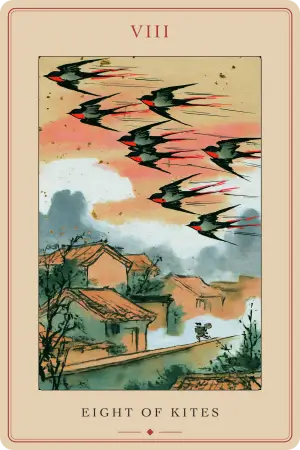
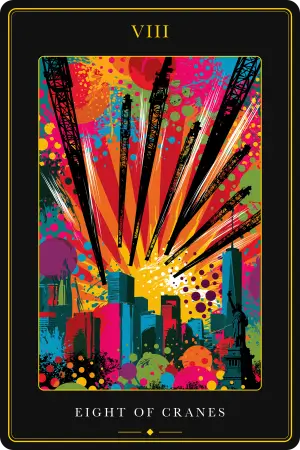
Každý balíček reinterpretuje ten istý archetyp. Porovnajte umenie a potom si otvorte balíček, aby ste si prečítali jeho úplný výklad.
Zobrazenie a symbolika
Waite venoval karte vo svojom diele The Pictorial Key to the Tarot (1910) jednu vetu: pohyb cez nehybné a let palíc otvorenou krajinou, ktoré sa blížia k cieľu. Kresba Pamely Colman Smithovej však robí niečo radikálnejšie, než priznáva táto veta. Odstránila z nej ľudí. Osem vyhladených drevených palíc letí v dokonalej rovine jasnou oblohou bez mrakov a klesá k zeleným horám a vodnej ploche. Nie je tu žiadna ľudská ani zvieracia postava. V balíčku, ktorý je takmer celý postavený na ilustrovaných ľudských scénach, je táto absencia tým najvýraznejším prvkom karty.
Tento balíček číta scénu cez rýchlosť a smer. Osem palíc v lete predstavuje rýchly pohyb, už prebiehajúcu zmenu situácie a tradične aj rýchle šírenie informácií alebo prebiehajúcu cestu. Rovnobežné usporiadanie je rovnako dôležité ako samotný pohyb. Palice sa nezrážajú, hádka z Päťky a patová situácia zo Sedmičky sa zjednotili do jedného cieľa. Osem palíc smerujúcich rovnakým smerom znamená neochvejné odhodlanie na ceste za cieľom a obdobie uvažovania sa skončilo.
Krajina nesie zvyšok. Zelené hory a vegetácia predstavujú zrelosť a stabilitu, dosiahnuté výsledky a pokračujúci rast. Hory samotné sú prekonanými prekážkami vďaka rýchlemu a rozhodnému konaniu a novými horizontmi, ktoré sa približujú, keď je tempo správne. Vodná plocha sú emócie a podvedomie, čo posúva tieto rýchle zmeny do emocionálnej roviny. Otvorená obloha predstavuje samotnú otvorenosť voči rýchlo prichádzajúcim nápadom a príležitostiam.
Chýbajúce postavy sú motorom výkladu. Keď sa palice uvoľnia, o zvyšku rozhoduje gravitácia a hybná sila. Pýtajúci sa už nie je hlavným hýbateľom. Karta stavia udalosti pod vplyv príčiny a následku namiesto vôle, pričom vyžaduje objektívny pohľad na to, čo je už v pohybe, a nie emocionálny. Waite tiež spojil kartu so šípmi lásky a náhlou vášňou a varoval, že v obrátenej polohe prináša šípy žiarlivosti, výčitky svedomia a domáce spory, čím udržuje Etteillov starší výklad nažive aj vo svojom vlastnom.
Osmička palíc v rôznych balíčkoch
Tarot de Marseille zobrazuje osem palíc v geometrickej mriežke bez akejkoľvek scény a pred Etteillom bez pevného významu. Kniha T Zlatého úsvitu to nahradila anjelskými rukami držiacimi prekrížené palice nad plameňom, pávím perom v trojuholníku a symbolmi Merkúra a Strelca. Karta Rider-Waite-Smith, z ktorej vychádzame, odhodila ruky aj mriežku a nakreslila palice samotné v otvorenom priestranstve. Preto sa karta vníma skôr ako neosobná hybná sila než len ako diagram.
Crowley a Lady Frieda Harris ponechali v Thothovom tarote názov Rýchlosť, ale odstránili drevo. Ich palice sú geometrické elektrické siločiary prenikajúce vesmírom, chaos menený na svetlo. Boj z predchádzajúcej Sedmičky palíc je úmyselne preč, nahradený rozhodnými činmi vo vysokej rýchlosti. Crowleyho tieňový výklad spočíva v tom, že keď sa energia poháňa príliš silno, rozbije sa na intelektuálne častice, ktoré nikdy nedosiahnu cieľ, čo vyvoláva neuváženosť, žiarlivosť a unáhlenosť.
Moderné balíčky posúvajú kinetický náboj vlastným smerom. Tabula Mundi redukuje kartu na jedinú palicu s Hermesovými sandálmi uprostred ôsmich jemných slnečných lúčov. Fountain Tarot kreslí ostré symetrické línie zbiehajúce sa k vzdialenému bodu svetla, pričom chápe kartu ako rýchlosť svetla a paralelné dráhy zužujúce sa do kozmickej jednoty. Light Seer's Tarot vracia späť súčasné ľudské postavy, aby zachytil nával náhlej inšpirácie a dlho očakávaných výsledkov prichádzajúcich naraz. Wild Unknown buduje strmý rebrík palíc stúpajúci k polmesiacu. Trvá na tom, že výstup vyžaduje vytrvalosť a cieľ je duchovný. Harmonious Tarot pracuje v jemných viktoriánskych pastelových tónoch, ktoré zjemňujú bojovú ostrosť farby a ponechávajú obraz otvorený jemnejšiemu výkladu o rýchlej komunikácii.
V kombinácii a kontexte
Prečítajte si to najprv v poradí. Sedmička palíc predstavuje boj, postavu brániacu si výhodnú pozíciu pred šiestimi vztýčenými palicami. V Osmičke tento boj jednoducho zmizol. Smithová vyčistila scénu, palice sa prestali zrážať a energia nabrala jediný smer. Po nej nasleduje Deviatka palíc so zúčtovaním v podobe obviazaného strážcu bdejúceho nad tým, čo rýchly beh získal.
Táto karta skôr zosilňuje. Keďže Jupiter vládne Strelcovi, pod ktorým sa Osmička palíc nachádza, táto karta znásobuje rýchlosť a premenlivosť všetkého, čo je vedľa nej. Vo vedľajšom postavení s kartou Veža odstraňuje časovú rezervu, takže šokujúce informácie menia život zo dňa na deň bez akejkoľvek šance pripraviť sa na ne. Pri karte Smrť je koniec rýchly a vo výkladoch o vzťahoch karta radí rýchlo a definitívne zatvoriť dvere. V blízkosti Trojky mečov alebo Desiatky mečov sa premení na rýchlu a bolestivú komunikáciu, ohnivé spory alebo zradu pochopenú naraz.
Na teplejšej strane urýchľuje zbližovanie. S Milencami alebo Dvojkou pohárov sa chápe ako strhujúca romantika a príťažlivosť, ktorá sa rýchlo prejaví. S Diablom je kombinácia výbušná, môže ísť o obsedantné pobláznenie, hyperfixáciu alebo nasťahovanie sa k sebe po druhom rande na základe príťažlivosti bez hlbšieho základu. S Rytierom palíc sa dve nespútané ohnivé karty navzájom podporujú a prinášajú veľké gestá od niekoho, kto však zmizne, len čo iskra vyhasne.
Načasovanie je to, v čom sa vykladači nezhodnú najviac. Živlové systémy priradzujú paliciam dni alebo hodiny. Sezónne systémy im dávajú jar. Zverokruhové systémy odkazujú na Barana, Leva a Strelca. Nech už vykladač používa akýkoľvek systém, táto karta ho potlačí a trvá na tom, že udalosť je bližšie, ako by sme čakali. Jej moderná prezývka nesie rovnakú logiku: karta textovej správy vytiahnutej ešte predtým, ako prídu notifikácie. Puristi tvrdia, že ovplyvňuje skôr koordináciu a rýchlosť udalostí ako samotný akt posielania správ. V obrátenej pozícii sa stala pre komunitu skratkou pre ghosting, na hybnú silu narážajúcu na stenu bez vysvetlenia.
Reversed meaning
Reversed, the alignment shatters. The wands wobble, miss, or lose height, and this deck reads the fall as delay, procrastination and obstruction on the path to a goal. Waiting, doubt and indecision hold progress back; things move slower than hoped, or barriers slow them. Energy drains and stagnation sets in with tension, stress and fatigue behind it. There is a second reversed reading that points the opposite way: too much at once, an overload of tasks, disorganisation and thoughtless action. The advice covers both. Slow the pace down, take a break, think before the next move, and be patient with obstacles that are temporary. In a yes-or-no reading it turns to no.
In love. The relationship hits a stop. Passion cools or interest drops, rapid developments slow, and barriers appear where there was flow. Disagreements surface, or the bond loses its dynamism because one partner is preoccupied. The deck treats the lull as temporary rather than terminal and asks you to reflect on the feeling and reassess what the relationship is worth. Conflicts here are an invitation to talk the issue through.
In career. Poor organisation and management, delays, downtime, work stalling. The causes are insufficient resources, weak planning, or an unwillingness to take responsibility. Too many ideas circulate with no clear direction; team conflicts appear and creative energy runs dry. Overload and an eagerness to keep acting lead to fatigue and exhaustion. Excessive haste or missing plans produce workplace friction and misunderstandings with colleagues. Careful analysis and deliberate planning are what fix it.
In finances. Momentum stalls and control slips. Income arrives late, projects stop short of completion, and visible progress disappears. Investments or financial decisions made impulsively without analysis produce stress and unreliability. Payments and transactions are delayed. Take a pause, reassess the plan, stay patient, and keep working through it. The card warns specifically against hasty action that turns into loss.
In health. Exhaustion, overwork and neglect of the body. Physical activity drops, diet and rest habits slip, and energy falls with them. Obstacles block the wish to train at all. This is a period asking for rest and recovery rather than intensity: reduce the load, let the body recharge, and treat its needs with some respect. Older medical readings add physical sluggishness and a compromised flow of energy.
Historical notes
Smith inherited a card that had almost no scene and a meaning that pointed somewhere else entirely. In the Tarot de Marseille, around 1650, this was simply the Eight of Batons: eight wooden staves in a geometric lattice, with no standardised esoteric reading attached to the pips. Meaning arrived in the late eighteenth century with Jean-Baptiste Alliette, writing as Etteilla, and his version is startling to a modern reader. Upright he tied the card to country life, agriculture, fields, woods and gardens, and French cartomancy sometimes called the Eight of Clubs "Amourette," a little love affair. Reversed it warned of quarrels, domestic disputes and discord among married people. Papus (Gérard Encausse) called it the Eight of Sceptres in 1892 and read it as opposition to success, an enterprise reaching only part of its goal. A.E. Thierens, in his General Book of the Tarot (1930), broke with the emerging tradition by assigning Wands to Air, read the card as critical examination, internal disputes and misgivings, and put country life, amusement and express messengers in the reversed position, flipping Etteilla outright.
The decisive shift came from the Hermetic Order of the Golden Dawn, founded in 1888. In Book T, compiled by S.L. MacGregor Mathers and Harriet Felkin, Mathers gave the card its title: the Lord of Swiftness. His visual prescription was dense. Four white angelic hands radiate from clouds on either side, clasped in two pairs by the grip of the First Order, holding eight crossed wands, four against four, with flames bursting from the central junction. A peacock feather sits inside a triangle for Maya, cosmic illusion, and the glyphs for Mercury and Sagittarius are placed above and below the intersection. Mathers described the energy as martial force without restraint, too much force applied too suddenly, explosive but short-lived, producing what the Golden Dawn called solitary successes: immediate victories with no foundation under them.
Waite and Smith, both Golden Dawn initiates, published the Rider-Waite deck in 1909. Waite wanted pictures with immediate appeal that still kept deeper material out of plain sight, and Smith's answer to the Lord of Swiftness was to draw the force and delete the actors. The reading almost everyone now uses, of momentum beyond human control, comes from her decision rather than from any text.
Correspondences
Number. Eight, which in this deck's numerology means momentum, power, authority and material achievement, the capacity to drive through obstacles and align effort with result. The figure of the eight mirrors the lemniscate, so it also carries continuity, cycles, and the law of cause and effect: what was set in motion is now arriving.
Astrology. Mercury in Sagittarius, the first decan of Sagittarius, November 23–December 2. Sagittarius adds movement, expansion and optimism, the search for truth and the widening of horizons. Mercury supplies variability, flexibility, quick thinking and quick adaptation, along with a strong pull toward communication and information exchange, and it introduces instability because its nature is not static. Astrologically Mercury sits in detriment here, ruling opposite Gemini where it moves with easy dexterity; in Jupiter-ruled Sagittarius the vision outscales the detail and the intellect travels fast enough to leave particulars behind. The result is the centaur's arrow: a shot flying high above the ordinary ground toward a distant target, enthusiastic and accurate but occasionally tactless or reckless, and short on the Saturnian endurance that long structures need.
Element. Fire, in Atziluth, the archetypal world of pure creative will. Here it reads as the energy of movement, action and decisiveness, a surge of force aimed at one goal, thought converting into reality.
Kabbalah. Hod, the eighth Sephirah, Splendour or Intellect, in Atziluth. The Golden Dawn's divine name for this placement is Elohim Tzabaoth, Lord of Armies. Hod holds the lower workings of intellect and structure while Atziluth is unbridled primal fire, and the combination is volatile by construction. Crowley made the same point in The Book of Thoth (1944): the Eights sit low on the Tree of Life, and their Mercurial tie lends them anxiety, instability and volatility.
Elemental dignity. A Fire card strengthened by Air and damped by Water, and it acts as an amplifier in either direction, so its neighbours decide whether the speed lands the arrow or scatters it.
Psychological perspective
The person this card describes upright lives on the move. Being in motion is their default state, they carry many projects at once, they adapt easily and decide fast. Enthusiasm and a plain love of life draw people to them, and they are direct to the point of bluntness. They take risks, experiment, socialise easily, and run on strong motivation and high ambition. Confidence and dynamism are the visible traits; willpower and a quick intuitive read are what sit underneath.
Reversed, the same energy turns inward and jams. Feeling gets suppressed and internal conflict produces confusion and instability. Communicating, deciding and acting all become difficult for want of confidence and clarity about what is actually wanted. Straightforwardness starts causing problems rather than solving them, balance in relationships slips, and conflict and indecision take over. The slow pace comes from having no direction to move in. Exhaustion follows, along with dissatisfaction and a shortage of the motivation needed to continue.
Smith's empty frame supports the deeper reading. If momentum requires that nobody in the picture is steering, then the anxiety of the reversed card is the ego trying to force a timing that is not available. There is also a warning built into the sequence. This is peak velocity in the suit, and it runs straight into the Nine of Wands, where exhaustion and guarded boundaries wait, and then the Ten, where the load becomes the problem. Speed is exhilarating, but no one sustains it indefinitely, and the uncurated intake of projects, relationships and information ends in the burnout the following cards describe.
The Eight of Wands across decks
The Tarot de Marseille shows eight batons in a geometric lattice with no scene and, before Etteilla, no fixed meaning. The Golden Dawn's Book T replaced that with angelic hands gripping crossed wands over flame, a peacock feather in a triangle, and the glyphs of Mercury and Sagittarius. Rider-Waite-Smith, the version this page follows, threw out both the hands and the lattice and drew the wands alone in open air, which is why the card now reads as impersonal momentum rather than as a diagram.
Crowley and Lady Frieda Harris kept the title "Swiftness" in the Thoth Tarot but removed the wood. Their wands are geometric electric lines of force piercing the cosmos, chaos converted into light, and the struggle of the preceding Seven of Wands is deliberately gone, replaced by decisive action at high speed. Crowley's shadow reading is that when the energy is rushed too hard the force shatters into intellectual particles that never reach the target, producing thoughtlessness, jealousy and rashness.
Modern decks take the kinetic charge in their own directions. Tabula Mundi reduces the card to a single staff with Hermes' slippers inside eight subtle solar rays, integrating Mercury and Fire without repeating the pip. The Fountain Tarot draws sharp symmetrical lines converging on a distant point of light, reading the card as the speed of light and parallel tracks narrowing into cosmic unity. The Light Seer's Tarot puts contemporary human figures back in, catching the rush of sudden inspiration and long-awaited results arriving at once. The Wild Unknown builds a steep ladder of wands rising to a crescent moon, which insists the ascent takes endurance and the destination is spiritual. The Harmonious Tarot works in soft Victorian pastels that take the martial edge off the suit and leave the imagery open to a gentler reading of swift communication.
In combination and context
Read it in sequence first. The Seven of Wands is the struggle, one figure defending high ground against six raised staves. In the Eight that struggle is simply gone: Smith cleared the frame, the wands stopped colliding, and the energy went into a single direction. The Nine of Wands follows with the bill, a bandaged watchman guarding what the sprint won.
The card is an amplifier more than a statement. Because Jupiter rules Sagittarius underneath it, the Eight of Wands multiplies the speed and volatility of whatever sits beside it. With The Tower it strips away the buffer of time, so shocking information rearranges a life overnight with no chance to prepare. With Death the ending is abrupt rather than slow, and in relationship readings the counsel is to close the door quickly and definitively. Next to the Three or Ten of Swords it becomes rapid-fire hurtful communication, a flame war, or a betrayal understood all at once.
On the warmer side it accelerates attachment. With The Lovers or the Two of Cups it reads as sweeping romance and attraction that manifests fast. With The Devil the combination turns volatile: obsessive infatuation, hyper-fixation, or moving in together after a second date on the strength of an attraction with nothing under it. With the Knight of Wands two unrestrained Fire cards feed each other, producing grand gestures from someone who vanishes as soon as the spark dims.
Timing is where readers disagree most. Elemental systems give Wands days or hours because fire burns through its fuel; seasonal systems give them spring; zodiacal systems point to Aries, Leo and Sagittarius. Whichever a reader uses, this card overrides it and insists the event is closer than expected. Its modern nickname carries the same logic in a smaller form: the text-message card, drawn before the notifications arrive. Purists argue it governs the coordination and speed of events rather than the literal act of texting, and reversed it has become the community's shorthand for ghosting, momentum hitting a wall with no explanation attached.
Otázky na zamyslenie
- Smithová nenechala na karte nikoho, kto by palice riadil. Čo sa v súčasnosti snažím mať pod kontrolou, hoci to už dávno letí bez môjho dosahu?
- Tento balíček hovorí, že okno príležitostí sa zatvára tak rýchlo, ako sa otvorilo. Aké rozhodnutie stále odkladám a ono jednoducho vyprší, ak budem ďalej váhať?
- Osmička vedie priamo do vyčerpania, ktoré znázorňuje Deviatka. Ktoré veci som teraz urýchlil a budem ich skutočne schopný uniesť, keď ten počiatočný zhon pominie?
Všeobecný význam vychádza z výkladu Rider-Waite-Smith — referencie používanej v celej Tarot Academy. Ak chcete zistiť interpretáciu pre konkrétny balíček, otvorte si ho vyššie.
Často kladené otázky
Preskúmať Tarot
Najnovšie príspevky
Objavte starodávnu múdrosť tarotových kariet a odomknite tajomstvá svojej duchovnej cesty. Náš blog je vašou bránou k pochopeniu bohatej symboliky, významov a praktických aplikácií čítania tarotu.




















































