
 EN (English)



Minor Arcana · Wands (Fire)
Eight of Wands
Eight polished staves fly in parallel over green mountains and water, and Smith left nobody in the frame to catch them: the only card in the suit where the querent is not the one acting.
Card at a glance
- Numerology
- Eight
- Element
- Fire
- Astrology
- Mercury in Sagittarius, first decan (November 23–December 2)
- Kabbalistic path
- Hod (Splendour) in Atziluth
- Timing
- Days or hours, spring, the first decan of Sagittarius
- Yes / No
- Upright a fast, emphatic yes · Reversed no, or not yet
Upright
Swiftness
Momentum
News and messages
Travel
Rapid progress
Flow
Sudden passion
Reversed
Delays
Stagnation
Miscommunication
Overwhelm
Scattered energy
Lost momentum
Impulsive haste
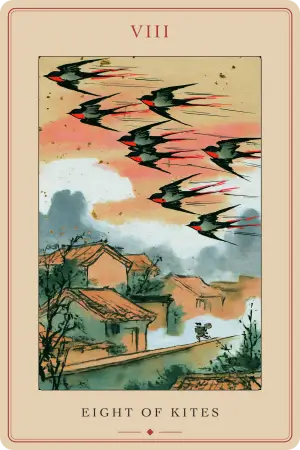
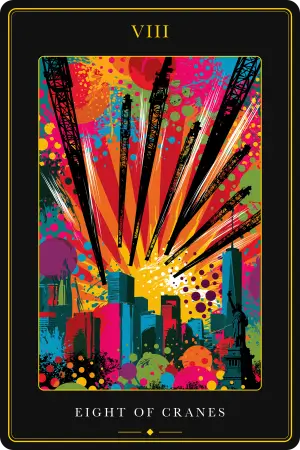
Eight of Wands in each deck
Every deck reimagines the same archetype. Compare the art, then open a deck to read its full interpretation.
Imagery and symbolism
Waite gave the card one line in The Pictorial Key to the Tarot (1910): motion through the immovable, a flight of wands through an open country, but they draw to the term of their course. Smith's drawing does something more radical than that sentence admits. She removed the people. Eight polished wooden staves fly in perfect parallel across a clear, unblemished sky, descending toward green mountains and a body of water below. No human figure, no animal, nothing with a face. In a deck built almost entirely on illustrated human scenes, that absence is the loudest thing on the card.
This deck reads the scene through speed and direction. The eight wands in flight are fast movement and a situation already changing, and their traditional freight is the quick spread of information or a journey under way. The parallel alignment matters as much as the motion: the wands are not colliding, so the quarrel of the Five and the standoff of the Seven have been organised into one unified aim. Eight staves pointed the same way stand for unwavering determination toward a goal, and the period of deliberation is over.
The landscape carries the rest. The green mountains and vegetation are maturity and stability, results reached and growth that continues, while the mountains themselves are the obstacles cleared by acting quickly and decisively, and the new horizons that come closer when the pace is right. The body of water is emotion and the subconscious, which places these rapid changes on an emotional level rather than a purely practical one. The open sky is openness itself, ideas and opportunities arriving fast.
The missing figures are the interpretive engine. Once the wands are loosed, gravity and momentum decide the rest, and the querent is no longer the prime mover. The card puts events under cause and effect instead of will, and asks for an objective view of what is already in flight rather than an emotional one. Waite also tied the card to the arrows of love and sudden passion, and warned that reversed it brings the arrows of jealousy, stings of conscience, and domestic quarrels, keeping Etteilla's older reading alive inside his own.
Core meaning
In this deck the Eight of Wands is drive and activity: rapid achievement of goals, ideas carried into execution, a breakthrough toward new opportunities. It combines energy, a focus on action, and the capacity to turn a plan into a thing that exists.
What separates the Rider-Waite treatment from the archetype is the point of view. Because Smith left no protagonist, the card describes a condition rather than a person. Momentum is the subject, and the querent is inside it. Everything around begins to change swiftly, and the useful question stops being what should I do and becomes how fast can I read this.
Eight supplies the other half. In this deck's numerology eight is momentum, power and material achievement, the force of directed action and the alignment of effort with result. It does not wait; it moves. Joined to Fire it becomes unstoppable forward motion, plans turning into reality in swift succession. Eight also carries cycles and the law of cause and effect, so what was set in motion earlier is now arriving. The wands in flight are the culmination of prior effort closing on its target.
Upright meaning
Upright, delays have dissolved and the situation is accelerating, often faster than expected. This is a time of sudden changes, unexpected news, and opportunities nobody scheduled. It reads as relief after a long wait or a stretch of stagnation, the imminent completion of a task, or a culmination coming into view. Travel appears here, especially the sudden and unplanned kind, and business air travel is a long-standing reading. The deck's instruction is to be flexible, adapt to the new pace, stay alert, decide quickly, and not delay plans. The window is real but brief. In a yes-or-no reading it answers yes, and quickly.
In love. Romance moves fast, carried by passion and energy. The connection between partners propels them forward and the relationship turns serious and intense in a short span. It signals a whirlwind romance, a wave of emotion, the swept-off-your-feet experience, or the sudden return of an ex-partner. For established couples it can mean a revival of passion, more communication after a period of distance, or a spontaneous trip together. The relationship is consuming, but the deck reads it as joyful rather than dangerous.
In career. A swift rise, quick project advancement, business processes speeding up. Negotiations conclude successfully and important contracts land. Motivation and energy are high enough to carry several projects at once, and sudden offers turn into profit quickly. The workload is the catch: exceptional focus and responsibility are needed to handle situations changing this fast, and the card advises clearing the calendar because the volume of incoming work will demand undivided attention.
In finances. A sudden breakthrough. Earlier investments pay out, new investment openings appear, and rewards arrive in the form of bonuses or unexpected inheritances. Act decisively, because delay here costs the opportunity outright. Income rises rapidly, sometimes fast enough to feel overwhelming, and the reading is that the chosen path was right and the effort is now bearing fruit.
In health. Swift movement and dynamism. Energy goes toward fitness, sport, running, active recreation, and reconsidering how you eat. Physical transformation happens quickly with visible improvement expected, and the card points to intense training or competition. Medical cartomancers have long read the upright card as swift recovery, coming safely through surgery, and vitality returning suddenly.
Reversed meaning
Reversed, the alignment shatters. The wands wobble, miss, or lose height, and this deck reads the fall as delay, procrastination and obstruction on the path to a goal. Waiting, doubt and indecision hold progress back; things move slower than hoped, or barriers slow them. Energy drains and stagnation sets in with tension, stress and fatigue behind it. There is a second reversed reading that points the opposite way: too much at once, an overload of tasks, disorganisation and thoughtless action. The advice covers both. Slow the pace down, take a break, think before the next move, and be patient with obstacles that are temporary. In a yes-or-no reading it turns to no.
In love. The relationship hits a stop. Passion cools or interest drops, rapid developments slow, and barriers appear where there was flow. Disagreements surface, or the bond loses its dynamism because one partner is preoccupied. The deck treats the lull as temporary rather than terminal and asks you to reflect on the feeling and reassess what the relationship is worth. Conflicts here are an invitation to talk the issue through.
In career. Poor organisation and management, delays, downtime, work stalling. The causes are insufficient resources, weak planning, or an unwillingness to take responsibility. Too many ideas circulate with no clear direction; team conflicts appear and creative energy runs dry. Overload and an eagerness to keep acting lead to fatigue and exhaustion. Excessive haste or missing plans produce workplace friction and misunderstandings with colleagues. Careful analysis and deliberate planning are what fix it.
In finances. Momentum stalls and control slips. Income arrives late, projects stop short of completion, and visible progress disappears. Investments or financial decisions made impulsively without analysis produce stress and unreliability. Payments and transactions are delayed. Take a pause, reassess the plan, stay patient, and keep working through it. The card warns specifically against hasty action that turns into loss.
In health. Exhaustion, overwork and neglect of the body. Physical activity drops, diet and rest habits slip, and energy falls with them. Obstacles block the wish to train at all. This is a period asking for rest and recovery rather than intensity: reduce the load, let the body recharge, and treat its needs with some respect. Older medical readings add physical sluggishness and a compromised flow of energy.
Historical notes
Smith inherited a card that had almost no scene and a meaning that pointed somewhere else entirely. In the Tarot de Marseille, around 1650, this was simply the Eight of Batons: eight wooden staves in a geometric lattice, with no standardised esoteric reading attached to the pips. Meaning arrived in the late eighteenth century with Jean-Baptiste Alliette, writing as Etteilla, and his version is startling to a modern reader. Upright he tied the card to country life, agriculture, fields, woods and gardens, and French cartomancy sometimes called the Eight of Clubs "Amourette," a little love affair. Reversed it warned of quarrels, domestic disputes and discord among married people. Papus (Gérard Encausse) called it the Eight of Sceptres in 1892 and read it as opposition to success, an enterprise reaching only part of its goal. A.E. Thierens, in his General Book of the Tarot (1930), broke with the emerging tradition by assigning Wands to Air, read the card as critical examination, internal disputes and misgivings, and put country life, amusement and express messengers in the reversed position, flipping Etteilla outright.
The decisive shift came from the Hermetic Order of the Golden Dawn, founded in 1888. In Book T, compiled by S.L. MacGregor Mathers and Harriet Felkin, Mathers gave the card its title: the Lord of Swiftness. His visual prescription was dense. Four white angelic hands radiate from clouds on either side, clasped in two pairs by the grip of the First Order, holding eight crossed wands, four against four, with flames bursting from the central junction. A peacock feather sits inside a triangle for Maya, cosmic illusion, and the glyphs for Mercury and Sagittarius are placed above and below the intersection. Mathers described the energy as martial force without restraint, too much force applied too suddenly, explosive but short-lived, producing what the Golden Dawn called solitary successes: immediate victories with no foundation under them.
Waite and Smith, both Golden Dawn initiates, published the Rider-Waite deck in 1909. Waite wanted pictures with immediate appeal that still kept deeper material out of plain sight, and Smith's answer to the Lord of Swiftness was to draw the force and delete the actors. The reading almost everyone now uses, of momentum beyond human control, comes from her decision rather than from any text.
Correspondences
Number. Eight, which in this deck's numerology means momentum, power, authority and material achievement, the capacity to drive through obstacles and align effort with result. The figure of the eight mirrors the lemniscate, so it also carries continuity, cycles, and the law of cause and effect: what was set in motion is now arriving.
Astrology. Mercury in Sagittarius, the first decan of Sagittarius, November 23–December 2. Sagittarius adds movement, expansion and optimism, the search for truth and the widening of horizons. Mercury supplies variability, flexibility, quick thinking and quick adaptation, along with a strong pull toward communication and information exchange, and it introduces instability because its nature is not static. Astrologically Mercury sits in detriment here, ruling opposite Gemini where it moves with easy dexterity; in Jupiter-ruled Sagittarius the vision outscales the detail and the intellect travels fast enough to leave particulars behind. The result is the centaur's arrow: a shot flying high above the ordinary ground toward a distant target, enthusiastic and accurate but occasionally tactless or reckless, and short on the Saturnian endurance that long structures need.
Element. Fire, in Atziluth, the archetypal world of pure creative will. Here it reads as the energy of movement, action and decisiveness, a surge of force aimed at one goal, thought converting into reality.
Kabbalah. Hod, the eighth Sephirah, Splendour or Intellect, in Atziluth. The Golden Dawn's divine name for this placement is Elohim Tzabaoth, Lord of Armies. Hod holds the lower workings of intellect and structure while Atziluth is unbridled primal fire, and the combination is volatile by construction. Crowley made the same point in The Book of Thoth (1944): the Eights sit low on the Tree of Life, and their Mercurial tie lends them anxiety, instability and volatility.
Elemental dignity. A Fire card strengthened by Air and damped by Water, and it acts as an amplifier in either direction, so its neighbours decide whether the speed lands the arrow or scatters it.
Psychological perspective
The person this card describes upright lives on the move. Being in motion is their default state, they carry many projects at once, they adapt easily and decide fast. Enthusiasm and a plain love of life draw people to them, and they are direct to the point of bluntness. They take risks, experiment, socialise easily, and run on strong motivation and high ambition. Confidence and dynamism are the visible traits; willpower and a quick intuitive read are what sit underneath.
Reversed, the same energy turns inward and jams. Feeling gets suppressed and internal conflict produces confusion and instability. Communicating, deciding and acting all become difficult for want of confidence and clarity about what is actually wanted. Straightforwardness starts causing problems rather than solving them, balance in relationships slips, and conflict and indecision take over. The slow pace comes from having no direction to move in. Exhaustion follows, along with dissatisfaction and a shortage of the motivation needed to continue.
Smith's empty frame supports the deeper reading. If momentum requires that nobody in the picture is steering, then the anxiety of the reversed card is the ego trying to force a timing that is not available. There is also a warning built into the sequence. This is peak velocity in the suit, and it runs straight into the Nine of Wands, where exhaustion and guarded boundaries wait, and then the Ten, where the load becomes the problem. Speed is exhilarating, but no one sustains it indefinitely, and the uncurated intake of projects, relationships and information ends in the burnout the following cards describe.
The Eight of Wands across decks
The Tarot de Marseille shows eight batons in a geometric lattice with no scene and, before Etteilla, no fixed meaning. The Golden Dawn's Book T replaced that with angelic hands gripping crossed wands over flame, a peacock feather in a triangle, and the glyphs of Mercury and Sagittarius. Rider-Waite-Smith, the version this page follows, threw out both the hands and the lattice and drew the wands alone in open air, which is why the card now reads as impersonal momentum rather than as a diagram.
Crowley and Lady Frieda Harris kept the title "Swiftness" in the Thoth Tarot but removed the wood. Their wands are geometric electric lines of force piercing the cosmos, chaos converted into light, and the struggle of the preceding Seven of Wands is deliberately gone, replaced by decisive action at high speed. Crowley's shadow reading is that when the energy is rushed too hard the force shatters into intellectual particles that never reach the target, producing thoughtlessness, jealousy and rashness.
Modern decks take the kinetic charge in their own directions. Tabula Mundi reduces the card to a single staff with Hermes' slippers inside eight subtle solar rays, integrating Mercury and Fire without repeating the pip. The Fountain Tarot draws sharp symmetrical lines converging on a distant point of light, reading the card as the speed of light and parallel tracks narrowing into cosmic unity. The Light Seer's Tarot puts contemporary human figures back in, catching the rush of sudden inspiration and long-awaited results arriving at once. The Wild Unknown builds a steep ladder of wands rising to a crescent moon, which insists the ascent takes endurance and the destination is spiritual. The Harmonious Tarot works in soft Victorian pastels that take the martial edge off the suit and leave the imagery open to a gentler reading of swift communication.
In combination and context
Read it in sequence first. The Seven of Wands is the struggle, one figure defending high ground against six raised staves. In the Eight that struggle is simply gone: Smith cleared the frame, the wands stopped colliding, and the energy went into a single direction. The Nine of Wands follows with the bill, a bandaged watchman guarding what the sprint won.
The card is an amplifier more than a statement. Because Jupiter rules Sagittarius underneath it, the Eight of Wands multiplies the speed and volatility of whatever sits beside it. With The Tower it strips away the buffer of time, so shocking information rearranges a life overnight with no chance to prepare. With Death the ending is abrupt rather than slow, and in relationship readings the counsel is to close the door quickly and definitively. Next to the Three or Ten of Swords it becomes rapid-fire hurtful communication, a flame war, or a betrayal understood all at once.
On the warmer side it accelerates attachment. With The Lovers or the Two of Cups it reads as sweeping romance and attraction that manifests fast. With The Devil the combination turns volatile: obsessive infatuation, hyper-fixation, or moving in together after a second date on the strength of an attraction with nothing under it. With the Knight of Wands two unrestrained Fire cards feed each other, producing grand gestures from someone who vanishes as soon as the spark dims.
Timing is where readers disagree most. Elemental systems give Wands days or hours because fire burns through its fuel; seasonal systems give them spring; zodiacal systems point to Aries, Leo and Sagittarius. Whichever a reader uses, this card overrides it and insists the event is closer than expected. Its modern nickname carries the same logic in a smaller form: the text-message card, drawn before the notifications arrive. Purists argue it governs the coordination and speed of events rather than the literal act of texting, and reversed it has become the community's shorthand for ghosting, momentum hitting a wall with no explanation attached.
Questions for reflection
- Smith left nobody in the frame to steer the wands. What am I currently trying to control that is already in flight and past my hands?
- This deck says the window closes as fast as it opened. What decision have I been deferring that will simply expire if I keep weighing it?
- The Eight leads straight into the exhaustion of the Nine. Which of the things I have just accelerated am I actually able to carry once the rush is over?
The general meaning follows the Rider-Waite-Smith reading — the reference used across Tarot Academy. Open a specific deck above for its own interpretation.
Frequently asked questions
Explore the Tarot
Latest Posts
Discover the ancient wisdom of tarot cards and unlock the mysteries of your spiritual journey. Our blog is your gateway to understanding the rich symbolism, meanings, and practical applications of tarot reading.




















































