
 EN (English)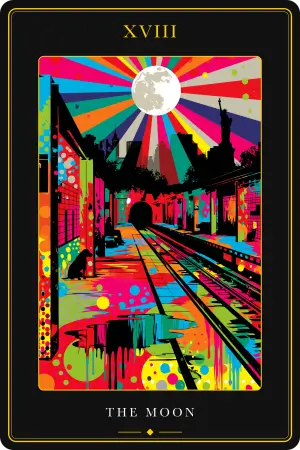


Major Arcana · 20
The Sun
July on the block with the hydrant cracked open, joy and truth out in full daylight for the whole street.
Read the complete guide: The Sun Tarot Card: A Complete Guide to Symbolism and Meaning
Card at a glance
- Numerology
- XIX
- Element
- Fire
- Astrology
- The Sun · Leo
- Kabbalistic path
- Resh (Hod → Yesod)
- Timing
- Summer · Leo season
- Yes / No
- An emphatic yes
Upright
joy
open hydrant
success in plain sight
vitality
community
warmth
clarity
celebration
Reversed
blocked joy
delayed success
burnout behind a bright front
forced fun
dimmed confidence
joy postponed
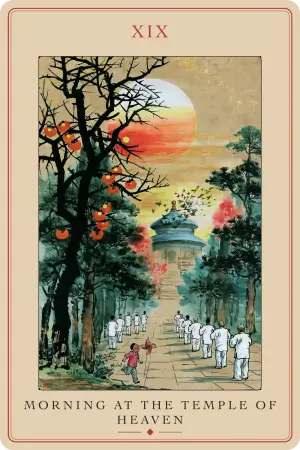
The Sun in each deck
Every deck reimagines the same archetype. Compare the art, then open a deck to read its full interpretation.
Imagery and symbolism
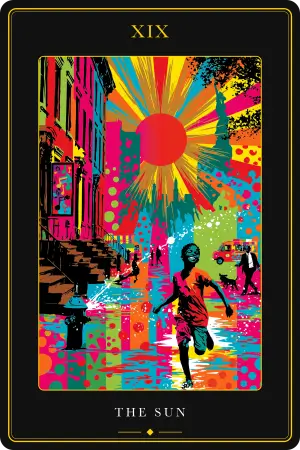
The New York Sun is a pop-art heat wave. The card comes down in saturated halftone dot fields and hard black silhouettes: hot pink, taxi yellow, hydrant red, pool-water turquoise. At the top a red sun detonates over the skyline, and its rays cut across the whole frame in yellow and pink, touching brownstone, hydrant, dog, and businessman with the same light. This is the July sun that softens the asphalt and empties the offices, and the card is plain that the light belongs to the whole block, not to whoever paid for it.
Where the Rider-Waite-Smith card puts a naked child on a white horse, this deck puts a kid mid-sprint through hydrant water, soaked and laughing, arms swinging. He is the inner child of the arcana made literal, riding nothing because in this city running is the victory lap. The open fire hydrant takes the place of the RWS sunflowers as the card's sign of abundance, the city's own infrastructure cracked open so that pressure meant for emergencies comes out as play. On the left a brownstone stoop steps into the scene and does the job the brick wall does behind the RWS child: home and safety at your back while you play.
The rest of the block fills in around them. An ice cream truck glows on the right corner, a small dog runs loose, and a man in a full black suit steps into the spray, the card's quiet joke that joy here is a choice anyone can make if they are willing to get their shoes wet. In the distance the Statue of Liberty lifts her torch inside the sun's rays, the city's oldest promise of light folded into the skyline, while music notes drift from an open window. The sky holds no cloud and no shadow. Alone among the deck's arcana, the Sun hides nothing in its corners.
Core meaning
The philosophical claim of the New York Sun is a bold one for this deck: the city keeps its promise. Seventy-seven other cards complicate that promise with the rent, the grind, the shell game, the shadow a developer decides to cast at 3pm. Against all of it, the Sun asserts one afternoon of the city as advertised, with light and water free at the point of use, the street handed back to the people who live on it, and joy that needs no reservation and no cover charge. The block party is what the city is for, and everything else is logistics.
Underneath the local scene sits the standard arcanum. The Sun is joy, success, vitality, and illumination, and it lands near the end of the Major Arcana as a homecoming. After the Tower's blackout, the one star found over the harbor, and the 3am platform of the Moon, it is the conscious mind at last prevailing over the fears of the unconscious. Its second claim is that joy is public or it is incomplete: the RWS Sun sealed one child inside a walled garden, while this card opens a hydrant on a shared street and treats happiness as pressure that only turns beautiful once it is released toward other people. The numerology carries the same message. Nineteen reduces to ten, the Wheel that lifts and drops people for no reason you can name, and then to one, a clean start returned to after everything the Wheel did, the Newcomer's innocence recovered with a full cycle of wisdom behind it.
Upright meaning
Upright, the New York Sun is July on the block: ninety-five degrees, somebody cracks the hydrant, and the whole street runs through the water. The effort you put in through the colder months is paying out in full daylight where everyone can see it. This is the one card in the deck where the answer to "what's the catch?" is that there isn't one. The advice that comes with it is to get outside, say yes to the invitation, and take the win publicly without deflecting. Run through the water in the suit.
In love. Romance in full daylight, the relationship you do not have to explain, hide, or decode. For couples it often marks a golden stretch, the trip or the summer when things feel easy and warm. For someone single it promises sincerity and a bold, playful new dynamic, and it advises flirting instead of treating the search as grim work.
In career. The win witnessed by the whole office: the project shipped and celebrated, the promotion said out loud in the all-hands, your name spoken kindly in a meeting you were not in. Step into the light, present the work yourself, take the stretch role. Recognition here is earned harvest, not luck.
In finances. The check that clears in full daylight. Visible, legitimate prosperity, the raise announced rather than hinted and the debt cleared with something left over. The card blesses spending on joy, since money released toward happiness is money well accounted.
In health. The healthiest card in the deck, vitality you can see from across the street. Strong energy, quick recovery, a body that catches the light. It favors joyful movement over grim discipline, the run through the spray rather than the run on the treadmill, and it reads as one of the deck's strongest signs of fertility.
Reversed meaning
Reversed, it is the same block in the same heat with the hydrant left capped. The joy is technically available and somehow you cannot reach it. More often this points to delayed success than to failure, the good outcome still coming but slower and dimmer than promised, like summer light cut off by a new tower's shadow at 3pm. It can also be happiness that photographs well and feels like nothing, the rooftop party posted by someone who spent it anxious in the corner. Sometimes there is burnout hiding behind a bright front, or a refusal to enjoy what has already been earned because it is not yet perfect. The counsel is to look for the specific thing blocking the light, usually a fear or an old habit of bracing for the worst, and to lower the bar for celebration.
In love. The couple that photographs happy while the warmth gets harder to reach. Feelings kept slightly out of the light, a compliment withheld, one partner burned out and hiding it behind cheerfulness. The work is to say the withheld thing out loud, since most reversed-Sun clouds dissolve on contact with plain speech.
In career. The job that looks great from the street and drains you in person. Delayed or misdirected recognition, the promotion pushed to next cycle, the win that lands during your week off. Watch for burnout behind team spirit, and locate the one cloud before deciding the whole career is overcast.
In finances. Money that shines without warming, earning that looks strong on paper while the account feels tight. It warns against optimism that blinds you to real risk, the investment made because the light felt lucky, and it advises auditing for the fee or habit quietly draining the flow.
In health. The body kept indoors, energy dimmed rather than broken. Fatigue that sleep does not fully clear, the sunlight-deficit paleness of someone who has not seen noon in weeks, or overexposure the other way, the body run past its limit at the party. The oldest prescription in the city applies: go outside, move gently, rest without guilt.
Historical notes
This deck reaches back through the same lineage as every modern Sun, then relocates it to a New York street: the single child becomes a kid sprinting through a hydrant, the sunflowers become the hydrant itself, and the brick wall becomes a brownstone stoop. The history behind that choice runs deep.
The earliest Sun cards were purely classical. In the Visconti-Sforza deck of about 1475 a naked winged putto rides a cloud and holds a glowing mask of Helios, the Greco-Roman sun later syncretized with Apollo. The Sola-Busca deck of around 1491 wrapped the card in humanist and alchemical learning for an educated elite.
The Tarot de Marseille then fixed an image that lasted four centuries: a massive solar disc above two nearly identical children before a low brick wall. The twins echo Castor and Pollux and the constellation Gemini, the wall marks a hortus conclusus where innocence can play, and drops of moisture drawn up toward the sun stand for alchemical distillation. A quieter branch mattered more in the end. The obscure Vievil deck of around 1650 swapped the twins for a single naked child on a pale horse holding a banner. The Golden Dawn kept the twins and turned the falling teardrops into Hebrew Yods, but for the 1909 Rider-Waite-Smith card Waite reached back to that Vievil child on horseback, the figure this New York deck finally lets off the horse and sets running through the spray.
Correspondences
Number. XIX, the nineteen. In the deck's own reading it splits into the one of the Newcomer, all beginnings, and the nine of the Hermit, all completion, so the kid in the water has already made the whole journey. Reduced, nineteen becomes ten, the Wheel that lifts and drops people, and then one again, a clean start returned to after everything the Wheel did.
Astrology. The Sun itself, and the sign Leo, the fixed fire of confidence, creativity, and a frankly theatrical love of visibility. It rules the fifth house of play and creative expression, a radiant outward energy set against the inward Moon just before it. The hydrant scene is a Leo scene: performance without shame, generosity without accounting.
Element. Fire, the warmth and vitality that gives life and, unchecked, scorches.
Kabbalah. The Hebrew letter is Resh, meaning 'Head' or 'Face,' the conscious mind facing reality head-on. Its path is the thirtieth, running from Hod down into Yesod, which the Sepher Yetzirah calls the Collecting Intelligence, the mind gathering the light of reason to steady the images of the subconscious. The Golden Dawn titled the card the Lord of the Fire of the World.
Timing. Summer and Leo season, late July into August, fire-hydrant weather in New York, and the full light of day. As a yes or no the card is an emphatic, unambiguous yes.
Psychological perspective
The New York Sun describes the psychology of unguarded vitality, the rarest disposition in a city that trains everyone to armor up. A person carrying this energy has resolved the local conflict of how to stay open in a place that punishes openness. They are warm without being soft and optimistic without being naive, and their joy is participatory: like the hydrant, they turn their own pressure into everyone's relief. This is the recovered child of the deck, innocence earned on the far side of experience rather than innocence that never left home.
Modern readers insist on the card's harder edge, and the deck agrees. Where Victorian occultists saw only gentle grace, contemporary practice reads a harsh light as well, a blistering brightness that sears away comfortable illusions the way the fire of Shiva burns off maya. If a person has been hiding in self-deception, the Sun exposes it in broad daylight, whether the revelation is welcome or devastating. That is why its shadow lines up with toxic positivity, the "good vibes only" mandate that shames real pain out of the room, and why a solar ego can grow large enough to flatten everyone else's feeling. The hardest case is drawing the Sun in the middle of depression, which feels like mockery until you read it right: the card exposes the lie that the darkness is permanent, insisting the sun still burns above the cloud cover even when you cannot feel it, and asking for patience while the dawn works its way back.
The Sun across decks
Tarot de Marseille. The long-standing European standard shows two children before a brick wall under a huge rayed sun, the Gemini twins in a walled garden of innocence, with alchemical dew rising toward the light.
Crowley-Thoth. Crowley and Lady Frieda Harris tie the card to the Solar Phallic current and the manifestation of True Will, the individual's authentic purpose. He keeps its joy and blossoming but sharpens the warning, adding that without the depth of water the sun will only make a desert, and naming arrogance and self-complacency as its real danger.
Modern decks. The Robin Wood Tarot turns the sunflowers to face the child rather than the sun, so the awakened inner child outshines the star overhead. Readers uneasy with the traditional naked child on a horse reach instead for decks like the Light Seer's or the Healing Light Tarot, which carry the solar joy through emotion, silhouette, and clothed figures.
The Tarot of New York City. This deck takes the same reach as Waite and goes one step further. It lets the child off the horse entirely, trades the sunflowers for an open fire hydrant and the walled garden for a brownstone stoop, and stages the whole card as a July block party where the light is explicitly free to everyone on the street.
In combination and context
The Sun reads most cleanly against the Moon, which sits directly before it. In this deck the Moon is the 3am platform where nothing is quite what it looks like, all fog and double meaning, and the Sun is the noon that dissolves the fantasy. Drawn together they often show an illusion being stripped away to protect the querent's core vitality. The Sun also completes the recovery arc, following the Tower's blackout and the one star found over the harbor with full, warming clarity.
Its trickiest appearance is in reconciliation questions, which readers argue over hard. Despite its sunny reputation, in a broken-relationship spread the Sun frequently works as brutal clarity rather than reunion. It can mean the querent finds real happiness only by moving on alone, having finally seen their own worth, or that a reunion flares up joyfully before the same harsh light exposes every unresolved issue that ended it. Beside a card like the King of Wands it can show an ex enjoying their freedom with no wish to return to the enclosure of a relationship.
In brighter company the reading is simpler. As an outcome it promises joy and recognition witnessed by the whole block, and in a fertility question, especially with The Empress or the Ace of Wands, it is among the strongest signs of a healthy pregnancy in the deck.
Questions for reflection
- What win are you deflecting, and what would it cost you to take it publicly, the way the whole block takes the hydrant?
- Where are you performing a joy you do not actually feel, and what would it take to feel it for real?
- If the dawn is guaranteed to return, what is one warm thing you can step toward today while you wait for it?
The general meaning follows the Rider-Waite-Smith reading, the reference used across Tarot Academy. Open a specific deck above for its own interpretation.
Frequently asked questions
Explore the Tarot
Latest Posts
Discover the ancient wisdom of tarot cards and unlock the mysteries of your spiritual journey. Our blog is your gateway to understanding the rich symbolism, meanings, and practical applications of tarot reading.




















































