
 EN (English)


Minor Arcana · Swords (Air)
Knight of Subways
A rider leaning out of the open door of a moving express, sword raised at the skyline: the fastest mind in the city, thrilling to ride and dangerous to stand in front of.
Read the complete guide: The Knight of Swords Tarot Card: A Complete Guide to Its Symbolism and Meaning
Card at a glance
- Numerology
- Knight
- Element
- Air
- Astrology
- Third decan Taurus into the first two of Gemini, third house, ruled by Mercury (Fire of Air)
- Kabbalistic path
- Yetzirah, Vau of the divine name, Tiphereth
- Timing
- Very fast, now rather than later, late spring
- Yes / No
- Upright an emphatic yes, reversed no
Upright
speed of thought
decisiveness
directness
sharp logic
the courage to say it plainly
momentum
ambition
cutting to the point
Reversed
recklessness
verbal cruelty
haste with no exit plan
arrogance
burnout
conflict for its own sake
inability to listen
words that cannot be taken back
Knight of Subways in each deck
Every deck reimagines the same archetype. Compare the art, then open a deck to read its full interpretation.
Imagery and symbolism
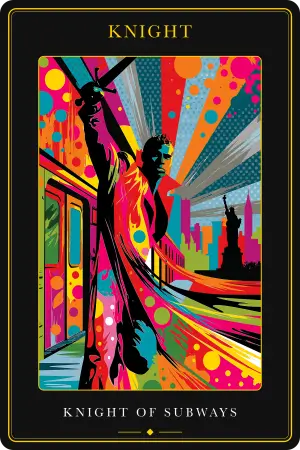
In the Tarot of New York City the Knight of Swords becomes the Knight of Subways, and the charging warhorse becomes the train itself. There is no horse. The rider leans out of the open door of a subway car in motion, one hand gripping the frame, his whole body a diagonal of speed. Where the Rider–Waite–Smith Knight gallops across a windswept plain, this one rides the loudest, fastest thing the city owns.
His sword is the one deliberate quotation from the old deck. It is thrust upward out of the moving car, still the emblem of his readiness for battle and the sharpness of his mind, but held from a speeding train it turns into something more local: a challenge shouted at the whole skyline at once. The figure is drawn as a black silhouette shot through with red, pink, and yellow, with streaks of fire caught inside the outline. The silhouette says he could be anyone on the 8:45 express. The color says what is burning inside the anyone. Red dominates his torso, the passion and urgency and the element of Fire that every Knight carries into its suit.
Behind him the sky breaks into pop-art rays, sunburst stripes of orange, red, blue, and gray exploding from a point near his head. They stand where the traditional card puts storm clouds. Here the turbulence is no longer weather, it is velocity: this Knight does not ride through the storm, he is the storm. Halftone dot fields scatter across the sky and the car, the printed texture of comics and newsprint, the city's own media static, occupying the place the old card gives to wind-bent trees and scattered birds. Motion streaks pour backward along the bottom of the frame, the wake of his speed smearing the ground.
The open door matters most. The doors of a moving train are supposed to be closed, and his are open. He rides at the threshold, at the edge of what is allowed, which is exactly where the Knight of Swords has always ridden. In the distance the Statue of Liberty and the skyline stand in flat silhouette. Liberty raises her torch as he raises his sword, a deliberate rhyme, and his convictions answer hers: the courage in this card is speed in the service of something he believes is honest, not aggression for the thrill of it. His face, caught in profile, is fixed forward. He does not look at Liberty, the skyline, or the viewer. He sees only the track ahead.
Core meaning
The Knight of Subways is swift intellect turned into motion. Air is the realm of the mind, of reason and communication and conflict, and the Knight is that mind at full charge: decisive action, forward momentum, the brakes filed off. As a court card he is the vanguard of his suit, the figure who carries an abstract idea straight out into the world and makes it happen before the plan is fully drawn.
His elemental formula is Fire of Air, the fiery active edge of the Air suit, thought ignited into movement. In New York terms he is the express train of the deck. When he appears the situation has stopped crawling and started to sprint, and the doors are closing: you commit or you watch the train leave. He rewards clarity and directness, the person who knows exactly which car to board so the doors open in front of the stairs. That is strategy executed at full speed.
The card also carries an honest caveat about pace. The express skips stops, and sometimes the thing you needed was at one of them. Velocity without aim overshoots the station. His whole lesson lives in that gap between speed and direction. Aim before you charge the doors.
Upright meaning
Upright, the Knight of Subways marks a period of rapid decisions: a project that suddenly accelerates, a conversation that can no longer be postponed, a truth that needs to be said plainly and now. He brings courage, clean logic, and the willingness to cut through complications everyone else has been politely walking around. If the question is a simple yes or no, this is a fast and definitive yes. The counsel is to act, and to act with your head. Take the straight line, not the scenic route, and give yourself one beat of thought before any move you cannot take back.
In love. The connection that moves at express speed. This is the relationship that goes from first coffee to meeting the friends in two weeks, the text thread that runs past midnight on pure momentum, the person who says exactly what they feel with a directness that is either the most refreshing thing you have met or slightly alarming. Passion here is verbal, conducted in debate that turns into flirtation and back. The card asks only that both of you are on the same train, sharing a direction and not just a speed.
In career. A phase of high velocity: compressed deadlines, rapid-fire decisions, the assignment that crawled for a year suddenly running. It favors initiative taken out loud, volunteering for the hard task and sending the direct message instead of the diplomatic one that says nothing. Intellectual sharpness is the currency of the period, and the person who cuts to the point earns the room's respect. Build in one review pass before anything ships, because the typo travels at express speed too.
In finances. Capital in motion. He signals the offer with a deadline, the negotiation that turns on one well-argued sentence, the window open now and closed by Friday. Know your numbers cold, then move. Persuasion is your strongest asset under this Knight, and a clear case delivered directly unlocks money that politeness left on the table. He favors bold moves rather than gambles: calculate first and charge second, in that order.
In health. Kinetic energy at city speed, the appetite to take the stairs two at a time and to start the program today instead of Monday. Mind and body run on the same track, sharp thinking fueling the workout and the workout sharpening the thinking. The one instruction inside the velocity is recovery. Schedule the rest day with the same discipline as the intervals, because even the express lays over at the end of the line.
Reversed meaning
Reversed, the velocity stays intact but the steering breaks. This is the rider sprinting down the stairs, wedging an arm into the closing doors, and boarding the wrong train. The card warns of haste that has stopped serving the goal and started serving the adrenaline. Words fly out sharp and land where they cannot be retrieved, and someone mistakes momentum for direction. The remedy is plain: get off at the next stop and look at the map. Slow down deliberately, just long enough to confirm the way, because there is always another train in four minutes.
In love. The relationship moving too fast for at least one person on it, or the partner whose sharpness has turned from thrilling to wounding. Directness curdles into verbal aggression, honesty gets weaponized, and the cutting remark on an ordinary Tuesday changes how safe the whole thing feels. It can describe hot-and-cold whiplash, intense pursuit followed by sudden distance, or pressure to commit now from someone who treats your hesitation as an obstacle rather than information. Name the pace out loud. A partner worth riding with can hear "slower" without taking it as an insult.
In career. The workplace at rush-hour crush: overload, tasks started at speed and abandoned at speed, decisions reversed daily. Conflict becomes the dominant register, the sharp reply-all and the bluntness that has crossed into cruelty while calling itself honesty. It can flag the burnout specific to brilliant people, where the mind is still fast but the judgment is eroding and mistakes multiply because slowing down feels like failure. Get off the express. Finish one task before starting the next, and say less in conflict, none of it in writing while angry.
In finances. The trade made at full sprint with no stop-loss. He warns of the investment entered because it was moving fast and fast looked like winning, or the lease signed to end the search rather than because it was right. Watch the fast talker, the pitch that is all velocity and no substance, the pressure dressed up as opportunity. If they are rushing you, that is the information. Slow every money decision down by one full day, because the deal that cannot survive a night of thought was never a deal.
In health. Speed the body can no longer cash. He points to injury through haste, the weight jumped to without the base, the run pushed through pain because slowing felt like weakness. It describes running on caffeine over sleep and adrenaline over food, and the conviction that exhaustion is a personality trait. The body is trying to communicate and being talked over, exactly like everyone else in the reversed Knight's life. The instruction is deliberate deceleration, with rest days treated as non-negotiable stops.
Historical notes
The Knight of Subways inherits the long history of the Knight of Swords. In the Tarot de Marseille the card was the Cavalier d'Épée, a standard military cavalry figure of raw martial energy that served as the culmination of the numerical cycle of the suit of Swords. The Marseille tradition read it pragmatically, less through psychological nuance than through direct action: defending a cause, striking a decisive blow, marking the exact moment when a period of waiting collapses into motion.
The late nineteenth and early twentieth centuries systematized it. The Hermetic Order of the Golden Dawn, through the correspondences Mathers set out in Book T, gave the court cards their astro-alpha-numeric coordinates and fixed the Knight's elemental signature as Fire of Air. Arthur Edward Waite and Pamela Colman Smith then gave the card its famous scene in 1909. A knight in full plate armor charges a stark white horse across a barren landscape, sword raised high, red cloak and helmet plumes streaming backward in a gale, visor lifted to expose his face. The jagged stratus fractus clouds above him are the same formations that appear over the Five of Swords, an iconographic link that roots his behavior in the combative, sparring nature of that card.
Crowley and Lady Frieda Harris reimagined him again in the Thoth deck, painted between 1938 and 1943, as the Prince of Swords. There the single galloping horse becomes a mechanized chariot drawn by capricious winged children who leap in any direction that strikes them, so the vehicle is agile past belief yet almost unable to hold a course. It is a portrait of the pure ungrounded mind, infinitely quick and frequently aimless.
The Tarot of New York City takes that inheritance and gives it an address. The white horse becomes the subway car, the gale becomes the tunnel draft, the storm clouds become pop-art sunburst rays, and the barren plain becomes a moving train with the Statue of Liberty and the skyline behind it. The raised sword survives the whole journey, the one detail carried intact from Marseille to the express platform.
Correspondences
Number. As a court card the Knight carries rank rather than a pip number. He sits third in the Rider–Waite–Smith court, behind the King and the Queen and above the Page, the mounted messenger who delivers the suit's energy into the world.
Astrology. In this deck the Knight governs the third decan of Taurus and the first two decans of Gemini, and his home in the natural chart is the third house of communication, short journeys, and neighborhoods. It is hard to imagine a more literal match, since the subway is the third house poured in concrete: the daily commute, the local errand, the words exchanged in transit. Gemini and its ruler Mercury give him his speed of mind, his verbal agility, and his appetite for information picked up on the move. The Taurus decan grounds and complicates the picture with a bull's refusal to change course once committed, which is why he charges the closing doors instead of waiting four minutes.
Element. Air, and specifically Fire of Air. The Knights are the fiery, active edge of every suit, so the Knight of the Air suit is flame fed by wind. The combination is brilliant and unstable. Air feeds fire until there is nothing left to burn, so his energy is enormous but not renewable at the pace he spends it.
Kabbalah. In the Golden Dawn and Thoth mapping the mounted Knight corresponds to Vau of the divine name Yod-Heh-Vav-Heh and to Yetzirah, the Formative World where ideas take shape and strategy takes form. He rests at Tiphereth, the sphere of Beauty on the Tree of Life, the harmonic center he shares with the Sixes of the Minor Arcana. Beneath the chaotic speed, the underlying aim is clarity and truth, even when the method is harsh.
Elemental dignity. As Fire of Air he sharpens and accelerates the cards around him. Beside other Subways he intensifies conflict and argument, beside the Cups suit his cold logic can scatter feeling, and beside the grounded Earth cards his urgency meets real resistance.
Psychological perspective
The Knight of Subways is the fastest mind in the room, and he knows it. He charges the closing doors, talks fast, thinks faster, and cuts straight to the point through anyone slow. He is the colleague who solves in the elevator the problem the meeting spent an hour circling, the friend who tells you the truth about your relationship while the train is still between stations, the debater who has your counterargument dismantled before you finish making it. His logic is clean and his courage is real, and his patience is a rumor. He is glorious in a crisis, when his refusal to panic and his taste for the direct route save everyone, and he is hard to live with after the crisis, when he is still moving at crisis speed. Independence matters to him more than comfort, and being right matters to him more than being liked.
The archetype's lesson is mastery of alignment. The blade must be carefully aimed before it is swung. In any situation that needs momentum the Knight supplies the courage to act before certainty arrives, and his shadow lives one degree past that same instinct.
Reversed, this is the same mind with the judgment stripped out. The sharp tongue turns cruel and the directness curdles into contempt for anyone who thinks slower, which in his estimation is everyone. He interrupts, steamrolls, wins arguments, and loses people. He can also turn the blade inward and become the chronic over-thinker, the person slicing up his own feelings and lying awake at three in the morning trying to out-argue his heart. Threatened, he would rather spew verbal lava than admit a wound. Under the impatience there is usually confusion, an aim that was lost and papered over with speed, and the real work is to build a structure strong enough to hold the fire past its first burst.
The Knight of Subways across decks
The Knight of Subways is one deck's answer to a court figure every tradition draws differently. In the Tarot de Marseille he is the Cavalier d'Épée, a plain cavalry rider read through direct, pragmatic action, the abrupt end of deliberation and the striking of a decisive blow. In the Rider–Waite–Smith deck Pamela Colman Smith paints him in 1909 charging a white horse across a barren plain, sword raised, red cloak and plumes streaming in the gale, visor lifted so he can look his target in the eye. The jagged clouds above him are the same stratus fractus formations that hang over the Five of Swords, tying his speed to that card's combative streak.
In Crowley's Thoth deck, painted by Lady Frieda Harris, the figure becomes the Prince of Swords, titled the Air of Air. He rides a mechanized chariot drawn by capricious winged children who pull it in any direction they please, a portrait of the intellect that is infinitely agile and almost impossible to steer. He holds a sword in one hand and a sickle in the other, the twin faces of a mind that creates and destroys ideas at the same pace.
The Tarot of New York City keeps the headlong momentum and swaps the horse for the city's own machine. The white steed becomes the subway car, the plate armor becomes a black silhouette shot through with fire, the gale becomes the tunnel draft, and the storm clouds become pop-art rays exploding from the rider's head. The Statue of Liberty stands where the RWS card leaves empty sky. The warning survives the translation. The open door of a train that should be closed says exactly what the rearing horse once did, that this much speed lives right beside the fall.
In combination and context
The Knight of Subways rarely sits quietly in a spread. His function is acceleration, so he strips the buffer of time out of whatever lands beside him and pushes it to arrive faster and hotter. Read him first for how much velocity the reading can safely carry.
Against the heavy Major Arcana he speeds up a reckoning. With the Tower he is the sudden intellectual breakthrough that shatters an old way of thinking, or, when he arrives reversed, the catastrophic crash caused by moving too fast, a wake-up call to cut the momentum before the querent wrecks his own foundations. With Death the ending turns swift and clinical, the intellect having judged a situation finished and moved to sever the tie without lingering. With the Devil he points to someone rushing headlong into a toxic situation, blinded by intellectual arrogance and refusing to read the obvious warning signs.
Beside the Five of Subways, which shares his exact cloud formations in the traditional deck, he becomes the argument won by being crueler, the sparring taken past the point where anyone can win. Among the cards of love he accelerates bonding, often past the point of safety, so a spark reads as genuine in the heat of the moment and structurally short on the patience a long road requires.
For timing most readers take him as very soon, because he burns fast. Think days rather than weeks, the late-spring window of his own Taurus-into-Gemini span, or simply the next open door. Whatever method a reader uses, this Knight tends to override it and insist the thing is already in motion, faster than the querent expects.
Questions for reflection
- Something has been sitting on your platform too long: a decision analyzed past the point of usefulness, a conversation rehearsed until you could perform it. What would it actually cost to get on the train now?
- When you cut straight to the point, are you clearing the air or just winning? Before the next sharp sentence, ask what it costs and what it buys.
- The express skips stops. Which detail, person, or warning sign are you blowing past to keep your speed, and does it matter more than the speed does?
The general meaning follows the Rider-Waite-Smith reading, the reference used across Tarot Academy. Open a specific deck above for its own interpretation.
Frequently asked questions
Explore the Tarot
Latest Posts
Discover the ancient wisdom of tarot cards and unlock the mysteries of your spiritual journey. Our blog is your gateway to understanding the rich symbolism, meanings, and practical applications of tarot reading.




















































