
 EN (English)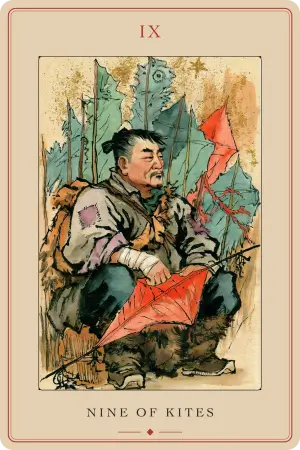
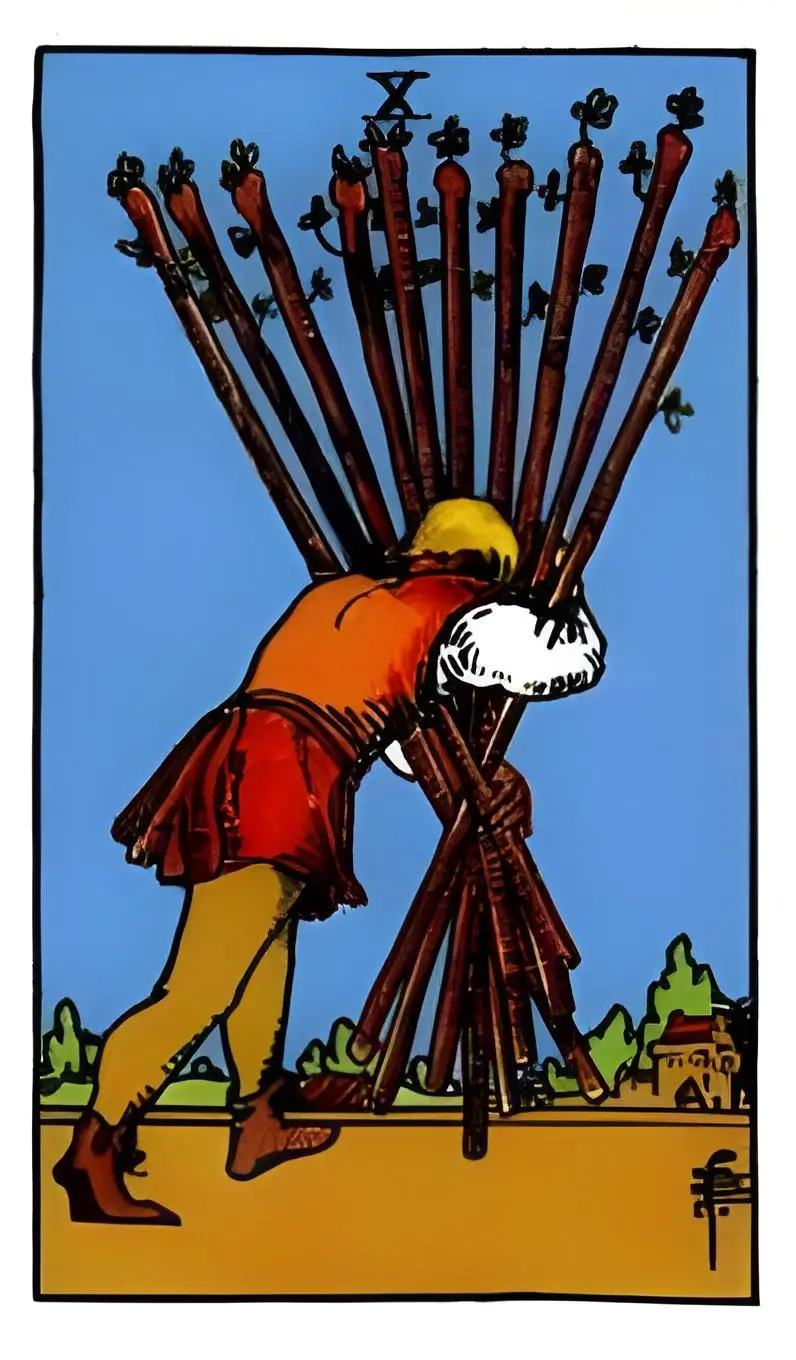

Minor Arcana · Wands (Fire)
Ten of Kites
Overload built from success: a man carries ten spools of furled kites home on one pole and cannot see the road for his own harvest.
Read the complete guide: The Ten of Wands Card in Tarot: A Complete Guide to Symbolism and Meaning
Card at a glance
- Numerology
- Ten
- Element
- Fire
- Astrology
- Saturn in Sagittarius · 3rd decan
- Kabbalistic path
- Malkuth (Kingdom) in Atziluth
- Timing
- December 13–21 · the run into the winter solstice
- Yes / No
- Upright no, or yes at a heavy cost · Reversed mostly no
Upright
overload
responsibility carried alone
the last heavy stretch
burnout
duty
endurance
inability to delegate
success as burden
Reversed
release
delegation
unburdening
collapse
avoidance
sharing the load
rest
dropped obligations
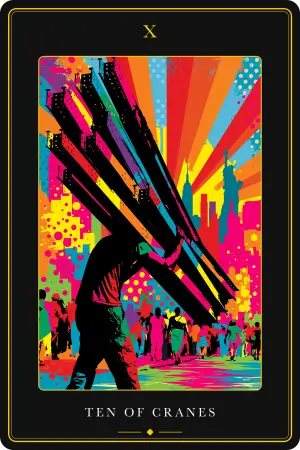
Ten of Kites in each deck
Every deck reimagines the same archetype. Compare the art, then open a deck to read its full interpretation.
Imagery and symbolism
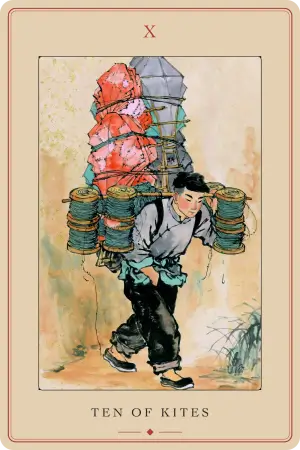
In the Tarot of Beijing the Ten of Wands is the Ten of Kites, and a young man walks down the lane with a bamboo shoulder pole across his back. Ten wound spools of glass-green kite string hang from the pole, and behind his head rises the bundled mass of his kites, vermilion and grey, patched and stitched, their bamboo spines lashed tight with cord. Every card before this one in the suit was about lift: the first wind, the contest, the victory carried on shoulders. Here nothing is airborne. The fire of the suit has been wound onto spools and strapped down.
The kites are furled, and a furled kite is potential deliberately bound. Each one is a venture, a promise, a success that once pulled hard toward the horizon and now presses on the spine instead. The stitches and patches on the vermilion silk mark these as veterans of many flights, so this is a champion's load rather than a beginner's. His head is bowed beneath the pole, his eyes nearly closed, and the bundle rises higher than his head. He cannot see the road ahead over his own successes, which is the card's central sentence.
Loose ends of string trail from the spools, and drops fall from the line, dew or rain wrung out by the weight. They are small signs that the load leaks strength with every step. Yet his stride is steady and his cloth shoes hold the ground, so the endurance is real and the destination is real. In the corner, sparse grass bends in a wind that touches nothing he carries. The sky is right there, still willing, waiting for him to remember what the cargo is for. The card is drawn in the deck's Feng Zikai manner: a few calm brush lines, grey and black washes with accents of vermilion and teal, warm kraft paper flecked with gold, a small red seal in the corner. The gentleness of the drawing is part of the meaning, because the deck does not scold the carrier. It shows him mid-lane and lets you notice that every single thing on his back has wings.
Core meaning
The Ten of Kites keeps the meaning the Rider-Waite tradition gives the Ten of Wands, overload and responsibility and the last heavy stretch of the road, then rewires its central irony. The burden here is made entirely of things that were built to fly. This is not overload built from misfortune. It is overload built from success: every venture, every yes, every spool was chosen gladly, and now their combined weight bends the back and blocks the view.
Will, ambition, and enterprise have not been lost. They have been accumulated past the point where any single one can act. The suit is Fire, and this is Fire at its point of excess, where the drive to launch one more kite becomes the very thing that grounds them all. The Kabbalah names the same trap: the Ten is Malkuth, the material kingdom at the bottom of the Tree, and Fire forced into that dense earthly vessel loses its lightness and mutates into a grinding weight. The card's essential detail, the one it wants you to feel, is that the load is not shameful. It is admirable, and that is precisely the trap.
Upright meaning
Upright, the Ten of Kites is a situation of sustained overload near its finish. You are carrying everything you ever launched, all at once, and none of it is flying. The work demands enormous effort, and you may feel that setting even one spool down will collapse the whole arrangement. It will not, but you cannot see that from under the pole. Count the spools honestly and ask of each furled kite whether it still wants the sky, or whether you haul it out of habit and pride. Hand some strings to other hands, finish what is nearly finished, and save your strength for the kites you actually intend to launch again.
In love. A partnership carried rather than flown. One partner has strung the whole household on their pole: the income, the plans, the relatives, the emotional weather of both people. The love is real, and its patches are the honorable stitches of shared history, but it may currently be all obligation and no lift. Name the loads aloud, divide the spools, and schedule the thing the whole suit exists for, an evening when something is launched into the sky purely for the joy of it.
In career. The reliable colleague's curse: because every kite you launch flies, every kite in the office ends up on your pole. You handle your own duties plus several inherited ones, working past the Bell Tower's evening watch, proud that nothing has been dropped. The load exists because of proven competence, and the cost is that your view of your own career is blocked by the bundle. The season this card marks is near its end. Finish it well, then renegotiate the pole and insist some spools return to their owners.
In finances. Prosperity that has become a haul: many income streams, obligations, and debts of gratitude strung on one shoulder, yours. The earnings are genuine, since each spool was wound from a kite that truly flew, but the administrative weight is consuming the energy that made the money. Guard against one more small obligation, because the pole is full.
In health. Read the posture on the card. Bowed head, loaded shoulders, a spine bearing more than its share: the body of chronic overload, with tension in the neck and back and a fatigue that sleep no longer clears. The trailing drops are the small leaks of skipped meals and shortened sleep. The body is the pole, and it is warning you. Unbind the shoulders with rest and unhurried walks, the way the old men walk their birds at dawn.
Reversed meaning
Reversed, the pole comes off the shoulders, and the whole reading turns on how. At best it is deliberate: you unbind the bundle, give some spools away, retire the kites too patched to fly, and walk lighter while the wind returns to the ventures that remain. It marks relief after a long stretch of carrying everything alone, a handover, the plain wisdom of delegation. At worst it is the pole dropped in the middle of the lane: obligations abandoned, strings left tangled, projects furled and forgotten where they fell, with others stepping around the wreckage. Distinguish setting down from dropping. If you are releasing, untie each string on purpose and watch where it lands. If you have already dropped everything, go back and untangle it before you start anything new.
In love. At its best a couple unbinds the bundle together, drops the obligations that were smothering the feeling, and rediscovers the lightness they began with, or a person finally releases a bond that had long stopped flying. There is grief in letting a kite go, and there is also sky in it. At its worst, duties are dropped on the other partner without warning and a relationship is left furled and tangled rather than honestly ended.
In career. The load shifting off your shoulders by choice or by limit. Positively, a workload finally redistributed, a role handed over, a firm and overdue no to the eleventh assignment. You may feel guilt at walking lighter, but that guilt is the habit of overload talking. Negatively, duties quietly dropped and a burnout that offloads the work by collapse, leaving colleagues to gather the scattered spools.
In finances. Unloading for better or worse. Positively: debts paid, an obligation transferred, a draining venture sold or closed. Negatively: bills ignored and a business left furled mid-lane for others to unpick at a loss. Beware the false lightness after a big offload that tempts you to wind new spools before your finances have rested.
In health. Ideally the strict regime relaxes into something livable, rest is scheduled rather than stolen, and the body recovers its natural lightness. In shadow the body offloads by force, through exhaustion or illness that makes the decision the mind refused to make. Aim for the deliberate middle: release the excess string by string and keep the few practices that genuinely give lift.
Historical notes
The modern Ten of Wands was fixed by Pamela Colman Smith under Arthur Edward Waite in the 1910 Rider-Waite-Smith deck. A man walks away bent almost double under ten heavy staves, his face hidden behind the bundle so he cannot see the path. The landscape is sunny and his clothes are clean and expensive, a deliberate contrast: he has the wealth, and the wealth has become a prison. A town waits in the distance, so this is the last grueling stretch of a journey rather than eternal labor, though his bowed head keeps him from seeing how close relief actually is.
The esoteric lineage is heavier still. The Golden Dawn's secret Book T titled the card the Lord of Oppression and described a cruel, overbearing force applied to selfish ends, a matter where the opposing forces are simply too strong to control. Crowley and Lady Frieda Harris carried that into the Thoth deck, where the card is named Oppression and the fires have burned so completely that only ashes remain. Waite kept a warning of deceit and false-seeming from the older tradition, and added the specific note that the card in a lawsuit signals loss.
The Tarot of Beijing keeps the burden and rewires the source. Where the RWS staves are dead wood and the Thoth wands are spent fire, the Beijing kites are objects made to rise, so the oppression is sharpened into irony: this carrier is crushed by his own successes, each of which still has wings. The sunny RWS landscape becomes a willing sky the man is too bowed to look up at, and the distant town becomes the courtyard gate, closer than it feels from under the pole.
Correspondences
Number. Ten, the full circle: the completion of one cycle and the seed of the next. The suit began with a single swallow kite offered to the first wind of spring, one string and everything possible. By Ten that possibility has multiplied into ten realized ventures, and the card shows what completeness weighs when it is all carried at once. Ten reduces to One, so somewhere in the bundle is the one kite that opens the next cycle, but it cannot launch until the other nine are set down.
Astrology. Saturn in Sagittarius, the third decan, roughly December 13 to 21, the run into the winter solstice. Sagittarius is the archer's upward pull, the kite straining toward the horizon beyond the city wall, while Saturn is the spool, the string, the pole, and the weight. Saturn does not forbid the flight. It asks who will carry the string, maintain the bamboo, and walk the whole load home after the festival, testing ambition by weight rather than by wind.
Element. Fire, in this deck the fire of the spring wind that lifts a kite: will, ambition, enterprise. The Ten shows that fire at its excess, wound tight and carried instead of flown.
Kabbalah. Malkuth, the Kingdom, in the fiery world of Atziluth. Volatile creative fire is forced into the densest, most material sphere of the Tree, where it cannot rise and hardens into obligation. In the Golden Dawn's I-Ching mapping the decan pairs the trigram Chen, thunder, over Sun, wind, enduring support holding structure amid explosive force.
Psychological perspective
This is the card of the person the whole lane relies on, the one who launched ten ventures and now carries all ten home on a single pole. Their real burden is their own capability. Everything they touch flies, so everything gets handed to them, and they refuse none of it. They are proud of the load and will not admit it is heavy. Ask how they are and they nod toward the road and keep walking.
Modern practice reads the card as the signature of hyper-independence, the trauma response that insists on complete self-reliance to avoid leaning on anyone. It is the go-to employee who absorbs everyone's overflow, the eldest-daughter figure who manages a family's whole systemic weight, the martyr who suffers for achievements the exhaustion then ruins. The root is an inability to hand over a single string, from a belief that no one else will hold it properly. They may be half right, which makes it worse. Left uncorrected this runs straight to burnout: the flyer who once made the whole sky dance ends up unable to see the sky at all. The lesson is that mature independence includes the ability to lean on others.
Ten of Kites across decks
Rider-Waite-Smith. The 1910 card shows a man bent under ten staves, his face obscured by the bundle, walking a sunny road toward a distant town. The burden is dead wood and pure weight. The Ten of Kites keeps the posture and the blocked view but makes the load out of furled kites, so the weight is compounded by the irony of hauling things designed to fly.
Tarot de Marseille. The older pip shows ten batons crossed in a dense lattice with little narrative, the burden implied by the sheer congestion of staves rather than by a laboring figure. Beijing keeps that sense of too much bound in one place and gives it a human back to press on.
Crowley-Thoth. Titled Oppression, the Thoth Ten sets its wands in a rigid cross with the fires reduced to ashes, Crowley's image of creative force that has consumed itself. The Beijing card reaches the same exhaustion by a warmer road, showing not ashes but veterans still stitched and patched, spent because they were never allowed to fly.
Modern reframings. Recent decks tend to read the Ten of Wands as burnout and the need to delegate rather than as karmic oppression. The Tarot of Beijing sits inside that shift, adding its own counsel through the kites: the fix is not only to set the load down but to remember that each burden was chosen for the joy of watching it rise.
In combination and context
The Ten of Kites reads most sharply against the card before it. The Nine of the suit is the scarred sentinel who holds the line after a long fight, still capable and aware of the strength left in reserve. The Ten is what happens when that sentinel refuses to rest and reassess: resilience tips over into stubbornness, and the individual who was holding the line is now buried by it. Read together, the two trace the edge between heroic endurance and toxic overextension.
Set beside the other Tens, the Kites stand apart. The Ten of Cups finds emotional satiety and the Ten of Pentacles finds settled wealth, because Water and Earth are at home in the material kingdom. Fire is not, so where those Tens realize their element, the Ten of Kites shows its element deteriorating under weight. Near cards of planning and rational review, a reversed Hierophant or a reversed Two of the suit, it counsels stepping back to find a less costly way to reach the same goal. Near the Ten of Swords it marks the difference between a sudden final ruin and the grinding agony of continuation, since this carrier is still on his feet.
When the card keeps returning in a reading, treat it as an audit rather than a verdict. Count the commitments you are hauling, name when each last actually flew, hand at least one string to another pair of hands, and carry only what you still intend to launch.
Questions for reflection
- Which of the kites on your pole last actually flew, and which are you carrying only out of habit and pride?
- If you set one spool down today, whose hands could hold it, and what stops you from asking?
- The bundle rises higher than the man's head so he cannot see the road. What is your own load hiding from view right now?
The general meaning follows the Rider-Waite-Smith reading, the reference used across Tarot Academy. Open a specific deck above for its own interpretation.
Frequently asked questions
Explore the Tarot
Latest Posts
Discover the ancient wisdom of tarot cards and unlock the mysteries of your spiritual journey. Our blog is your gateway to understanding the rich symbolism, meanings, and practical applications of tarot reading.




















































