
 EN (English)



Major Arcana · VIII
Strength
Soft power in Pamela Colman Smith's rendering: a maiden calming a red lion with her bare hands.
Card at a glance
- Numerology
- VIII
- Element
- Fire
- Astrology
- Leo · ruled by the Sun
- Kabbalistic path
- Teth (Chesed → Geburah)
- Timing
- Late summer · Leo season
- Yes / No
- Yes, with patience
Upright
soft power
courage
compassion
self-control
resilience
self-discipline
confidence
mastery over instincts
Reversed
self-doubt
loss of control
raw emotion
aggression
abuse of power
burnout
insecurity
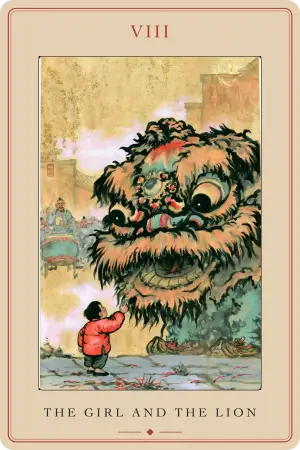
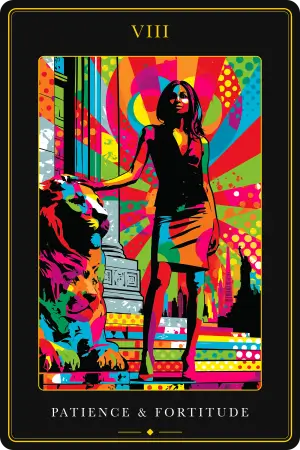
Strength in each deck
Every deck reimagines the same archetype. Compare the art, then open a deck to read its full interpretation.
Imagery and symbolism
Pamela Colman Smith drew this card under Waite's direction, and every element is placed to read as calm rather than combat. A woman in a flowing white robe bends over a great lion and closes her bare hands gently over its jaws. She carries no weapon and wears no armor. The white of her garment reads here as purity of intention and the spiritual side of the work, the same innocence that clothes The Fool, while her greenery recalls The Empress.
The lion in this deck is unmistakably red, and the color is doing interpretive work. Red marks passion, physical energy, and the animal side of human nature, the raw drive people usually fear and try to suppress. Smith paints the beast calm under the woman's hand, its aggression soothed rather than beaten out of it. The two figures stand for mind and primal instinct meeting on gentle terms.
Above her head floats the lemniscate, the sideways figure of infinity she shares only with The Magician. It marks a strength drawn from an endless spiritual source rather than muscle. A garland of red roses runs from her waist to the lion, binding the beast with flowers instead of iron. Waite called this the "sweet yoke and light burden of Divine Law," his way of saying that mastery grounded in compassion costs no strain. Her crown of flowers signals serenity and harmony with the world around her, and the rose belt reads as vitality and pure love. Behind the pair the Rider-Waite scene keeps two details many readers overlook: a forest that anchors her to the natural world, and distant mountains that stand for the obstacles crossed on the way to inner strength.
Core meaning
In this deck Strength is fortitude turned inward. It is life energy and the ability to direct it, the reconciling of the conscious mind with the animal passions it would rather disown. The red lion carries the lust, rage, grief, and fear that cannot be argued away; the woman is the higher self who neither cages the beast nor lets it loose.
The Rider-Waite reading of the card insists that real power is spiritual and emotional before it is physical. True strength here rises from love and the capacity for empathy, not from force. This is soft control: courage held between two failures, the cowardice that collapses under fear and the blind rage that lashes out. The woman applies patience and compassion until the lion's immense energy answers to a higher purpose, and its calm face is the proof that it worked.
Upright meaning
Upright, Strength promises that patience and compassion win out over force. It says you already hold the inner reserves to endure a hard trial, and that the moment calls for a gentle, understanding hand rather than aggression. Willpower, calmness, and quiet confidence run through the reading.
In love. Intense passion carried with the maturity to hold it. The card shows a bond built on moral resilience and spiritual connection, blending deep respect with real emotional depth. Its lemniscate hints at a lasting, soul-deep loyalty that survives distance and hard seasons, and partners here tackle trouble as a united front.
In career. Confidence in your role and the willpower to decide and act. Strength favors stepping into leadership, defusing tense workplace politics, and outlasting competitors through steady composure rather than aggression. Expect demanding tasks, and trust that your endurance is equal to the pressure.
In finances. A period of stability built on self-belief and a firm grip on your position. The card rewards determination, skillful negotiation, and holding your nerve through a slow rebuild instead of impulsive moves.
In health. A strong omen of vitality and natural grace, a body and mind brought into balance by steady effort. Through its Leo and solar link it touches the heart and circulation, and it rewards respectful, consistent care over punishing extremes.
Reversed meaning
Reversed, the harmony between woman and lion breaks. It rarely means physical weakness. More often it is self-doubt, shaky confidence, and an inner lion of fear or anger left to run wild. At the far extreme it shows bullying and the abuse of power, someone forcing a situation because they hold no real security inside.
In love. Volatility and insecurity, one partner dominating the other, or emotion curdling into aggression and manipulation. The card can also mark an unhealthy dependency fueled by deep fear, a signal to reassess your boundaries and address what is driving the extremes.
In career. A crisis of confidence, an unmanageable workload, or a strategy quietly failing. Watch for the urge to dominate colleagues as a mask for feeling unsure, and guard your work-life balance before stress tips into burnout.
In finances. Losses driven by reckless spending and a failure to check impulses. Hesitation and a lost grip on the situation call for strict discipline and no hasty decisions.
In health. Neglected exercise, poor nutrition, and self-care abandoned to lethargy, with the body paying the price of prolonged stress. You are spending more energy than you replace, so rest comes first, then the slow work of cutting the habits that harm you.
Historical notes
Strength began as Fortitude, one of the four Cardinal Virtues of classical philosophy and Christian theology, named La Forza or La Force in the early Italian and Marseille decks. Its philosophy is Aristotle's: courage as the mean between two failures, the cowardice that yields to fear and the blind rage that destroys through brute force.
Before the maiden and lion settled into place, the card borrowed from two strongmen. Samson, who killed a lion barehanded and died pulling down a temple's pillars, lent the broken-pillar motif; Hercules, who choked the Nemean Lion, lent the lion itself, and both stood as warnings about untamed power. The Mantegna deck of around 1470 showed a woman with lion and pillar at once, and early cards like the Visconti di Modrone have her forcing a struggling lion's jaws apart.
What Waite and Pamela Colman Smith inherited was the calmer Marseille version, a woman seated over a passive lion, quietly opening its mouth. The Rider-Waite-Smith deck of 1909 took that composure further and loaded it with esoteric detail, the lemniscate and the rose garland chief among them. The result recast a picture of physical mastery as an allegory of the shadow integrated through love.
Correspondences
Number. In the older Marseille and Italian order Strength was XI and Justice VIII, but the Golden Dawn and Waite swapped them, since Leo naturally precedes Libra in the zodiac. That makes this card VIII in the Rider-Waite-Smith tradition most English readers follow. Its numerological root is 8, tied to power, karmic balance, and the weight of every choice, and also to wealth won by using inner strength to shape favorable circumstances. The figure of 8 echoes the lemniscate hovering above the maiden's head.
Astrology. Leo rules the card, the fixed fire sign of the Sun, all vitality, pride, and enduring willpower. The pairing is where Rider-Waite reads its "soft power": Leo's drive for authority tempered by gentleness and the urge to protect.
Element. Fire, the creative, willful heat of Leo that has to be managed so it warms rather than burns out.
Kabbalah. Her Hebrew letter is Teth, the serpent or lion-serpent, and she holds the path between Chesed (Mercy) and Geburah (Severity). The serpent ties her to Kundalini, the coiled life force whose controlled rise up the spine turns raw, primal energy into spiritual light.
Elemental dignity. Beside Wands her fiery Leonine vitality flares brighter; beside Cups the reading turns toward mastering strong emotion with a gentle hand.
Psychological perspective
The Rider-Waite Strength maps cleanly onto shadow work, and it overturns the usual Western script that says being strong means suppressing fear and silencing anger. Smith's maiden does the opposite: she looks the lion in the eye. The work is to find what you have been caging in the name of strength, then to sit with your grief or shame and offer it patience rather than contempt. The lion's appearance is not a flaw; it is proof you are fully alive.
Read through personality, the card describes someone self-assured and able to direct their emotions, decisive and resilient, keeping negative traits in check through inner calm. Its failure modes are specific. Fatigue can turn that confidence into aggression or stubbornness, and natural firmness can harden into inflexibility or the urge to dominate. The subtler saboteur is martyrdom, the moment patience curdles into silent suffering and pain gets worn as a badge. Real strength sometimes means a firm boundary and knowing when to stop carrying others at your own cost.
Strength across decks
Rider-Waite is the anchor most readers picture, so its choices stand out most clearly against its neighbors.
Tarot de Marseille. La Force sits calmly over her lion, gently opening its jaws, but keeps the older number XI and none of the RWS esoteric loading, no lemniscate and no rose chain.
Crowley-Thoth. Crowley renamed the card Lust and restored it to XI. Gone is Smith's modest maiden; in her place a naked, ecstatic woman rides astride a many-headed beast, Babalon upon Therion, holding the Holy Graal aloft. Where Rider-Waite tames the animal, Lust merges with it and drinks in the ecstasy of creation.
Modern decks. Contemporary artists keep reworking Smith's theme. The Light Seers Tarot shows the woman shapeshifting into the lion, having absorbed its power; the Spacious Tarot makes her a desert cactus blossoming against the odds; and the An Other Tarot places Olympic athlete Tommie Smith mid-Black-Power-salute, where strength becomes the moral courage to stand against oppression without force.
In combination and context
Strength is most sharply defined against The Chariot just before it. Both are cards of control, but the Chariot uses hard control, gripping opposing forces through sheer willpower, while Strength uses soft control, harmonizing them with an unarmored touch. The Chariot runs on finite willpower and can burn out; Strength draws on an endless inner reservoir and lasts a lifetime.
Its pairings tend to reassure. With The Magician it becomes near-unstoppable manifestation, intellect joined to emotional endurance, and the two share the lemniscate that crowns them both. With The Tower it promises you will survive the upheaval and rebuild, and with The Devil it lends the willpower to break an obsession or a toxic bond. Beside The Star it is the courage to heal and show your true self; beside The Fool, the nerve to leap into a new beginning.
As a straight yes or no, Strength is a firm yes that cannot be hurried. The outcome you want will come, as long as you meet it with diplomacy and steady resolve instead of haste or force.
Questions for reflection
- What feeling are you calling weakness that is really a sign you are fully alive?
- Where could a gentle, patient hand accomplish what force cannot?
- Sit with the card as a meditation: picture yourself as the maiden calming the red lion. What in you is that lion right now?
The general meaning follows the Rider-Waite-Smith reading — the reference used across Tarot Academy. Open a specific deck above for its own interpretation.
Frequently asked questions
Explore the Tarot
Latest Posts
Discover the ancient wisdom of tarot cards and unlock the mysteries of your spiritual journey. Our blog is your gateway to understanding the rich symbolism, meanings, and practical applications of tarot reading.




















































