
 EN (English)

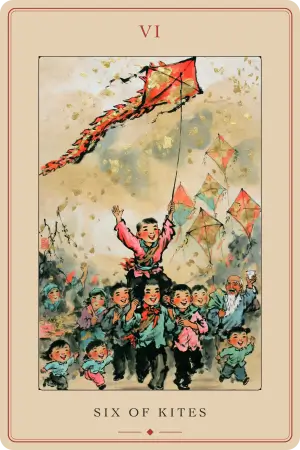
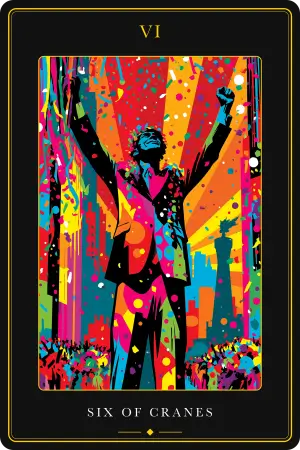


Minor Arcana · Wands (Fire)
Six of Wands
A laurelled rider on a white horse comes back through a cheering crowd with a wreathed wand raised: the victory parade, staged by an artist who knew exactly how a stage works.
Card at a glance
- Numerology
- Six
- Element
- Fire
- Astrology
- Jupiter in Leo, second decan (August 2–August 11)
- Kabbalistic path
- Tiphareth (Beauty) in Atziluth
- Timing
- Early August, second decan of Leo
- Yes / No
- Upright yes · Reversed no
Upright
Victory
Recognition
Deserved reward
Leadership
Self-confidence
Triumph
Respect from others
Reversed
Lack of recognition
Fear of success
Self-doubt
Delay
Loss of authority
Missed opportunities
Abuse of power
Six of Wands in each deck
Every deck reimagines the same archetype. Compare the art, then open a deck to read its full interpretation.
Imagery and symbolism
A rider comes home through a crowd. He sits a white horse, wears a laurel wreath on his head and carries a second wreath tied to the wand raised in his right hand, while the people flanking him hold their own wands aloft. This deck reads the scene as victory, success and recognition arriving together: a person returning to applause and approval after a project, a battle or a life stage has been carried through.
The props each do a job. The raised wand is power, high status and authority, the beacon that announces something worth the public gaze. The wreath on his head is a reward earned through effort, proof that challenges were overcome. There are six wands in the picture, two of them crossed, marking the specific achievements behind the parade. The white horse carries the strength, passion and energy invested in getting here, and its whiteness stands for purity of intention come to fruition. His red clothing signals determination and self-confidence, the green background ties the victory to growth and expansion, and the open landscape speaks to the freedom this win buys and the possibilities it opens.
Then there is the detail Smith's theatre background put into the frame. Her horse is draped in a heavy, tablecloth-like shroud that hides its legs, and readers have long compared it to a stage horse or a mummers' hobby horse worked by two actors underneath. It also carries no reins, a trait it shares only with the horse in The Sun. Both observations open the card's sharpest question: is this a genuine triumph or a pageant staged for an audience, and who is doing the walking under the cloth? The crowd is real support and real scrutiny at once, and the horse, sometimes read as side-eyeing its rider, is the reminder that somebody always does the unglamorous carrying.
Core meaning
In the Rider-Waite deck the Six of Wands is victory, achievement and recognition: the successful completion of a project, battle or life stage, and accomplishments worth acknowledging publicly. The deck is careful about how the triumph was earned. It comes through diligence and effort, and it brings unity and harmony that clear the way for the next set of plans.
Structurally the card resolves the Five. Where five youths brawled with nobody winning, one figure now rides out of the scramble with the prize, order restored under a recognised leader. The number six is the stabilising force after the five's disruption, and here it lands on Fire: directed energy, the force of movement, a bold breakthrough that gets rewarded.
What makes this card distinctive among the deck's success cards is the double wreath. One is worn, one is displayed. Internal satisfaction and external recognition line up for once, which is rarer than it sounds and is the reason the deck pairs the victory with self-respect rather than applause alone. Efforts have been rewarded, and the deck's instruction is simply to enjoy the accomplishment.
Upright meaning
Upright, victory and the achievement of goals arrive after real trials: a moment of recognition, reward and praise, with confidence in your abilities showing plainly. The deck's advice is unusually permissive. Take a break after the difficulty, enjoy the success and gather strength for what is next. Allow yourself to shine and stand out, accept the recognition, do not be shy about the win, share it. Recovery and rest matter as much as the effort that earned them. In a yes-or-no reading it is a yes.
In love. The triumph of love: pride and satisfaction in what the partnership has built, stability, reciprocity and the wish to protect each other. It can mark a proposal or the next step, marriage or cohabitation, and it reads difficulties overcome together as the thing that strengthened the bond. Self-worth and mutual respect carry real weight here, and the relationship moves to a new level on that footing.
In career. Difficulties overcome and effort paying out: success in projects, satisfaction in the work, support and recognition from colleagues or superiors, career progress won through diligence. New openings for leadership and self-affirmation appear, and the deck says to use the momentum rather than let it settle. In business it points to rapid growth, an award or recognition for building a team, and individual talents converging on a shared goal.
In finances. Ideas brought to life and investments returning: good profit from business activity, a successful deal, financial expansion, a favourable window for investing or stabilising. Work put into economic growth has been acknowledged, and the rewards are due.
In health. Successful progress in training and confirmation that the chosen path is the right one: regimen maintained, diet in order, workouts regular, obstacles to physical self-improvement overcome. The deck frames it as seeing yourself as a winner, with energy high enough to carry the improvement forward.
Reversed meaning
Reversed, the parade does not arrive. The deck describes a lack of recognition, obstacles to success, or a success that brings no inner satisfaction: plans unmet despite the effort, fatigue and discouragement after setbacks, strength depleted, fear of competition or of measuring up. In a yes-or-no reading it turns to no. The counsel is practical and kind: understand the reasons for the failure, accept that even the bitterness of defeat is temporary, and remember that sometimes you have to learn to lose in order to learn to win. Guard against burnout, and measure yourself against your own growth rather than other people's.
In love. Delays, inequality or misunderstandings between partners, and an unwillingness to admit the problems that have surfaced. The relationship stalls in uncertainty and doubt. It can also mark a short-lived romance or a partner not taking things seriously. The instruction is to work for equality and real understanding rather than let the drift continue.
In career. Apprehension and insecurity, unexpected problems, unfriendly rivalry, and a lack of support from colleagues or leadership that leaves you feeling isolated, as though the obstacles must be cleared alone. Setbacks breed doubt in your own ability. In business it warns of stalled projects, an overload of responsibility, and disputes from an uneven distribution of work or a strategy that no longer fits.
In finances. Confidence that curdled into complacency and premature celebration. Expect mistakes, unexpected expenses or losses where profit was assumed, often traceable to thin planning. The deck's advice is caution: avoid risky deals, watch spending, be patient, and reassess the approach before committing again.
In health. Energy dropping and discipline lapsing: exhaustion, improper training, poor eating, disrupted sleep, significant effort with no results to show. It also flags the opposite error, pushing the body without regard to its actual capabilities. Listen to what it needs and rebuild the plan around that.
Historical notes
Smith drew this card in 1909 from an inheritance with almost nothing in common with what she produced. The Tarot de Marseille gives the Six of Batons a rigid lattice of six wands with flowers breaking through the structure, triumph expressed as organic growth pushing through inanimate form, with no rider and no crowd. The Sola Busca deck of the 15th century, whose fully illustrated pips inspired Smith's whole approach to the minors, offers something stranger still: a woman with lettuce-like hair and long branching hands, floating tree-people, a blood-red moon. Smith kept the structural innovation of scenic pips, discarded the surrealism, and reached instead for the Roman triumph.
That choice carries its own freight. In the Roman triumph a slave rode behind the victorious general holding a crown above his head and repeating memento mori, remember you are mortal, a ritual designed to keep the man from believing he had become a god. Waite's rider has no such whisperer, which is one reason later readers hear the warning in the card's shadow rather than its picture.
Crowley and Lady Frieda Harris took the opposite road in the Thoth deck, naming the card "Victory" and dropping the human scene for geometry: six wands intersecting, two topped with lotuses, two with Set-creatures for chaos overcome, two with solar disks, flames rising from the crossings in Leo orange against Jupiter violet. There the victory is the alchemical resolution of the Five's strife, chaos transmuted into stable gold.
Correspondences
Number. Six, linked with harmony, balance, responsibility and care, and here with overcoming obstacles. It is the stabilising number after the five's conflict, and joined to Fire it produces directed energy, the force of movement and a bold breakthrough that gets rewarded. Six also promises good fortune and returns on effort while carrying leadership, dominance and control, so the harmony it brings is the harmony of a group under a recognised leader rather than of equals.
Astrology. The second decan of Leo, August 2–August 11, ruled by Jupiter. The decan brings pride and confidence, a drive for leadership and power, a heightened sense of self-worth and sharpened ambition. Jupiter adds wisdom, enthusiasm, optimism, generosity and luck, marking the moment of victory and guarding against major difficulty. The older tradition notes the risk in the same pairing: Jupiter expands whatever it touches without discrimination, so Leo's pride can swell into pomposity if the ego is not tempered.
Element. Fire, in Atziluth, blended here into energy, passion and creativity aimed at action, with the ambition and courage that back a public win.
Kabbalah. Tiphareth, Beauty, the sixth Sephirah, at the exact centre of the Tree and the point of equilibrium between the Pillars of Mercy and Severity. It is the sphere of the Sun and the redeemed ego, the Beauty of the King: will purified of the lower spheres' squabbles and aligned with a higher purpose. Esoteric tradition adds the caution that Tiphareth is a plateau, not a destination, since the energy must still descend into denser spheres and meet new tests.
Elemental dignity. A Fire card that strengthens beside Air and meets tension with Water, so its neighbours decide whether the victory holds its shine or the applause turns thin.
Psychological perspective
The person carrying this card's upright energy is unafraid of competition and sets ambitious goals: active, courageous, persistent, high in self-esteem, willing to fight for their beliefs and their place. They have overcome the obstacles and now show the results and enjoy the recognition, and the deck notes that they still value approval and support, which keeps the confidence sociable rather than solitary. Reversed, the same person avoids competition and confrontation, feels insecure and drained by stress or the fear of failing, and becomes so focused on winning recognition that the wanting itself produces the disappointment.
The card's real psychological subject is what victory does to the ego, and the imagery gives it two shadows. One is the hollow crown: recognition denied or delayed, the work finished with no crowd to meet it, which hurts most when someone has outsourced their sense of achievement to other people entirely. Its near neighbour is imposter syndrome, applause received by someone convinced they do not belong on the horse and braced to be found out. The correction for both is the same, to locate the value in the mastery rather than in the noise around it.
The other shadow is the opposite excess: applause becoming oxygen, the leader hardening into a tyrant, others treated as stepping stones to keep the position. This is where the Roman ritual behind the imagery earns its keep. The card sits between the Five's strife and the Seven's defensive stand, which tells you what it is worth: a real moment, and a temporary one. Enjoy the parade, and remember the horse under the cloth.
The Six of Wands across decks
The four main traditions disagree about what victory even looks like. The Tarot de Marseille keeps six wands in a geometric lattice with flora breaking through, triumph as steady structural growth and nothing theatrical about it. The Sola Busca offers surreal, arcane imagery, a tree-woman under a blood-red moon, whose lasting contribution was the scenic pip itself rather than any of its symbols. Rider-Waite-Smith turned the archetype into a human narrative of public recognition, where the win exists because a community witnesses it.
Crowley's Thoth card, titled "Victory," removes people entirely for six intersecting wands under Leo-orange flame and Jupiter violet, reading the triumph as the systemic stabilisation of Tiphareth after the Five's strife. Kim Krans' Wild Unknown goes the other way again, showing a luminous butterfly rising out of a dark tangle of wands: metamorphosis and personal liberation, where the crowd is irrelevant and the validation is entirely intrinsic. Read as a set, they map the card's central tension. Smith's version needs an audience, Krans' explicitly does not, and the Rider-Waite reader inherits the question of which kind of victory they are actually after.
In combination and context
Sequence explains this card better than almost any other in the suit. The Three of Wands planned and waited; beside the Six it confirms the ships came in. The Four celebrated too, but inclusively and among equals, where the Six is unmistakably hierarchical, one rider and one crowd. The Five was the brawl this rider won. And the Seven of Wands is the consequence: once you are on the horse you are the target, and the crowd that cheered can become the challengers you must fend off. Further along, the Ten of Wands shows what the leadership won here can turn into if it goes unmanaged, a load carried alone.
Other success cards differ in kind. The Chariot is the willpower and control of the journey itself; the Six of Wands is the parade afterwards. The Sun is unconditioned joy, radiance that owes nothing to anyone's approval, while this card's happiness is specific, social and hard-won.
Major Arcana neighbours raise the stakes. With The World the temporary victory becomes a lasting milestone, a life-defining goal completed. With The Devil it curdles: success built on a false sense of security, an ego caught in its own accolades, or a partner who values the relationship as a trophy and an ego boost rather than as intimacy. With The Tower or the Five of Cups it reads bittersweet, a triumph on a hubristic foundation with a humbling due, or a win that only arrived after real upheaval and grief. A note on yes-or-no questions, where this card gets over-read: victory in the picture does not guarantee a good outcome to a bad plan. Sometimes it is reflecting how badly the querent wants to win, and asking why.
Questions for reflection
- Smith's horse may be two actors under a cloth. Is the success I am presenting the thing itself, or the performance of it?
- The rider wears one wreath and displays another. Does my private sense of what I achieved match what I am being recognised for?
- Somebody is carrying the weight under the drapery. Whose unseen work put me where I am, and have I said so out loud?
The general meaning follows the Rider-Waite-Smith reading — the reference used across Tarot Academy. Open a specific deck above for its own interpretation.
Frequently asked questions
Explore the Tarot
Latest Posts
Discover the ancient wisdom of tarot cards and unlock the mysteries of your spiritual journey. Our blog is your gateway to understanding the rich symbolism, meanings, and practical applications of tarot reading.




















































