
 EN (English)



Minor Arcana · Wands (Fire)
Five of Wands
Five youths in mismatched tunics swing sprouting staves on a sunny hillside, everyone attacking and no one bleeding: Waite's mimic warfare, the clash that tests rather than wounds.
Card at a glance
- Numerology
- Five
- Element
- Fire
- Astrology
- Saturn in Leo, first decan (July 22–August 1)
- Kabbalistic path
- Geburah (Severity) in Atziluth
- Timing
- Late July, first decan of Leo
- Yes / No
- Upright a struggling maybe · Reversed no
Upright
Conflict
Rivalry
Competition
Tension
Ambition
Test of strength
Creative struggle
Reversed
Reconciliation
Compromise
Conflict resolution
Concession
Refusal to fight
Fatigue
Avoiding rivalry
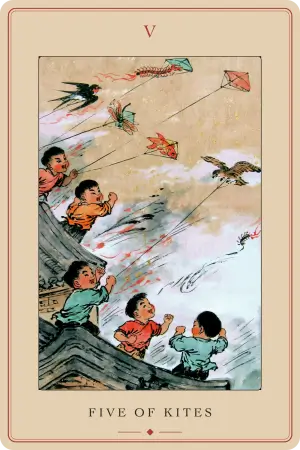
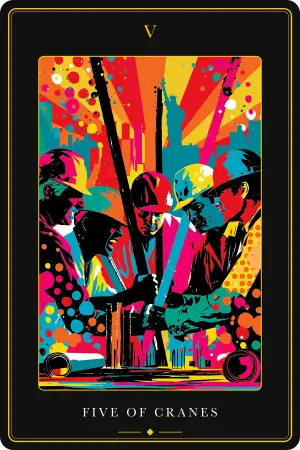
Five of Wands in each deck
Every deck reimagines the same archetype. Compare the art, then open a deck to read its full interpretation.
Imagery and symbolism
Pamela Colman Smith set this scuffle on real English ground: the verdant, rolling hills she knew from Winchelsea in East Sussex and Smallhythe in Kent, painted in acid-bright colour under a clear sky. Five young men in tunics of red, yellow, blue and green swing large, still-sprouting staves at one another in a melee with no formation and no plan. Waite described them in The Pictorial Key to the Tarot as a posse of youths acting "as if in sport or strife," and named the action mimic warfare.
This deck reads the scene as open competition: five men, each aiming to demonstrate strength and dominate the others, conflict and rivalry played out in daylight. Their varied poses matter, some aggressive, some defensive, each stance a different strategy for the same contest. All of them ignore everything around them, intent only on the opponent in front, which is the card's picture of a group working at cross purposes: everyone swinging, no one listening.
The details keep lowering the stakes. The youths are unarmored, nobody bleeds, and none of the wands touch the ground, a cue that the conflict is a surface battle of egos and ideas rather than a fight over survival. The raised wands stand for the pursuit of success and the challenges that come with it, and as instruments of Fire they carry energy, passion, initiative and the will to lead. The figure in green symbolises growth, renewal and regeneration in the middle of the conflict. The bright sky and green fields say the moment matters and the participants see their goals clearly, and for all the tension there is an element of festivity in the scene: a contest, not a war, with self-confidence available to whoever engages it well.
Core meaning
In the Rider-Waite deck the Five of Wands is competition, conflict and the power struggle, with the need to defend one's position at the centre. It shows tense relationships, discussions and conflicts of interest, obstacles and rivalry on the path to a goal, and also what the deck insists on alongside them: personal growth through trials. The Golden Dawn titled the card the "Lord of Strife," and what Smith did in 1909 was drain the strife of malice and stage it as sport.
The five breaks the settled square of the Four of Wands. After the garlands and the homecoming, the suit of Fire runs into other people's fire, and the card describes the scramble that follows: a clash of opinions, a contest in business, sport or daily life, the fight for a place in the sun. No one in the picture is winning, which is the point. The card is about being in the fray, not about the outcome.
The deck's advice is unambiguous: fight and stand up for your opinion. Do not fear competition or abandon your beliefs. Accept the challenge, face opponents directly, act boldly and do not retreat. Keep the competitive energy healthy, and aim to live in harmony with the same people you are contending with.
Upright meaning
Upright, this card puts you in the middle of confrontation and competition: a clash of opinions, unresolved issues, the need to defend your interests and your principles. As a card of the day it brings a charge of competitive energy and a useful question: are you fighting to win, or fighting to be heard? Friction sparks growth here, and colliding perspectives force you to sharpen your thinking and define what you stand for. In a yes-or-no reading it is a struggling maybe: the goal is reachable, through effort rather than a clean run.
In love. Ambition and competition come to the fore: rivalry, an uneven distribution of power, struggles for dominance within the couple or friction from outside. Disagreements become the basis for real conversation, and the passion that tests the relationship's resilience can fortify it. The deck is direct about the arc: go through the challenges with determination from both partners, and the relationship comes out stronger, with deeper understanding and mutual respect.
In career. Competitive situations and a struggle for leadership: a period demanding thorough preparation and maximum concentration. Showcase your achievements, apply every skill to the difficult tasks, and expect differing viewpoints to become a source of conflict. Those disputes stimulate creativity and innovation, provoke deeper thinking and help clarify goals. In business the theme is the fight for market share, influence or a new product's place, with complex negotiations that need preparation and nerve.
In finances. Competition and struggle in the material realm: significant challenges or competitors, obstacles on the path to stability. Fight for your ideas and projects to win the financing they deserve, take active steps, and engage in healthy competition for the ideas that bring gain. Effort and perseverance are the entry fee.
In health. The inner athlete's card: sports contests, marathon preparation, intensive testing of your abilities, competition even in fashion and style. It calls for activity, energy and initiative, and suggests treating personal rivalry, including rivalry with yourself, as motivation for improving your form.
Reversed meaning
Reversed, the fight winds down, and the deck reads the winding down in two ways. The bright reading is resolution: victory in arguments, disputes settled, contradictions eliminated, reconciliation, compromise, a way out of the difficult situation found. The heavy reading is exhaustion: conflict that leads to fatigue, a strenuous struggle without a clear aim, loss of the internal spark, laziness or fear of competition, the refusal to fight at all. In a yes-or-no reading it leans no. The deck's counsel is to give up pointless struggles, try negotiation, and step away from the conflicts that only drain you.
In love. Avoidance of conflict, or the end of it. Deeper issues go unaddressed when open struggle disappears, and fear of criticism can stall the relationship; equally, the card can mark the moment when exhausting quarrels are left behind and reconciliation approaches, one party accepting the situation or conceding. Which reading applies depends on whether the silence is peace or postponement.
In career. Manageable conflicts moving toward resolution, or confrontation dodged altogether: steering clear of clashes rather than stepping up to claim leadership. Competition receding can create genuine harmony and productive teamwork, but overlooked conflict and passivity cost advancement. In business it warns of stagnation dressed as stability, problems set aside, a team whose will to win needs restoring.
In finances. A weakening of the struggle: opportunities and resources lost to inactivity, not enough effort made, interest in the fight for financial success fading. The deck's fix is unglamorous: organisation, planning and confident forward movement overcome any of it.
In health. An unbalanced relationship to effort, chasing records at the expense of health, or the opposite, inertia and no desire to train at all. It can mark entering a competition without sufficient preparation. Attend to the body's real capabilities and rebuild the routine around them.
Historical notes
The card's ancestry runs through three very different tempers. In the Sola Busca deck of about 1491, engraved in Ferrara and the first known deck with fully illustrated pips, the Five of Batons is personified by Gaius Lutatius Catulus, the first plebeian to reach the Roman consulship, shown as a wounded soldier wearing a garland and holding a scale: conflict as classical duty and balance won through adversity. The Tarot de Marseille then stripped the figures away entirely, leaving five interwoven batons read through numerology, the five as the disruption that breaks the four's stability.
Smith knew the Sola Busca; photographs of it had recently been acquired by the British Museum, and she took structural cues from its scenic pips. The mood is entirely hers: sunlit English hills and youths at play-war in place of armored fatalism. The Golden Dawn supplied the esoteric spine both Waite and Crowley worked from: the title "Lord of Strife," the decan of Saturn in Leo, and the sphere of Geburah. Crowley's Thoth deck kept the title and rebuilt the image as ritual geometry, the Wand of the Chief Adept crossed by Phoenix and grey-blossomed Lotus wands, strife as the purifying fire of initiation. One curiosity ties him to the card personally: Crowley's own astrological ascendant fell within this very decan of Leo.
Correspondences
Number. Five, the number of change, instability and moving forward: active dynamics, conflict and obstacles, and the ability to overcome them, gain freedom and advance. In this deck's numerology the five joined to Fire highlights determination, energy, passion and willpower, and asks you to manage that energy and develop a strategy for the change it demands.
Astrology. The first decan of Leo, July 22–August 1, ruled by Saturn. Leo is Fire at its most powerful: creativity, self-assertion and leadership rising to the challenge under pressure. Saturn introduces limitation and discipline, and this deck reads that influence kindly: structure, order, responsibility and seriousness that temper Leo's blaze, so that achievements built here are solid and lasting, won through patience and endurance. The older Golden Dawn tradition read the same pairing more darkly, gloomy Saturn embittering the fire, and the decan also holds Regulus, the royal star, which lends the contest its proud, competitive undercurrent.
Element. Fire, in Atziluth, the archetypal world of pure emanation, here at its most crowded: five flames in one arena.
Kabbalah. Geburah, Severity or Strength, the fifth Sephirah, in Atziluth. Geburah is ruled by martial Mars and works as the pruning force that removes the weak so the strong can flourish; fiery Atziluth entering that restrictive sphere produces the friction the card is named for. Five compounds the first odd number and the first even, so opposition is built into its arithmetic.
Elemental dignity. A Fire card that strengthens beside Air and meets tension with Water, so its neighbours decide whether the contest energises or exhausts.
Psychological perspective
The person carrying this card's upright energy is full of competitive spirit and ambition: decisive, energetic, unafraid of obstacles, betting on their strengths and fighting gracefully. Enthusiasm and indomitability dominate; they take action, pursue new projects and face confrontation with courage. Reversed, the same temperament sours into ongoing tension: headstrong, stubborn people who love to be right and rarely admit mistakes, whose need to win even the smallest dispute spirals into exhaustion and stress, until every clash feels like an internal battle and confidence gives way to indecision.
The wider psychology of the card maps neatly onto what organisational research calls the storming phase of a group: personalities pushing against boundaries, egos vying for leadership, friction that is uncomfortable and necessary at once. Teams that refuse this phase never reach the settled cooperation beyond it, which is the card's sternest lesson: avoiding the fray only postpones it, and suppressed fire burns inward as passive aggression and resentment.
There is also a lighter register the imagery insists on. The combatants are theatrical, brightly dressed, swinging oversized sticks with no one hurt. Much daily strife is exactly this: low-stakes drama that passes like a summer storm. The mature response the card teaches is to know which fights sharpen you and which merely entertain the crowd, and to enter the first kind with full commitment and fair play.
The Five of Wands across decks
Set against its relatives, the Rider-Waite version is the playful one, the only classic rendering that stages the Lord of Strife as a game. The Sola Busca of 1491 gives the five a single wounded warrior, Catulus with his garland and scale, conflict as fatalistic Roman duty. The Tarot de Marseille offers five interwoven batons and no story at all, disruption expressed as pure geometry. Smith turned that inheritance into a sunlit brawl of unarmored youths, and the card's modern meaning has followed her ever since: competition without malice.
Crowley's Thoth deck pulled the card back into the temple. Keeping the Golden Dawn title "Strife," it arranges five ritual wands against a stark yellow ground: the Wand of the Chief Adept, surmounted by a winged globe and twin serpents, crossed by two Phoenix Wands of purification and resurrection and two Lotus Wands whose blossoms show grey and leaden, anxiety hindering the wisdom that wants to open. Where the Rider-Waite card asks how you behave in a crowded arena, the Thoth card asks what the pressure is burning out of you. Modern decks tend to follow Smith rather than Crowley, keeping the ensemble scuffle and its low-stakes energy while re-dressing the combatants for new arenas.
In combination and context
The comparisons that matter most are with the deck's other conflict cards. Against the Five of Swords the difference is elemental: the Wands fight is Fire, active, loud, disorganised and free of real malice, a fair scramble where nobody lies bleeding. The Swords card is Air, the cold aftermath of a win-at-all-costs fight, a smug victor collecting weapons while the defeated walk away. Against the Seven of Wands the difference is geometry: the Five is a free-for-all among equals scrambling for position, while the Seven is one person holding established high ground against many. Sequence matters too. The Five follows the Four's celebration as the necessary friction after rest, and handled with purpose it resolves into the public victory of the Six of Wands.
Combinations tune its temperature. Beside The Lovers or the Page of Cups the antagonism softens into flirtatious teasing and a headstrong, passionate pursuit, the tension that reads as banter rather than hostility. In group and team questions it names the storming phase directly, and the advice is the deck's own: use tactics and strategy in communication so the conflict does not harm you, and remember that not everyone in the noise is an opponent. Some of the chaos is people testing each other in mutual respect.
By position, as advice it says accept the challenge and hold your ground. As an obstacle it warns that rivalry or scattered effort is costing you the goal. As an outcome it promises no clear winner, only a contest that clarifies your strengths and shows you where you stand.
Questions for reflection
- Five figures swing and none of them listens. In my current conflict, am I fighting to win, or fighting to be heard, and do I know which matters more to me?
- None of the wands in Smith's scene touches the ground. How much of the friction around me is rooted in anything real, and how much is ego sparring I could step out of?
- The figure in green keeps growing in the middle of the brawl. What is this contest actually developing in me that calm would not?
The general meaning follows the Rider-Waite-Smith reading — the reference used across Tarot Academy. Open a specific deck above for its own interpretation.
Frequently asked questions
Explore the Tarot
Latest Posts
Discover the ancient wisdom of tarot cards and unlock the mysteries of your spiritual journey. Our blog is your gateway to understanding the rich symbolism, meanings, and practical applications of tarot reading.




















































