
 EN (English)

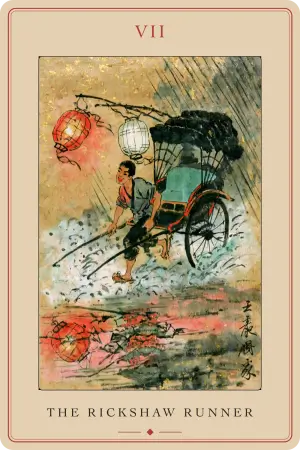
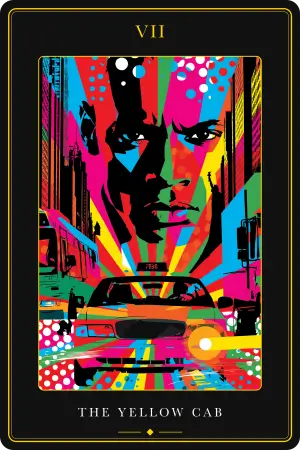


Major Arcana · VII
The Chariot
Breakthrough held together by will, two opposing sphinxes steered forward without a single rein.
Read the complete guide: The Chariot Card in Tarot: A Complete Guide to Symbolism and Meaning
Card at a glance
- Numerology
- VII
- Element
- Water
- Astrology
- Cancer · ruled by the Moon
- Kabbalistic path
- Cheth (Binah → Geburah)
- Timing
- Summer · Cancer season
- Yes / No
- Yes, if you take the reins
Upright
willpower
victory
self-control
determination
direction
leadership
momentum
discipline
Reversed
loss of control
stagnation
aggression
scattered ambition
recklessness
no direction
self-doubt
car trouble
The Chariot in each deck
Every deck reimagines the same archetype. Compare the art, then open a deck to read its full interpretation.
Imagery and symbolism
Pamela Colman Smith drew the Chariot for the 1909 Rider deck in her flat, poster-clean style, and every colour on the plate carries a reading. The vehicle is carved from solid grey stone, not the war-wood of older cards, the same neutral grey as the Emperor's throne and the Hierophant's pillars. It roots the driver in the material world and hides his lower half, the way our deepest motives stay out of conscious view. A golden-haired youth stands upright in armour, the active will ready for battle, holding a wand in his right hand that recalls the Magician and the power to shape events through the mind alone.
Above him an azure canopy of six-pointed stars ties the heavy stone vehicle to cosmic space and a higher purpose. In this deck's own reading those stars stand for hope, immortality, and limitless possibility. A crown set with a star sits on his head for spiritual awakening and leadership, and the star marks growth won through hard work rather than luck. Two golden crescent moons rest on his shoulders like the masks of comedy and tragedy, the swing of human feeling and the sacred Urim and Thummim of the high priest, and they also read as the driver himself caught in constant change. On the front of the chariot a square shield carries the Hindu lingam and yoni for the union of active and passive, topped by the winged sun. The wings and shield speak of protection and freedom, the hero called out to a destined journey.
The team decides the card. In place of horses, a white sphinx and a black one crouch at the front and pull in opposite directions, the deck reading the white as the positive, active side and the black as the passive, and yet the chariot moves. No reins connect them to the driver; he commands them by the focus of his mind. Under his feet a green carpet ties the whole scene to the laws of living nature. Behind him a river runs before a walled city of tall buildings, the city standing for goals already reached and the social order built from them, the river marking the boundary he keeps under control, order on one bank and the unknown on the other.
Core meaning
In the Rider-Waite deck the Chariot is the card of breakthrough: success, ambition, and control won by a driver who has taken charge of his own destiny and moves forward whatever stands in the way. Its keywords in this deck run through victory, self-discipline, leadership and submission, and the balance between activity and passivity, all of it bent toward one search for truth and one clear goal.
The paradox Smith painted keeps the card honest. For all its martial armour and forward drive, the wheels rest still over water and nothing visibly pushes them. The real victory is internal. Outer momentum stays impossible until the driver holds his two sphinxes, his own opposing forces, in a single steady harness. He does not whip the beasts or force the wheels; he advances through the unbroken command of his mind, and the card asks the same of anyone who draws it.
Upright meaning
Upright, the Rider-Waite Chariot is a strong green light: willpower, control, and victory for anyone who applies discipline and sets firm boundaries. It tells you to take the reins of a situation and stop waiting for fate or other people to move first. Read literally it often points to travel or a change of address, the card's theme of transition made concrete. Your decisions now carry real weight, so make them decisively.
In love. Moving a relationship forward with confidence, committing, perhaps moving in together, with assertiveness carrying the day and masculine and feminine energies pulling toward one shared goal. Watch the shadow, though: this card can be the conqueror who loves the chase and loses interest once the prize is won.
In career. Focused ambition and measurable progress. The card favours leaving a stagnant role for leadership, especially in transport, media, sales, or project management, and rewards driving hard toward a clear destination with the discipline to finish a complex project.
In finances. Disciplined money management. This is clearing debt by sheer will and hitting savings targets by refusing to spend on impulse, sometimes marking a step up in income or a major purchase seen through, active control in place of passive hoping.
In health. A war of attrition that willpower sees through. The card asks you to hold a grueling regimen when motivation fades, to take autonomy over your own body through sport, diet, and an active routine, and to trust cyclical progress without burning yourself out.
Reversed meaning
Reversed, the Chariot loses its harness. The ego has taken the wheel from the deeper will, and ambition scatters into aggression, bulldozing allies toward a goal with no clear target. The two sphinxes have overpowered the driver, so the chariot either stalls in inner conflict or spins in circles, and this deck reads it plainly as stagnation, procrastination, and lost control.
In love. The player laid bare: the bond treated as a contest to win rather than a partnership to tend, the victor quickly bored and hunting the next challenge. It can also show a controlling streak, or partners pulling the relationship in different directions until it clashes.
In career. Drive without direction. Effort scatters, obstacles pile up, and the momentum you counted on stalls for lack of a real plan. It can mark burnout, poor coordination with a team, or a job that no longer fits.
In finances. Control slipping, impulse spending, a budget abandoned. The discipline that made the upright card work has fallen away, and money can feel like it is running through your fingers.
In health. Vitality draining and a sense that your body now controls you, or the opposite strain of pushing far too hard. Many readers also take the reversed Chariot literally, as a caution about car trouble or accidents, and advice to avoid driving while emotionally frayed.
Historical notes
The Chariot descends from the Roman triumph, the days-long parade a victorious general led through the city, followed by chariot races in the hippodrome. Its literary ancestor is Petrarch's 1374 poem I Trionfi, whose triumph of Fame rode a chariot trampling the dead underfoot. Early Italian decks kept it worldly: the Visconti-Sforza card shows a crowned woman with a scepter and a globus cruciger drawn by white horses, aristocratic power with none of the later occult symbolism, and oddly stationary at that.
The esoteric layer arrived in the French occult revival. Building on Court de Gébelin's Egyptian theories, Eliphas Levi swapped the draft horses for two sphinxes, one black and one white, the active and passive principles that will must subjugate. He set the conqueror in a cubical chariot with a pentagram coronet, crescent-moon Urim and Thummim on the shoulders, and a winged globe on the crest. Arthur Edward Waite took Levi's design and had Pamela Colman Smith render it for the 1909 Rider deck, and her hand is what most readers now picture. Smith fixed the grey stone, the starry canopy, the paired sphinxes, and the still wheels over water into a single legible plate, the version that became the template for most English-language decks that followed.
Correspondences
Number. He is VII, a number of completed cycles and the search for truth, from the seven days to the seven classical planets. In this deck the seven pulls toward the inner world, intuition, and spiritual aspiration, so the card's explosive motion reads as the payoff of deep reflection, the first six lessons synthesized and driven forward.
Astrology. Cancer rules him, the cardinal water sign of the Moon, which surprises readers until you see the crab. Its hard shell over a soft interior is the driver's armour over a sensitive core, and a crab moves sideways, a reminder that real progress zig-zags more than it runs straight.
Element. Water. Beneath the martial surface runs the emotional, intuitive current of Cancer and the Moon.
Kabbalah. He holds the 18th path, from Binah (Understanding) to Geburah (Severity), crossing the Abyss. His Hebrew letter is Cheth, the fence or enclosure, the boundary that guards something precious and volatile as it travels between those spheres.
Elemental dignity. Beside Wands his forward drive intensifies; beside Cups the Cancerian, emotional undertow of the card rises to the surface.
Psychological perspective
Plato drew the Chariot's inner scene two millennia early. In the Phaedrus he pictures the soul as a chariot whose driver, Reason, steers a white horse of noble spirit and a black horse of base appetite; let them pull unchecked and they tear the cart apart or send it in circles. The hard lesson is that what we crave, driven by the dark horse of money, sex, or power, is rarely what we need to grow.
Jung adds the armour. The stiff, shielded charioteer is the Persona, the polished mask we show the world, and the Janus faces on his shoulders look to past and future at once. Drawn in a reading about identity, the card often surfaces imposter syndrome and asks a pointed question: is your armour protecting you, or has it started to trap you? The occult reading turns the whole thing over. Since the driver holds no reins, the deepest victory is not seizing control but surrendering the ego to a higher will and letting Spirit steer.
The Chariot across decks
Tarot de Marseille. The horses rear as if to bolt, but their bodies face outward and the wheels point the wrong way, so the whole card hangs in suspended motion, and the Rider-Waite stillness reads as an inheritance of that older pose.
Crowley-Thoth. Crowley armors his charioteer in amber and sets a crab on his head for Cancer. Four rotating sphinxes of mixed animal parts replace Smith's two, standing for the Cherubim, the elements, and the fixed signs, and the driver's one true task is to bear the Sangraal, the Holy Grail, tipped in his hands and shedding rays. The walled city behind him answers the enclosure of Cheth, the same wall Smith painted behind her river.
Modern decks. Across traditions the wheels stay curiously still, keeping the paradox Smith made famous intact: the movement is internal, and the true engine is a mind held in balance rather than a whip laid on the beasts.
In combination and context
The Chariot sharpens whatever sits around it into a matter of will and direction. With the Emperor it reads as a swift, logical decision made from a cool head rather than raw feeling, useful when weighing an ex-partner's intentions. With the Five of Pentacles it promises a new role that pulls you out of hardship, the vehicle that carries you clear of a rough patch.
When it turns up again and again as a stalker card, readers take it as a push to synthesize the opposing forces in your life or to physically leave a toxic environment. Paired with the Page of Wands reversed on a question about a harmful relationship, the advice sharpens: build the exit plan first, secure money and shelter, and only then take the reins and go.
As a straight yes or no, the Chariot is an emphatic yes, on one condition. The green light holds as long as you are willing to take charge and stop waiting for fate or someone else to move on your behalf.
Questions for reflection
- What opposing pulls in your life do you need to hold in a single harness right now?
- Is your armour protecting you, or has it started to trap you?
- Where are you forcing motion before you have found your own inner balance?
The general meaning follows the Rider-Waite-Smith reading, the reference used across Tarot Academy. Open a specific deck above for its own interpretation.
Frequently asked questions
Explore the Tarot
Latest Posts
Discover the ancient wisdom of tarot cards and unlock the mysteries of your spiritual journey. Our blog is your gateway to understanding the rich symbolism, meanings, and practical applications of tarot reading.




















































