
 EN (English)



Minor Arcana · Swords (Air)
Six of Swords
Smith's ferry crossing: a cloaked family poled away from turbulence toward the calm far shore.
Read the complete guide: Six of Swords in Tarot: A Complete Guide to Its Symbolism and Meaning
Card at a glance
- Numerology
- 6
- Element
- Air
- Astrology
- Mercury, second decan of Aquarius
- Kabbalistic path
- Tiphareth (Beauty)
- Timing
- Late January to early February, around Imbolc
- Yes / No
- Upright a qualified yes, Reversed no
Upright
Transition
Passage away
Recovery
Calmer water
Relocation
Guided support
Bittersweet relief
Reversed
Stuck
Resistance to change
Return to trouble
Stagnation
Heavy baggage
Cancelled departure
Fear of the unknown
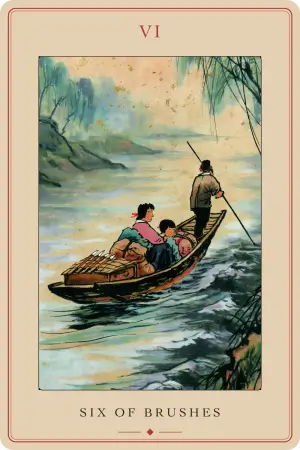
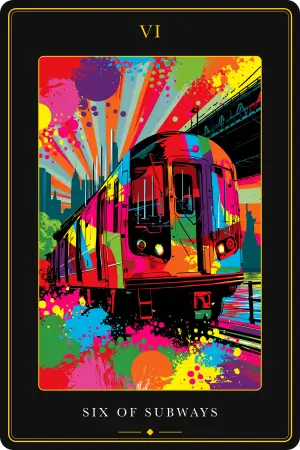
Six of Swords in each deck
Every deck reimagines the same archetype. Compare the art, then open a deck to read its full interpretation.
Imagery and symbolism
Pamela Colman Smith's 1909 drawing is one of the quietest scenes in the deck. A cloaked figure, usually read as a woman, sits hunched beside a small child in a flat wooden boat, and a ferryman stands at the stern working a long pole to push the craft forward. Six swords stand upright in the bow, their blades driven point-down through the floorboards. The palette is muted: a grey sky, grey water, and a low far shore with mountains on the horizon.
What this deck asks you to read is the whole vessel as a family in passage. The ferryman looks ahead rather than back, and in the Rider-Waite reading that forward gaze is his determination and quiet confidence in the route, since the decision to cross was made on purpose. The cloaked woman carries the weight of what is being left: pain, fear, or mourning wrapped around her, the part of the past that has to travel a little further before it can be set down. The child is the opposite pole, the future, hope, and a fresh start riding in the same boat. Between them stand the six swords, thoughts and hard experiences that have been survived but still ride along, upright and present.
The water carries the story from one side to the other. It is choppy and broken near the ferryman's pole, the recent trouble, and glassy and still ahead toward the shore. The passengers barely move, which tells you the crossing is happening with little visible effort, the current doing the work. The mountains behind them mark the hardest trials as finished and behind, and the strip of land with trees rising on the horizon promises the new beginning the card is built around, a return of prosperity after a hard stretch. The grey sky holds both readings at once: difficulty already weathered, and readiness for whatever the far bank brings.
Core meaning
In the Rider-Waite-Smith deck the Six of Swords is a passage from a place of great difficulty to one of safety and calm, read through a single picture: a family being carried across the water. You already know the archetype from the canonical page, transition and moving on. What this deck adds is the emphasis on who is in the boat and how little they are doing to move it. The travellers sit still. The relocation is conscious, but the motion itself is passive, handed to the ferryman and the current.
Smith's boat is transport in the plain sense and in the deeper one: a shift to a new stage of life or a new level of awareness. The six swords riding upright in the hull are the point of the image, thoughts and experiences that have been overcome yet are carried into the next chapter rather than dropped overboard. This deck reads the card as healing in motion, a move away from conflict toward stability, with the storm treated as something already behind rather than a fight still underway. Its Golden Dawn title, the 'Lord of Earned Success', fits the tone: the calmer shore is reached through the crossing, not handed over for free.
Upright meaning
Upright, the Rider-Waite Six of Swords marks a move to a more peaceful, stable phase after a turbulent stretch. It asks you to recognise that change is needed and to move in the new direction without fear, since here the change tends toward a better outcome. Stay calm, keep your goal in view, and let the crossing happen at its own pace, whether the move is a physical relocation or simply a change of scenery.
In love. A shift toward a calmer, steadier phase after conflict, partners discovering new ground together and leaving old grievances on the far bank. One person often helps the other through the difficult water, easing the transition so the relationship can move forward in a gentler direction.
In career and work. A transitional period: a new work location, a change within the team, a new position, or a fresh career phase after disputes wind down. It can point to literal travel or relocation for a better opportunity, a job abroad, or a new partnership, with stability earned by moving toward an environment that suits you better.
In finances. Overcoming hardship and finding new opportunities, a steady return to stability and calm after tension. It can mark relocating or changing jobs for financial reasons, closing a deal, or repaying a debt, with the situation settling once the worst has passed. Manage resources wisely and read your prospects realistically.
In the body. A shift toward a healthier, more balanced state, movement from an unhealthy pattern to a harmonious one and a focus on rehabilitation and recovery. Travel tied to health, such as a therapeutic or wellness retreat, can also show up here.
Reversed meaning
Reversed, the boat's forward motion stalls. This deck reads it as an unwillingness to leave problems behind, or an inability to accept a new reality: the traveller anchored in the choppy water, unwilling to let go of old grievances and emotional wounds, held in place by the comfort of the familiar. Unexpected obstacles block the path to change, and staying put keeps you from the risk that a fresh start would require. Name the obstacles, look for inner resources or outside help, and address what you have been avoiding.
In love. Feeling tied to past relationships in a way that blocks new ones, a bond stuck in old hurt and breeding misunderstanding. It asks you to work through the reluctance to move forward before the strain hardens into routine.
In career and work. Trouble with change or outright resistance to it: fear of the unknown, difficulty adapting to a new workplace, or a delayed promotion. A move may stall, or arrive without the improvement you hoped for, prompting you to reassess your expectations.
In finances. Delays on the way to better circumstances, funds held up, or planned changes proving harder than expected. It warns of debt trouble or unforeseen expenses and calls for careful planning rather than a retreat to old habits.
In the body. Reluctance to make the changes your health needs, too little effort put toward recovery, or procrastination on decisions that matter. Old habits are hard to drop and a new routine hard to start, so the obstacles need working through before well-being improves.
Historical notes
The card was conceived by A.E. Waite and drawn by Pamela Colman Smith in 1909, published by William Rider & Son of London, the house that gives the deck its 'Rider' name. Waite set the esoteric direction and Smith supplied the illustration, and her fully pictorial pip cards, this ferry scene among them, are what made the deck the reference point it became. Before Waite and Smith, most decks left the numbered Swords as bare arrangements of blades with no narrative scene, so the boat, the passengers, and the crossing are largely Smith's contribution to how the card is now read.
The imagery draws on a deep mythic well. The ferryman recalls Charon poling souls across the River Styx, and the boat of healing echoes the wounded King Arthur carried across the water to Avalon to recover and one day return. The Hermetic Order of the Golden Dawn, which shaped Waite's system, placed the card at Tiphareth on the Tree of Life and titled it the 'Lord of Earned Success'. The number six and the suit also tie it to the Hebrew letter Vav, a conjunction meaning 'and', drawn from an old image of an oar, the instrument that carries a traveller from one shore to the next.
Correspondences
Number. Six, the number of Tiphareth: harmony, balance, and the synthesis of opposites, with a note of responsibility and service. In the suit of Swords it points toward decisiveness and the will to change, mental strength put to use for stability.
Astrology. Mercury, ruling the second decan of Aquarius, roughly January 30th to February 8th, a stretch centred on Imbolc and the first return of the light. Aquarius, a fixed Air sign, brings a broad view and openness to new ideas, while Mercury adds speed, flexibility, and movement between worlds, which suits both the physical relocation and the mental shift from old thoughts to new.
Element. Air, the suit of intellect and communication, here laid over Water so the mind is shown navigating emotion. It favours logical analysis over impulse, understanding a situation before choosing a path.
Kabbalah. The card sits at Tiphareth, Beauty, the central sixth sphere associated with the Sun and equilibrium, within Yetzirah, the formative world of mind. It reads as the high point of the airy suit, a rare oasis of clarity in a run of grief and conflict.
Elemental dignity. As a balanced Air card it steadies and clarifies its neighbours, and it pairs naturally with travel cards like the Three of Wands to reinforce a journey over water.
Psychological perspective
The crossing in Smith's picture is cognitive distancing made visible. Moving physically away from a painful scene grants the vantage point to think about it clearly, so the external journey mirrors an internal one, the mind stepping back from a volatile situation to see it whole rather than staying trapped, unable to see the forest for the trees. In the Thoth tradition Crowley named this same card 'Science', from the Latin scientia, knowledge, for exactly that capacity to observe with some detachment.
That detachment has a shadow. Leaning too hard on cold logic can become an escape hatch from the real grief of departure, what analyses tied to William Blake call 'Newton's Sleep', losing the soul to pure empiricism. The deeper counsel of the card is patience with your own defences. The swords are driven through the floorboards, and pulling them out mid-crossing would let the water in, so the heavy coping mechanisms built to survive the storm are also, for now, keeping the boat afloat. They belong to the safety of the far shore, not the middle of the water.
The Six of Swords across decks
This page follows the Rider-Waite-Smith version, the narrative one: the cloaked family, the ferryman looking forward, the six swords standing in the hull, the choppy water yielding to calm and the wooded shore on the horizon. Waite and Smith turned a bare pip into a scene, and that scene is why the crossing became the standard reading.
Other decks frame the same idea differently. In Crowley and Harris's Thoth deck the card is abstract and retitled 'Science', six swords meeting at their points on a Rosicrucian cross against a balanced background, standing for focus and objective distance rather than a physical journey. Vicki Noble's Motherpeace deck makes a similar point with six women risen into the air to gain perspective. Nicoletta Ceccoli's modern deck reads the crossing as the bittersweet loss of childhood innocence on the way to the adult world. The Smith image is also best understood against its cousins. Unlike the Eight of Cups, where a lone seeker walks away from emotional emptiness and leaves the cups behind, the Six of Swords escapes toward safety with loved ones and carries its baggage along. Unlike the willpower-driven Chariot, its movement is passive, surrendered to the ferryman. And where the Six of Wands is a public, cheering homecoming, this is a quiet, uncelebrated departure under grey skies, its triumph one of endurance.
In combination and context
The Six of Swords takes its exact weight from its neighbours and its position. Read after the Five of Swords it is the escape from conflict toward calmer water, the natural next beat of the suit. Paired with the Three of Wands the travel reading sharpens into emigration, relocation, or launching something new over water. Alongside Death it gains a 'no looking back' finality, a life-altering rite of passage with a brighter dawn on the far shore, since the path of Death on the Tree of Life leads straight into Tiphareth where this card lives.
Position refines it further. In a past slot it names the crossing that brought the querent here. As an obstacle it is the difficulty of leaving, the swords weighing the boat down. As advice it says recognise the need for change, accept the guidance, and move. As an outcome it promises calmer water reached through effort. In a yes-or-no reading it is a qualified yes, a quiet 'yes, if you are willing to move forward and leave the current situation behind'.
Questions for reflection
- Who is in my boat for this crossing, and what am I carrying for them as well as for myself?
- The ferryman looks ahead, not back. Am I steering toward the calmer shore, or quietly turning the boat around because the old trouble is familiar?
- Which of my swords is holding water out of the hull right now, and which could I set down once I reach dry land?
The general meaning follows the Rider-Waite-Smith reading, the reference used across Tarot Academy. Open a specific deck above for its own interpretation.
Frequently asked questions
Explore the Tarot
Latest Posts
Discover the ancient wisdom of tarot cards and unlock the mysteries of your spiritual journey. Our blog is your gateway to understanding the rich symbolism, meanings, and practical applications of tarot reading.




















































