
 EN (English)



Minor Arcana · Wands (Fire)
Seven of Wands
One figure on a craggy height, six wands coming up at him from outside the frame, and two shoes that do not match: Smith drew the defence before the defender had time to dress for it.
Read the complete guide: Seven of Wands in Tarot: A Complete Guide to Its Symbolism and Meaning
Card at a glance
- Numerology
- Seven
- Element
- Fire
- Astrology
- Mars in Leo, third decan (August 12–22)
- Kabbalistic path
- Netzach (Victory) in Atziluth
- Timing
- Mid-August, third decan of Leo
- Yes / No
- Upright yes, but you fight for it · Reversed no
Upright
Defence
Resistance
Holding one's ground
Inner strength
Vigilance
Perseverance
Self-respect
Reversed
Fatigue
Giving up the fight
Loss of confidence
Retreat
Overload
Peaceful resolution
Missed opportunity
Seven of Wands in each deck
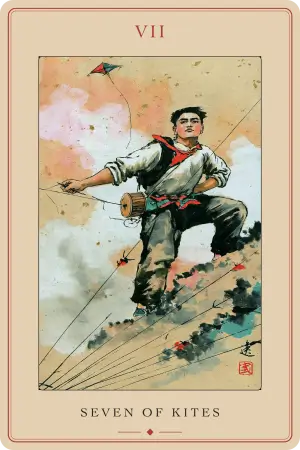
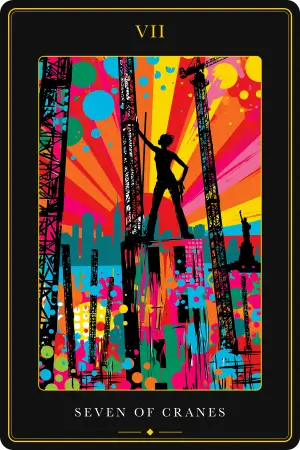
Every deck reimagines the same archetype. Compare the art, then open a deck to read its full interpretation.
Imagery and symbolism
Waite described the scene in one sentence: a young man on a craggy eminence is brandishing a staff, and six other staves are raised towards him from below. Everything the card does, it does inside that sentence. Smith gives the figure a wide combat stance on the lip of a low cliff and puts him mid-swing, one wand driving downward against six that thrust up from an unseen collective. This deck reads the raised ground as an advantageous position and control over the situation, and it makes a point that softens the violence: the struggle is against problems and challenges, not against people.
The wand in his hands is the will to win, a weapon and a statement of confidence at once. The six wands below are the conflicts and obstacles to be met with ingenuity as much as force. His green tunic and brown trousers tie him to the earth and the natural world, clothing chosen for resilience and practicality rather than ceremony, and the research tradition adds that green marks strength grown through the struggle itself. Behind him the sky is bright and clear, read in the older commentary as yellow for solar intellect and luck on his side, and in this deck's own reading as spiritual aspiration set above the fertile fields that stand for the results of his labour. He is alone and yields nothing, which the deck treats as the strength of the card rather than its pathos.
Then there is the detail that no other tradition supplies, because Smith put it there and said nothing about it. Look at the feet. On the right is a high laced leather boot; on the left, a low slip-on shoe or soft slipper. Readers have argued about the mismatched shoes for a century and have landed on four readings that all hold. The first is unpreparedness: the attack came so fast he had no time to lace a matching pair before reaching the edge, so the card honours courage that is imperfect and immediate rather than rehearsed. The second is nonconformity, a man in odd shoes on a hilltop thumbing his nose at a crowd obsessed with uniformity. The third is uneven footing, a stance that is physically high but internally still assembling its arguments, which says you do not need flawless certainty to hold a boundary. The fourth is the least flattering, offered by the creator of The Erenberg Tarot: bluster. Under-dressed and overconfident, the figure may have rushed into a fight nobody required, taking the high ground mainly to shout from it.
Core meaning
In this deck the Seven of Wands is defence: readiness to stand up for beliefs, principles and goals, and the courage to keep standing when the pressure is sustained. It is a card of steadfastness in situations that ask for strength and independence, and its subject is the position already won rather than the position still being chased.
What marks the Rider-Waite treatment is where it places the reader. Smith puts the six attackers outside the frame and gives them no faces, so the querent never gets to identify the enemy. That absence is the interpretive engine of the card. The opposition can be mob pressure, institutional demand, a rival, or the querent's own doubt, and the picture will not settle the question. The deck's own commentary pushes toward the impersonal reading, that the fight is with problems and not with persons, which keeps the card from curdling into simple hostility.
Seven here carries introspection and the pursuit of truth alongside the combat. In this deck's numerology the number is a test of will, and the struggle is as much internal as external: victory arrives when you know your convictions clearly enough to defend them without wavering. Joined to Fire, seven becomes active endurance, a call to find strength inward rather than lean on what is around you.
Upright meaning
Upright, this is the desire to defend your position, expressed as resistance, self-protection and personal strength under opposition. You are fighting for beliefs or principles, or protecting a project or an idea, and the moment calls for courage in the face of criticism. There is competition here that demands effort and independence. The deck's instruction is blunt: do not back down, stand your ground, confront the obstacles openly. Consistency and patience carry you through where a single burst of force would not. Consider what your competitors are actually doing and build a defensive strategy around it, and stay true to your convictions even when others challenge them. In a yes-or-no reading it answers yes, with the fight included in the price.
In love. Protection and the facing of obstacles, a reminder to preserve and safeguard feelings. It can mean defending your independence, or fighting for respect within the bond. Where challenges have arrived, the card asks for resilience and spiritual strength, and it frames the difficulties as tests that strengthen a solid relationship rather than as verdicts on it. Conflict here needs effort from both sides. The relationship is under pressure, and the card reads that pressure as a readiness to fight for the feeling and hold it.
In career. Constant effort to maintain the level you reached, or to get past what is blocking you. Expect competitive battles and the need to defend your interests, your ideas and your projects at work. The deck describes an uneven struggle where the forces look badly matched, then promises success anyway if you keep standing. In business it forecasts a period of contending with competitors or protecting market position, with responsibility taken on and careful planning required.
In finances. Vigilance and resilience. You have the resources to reach your financial goals, but pressure from competitors and obstacles that look insurmountable will show up on the way. Financial tension is likely. Success is protected through persistence, and the challenge is often defending rights and gains you have already won rather than chasing new ones.
In health. Competitive sport and high-intensity training: muscle work, intense yoga, preparation for competition, rehabilitation after injury or illness. Physical resilience holds up well despite the challenges, and extra motivation is needed to keep the diet and the active routine in place. It can also mark the wish to defend your appearance against ageing or other outside wear.
Reversed meaning
Reversed, the card describes instability, thin confidence and an unwillingness to engage. Fatigue has set in from endless opposition, doubts have crowded in, and the querent either avoids the conflict or needs to retreat from it. Effort has gone entirely into the struggle with nothing left over to continue. This deck reads the reversal generously rather than as bare defeat: it can also mean a peaceful resolution, an open conversation, a deliberate choice of the quieter path. The advice is to step back and regain strength, analyse your priorities, change the strategy, and watch your health and nerves. Temporarily leave the fight and do something you enjoy. In a yes-or-no reading it turns to no.
In love. Exhaustion and overwhelm, or an excessive drive to dominate. Conflicts multiply and it becomes hard to tell whether the bond can take the pressure, often because one partner wants too much control. Assess your own conduct honestly and decide whether the short-term disagreements are worth working through for a long-term relationship. Keep the balance: assert your interests while respecting your partner's position.
In career. Overload, or competition that has become inappropriate in its intensity. Fighting for the sake of fighting is unproductive, and overestimating your abilities or resources leads to exhaustion and burnout. Productivity drops sharply and conflicts with colleagues surface. In business this reads as burnout, a sense that the effort is futile, and excessive defensiveness or stubbornness that costs you opportunities. Retreat, reassess the goals, and rethink a strategy that is not producing what you expected.
In finances. Self-doubt and an inability to defend your interests with money. Opportunities are missed for want of courage, and stress about money worsens the underlying problem. It can mean yielding ground, loss of resources, unsuccessful investments or plain instability. Review your approach: the trouble often sits in how you are reading the situation rather than in the situation.
In health. Fatigue, lost motivation, the pull to abandon the goal. The diet and the training stop delivering and the old lifestyle starts looking reasonable again. It can point to weakness, illness or a loss of interest in sport, and to neglecting the body in favour of short-term pleasure. Do not drop the goal; find activities that inspire you, allow the change its time, and treat your body more gently while you recover.
Historical notes
Smith inherited a card with no scene in it. The Tarot de Marseille shows Le Sept de Bâton as seven batons in a dense lattice, three crossed pairs bisected by a single vertical axis, and early European cartomancers read that structure positively: strenuous effort rewarded, with keywords of profit, advantage, competitive struggle and eventual victory. The unbroken central wand was the individual will cutting through the crossing chaos of circumstance. Reversed, the same tradition warned about timing, that the window for asserting yourself had closed through hesitation, leaving inaction and defeat, with retreat the sensible move.
Between Marseille and 1909 sits the Hermetic Order of the Golden Dawn, which fixed the card as Netzach in Atziluth and assigned it the third decan of Leo under Mars. Smith's job, under Waite's conceptual direction, was to turn that formula into something a person could look at. Her solution was the outnumbered defender on the cliff, and it worked so completely that the modern reading of the card as the last stand and the king of the hill comes from her drawing rather than from any text.
Crowley and Lady Frieda Harris went the other way in the Thoth deck, titling the card "Valour" and abandoning the human figure for geometry that tells a story of degradation. Six ornate Adept wands cross harmoniously in the background, two tipped with lotus blossoms, two with Phoenix heads, two with the winged sun disc and uraeus snakes. Through the centre of that harmony thrusts a crude, uneven club, and the flames that were orderly in earlier Wands cards scatter. The army, Crowley wrote, has been thrown into disorder, and victory in that state comes only by dint of individual valour: a soldier's battle.
Correspondences
Number. Seven, which in this deck's numerology carries introspection, inner wisdom and the pursuit of truth, with a spiritual quality tied to testing and perseverance. In the Golden Dawn scheme it is the number that breaks the perfect equilibrium of six, uniting the spiritual properties of three with the material properties of four, so the result cannot be coasted into and must be obtained by skill and force of will.
Astrology. Mars in Leo, the third decan of Leo, August 12–22. Leo is fixed fire, proud and territorial about the individual self; Mars is war and survival instinct. This deck is precise about how the combination behaves: Mars works here through the drive to assert personal authority and control rather than through aggression, supplying resilience, courage, initiative and a thirst for victory. Crowley noted the imbalance in the same placement, since Netzach is governed by Venus, so martial fire descending into a Venusian sphere produces a chaotic skirmish rather than a marching army, won on reactive ferocity instead of strategy.
Element. Fire, in Atziluth, the archetypal world of emanation and pure creative will. In this card it reads as spiritual energy, passion, focus and decisiveness.
Kabbalah. Netzach, translated as Victory, Firmness or Splendour, the seventh Sephirah, here in Atziluth. Netzach is the first node falling entirely below the harmonising solar influence of Tiphereth, which drops the descent into raw natural force and unfiltered instinct. The Golden Dawn called it the Refulgent Splendour of all Intellectual Virtues and gave the card the divine name Jehovah Tzabaoth, the Lord of Hosts, a martial force capable of annihilation and held in deliberate restraint.
Elemental dignity. A Fire card that strengthens beside Air and meets tension with Water, so its neighbours decide whether the defence holds or the defender is worn down.
Psychological perspective
The person this card describes upright has unshakable faith in their goals and abilities. They are strong and resilient, conscious of what their successes cost, and they treat competition as a source of motivation. They are ready to assert their right to hold their beliefs, unafraid of obstacles, marked by high self-confidence and steady conviction. Reversed, the same person feels the world is arranged against them. They fear loss or rejection, avoid conflict rather than use their willpower, carry constant self-doubt, and feel powerless to protect what they have built. Their actions turn chaotic and poorly planned, which erodes the successes they already had.
Smith's faceless attackers make room for the reading most contemporary psychological readers reach for. The six wands thrusting up from below are frequently not rivals or relatives at all but the querent's own internalised anxiety, the mechanism of imposter syndrome. Having won recognition in the Six of Wands, the individual suddenly feels fraudulent, and the wands become the inner critic repeating "no" and questioning their right to occupy the ground they are standing on. The card asks them to spend their passion telling that critic to stand down.
The shadow side is the combative complex: a chronic habit of injecting struggle into ordinary tasks, of living inside an exhausting me-against-the-world stance. That paranoia braces the body before anything happens, and it shows up as physical tension in the neck and shoulders, guard held up with no evidence of a threat, help refused from people genuinely offering it. This is where the reversed counsel of acceptance becomes the healthier move. Losing control, in that frame, is a chance to put the weapons down.
The Seven of Wands across decks
The Tarot de Marseille keeps the card abstract, seven interlocking batons read by their structure, with meaning drawn from geometry rather than narrative. Rider-Waite-Smith, the version this page follows, converts that geometry into a single human predicament and supplies the details every later reader argues about: the craggy height, the invisible attackers, the odd shoes. Crowley's Thoth deck names it "Valour" and drives a crude club through the Adept's six refined wands, insisting that when strategy fails only primal bravery is left.
Modern decks aim the same defensive energy at contemporary targets. In the America Eclipsed Tarot by Laurent Lewis Colvin and Morpheus Ravenna, the Wands chart political resistance, and where the Five is police brutality and the Six is the glory of the movement, the Seven turns dark and shows the arrest and systemic oppression of the resisters. The America 250 Tarot Series, commemorating 1776–2026, ties the card to national defence and the stubborn holding of ground against colonial powers. Maggie Stiefvater's Raven's Prophecy Tarot strips the human combatants out entirely: its Seven is the command to protect, a figure standing exposed to hard weather so that one fragile flame is not blown out. Body-positive decks reimagine the defender in other bodies, on the principle that holding your ground is not the property of a single physical ideal.
In combination and context
Read it against its siblings in the suit's arc of conflict. The Five of Wands is the striving, a horizontal scrum of equals fighting on level ground for something nobody holds yet. The Seven is the defence, and Smith marks the difference with elevation: her figure has climbed out of the scrum and now faces a vertical assault aimed specifically at his authority. The Nine of Wands is what comes after, a bandaged warrior leaning on his staff behind a palisade of eight, carrying the psychological cost of the vigilance the Seven demanded. Five works to arrive, Seven works to maintain, Nine works to keep standing.
The sevens across the suits divide by what they discern. The Seven of Cups weighs vice against virtue, the Seven of Swords weighs risk against control, the Seven of Pentacles weighs action against waiting. The Seven of Wands weighs fight against flight, and when it lands upright the flight option has already expired.
Neighbours colour it. Clarified by the Three of Cups it shows someone who wants a casual, enjoyable connection while defending hard against real intimacy or commitment. As an outcome beside The Sun or the Eight of Pentacles it predicts frustrating uphill battles alongside partners willing to do the repetitive work and bring the problems into the open. As advice the card is consistent with itself: reinforce the boundary, work out who is genuinely on your side, delegate rather than play the sole martyr on the hill, and hold the line only where the ground is worth it.
Questions for reflection
- Smith drew the attackers outside the frame and gave them no faces. When I name what I am defending against right now, am I describing people, problems, or my own inner critic?
- The figure had no time to lace a matching pair of boots. Where am I waiting to feel fully prepared before I defend something that needs defending today?
- This deck says the elevated ground was earned and nobody takes it unless I step down willingly. What have I been treating as under threat that is not actually at risk?
The general meaning follows the Rider-Waite-Smith reading, the reference used across Tarot Academy. Open a specific deck above for its own interpretation.
Frequently asked questions
Explore the Tarot
Latest Posts
Discover the ancient wisdom of tarot cards and unlock the mysteries of your spiritual journey. Our blog is your gateway to understanding the rich symbolism, meanings, and practical applications of tarot reading.




















































