
 EN (English)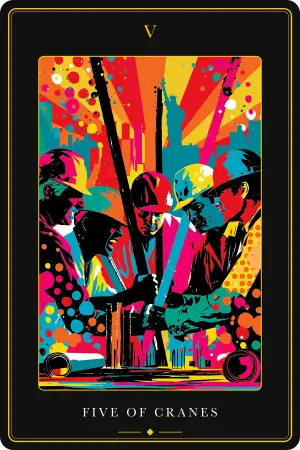


Minor Arcana ·
Six of Cranes
The ticker-tape parade down the Canyon of Heroes: a public win the whole city can see, earned beam by beam against the odds.
Card at a glance
- Numerology
- Six
- Element
- Fire
- Astrology
- Jupiter in Leo, second decan
- Kabbalistic path
- Tiphareth (Beauty) in Atziluth
- Timing
- Early August, second decan of Leo
- Yes / No
- Upright yes · Reversed no
Upright
public victory
ticker-tape parade
recognition
confidence
leadership
earned reward
the win everyone sees
Reversed
cancelled parade
delayed recognition
hollow victory
imposter feelings
arrogance after praise
burnout behind a smile
Six of Cranes in each deck
Every deck reimagines the same archetype. Compare the art, then open a deck to read its full interpretation.
Imagery and symbolism
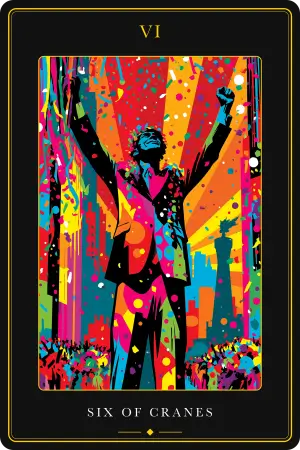
The Six of Cranes stages its victory on a parade route in Lower Manhattan. At the center a man in a suit that explodes with color throws both arms to the sky, fists up, face lifted into falling confetti. The pose is raw triumph rather than a bow or a wave, the gesture of someone who fought for this and knows it. His raised fists do the work the raised wand does in the older card: power, high status, victory claimed openly and without apology.
The ticker tape and streamers falling across the whole frame are this deck's laurel wreath. In New York the ticker-tape parade is the city's highest civic honor, given rather than taken, and it falls only on the people the crowd has chosen to celebrate. It stands for reward earned through effort and deeds, recognition that arrives from outside once the work is genuinely finished.
Behind the figure, sunburst rays in red, orange, and gold radiate out in the deck's pop-art style, turning the sky itself into a halo. What the traditional card grants one hero as a wreath, this card grants as weather: the whole atmosphere celebrates. Those rays also carry the fire of the suit of Cranes, the ambition and the hustle now blazing at full brightness. At the lower edge the crowd is a dense, jubilant field of raised hands and color, filling the canyon between the towers so the win reads as public and witnessed, confirmed by the community rather than kept private.
The skyline framing the scene is the suit's home ground: black silhouettes of towers streaked with color, the buildings the Cranes raise. Among them stands a construction crane topped with a small tree, the topping-out tree carried over from the Four of Cranes, a hint that this parade was built beam by beam through every earlier card of the suit. Halftone dots and saturated color blocks cover the victor's suit until the boundary between the man and the celebration dissolves. At the moment of real recognition, the winner and the city that celebrates him become one image.
Core meaning
The Six of Cranes is the moment self-belief goes public and the city agrees. In numerology six is harmony and responsibility, the order restored after the chaos of five. Where the Five of Cranes was a scrum of contractors underbidding each other, the Six is a single figure stepping out of the fray to claim the prize and give the collective its direction.
This deck reads the win as inseparable from the crowd. Ticker tape requires a crowd, so the number six binds the winner to the people who witness and confirm the victory: the crew, the block, the city. Success here is not solitary satisfaction but effort and reward finally coming into balance, the work sent out and the recognition coming back. The card's own wisdom is in its transience. It is the breather in the middle of the suit, the still point before the defense of the Seven begins, and the deck says so plainly: the crowd is fickle, and the next person's float is already under construction. Savor the parade, then step off it rested, rather than trying to live on the route forever.
Upright meaning
Upright, the Six of Cranes is one of the suit's most positive cards: a stretch of struggle has ended in a well-deserved, public triumph. The permits that stalled, the rivals who undercut you, the nights at the site fence have converted into visible reward, and the crowd is on your side. In a yes-or-no reading it is a clear yes for a healthy goal. Its advice is to let yourself have the parade, accept the recognition without deflecting, and share the win with the crew that helped carry it.
In love. The triumph of a relationship that made it through the hard part: the couple who survived the long distance, the tiny apartment, the two-job years, now standing in their own kind of confetti. It often marks a public step, a proposal or moving in together or meeting the families, and it favors partners who cheer each other's wins instead of competing over them.
In career. The signature card of the shipped project, the promotion said out loud, the review that lands. Long effort is finally credited in public, your name attached to the win, and new room for leadership and visibility opens as a direct result of work already done.
In finances. The moment invested effort and invested money start paying back: the project rents, the deal closes, the funding clears. The emphasis falls on recognition and returns from finished work. One caution from the parade route: celebrate, but do not spend as though the ticker tape falls every day.
In health. Real, visible progress, the training plan that finally shows, the race finished, the reflection you recognize in a shop window. The obstacles overcome were mostly internal, which makes the victory honest. Accept the compliments and let the reward for discipline fuel the next stage.
Reversed meaning
Reversed, the parade is cancelled, postponed, or thrown for someone else. Recognition may be missing despite genuine effort, the project topped out late or not at all, and fatigue or discouragement sets in. The card can also flip to the opposite failure: chasing applause for its own sake, performing success while the foundation cracks, or resting so long on one win that the momentum dies. As a yes-or-no answer it turns to no, often warning that the outcome will not arrive in the near term. The correction is to separate the win from the noise about the win.
In love. Imbalance, one partner always on the float while the other stands in the crowd, or competition creeping in where partnership should be. It can point to a relationship kept up for appearances, celebrated outwardly while stalled inside. The call is for honest effort: get off the parade route, sit down at the diner booth, and actually talk.
In career. The sting of unrecognized work, when you did the job and someone else rode the float. Passed over despite strong performance, a colleague taking credit, results delayed, or exhaustion hidden behind a professional smile. Keep the record of what you actually delivered, and remember that in the long run this city pays its debts to the ones who keep showing up.
In finances. A hollow win: the party thrown before the check cleared, a payout smaller and later than promised, ambition without a plan behind it. Keep the overhead low and the craft sharp until the real reward arrives, rather than spending to look successful.
In health. A drop in energy or discipline, the collapsed routine or the burnout of trying to sprint a marathon. It can also mean undervaluing genuine progress because it does not match someone else's highlight reel. Listen to the body, balance exertion with rest, and treat observation as more useful than punishment.
Historical notes
The Tarot of New York City inherits the Six of Wands and moves its Roman triumph to the Canyon of Heroes. The older imagery it draws on was first structural rather than narrative. The Tarot de Marseille shows six batons in a rigid lattice with flowers breaking through, read as organic growth through solid structure and a steady, enduring victory. The surreal 15th-century Sola Busca gave the Six of Batons a strange tree-woman under a blood-red moon, and while later artists discarded that image, they kept its innovation of fully illustrated pip cards.
Pamela Colman Smith and Arthur Edward Waite published the familiar victory-parade scene in 1909, a rider on a white horse crowned with laurel and flanked by a cheering crowd, turning a geometric pattern into a human story. Crowley's later Thoth deck named the card "Victory" and dropped the figures for six intersecting wands tipped with lotuses and solar disks, flames rising in Leo orange against Jupiter violet, the strife of the Five resolved into stable gold. This deck keeps the public triumph of the Smith image but swaps the white horse for a parade route, the laurel for ticker tape, and the single crowd for the whole city filling the canyon between the towers.
Correspondences
Number. Six, harmony and responsibility, the equilibrium restored after the disruption of five. In this deck six is also community and reciprocity, the number that binds the winner to the crowd whose ticker tape makes the victory real. It links to The Lovers, trump six, and the theme of aligning personal goals with the people around you.
Astrology. Jupiter in the second decan of Leo, roughly August 2 to August 11, energies New York understands natively. Leo brings pride, confidence, and the drive to stand where the light falls, the astrology of the parade route and the name in lights. Expansive Jupiter gives the win its scale, a public celebration rather than a private payout, and adds its better qualities: generosity toward the crew, and the wisdom to keep the victory from turning hollow.
Element. Fire, here the fire of the forge and the construction site, ambition and energy focused on the build. In the world of Atziluth, the realm of pure will.
Kabbalah. Tiphareth, Beauty, the sixth Sephirah at the exact center of the Tree and the sphere of the Sun. It is the point of equilibrium and the redeemed, integrated ego, a real but temporary plateau before the energy descends toward denser, more practical challenges.
Elemental dignity. A Fire card that strengthens beside Air and meets tension with Water, so its neighbours shape whether the confetti keeps falling or the parade curdles.
Psychological perspective
The Six of Cranes takes the human need for validation seriously. Recognition by peers is a genuine part of feeling whole, and in its bright state the card grants permission to celebrate a hard-won victory and lead with confidence. New York trains people to keep moving and play it cool, so there is a real temptation to downplay success or deflect attention. Here the card asks the opposite: hold your head up on the route and accept the recognition gracefully.
The trouble starts when the applause becomes oxygen, and the shadows map that trouble precisely. On one side sits imposter syndrome, receiving the praise while feeling fraudulent and shrinking from the spotlight, sometimes tied to a fear of the responsibility that visibility brings. On the other sits ego overgrowth, where the leader who needed applause hardens into someone who treats the crew as stepping stones and every rival as an enemy. The old antidote is the memento mori whispered to the triumphant Roman general, a reminder that he is mortal, and the card carries the same counsel. Enjoy the confetti while it falls, but generate your worth from the work itself, because in this city everyone who has had a parade has also walked home alone in the rain.
The Six of Cranes across decks
The archetype holds while the imagery changes. In the Tarot de Marseille it is six batons in a flowering lattice, an enduring structural triumph read by geometry. In the surreal Sola Busca it is an arcane tree-woman under a red moon, strange and mystical, but structurally the ancestor of the illustrated pip cards that followed. In Crowley's Thoth deck it is "Victory," abstract intersecting wands where the strife of the Five resolves into floating gold.
Modern decks often turn the victory inward. Kim Krans' Wild Unknown shows a luminous butterfly rising from a dark thicket of tangled wands, a personal liberation where the crowd's applause is beside the point. Against that, the Rider-Waite-Smith card keeps the outward, public triumph, its returning hero on a white horse recognized by the community that witnessed the win. The Tarot of New York City takes that public reading and makes it civic: the white horse becomes a parade route, the laurel becomes ticker tape, the wreath becomes the whole sky of sunburst rays, and the crowd becomes the city itself filling the Canyon of Heroes. Where the traditional card celebrates one hero, this one hands the win to the block that helped raise it.
In combination and context
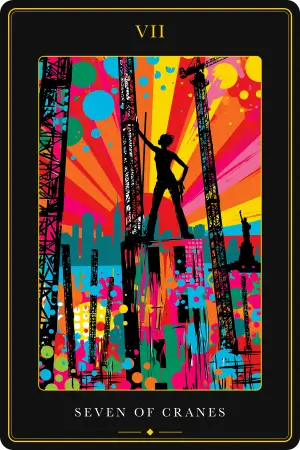
The Six of Cranes earns its meaning from its place in the suit's arc. It is the direct resolution of the Five, a single victor stepping out of the bidding scrum, and it differs from the warm, inclusive celebration of the Four by being hierarchical, one figure raised above the rest on the float. It sets up the Seven of Cranes, since once you are on top you become the target and yesterday's cheering crowd can turn into today's challengers you have to fend off. Later, the Nine and Ten warn that the leadership won here can harden into overload and burnout if it is carried too far.
Against other victory cards its flavor is specific. The Chariot is the willpower of the journey itself, while the Six of Cranes is the parade after the finish line. Beside the deck's Sun it reads as a hard-fought social win rather than broad, unconditioned joy. With The World it becomes a lasting culmination instead of a fleeting plateau; with The Devil it warns of a success that has trapped the ego, the partner or the prize kept as a trophy; with The Tower or the Five of Cups it turns bittersweet, a triumph built on a fragile foundation or won only after real loss. As advice it says claim the recognition, thank the people who carried the beams, then get back to raising the next building.
Questions for reflection
- What have you built that the city has not thrown you a parade for yet, and whose applause are you still waiting on?
- Is the recognition you want tied to the work itself, or to how the work makes the crowd see you?
- When the confetti stops falling and the route empties, what part of this victory still feels worth having?
The general meaning follows the Rider-Waite-Smith reading — the reference used across Tarot Academy. Open a specific deck above for its own interpretation.
Frequently asked questions
Explore the Tarot
Latest Posts
Discover the ancient wisdom of tarot cards and unlock the mysteries of your spiritual journey. Our blog is your gateway to understanding the rich symbolism, meanings, and practical applications of tarot reading.




















































