
 EN (English)


Minor Arcana ·
Seven of Cranes
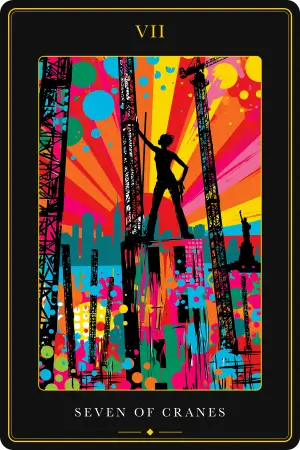
One builder on her own half-built tower, tool belt on, holding the high ground while the rival cranes climb in from every side.
Card at a glance
- Numerology
- Seven
- Element
- Fire
- Astrology
- Mars in Leo · third decan
- Kabbalistic path
- Netzach (Victory) in Atziluth
- Timing
- Mid-August, third decan of Leo
- Yes / No
- Upright yes, but you fight for it · Reversed no
Upright
Defended ground
Nerve
High ground
Persistence
Competition
Conviction
Holding on
Reversed
Burnout
Outbid
Retreat
Paranoia
Overextension
Giving up the spot
Seven of Cranes in each deck
Every deck reimagines the same archetype. Compare the art, then open a deck to read its full interpretation.
Imagery and symbolism
In the Tarot of New York City the Seven of Wands becomes the Seven of Cranes, drawn in the deck's pop-art language: a sunburst of red, orange, pink and yellow rays exploding across the sky, scattered with halftone dots like sparks or camera flashes, and everything human rendered in black silhouette against that saturated light. In this deck the Cranes carry the fire of the Wands, the ambition and construction that raises steel out of nothing, and the Seven shows what happens once that fire succeeds and the whole city notices.
At the center a lone figure stands on top of a half-built structure, her own project, the high ground she raised herself. She plants her feet wide, one hand on her hip, a tool belt at her waist, chin lifted toward the light, in the stance of someone who is not coming down. Her other hand grips the mast of a crane, the seventh, hers. That crane is the wand she holds: her will, her means of building, and if it comes to it the thing she defends with.
Around and below her the other cranes rise, the rival builds crowding the skyline, leaning in toward her position from every side. They are the deck's translation of the six wands thrust up at the figure on the hill, the competition and the imitators arriving from more directions than one person should be able to face. She is outnumbered, and she is higher, and both facts matter.
Behind the cranes stretches the skyline she is part of and fighting to stay part of, the Empire State Building among the teal towers, the harbor flat and bright below. The skyline is the stake itself, a place in the city's silhouette. On the right, small in the distance, the Statue of Liberty raises her torch, a quiet rhyme with the builder's raised arm on the mast. Liberty holds her flame the way the builder holds her crane, an emblem that in this city standing your ground and holding your fire up where everyone can see it are the same act. The unfinished floors under her boots carry the final meaning: the position she defends is still under construction. She guards it and builds it at once, because in New York the two were never separate jobs.
Core meaning
The Seven of Cranes is the stage after success, when what you built must now be held. The project is standing, the name is known, the spot is yours, and that is exactly why the imitators, the cheaper version and the rival bidding on your next lot are all coming for it. You hold the advantage of elevation, the finished floors under your feet, but the advantage only holds while you stand on it. This is the card of one against the field: pressure from several directions at once, met with the same fire that built the thing in the first place.
In numerology seven breaks the settled harmony of six. It is a result that cannot be coasted into, only actively seized and kept. Its lesson is that recognition and pressure are the same event seen from different floors. The real test is not whether the rivals can take the spot but whether the builder still knows why she wants it. Defend the ground because the work is yours and true, and the height holds. Defend it out of habit or vanity, and no amount of steel keeps it.
Upright meaning
Upright, the Seven of Cranes says hold the position. There is real opposition here, real competition over territory, credit or market position, and it leans toward victory for the one who does not fold. Do not come down off the structure to argue on everyone else's terms; make them come up to yours. Answer the challengers and defend your standards without apology, because you earned the ground. Keep one eye on the cost, though, since you can spend everything just guarding the hill. Pick the fights that actually threaten the foundation, let the noise below stay noise, and keep building while you defend.
In love. The relationship, or your place in it, needs defending, and you have the strength to defend it. Rivals may be circling, an ex who resurfaced or family campaigning against your choice, or simply the city itself grinding its schedules against the time love needs. It can also mean defending the inner ground: your independence within the couple, your right to your own work and fire. Fights here are tests, not verdicts; a bond defended together comes out with deeper foundations.
In career. Defend your professional ground. You have climbed to a visible spot, and now come the challengers: the colleague angling for your position, the credit migrating to someone else's slide deck, the criticism aimed at work you know is sound. Claim your results out loud, correct the record when your work is misattributed, and hold your standards when they are pressured. The pressure is the proof of the position, since nobody fights you for ground that is worth nothing.
In finances. Your financial position is real, visible and contested. Competitors undercut you, costs circle the lot, offers arrive designed to pry the position from your hands. The ground can be held, but only actively: read every contract twice, defend your rates, refuse the lowball. This is confidence backed by receipts, knowing what the thing cost to build and therefore why it is not for sale cheap.
In health. The card of physical ground held under pressure, favoring competition and endurance, the training cycle that asks for one more round on an empty tank. Consolidating results, holding the routine and the standard you already reached, is this period's real victory. It also warns of the chronic tension of staying braced, the tight neck and shoulders of someone who never lowers their guard.
Reversed meaning
Reversed, the Seven of Cranes is the defender running on fumes. You have held the fence line so long that the fight became the job, and somewhere in there the building stopped. It points to exhaustion from constant competition, the feeling of being outnumbered and outbid, doubts about whether the spot is even worth keeping, or a retreat that has already quietly begun. Sometimes it shows the opposite distortion: defensiveness turned paranoid, a competitor seen in every shadow on the lot, battles fought that nobody actually declared. Step back from the fence and count honestly. Rest before you decide anything, because a decision made at the bottom of the tank is the fatigue talking. Retreat is not always defeat; in this city, knowing when to sell a position is a skill equal to knowing how to hold it.
In love. A love exhausted by combat, the relationship turned into a permanent siege of rivalry and score-keeping. Or the fatigue runs the other way and you have stopped defending it at all, letting distance or a third presence advance because fighting for it feels beyond your strength. The counsel is honesty over stamina: put down the domestic arms race and see what remains when neither of you is defending anything.
In career. Overload, unfair competition, or a professional fight that stopped being worth its cost. You may be defending your role so constantly that the actual work has stopped, or conceding, shrinking in meetings because pushing back feels impossible today. Take the rest before collapse takes it from you. Leaving a fight deliberately, on your own schedule, is a career move; being carried off it is not.
In finances. Ground slipping away through fatigue and avoidance: conceding terms you should contest, dropping rates because arguing exhausts you, watching a rival take clients you were too tired to fight for. Sometimes it is the reverse, money clutched so defensively that the wealth stops working. Either way the fix begins with an honest audit of what the position is worth and what defending it costs.
In health. A body pushed past defense into depletion: overtraining, under-recovering, the grind mistaken for discipline. It can also mean losing motivation entirely, or fighting the body instead of tending it. Here retreat is the strategy. Rest deliberately, let the nervous system come down off the high steel, then return with a plan built on sustainability rather than siege. The body is not a position to be defended against yourself.
Historical notes
The Cranes inherit the whole history of the suit of Wands. In the older pip tradition the card was pure structure. The Tarot de Marseille shows the Sept de Baton as seven batons in a dense lattice, three crossed pairs bisected by a single upright, and early cartomancers read it positively, as the assured success of strenuous effort: profit, competitive struggle and eventual victory, with the central unbroken wand as the individual will cutting through chaos. Reversed, that tradition warned of a missed window, the moment to act lost to hesitation.
The scenic version arrived in 1909, when Pamela Colman Smith turned the Golden Dawn's abstract geometry into an outnumbered defender on a cliff, swinging one staff against six raised from below. Arthur Edward Waite summed the image up plainly: a young man on a craggy height brandishing a staff while six staves are raised toward him. Crowley's later Thoth deck titled the card "Valour" and told a story of degradation, six refined Adept wands crossed harmoniously in the background with a crude, uneven club thrust through the center and the flames scattered. The army, he wrote, has been thrown into disorder, and if victory comes it will come only by individual valour, a soldier's battle fought with whatever is at hand. The Tarot of New York City keeps that lone defender and gives him a tool belt and a crane.
Correspondences
Number. Seven, the force that breaks the perfect equilibrium of six. It joins the spiritual three to the material four, a result that must be actively obtained by skill and will rather than coasted into. In this deck it marks the point where the suit's climb turns success into exposure: at three the ships came in, at six the parade rolled down the Canyon of Heroes, and seven is the morning after, when the applause has revealed exactly where you stand.
Astrology. Mars in Leo, the third decan of Leo, roughly August 12 to 22. Leo supplies the elevation, the visible position and the pride of the one who stands where everyone can see. Mars supplies the defense, the combative will that meets a challenge head-on rather than negotiating it away. Mars here works less through raw aggression than through the assertion of earned authority: this is mine, I made it, and I will hold it.
Element. Fire, in the world of Atziluth, the realm of pure will and emanation, fire under siege rather than the first spark.
Kabbalah. Netzach, Victory or Splendour, the seventh Sephirah, in Atziluth. Netzach is the first sphere below the harmony of Tiphareth, dropping into raw instinct, so the card's victory is seized and defended rather than gracefully given.
Elemental dignity. A Fire card that strengthens beside Air and meets tension with Water, so its neighbours decide whether the defense holds or is worn down.
Psychological perspective
Psychologically the Seven of Cranes is the responsibility of standing alone. Having won recognition, the individual now has to defend the right to occupy that ground, and the rival cranes below are often not other people at all but the builder's own inner critic, the voice of imposter syndrome repeating "no" and questioning whether she belongs at this height. The card asks her to use that same passion to tell the critic to stand down.
These are proud people in the specific way of those who know exactly what the climb cost, every permit and rejection and winter on the site, and that knowledge makes them formidable. They do not scare easily and they take a challenge as a compliment. The shadow is the combative complex, the habit of treating everything as a fight. Braced permanently for an attack that may never come, a person tenses against the city itself, isolates and rejects genuine help, which is where the reversed card's counsel of acceptance becomes the healthier path. True valour does not require perfect preparation. It requires the willingness to plant your feet on the high steel and refuse to be moved from what you know is yours.
The Seven of Cranes across decks
The archetype holds while the imagery shifts. In the Tarot de Marseille it is seven crossed batons read by structure, strenuous effort rewarded with victory. In the Rider-Waite-Smith deck it is the outnumbered defender on the cliff in mismatched shoes, one laced boot and one soft slipper, read most often as a man caught off guard with no time to dress for the fight. In Crowley's Thoth deck it is "Valour," a crude club driven through the refined wands of the Adept, victory won only by primal bravery once elegant strategy has failed.
Modern decks turn the defense toward new fronts. In the America Eclipsed Tarot the Wands map political resistance, and the Seven marks the arrest and oppression of the resisters. In Maggie Stiefvater's Raven's Prophecy the command is simply to protect, a figure exposing itself to harsh weather to shield a fragile flame. The Tarot of New York City makes its own translation: the cliff becomes a half-built tower, the six raised wands become rival cranes climbing the skyline, and the defender becomes a builder holding the mast of her own crane with the harbor and the Statue of Liberty behind her. Under every version sits the same defended height.
In combination and context
The Seven is best read against its siblings in the suit's arc of conflict. The Five of Cranes is the striving, a level scrum of equals competing to attain a position not yet held. The Seven is the defense, one builder who has climbed above the others now fending off a targeted assault on the ground she earned. The Nine of Cranes is the endurance that follows, the weary guard standing watch long after the heat of battle has passed. Five works to arrive, Seven works to maintain, Nine works to hold on.
Context colours it. Beside a strongly positive card, an uphill fight still ends in ground kept and worth the stubborn work. Beside heavy or draining cards, the reversed warnings sharpen: too many fronts, the wrong battles, resources scattered on skirmishes while the foundation cracks. As advice the card says the time for flight has passed. Reinforce the boundary, name your true allies, and hold the line on what actually threatens the foundation while you let the rest echo past.
Questions for reflection
- What position am I currently defending on this skyline, and is the ground still worth the fire it takes to hold it?
- Are the rival cranes closing in real competitors, or my own inner critic questioning whether I belong at this height?
- Where have I spent so long guarding the fence that the building stopped, and what would it take to start rising again?
The general meaning follows the Rider-Waite-Smith reading — the reference used across Tarot Academy. Open a specific deck above for its own interpretation.
Frequently asked questions
Explore the Tarot
Latest Posts
Discover the ancient wisdom of tarot cards and unlock the mysteries of your spiritual journey. Our blog is your gateway to understanding the rich symbolism, meanings, and practical applications of tarot reading.




















































