
 EN (English)


Minor Arcana ·
Seven of Tokens
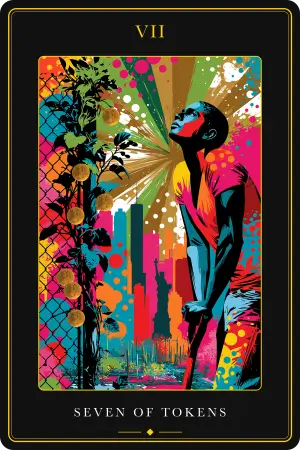
The gardener at the chain-link fence, looking up at a vine hung with seven golden subway tokens, none of them ripe enough to pick yet.
Card at a glance
- Numerology
- 7
- Element
- Earth
- Astrology
- Saturn in Taurus (third decan, ~May 11–20)
- Kabbalistic path
- Netzach (Victory) in Assiah
- Timing
- Mid-May, or a long wait before the harvest
- Yes / No
- Upright a patient maybe · Reversed no
Upright
patience
the long game
assessment before reinvestment
slow money
compounding
honest evaluation
roots under the pavement
the pause at the fence
Reversed
impatience
sunk cost
grinding a dead lot
scattered effort
burnout
envy of another's harvest
spending the token instead of planting it
Seven of Tokens in each deck
Every deck reimagines the same archetype. Compare the art, then open a deck to read its full interpretation.
Imagery and symbolism
In the Tarot of New York City the Seven of Tokens moves the Rider-Waite farmer's field to a community garden reclaimed from a vacant lot, the kind of green pocket carved out of the city and held by patience alone. At the left, a vine climbs a chain-link fence. The fence is the city's honest material, cheap and everywhere, marking the border between what is yours to tend and what isn't. That the vine uses the fence as its trellis is the card's central statement: in New York even the barriers become the structure you grow on.
Seven golden tokens hang on the vine like fruit. They are old subway tokens, this deck's coin of the material world, the small brass proof that you paid your way. They ripen at different heights, some low and early, some high and new, the stages of a long investment with no two matured at the same moment. None have been picked. The harvest is visible but not yet taken, and that restraint is the whole card.
The figure stands at the right, leaning on a long-handled tool, head tipped back, gazing up at the vine. He is not working. His hands rest on the handle, and his posture is the posture of assessment: the pause after labor, before the decision. His face is lifted into the light. In a deck where everyone is always moving, a still figure is the rarest image of all. Behind him a sunburst of gold, green, and rose rays breaks across the sky, the deck's pop-art signature, scattering halftone dots over everything. The rays converge behind his head, crowning the act of looking.
In the middle distance stands the downtown skyline in silhouette, One World Trade at its center and the Statue of Liberty small beside it. The skyline is what long bets look like when they finally pay: every tower was once a lot, a permit, a decade of tending. Liberty holds her torch at the vine's own height, rhyming the gardener's patience with the immigrant's, both of them wagers placed years before the return. At the base of the card the garden beds run toward the harbor in rows of stakes and seedlings, work already done, still maturing, asking nothing today but time. The scene keeps the full Rider-Waite meaning of labor paused and harvest deferred, dressed in the city's clothes.
Core meaning
The Seven of Tokens marks the moment the city rarely gives you: the pause. You have been feeding something for a long time, a savings account, a side business run out of your kitchen, a skill practiced after your shift, a garden coaxed out of a vacant lot, and now you are standing at the fence, leaning on the tool, looking at what has actually grown. The card says the growth is real. The vine has climbed the chain-link and there are tokens on the branches. It also says the harvest is not today.
This is the long middle of the long game, where the effort is behind you and the payoff is ahead of you, and the only work available right now is honest measurement. The number seven questions material attachments, and here the desire for a return crashes into the dense, slow reality of earth. You can pour money, feeling, and knowledge into a plot, but you cannot force a seed to sprout faster than its own timing. That is the humbling lesson of the card. Its difficulty and its peace both lie in whether you can surrender to the timeline of the material world instead of fighting it.
Upright meaning
Upright, the Seven of Tokens asks you to step back from daily execution and assess like an owner rather than an operator. It marks a committed, long-term effort where the payoff is real but not yet here, and it says: take honest stock, then trust the slow build. Hold the line, but hold it with your eyes open. This is not blind persistence. The figure on the card is not working, he is looking. Do not confuse a slow season with a bad bet, and stop checking the pot every day.
In love. A slow-built relationship past the fireworks, into the season where love looks like showing up, splitting the rent, and learning each other's difficult months. For couples between milestones it counsels looking at the vine honestly, the trust accumulated and the conflicts survived, before mistaking a quiet stretch for a dead one. For single querents it favors the long game over the endless first dates: invest where something can actually root.
In career. The long apprenticeship, the years between competent and known, where you are doing the right things and the city has not noticed yet. The skills are compounding and the reputation is forming in rooms you are not in. Do not confuse being unnoticed with being unvalued. Assess whether the job is still trending toward the pay and role you planted it for, and if it is, recommit with less resentment and more patience.
In finances. Slow money, the kind the city pretends not to respect and secretly runs on: the index fund, the down-payment account at sixty percent, the pension quietly compounding. Your position is growing even when the growth is invisible month to month. It often marks the right moment for a financial review, not a panic but an audit. Keep contributing, keep costs low, and let time do the part of the work that only time can do.
In health. The body compounds like money. The runs along the river, the weights, the sleep defended against the city's every argument accrue below the threshold of the mirror and surface on their own schedule. The card often appears at the motivational trough, month three, when the novelty is dead and the results are not loud yet. Its message there is exact: this is the part that builds it.
Reversed meaning
Reversed, the Seven of Tokens is the assessment that never happens, or the assessment nobody wants to hear. Either you are grinding on autopilot, pouring hours and dollars into a lot where nothing is coming up because stopping would mean admitting the years, or you are so impatient that you keep yanking the seedlings out to check the roots and killing the very thing you planted. It can also mark burnout: you have been at it so long that you can no longer tell whether the thing is growing, because you are too tired to look at it straight. The fix is the audit you have been avoiding. Sit down with the actual numbers, the actual calendar, the actual trend, not the story you tell at parties.
In love. A relationship where one or both people have stopped tending, or never stopped tending but stopped receiving. Sunk cost haunts it: 'we have been together so long' is a history, not a reason. It can flag simple impatience too, demanding the relationship ripen on your schedule and comparing your slow real thing to other people's highlight reels until the comparison poisons the soil.
In career. The moment a job crosses from investment to sunk cost, where you stay because leaving would mean the years were for nothing. The overtime that no longer registers, the promotion that has been next cycle for three cycles. It equally catches the restless worker who bails eighteen months into every role, always just before the compounding starts. Look at what the job has returned in the last year, then decide from the count rather than from exhaustion.
In finances. Two opposite failures with the same root. Impatience raids the savings for a fast play, sells at the bottom, and spends the token instead of planting it. Stubbornness stays in an investment or a lease that stopped making sense long ago because admitting it means grieving the money already gone. Turn the lights on and do the real accounting. If the math says wait, the problem is your nerves. If it says out, get out cleanly and early.
In health. The crash diet abandoned in week three, the program switched every month so nothing compounds, the shortcuts that spend the body's capital instead of growing it. On the other side, the routine kept from stubbornness rather than results, the workout that keeps aggravating the same injury. Measure something real, strength, endurance, or how the stairs feel, over months rather than weeks, and let that count decide the strategy.
Historical notes
Older esoteric traditions cast the ancestor of this card, the Seven of Pentacles, far more darkly than modern reading does. The Golden Dawn titled it the Lord of Success Unfulfilled, and Crowley's Thoth deck named it bluntly "Failure." That pessimism comes from geomancy: the seven coins are arranged as the figure Rubeus, Latin for red, an omen of ill fortune so dire that traditional geomancers would abandon a reading in which it appeared as the ascendant. Crowley tied it to Mars in Scorpio and used its oppressive shape to show matter reaching its most stagnant point before ruin.
Waite and Pamela Colman Smith kept a loose tie to that framework in the 1909 Rider-Waite-Smith deck, then added a defining ambiguity: a weary farmer leaning on a hoe over a vine of six pentacles with a seventh at his feet, resting or failing, complete with browned, withered leaves in the original printing that hint at over-ripe decay. As tarot moved from fortune-telling toward psychology, modern decks rescued the farmer from the brink and read the pause as strategic evaluation or necessary rest.
The Tarot of New York City inherits that gentler, evaluative reading and relocates it. The medieval field becomes a community garden reclaimed from a vacant lot. The golden coins become old subway tokens, the deck's coin of fare, work, and rent. The vine climbs a chain-link fence instead of a wooden stake, and the evening mountains become the downtown skyline with One World Trade at its center and the Statue of Liberty beside it. The archetype survives whole: labor paused, growth assessed, harvest deferred.
Correspondences
Number. Seven, the number of assessment, reflection, and the pause before the next cycle. After the ace's seed, the four's locked-down security, and the six's flow of giving and receiving, the seven stops the action and asks the only question that matters mid-journey: is this working? It carries the sense of a cycle nearing but not reaching completion, seven of ten, the hardest stretch precisely because the end is visible but not yet touchable.
Astrology. The card rules the third and final decan of Taurus, from roughly 11 to 20 May, governed by Saturn. Taurus understands that security is built, not found, the rent-stabilized lease and the union pension. Saturn is the landlord of the zodiac, the planet of time, structure, and delay, under whose rule nothing real is given fast. Together they produce the card's weather: growth that is real but slow, and a test not of effort, which is already spent, but of patience and honest assessment.
Element. Earth, the suit of Tokens, carrying money, rent, work, and the material grind of the city. Earth here is not stillness but ground, the paycheck and the lease and the physical fact of what things cost.
Kabbalah. As a Seven it belongs to Netzach, Victory and endurance, a sphere of high creative energy. In the suit of Earth this is Netzach in Assiah, the active material world, where the desire for victory is tested against a physical reality that refuses to yield on demand.
Elemental dignity. Its Earth is at its slowest and most patient here. The Saturnian weight asks for humility and the acceptance that the outcome is partly out of human hands.
Psychological perspective
Psychologically, the Seven of Tokens is a test of the ego's need for control. Saturn's heavy influence demands humility, the quiet acceptance that you are not the sole author of the outcome. The anxiety in the card, and the modern dread of the sunk cost fallacy, both come from the ego's refusal to accept that lack of control. When you finally surrender to the timeline of the material world, the card turns from a symbol of stagnation into a calm affirmation of natural growth.
In this deck the card belongs to the long-game New Yorkers, the ones the city does not make movies about but could not run without. The super who has fixed the same boiler for twenty years, the woman who kept the community garden alive through three administrations, the line cook saving for the food truck, the freelancer with the spreadsheet and the five-year runway. They are patient without being passive, watchful, and allergic to hype. They check their progress the way a gardener checks a vine, calmly and with their hands behind their back, because they can already see the tokens on the branch.
The shadow is when the grind gets to that same person. Envy leaks into the assessment and ruins it: the friend who flipped a condo, the coworker who got the promotion, the stranger whose garden is somehow lusher on the same block. Underneath is usually grief, the sense of having planted in good faith while the city did not hold up its end. The deeper work is distinguishing genuine patience from paralysis dressed up as patience, and measuring honestly without turning the measurement into self-punishment.
The Seven of Tokens across decks
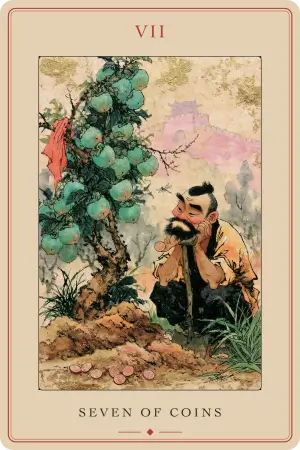
The foundational decks split sharply on this card, and this deck's contribution is to move it to a reclaimed lot and make patience the city's shared condition. In the Tarot de Marseille the Seven of Coins is a geometric arrangement of seven discs, its layout echoing the geomantic figure Rubeus that the esoteric tradition read so darkly. In the Rider-Waite-Smith deck it is the weary farmer leaning on his hoe over the laden vine, the seventh coin fallen at his feet, the version whose ambiguity opened the door to gentler modern readings.
In Crowley's Thoth deck it is the Seven of Disks titled "Failure," the coins pressed into the oppressive Rubeus shape to show matter stalled at its lowest point. Modern decks turn the archetype around. Chris-Anne's Light Seer's Tarot shows a figure sending healing intention to a sprouting plant while its roots spread unseen below, an image of invisible progress. Lisa Sterle's Modern Witch Tarot casts the pause as non-negotiable rest against burnout culture, and Carrie Mallon's Wild Unknown lines seven pentacles in a rigid diagonal, all about strategic assessment.
The Tarot of New York City keeps the archetype whole and swaps the medieval shoreline for the reclaimed lot: the farmer becomes a still figure leaning on his tool with his face lifted to the light, the golden coins become subway tokens ripening at different heights on the vine, the wooden stake becomes a chain-link fence, and the evening mountains become the downtown skyline under a pop-art sunburst. Across all of them the meaning holds: labor is paused, the growth is assessed, and the harvest waits.
In combination and context
The Seven of Tokens follows the exchange of the Six as the point where you stop to weigh what the giving and building have actually grown. It grounds the number seven in the most concrete material in the city, the balance, the lease, the business, the long bet, and asks that the evaluation be real: numbers, months, and dollars, not vibes. Beside compounding, long-term cards it reads as patience rewarded. Beside darker cards such as The Devil or a reversed King of Swords it turns toxic, a person manipulated into staying, trapped by their own refusal to cut their losses and walk away from a barren investment.
Position steers it too. As advice it says take stock, prune, and then leave the growing things alone, resisting the urge to harvest early out of anxiety. As an obstacle it names impatience and the sunk cost trap, the inability to tell necessary waiting from wasted waiting. In a yes-or-no reading it declines a clean answer, landing on "it depends," "yes if you are willing to wait," or "not right now." As an outcome it promises a slow, sustainable yield to those who let the timeline do its work, the thing the Ten shows finished: the stoop, the paid-off brownstone, the harvest that took a hundred years to grow.
Questions for reflection
- Stand at the fence and count what has actually grown on your vine this year. Are the tokens really there, or have you been telling yourself a story you have not checked against the numbers?
- Where might you be tending a dead lot out of pride, watering something purely because of the seasons you have already spent on it?
- If a long effort is not paying out on your schedule, can you extend the schedule in your head, or is the honest answer that this plot needs to be cleared for something living?
The general meaning follows the Rider-Waite-Smith reading — the reference used across Tarot Academy. Open a specific deck above for its own interpretation.
Frequently asked questions
Explore the Tarot
Latest Posts
Discover the ancient wisdom of tarot cards and unlock the mysteries of your spiritual journey. Our blog is your gateway to understanding the rich symbolism, meanings, and practical applications of tarot reading.




















































