
 EN (English)



Major Arcana · 21
Judgement
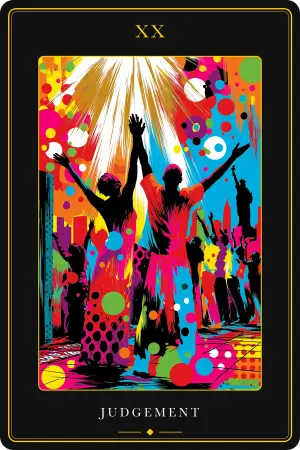
The street at the moment the light breaks through: your name called across the platform, and the whole block rising into who they became.
Card at a glance
- Numerology
- XX
- Element
- Fire
- Astrology
- Primal Fire · Pluto
- Kabbalistic path
- Shin (Malkuth → Hod)
- Timing
- Sudden · a calling
- Yes / No
- A resounding yes, if you answer honestly
Upright
Awakening
Reunion
Reckoning
Absolution
The call answered
Rebirth
Forgiveness
Communal rising
Reversed
Screening the call
Self-judgment
Refusing the summons
Stagnation
Guilt
The reunion avoided
Judgement in each deck
Every deck reimagines the same archetype. Compare the art, then open a deck to read its full interpretation.
Imagery and symbolism
In the Tarot of New York City, Judgement is a city street at the moment the light breaks through. No angel is drawn. A crowd of black pop-art silhouettes, men and women and children, whole families of the block, stand with their arms flung upward toward a white-and-gold sunburst that tears open the top of the frame. This is the deck's answer to the trumpet: in this city the call comes as light between the towers, the brightness at the top of the subway stairs, the beam that finds you on the sidewalk the moment your name is spoken.
The two central figures rise tallest, hands nearly touching inside the light. They are the reunion the card describes, two people from the old life who found each other again on the platform of years and lift each other into who they became. The smaller silhouettes around them are the whole block showing up: the memorial, the celebration, the crowd that rises together. Resurrection here is communal. Nobody climbs out of the grave of the old life alone.
The Statue of Liberty stands in the skyline to the right, torch raised in the same gesture as the crowd. She is the deck's permanent angel of Judgement, the figure who has been calling people to a new life for a hundred and forty years. Behind her, the Empire State Building and the massed skyline are the graves of the traditional card transfigured, the towers people disappear into for decades now standing witness as their people finally rise out of them.
The halftone dots and confetti circles filling the air read three ways at once: ticker tape from the Canyon of Heroes, confetti from the ball drop, the perpetual visual static of the city suddenly turned festive. The saturated color blocks of hot pink, taxi yellow, hydrant red, and sky blue put every borough and every era of a life into a single reckoning. Underfoot, the cracked patterned pavement is the honest part of the card, the ground of the past stood upon rather than erased. The light does not descend into a void. It lands on the exact sidewalk where everything happened, and the black silhouette against blazing color carries the meaning: the past is fixed and fully yours, and the moment you stop hiding it, the light behind it turns it radiant.
Core meaning
Judgement is the great awakening, the penultimate card of the Fool's Journey and its final reckoning. Despite the legal-sounding name, it is not a courtroom. It is an inner summons, a call heard at once by the conscious and unconscious mind, and it triggers a change already past the point of return. This deck stages that summons in public, on a sidewalk, in front of everyone who knew you before.
What New York adds to the archetype is the reckoning that lifts instead of crushing. You add it all up, every year and every block and every choice made at 2am and at 9am, and you accept the total as genuinely yours. In that acceptance the sum stops being a debt and becomes capital. The city has been keeping the receipts, and today it hands them back stamped paid. Old ties are released, old accounts are settled, and the version of you that survived all those years underground steps out into the light.
The deck insists the transformation is communal. The traditional image raises the dead as families; this one raises them as a block. No one absolves themselves alone in an apartment. The reckoning wants witnesses: the person from the old life who sees who you became, the neighbors at the memorial, the crowd rising together under one beam. What waits on the far side of that honesty is rebirth, absolution, and a whole new sense of where your life is pointed.
Upright meaning
Upright, Judgement is the reunion you didn't expect and the call you finally answer. Someone from the old life finds you on the platform years later, or the phone lights up with the vocation, the apology, the move you have been putting off, and this time you pick up. The card marks a sudden awakening, an important decision, the transition into a new stage of life. The past is added up honestly and the sum turns out to be a beginning rather than a sentence.
Its counsel is plain. Answer the call while it is still calling. Do not perform for the crowd; rise the way the figures on the card rise, arms open, because the light is real. Forgive the people from the old life and let them see who you became, then forgive yourself for how long it took. This is the rare day the city stops grinding and starts blessing, so stand in the beam while it lasts.
In love. The reunion card in its purest form, sometimes the return of a past love under genuinely new conditions, between two people who have each done their years and their reckoning. Within a relationship it is the era of the honest sum, when a couple adds up the whole ledger, forgives what needs forgiving, and crosses into a deeper chapter. Feelings believed dead prove only dormant and rise renewed.
In career. The calling card, literally. It speaks of hearing at last what you are actually meant to be doing and finding the courage to answer: the change toward the real vocation, the return to an abandoned field, the application finally sent. It also brings reward for past labor, a promotion or a favorable review, and often the professional reunion where a former colleague resurfaces with an offer or a door.
In finances. A significant financial reckoning that resolves in your favor. Money can arrive from the past, an inheritance, an insurance payout, a court decision, a security deposit finally returned, or an old debt repaid. It is also the card of the honest audit: add up the real numbers now and draw the conclusion.
In health. The wake-up call answered. The body responds surprisingly fast once the summons is heard, which favors the reset, the comeback after illness or injury, and the return to a physical practice from the old life.
Reversed meaning
Reversed, Judgement is the call you keep screening. The number lights up the phone, the old friend, the true calling, the overdue conversation, and you watch it ring out again, telling yourself you will deal with it next week. It reads as stagnation dressed up as routine: staying in the job, the apartment, the version of yourself that stopped fitting years ago, because facing the full accounting feels unbearable. It can point to a missed reunion, an avoided reckoning, or a fear of being seen by the people who knew you before, as if the old block would judge the new you.
Most often the objective reckoning curdles into harsh self-judgment, an endless loop of self-blame in which you are your own cruelest judge, so fixed on old mistakes that no present or future can form. It can mean a stubborn refusal to learn the lesson, which only guarantees the same painful situation returns like a train stopping at every station of the same mistake. The remedy is the card's own: do the honest sum yourself, on your own terms, before the reckoning arrives on its.
In love. Old wounds stay open because reopening them honestly feels too costly, and grievances from years ago ride along unnamed in every argument. There may be an unwillingness to forgive, a partner unable to make the defining decision, or the wrong kind of reunion, a return to a past love with no reckoning in the hope the old pattern behaves differently on its own. It won't.
In career. The ignored vocation sent to voicemail because answering would mean change. It can also mark a final decision jumping ahead of the facts, a promotion postponed, or recognition quietly withheld while you know you have outgrown the seat.
In finances. The payout postponed, the decision stuck in someone's inbox, the audit of your own numbers you keep rescheduling while old debts compound. Hesitation in this city has a price, and it is usually charged monthly.
In health. The snoozed alarm. The fatigue, the symptom, the checkup reminder arrive and get screened like unwanted calls, and merciless self-judgment about appearance paralyzes instead of mobilizing. The reckoning held on your own terms is a renewal; the one you postpone arrives as a diagnosis.
Historical notes
In fifteenth-century Italy the card was called L'Angelo, the Angel, and it staged a single terrifying moment of Christian eschatology, the Last Judgement. The Cary-Yale Visconti deck of about 1440 carries the inscription Surgite ad Judicium, 'Rise to Judgment,' with angels blowing trumpets and naked souls climbing from stone tombs beneath a figure of Christ. The Charles VI deck shows seven souls rising, some joyful and some crossing their arms in fear, and the Visconti-Sforza set places God above with a sword and orb.
In France the card became Le Jugement, and the Tarot de Marseille consolidated the crowds into a static trio: a woman, a man, and a central tonsured figure whose monk's shaved head marks him as clergy, a pointed suggestion that even the Church stands under the same divine scrutiny as the laity. The occult revival then stripped the fear-based Christian reading away. For the Golden Dawn the summons no longer came from a punishing sky-god but from the divine spark within, and the figures rising from the graves were spirit lifting free of materialism rather than corpses awaiting a verdict. The Tarot of New York City is heir to that internal reading, and it takes the last step the tradition was already making: it removes the angel altogether and lets the call arrive as ordinary city light.
Correspondences
Number. XX, the twenty, built on the meeting of 2 and 0. The 2 is the pair and the reunion, two people from the old life standing face to face, two raised silhouettes at the center of the crowd. The 0 is the clean slate, the open turnstile, the blank page of a new lease, and it blows the meeting wide into a doorway. Reduced, 20 returns to 2, but a 2 transformed: partnership with all accounts settled. One step before XXI, The World, it is the last threshold, the honest sum drawn before the completed circle.
Astrology. In the early Hermetic systems Judgement carries no planet, only the element of Primal Fire. Modern astrologers attach it to Pluto, and no planet has a more New York résumé. Pluto governs demolition and rebuild, the deep underground, the buried past, and this is the city's whole biography: blocks razed and reborn, the passenger of the tunnels finally coming up the stairs into the light. Pluto co-rules Scorpio alongside Death.
Element. Fire, of a specific kind. This is not the destructive, Mars-driven fire of The Tower. It is the cosmic, purifying fire of divine inspiration that burns away the grave-clothes of earthly limitation.
Kabbalah. The Hebrew letter is Shin, a mother letter meaning 'tooth.' Just as a tooth breaks down solid food so the body can use it, Judgement breaks down the dense illusions of the material world into pure spiritual energy. Its path is the thirty-first, from Malkuth up to Hod, often the initiate's first step toward conscious spiritual awareness.
Timing and yes/no. The card points to something sudden, a calling rather than a season. As a yes or no it is a resounding yes, on the condition that you answer the call honestly and do the inner work.
Psychological perspective
Read psychologically, this is the awakened New Yorker: a person at the moment the old life and its former self-image are set down so a truer one can be picked up. Such a person has done the accounting. They understand cause and effect in the fine grain, which choice led to which year, which avoidance cost which friendship, and they hold that knowledge without self-flagellation or excuse. When life summons them through a phone, a crisis, or a calling, they pick up. They can say 'I was wrong back then' without collapsing, and they extend the absolution they found for themselves to others, which makes them the person the block trusts with its reckonings.
The shadow of this psychology is judgment turned punitive, either inward in guilt loops and merciless self-audits or outward in verdicts too harsh for anyone's actual weaknesses. Such a person may fear the tribunal of the old block, or endlessly re-examine the past without ever filing the paperwork on it, so there is perpetual review and no verdict.
Modern readers know this trump well as a 'stalker card,' the one that keeps leaping from the deck day after day. When it does, the near-universal read is that an alarm is being ignored. The querent already knows the truth, most often that a toxic cycle has to end or a leap has to be taken, and the ego keeps refusing it out of fear. The card goes on stalking until the decision is finally made. As a person it describes someone Phoenix-like, who has survived real trauma or a dark night or hard-won sobriety, and who now acts as a catalyst, fiercely honest and impossible to be around without being changed.
Judgement across decks
The Tarot of New York City makes one large choice that sets it apart: it removes the angel and hands the role to the city's own light and to the Statue of Liberty, and it turns the private resurrection into a communal one, a whole block rising together rather than a lone soul before a judge. Every object is restaged, the trumpet becoming the sunburst over the towers, the coffins becoming the buildings people vanish into for decades, the sea becoming the crowd on the pavement.
Set against that, the older decks read as a lineage. In the early Italian decks, titled L'Angelo, the card is a literal scene of the Last Judgement, trumpeting angels and naked dead climbing from tombs beneath Christ or a sword-bearing God, the medieval terror of damnation held in one image. In the Tarot de Marseille, under the title Le Jugement, the crowd shrinks to a disciplined triad, a woman, a man, and a central tonsured clergyman, with the woman looking to the Church for guidance and the man gazing straight up to the angel.
In Crowley's Thoth deck, Crowley found the Christian framing too narrow and renamed the card The Aeon. It pictures a cosmic changing of the guard, from the old Aeon of Osiris to the new Aeon of Horus: the star-arched goddess Nuit above, the winged sun-disk of Hadit at the center, the twin child-god Ra-Hoor-Khuit and silent Harpocrates, and three embryos waiting to be born. It strips out the external judge and asks the querent to leave a narrow 'frog perspective' for a higher view, which is the same internal summons this New York deck stages on a sidewalk.
In combination and context
Judgement is easily confused with Justice and with Death, and the distinctions are worth holding. Justice and Judgement both reduce to two and both weigh truth, but Justice is earthly and interpersonal, the scales asking whether you have been fair to others under the rules, while Judgement is cosmic and intrapersonal, the trumpet asking whether you are living in line with your soul and have forgiven yourself. Justice hands down accountability; Judgement offers absolution and a clean slate. Against Death the difference is pacing. Death is slow, organic, and foreseeable, the change you see coming for miles, while Judgement is the sudden trumpet blast that breaks a deep sleep before you knew change was near. Sitting just before The World, the deck's observation deck and completed circle, it is the awakening that has to happen before the final integration.
In reconciliation questions the card is often misread. Its resurrection imagery tempts a hopeful querent to expect an old relationship back exactly as it was, but the usual meaning is harsher and more freeing: that dynamic is dead, and the call is to a personal rebirth independent of the other person. Any real reunion could only happen if both people have genuinely transformed and begun again as new.
Position and neighbours sharpen it. Any decision made under this card is a threshold decision that echoes further than an ordinary Tuesday's choice, so it favors settlements, revivals, and second chances taken in public. Reversed or crossed by heavy cards, it warns against relaunching without reckoning, reviving the old project or the old love without first settling why it failed, which only rehearses the same failure at higher rent.
Questions for reflection
- What call have you been screening, and what would change the moment you finally picked up?
- If you walked past every address of your old life today, which memory are you still carrying as a debt instead of a foundation?
- Who from the old life would you let see who you became, and what would it take to stand in that reunion with your arms open?
The general meaning follows the Rider-Waite-Smith reading — the reference used across Tarot Academy. Open a specific deck above for its own interpretation.
Frequently asked questions
Explore the Tarot
Latest Posts
Discover the ancient wisdom of tarot cards and unlock the mysteries of your spiritual journey. Our blog is your gateway to understanding the rich symbolism, meanings, and practical applications of tarot reading.




















































