
 EN (English)


Minor Arcana ·
Ace of Kites
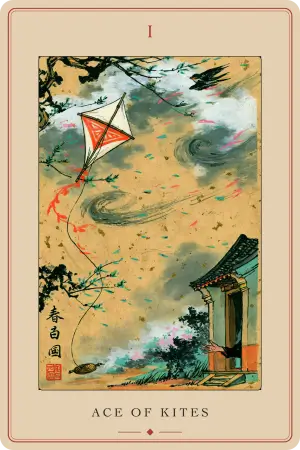
Fire flown, not burned: a hand offers a new swallow kite into the first wind of spring, the string still coiled.
Card at a glance
- Numerology
- Ace
- Element
- Fire
- Astrology
- Fire quadrant · Aries, Leo, Sagittarius
- Kabbalistic path
- Kether (Crown) in Atziluth
- Timing
- First wind of spring
- Yes / No
- Upright yes · Reversed no
Upright
beginnings
creative spark
opportunity offered
enthusiasm
initiative
untested potential
the launch
readiness for flight
Reversed
hesitation
false start
coiled string
lost motivation
delay
burnout
scattered energy
the wind passing unused
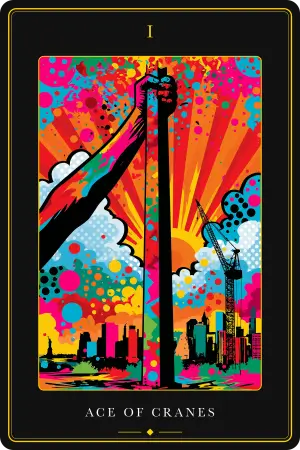
Ace of Kites in each deck
Every deck reimagines the same archetype. Compare the art, then open a deck to read its full interpretation.
Imagery and symbolism
In the Tarot of Beijing the Ace of Wands is the Ace of Kites, and the whole suit of Fire has stopped burning and started flying. Where the canonical card shows a hand from the clouds gripping a sprouting branch, this one shows a hand reaching out of a dark courtyard doorway, offering a brand-new swallow kite of bamboo and paper into the first wind of spring. The beginning is not handed down from heaven. It is offered across a threshold, from inside the house to the open lane, and it still has to be accepted: the hand offers, it does not throw.
The swallow kite (shayan), the classic kite of old Beijing, is the emblem of the whole suit. Its bamboo frame is discipline, its paper skin the fragile, flammable material of an idea, its vermilion pattern the single accent of fire the deck permits itself. A kite only flies against resistance, so the card makes its argument in one image: the same wind that fights the kite is what lifts it, the way will only becomes real when it meets the world.
The coiled spool of string on the ground is unspent potential, the entire future flight wound tight and untouched. Not one metre has been let out, so not one metre has been lost. The string also carries the suit's warning, because the flyer never releases it. Ambition here stays tied to the hand, the house, and the ground.
The rising wind is drawn as grey ink swirls full of loosened leaves and petals, the moment itself: favorable conditions no one commands and everyone must wait for. Wind in the suit of Kites does the work that flame does in the suit of Wands, invisible and moving, revealed only by what it lifts. Above the paper swallow a living swallow crosses the sky, the card's promise that bamboo and paper can behave, in the right wind, like a living thing. An old branch above the gate is just breaking into sparse green leaf, marking early spring, the season of launches. The teal and vermilion woodwork of the doorway is the threshold between the settled world and the open sky, and the warm kraft paper flecked with gold carries a small red seal in the corner, the maker's promise that even a beginning as light as paper is witnessed and signed.
Core meaning
The Ace of Kites is Beijing's Ace of Wands, the root of the suit of Fire, and the deck states its meaning as an offered beginning. A hand extends a new kite into rising wind. Energy and passion are at their peak, the conditions you have been waiting for have finally arrived, and nothing has yet been risked. It marks the start of a creative endeavor, a business, an enterprise, or a study, the one morning when the wind, the kite, and the hand are all ready at once.
Like all Aces, this is potential rather than a finished outcome. The card gives the explosive push needed to leave the doorway, but it will not carry the flight to any horizon on its own. The spark must be actively fed. In the Beijing image that feeding is literal work: you step across the threshold, run a few committed steps into the wind, and let the string out boldly while the weather holds. The deck's own emphasis falls on this readiness to act. An opportunity offered and refused is a wind that passes unused, and the same energy released carelessly ends in tangled string and torn paper. Will needs a hand on the spool to become flight rather than wreckage.
Upright meaning
Upright, the Ace of Kites is a definitive green light. Step across the threshold and take the kite that is being offered. Accept the new proposal or opportunity and act with enthusiasm and determination. This period favors launching what you have long prepared, so take reasonable risks and channel your energy toward new goals. The wind does not blow every day, and this is the cheapest lift your venture will ever get.
In love. A new spark, strong attraction, or a fresh connection offered like a kite you only have to accept. It reads as a new romance or romantic adventure carried on the excitement of novelty, sensual and forward-moving. For established couples it revives feeling and reawakens passion, the old kite taken down from the wall and found still airworthy. Let the string out a little further than feels safe, but remember a kite is held, not seized: be mindful of your own depth of feeling and of the other person's.
In career. A powerful surge of energy and enthusiasm, the first wind of a new professional season. It points to a new project, position, or direction, the kind of work you run toward the way a flyer runs to raise a kite. It supports rapid advancement, taking on leadership, or launching an initiative the whole lane can see. Enthusiasm meets favorable conditions, and effort finally gets lift.
In finances. The first favorable wind for your money. Long-prepared plans are ready to launch, and the card brings the courage to invest in something new. It can mean a surge of income, a new source of earnings, or an unexpected offer that arrives like a hand from a doorway, small in appearance and large in potential. It carries responsibility for timely action, since a wind unused is a wind lost. Let out the string while the wind holds.
In health. The body's own first wind of spring: a surge of vitality and the motivation to move. It favors starting a physical routine, from walking or running to tai chi at dawn, and a renewal of habits and image. Like a kite, the body answers steady tension rather than violent jerks, so begin now but build gradually, and refresh your diet with simple, wholesome fuel for the new flight.
Reversed meaning
Reversed, the kite stays in the doorway. The wind is blowing, but the hand hesitates, the string stays coiled, and the spring passes. The opportunity itself may be sound. It is the launch that fails, through indecision, thin energy, fear of new ideas, or an inability to turn intention into action. Find the source of the hesitation and name it honestly: fear of failure, fear of ridicule, or plain fatigue. This is not the day to fly, but it is a good day to mend the frame, wax the string, and study the sky.
In love. A missing spark. The wind is calm, the kite will not rise, and effort cannot replace attraction. It shows dulled feelings, waning passion, or a fear of new beginnings, standing in the doorway with the offered kite and never stepping out. Do not launch anything out of desperation, since a kite thrown into dead air only falls. Be honest about whether the feeling is resting or gone, and do not mistake a windless week for a windless life.
In career. Delays, blocked creativity, and problems with motivation, the assignment left in the corner like a kite nobody raised. It can mean procrastination and wasted effort, or the opposite fault of energy scattered across too many strings at once, so no single kite gains altitude. It also warns against an overly hasty launch into a gusty situation, which ends in mistakes and tangles. Reel in the string, land the kite, repair the frame, and rest before the next wind.
In finances. A launch that never happens: the opportunity is real, the wind is blowing, but caution keeps the string coiled. It points to stagnation, missed chances, or money committed to a kite that was never properly built, a plan without a frame. Treat it as a brief difficulty rather than a ruin. Reassess the venture, repair what is flawed in the design, and wait for a better wind before investing further.
In health. Stagnation and a lack of inner drive, the kite of the body left leaning in the corner while good weather passes. It shows apathy, avoided exercise, and enthusiasm that flares for one morning and dies by evening. Take honest responsibility, start with the smallest possible step, and rebuild momentum patiently. If the real cause is exhaustion, rest first, since even kites are grounded for repair before they fly again.
Historical notes
The card the Ace of Kites reimagines is the Ace of Wands, and its history runs through the pip decks. In the traditional Tarot de Marseille the Ace of Batons is plain structural geometry: a large, robust wooden club, sometimes held by a disembodied hand, with no landscape and no narrative. Marseille readers weighed such cards by number and size, treating the Ace as the largest, most concentrated reserve of the suit's energy.
The 1909 Rider-Waite-Smith deck, drawn by Pamela Colman Smith under Arthur Edward Waite, layered the pip with Golden Dawn meaning. A right hand issues from a grey cloud and grips a living, sprouting staff, with eighteen leaves shaped like the Hebrew letter Yod falling around it. Through gematria the number eighteen corresponds to Chai, meaning life, so the falling Yods declare the card the primordial infusion of life force into the world. A river, hills, and a distant castle in the background stand for the physical journey the raw spark must travel to become real. Aleister Crowley's Thoth deck pushed the same root toward pure velocity, painting a fiery torch crowned with ten Yod-shaped flames for the ten Sephiroth, a lightning bolt of untamed natural force.
The Tarot of Beijing keeps the Golden Dawn root and changes its climate. The hand from the clouds becomes a hand from a courtyard doorway, the sprouting branch becomes a bamboo-and-paper swallow kite, and the invisible flame becomes an invisible wind. The falling Yods of life force become loosened leaves and petals riding the first gust of spring. The card holds the same meaning, the root of creative fire, and grounds it in a domestic, human-sized beginning launched from a home rather than descending from heaven.
Correspondences
Number. One, the number of first steps, initiations, and beginnings. On this card it is drawn literally: one kite, one hand, one doorway, one wind. Nothing has yet divided, doubled, or competed. The coiled spool holds the entire flight as a single unbroken line, and everything the suit of Kites will later show, from rivalry to victory to burden, is still wound inside this one coil.
Astrology. The element of Fire and the whole fire quadrant of the zodiac rather than a single decan. Aries gives the impulse to launch, Leo the pride of the kite riding high for the lane to see, Sagittarius the pull of the string toward the horizon beyond the city wall. Their ruling planets follow: Mars for the courage to step out of the doorway, the Sun for the visibility of the flight, Jupiter for the expansion of string let out toward greater distance.
Element. Fire, but fire flown instead of burned. The kite is will made visible, and the spring wind is the fast-spreading, initiating energy the fire signs carry. Lift here requires tension. Without the string and a steady hand on the spool, the same wind that raises the kite tears it away and breaks it on the rooftops.
Kabbalah. As the root of the suit of Fire, the Ace corresponds to Kether, the Crown, in Atziluth, the World of Emanation. Its Golden Dawn title is the Root of the Powers of Fire, the source of the element arising from the unmanifest rather than the element itself. It governs space rather than time, the reservoir a beginning draws from before it takes any particular shape.
Psychological perspective
The person of this arcana feels the wind change before anyone else on the lane. They carry high enthusiasm and ambition, immerse themselves in ideas, and know the moment a launch has come. They start things: shops, journeys, friendships, movements. The desire to act is their defining trait, and they are the first ones on the rooftop when the spring wind rises, bold and enterprising enough to overcome obstacles once they have committed.
The shadow of the arcana stands in the doorway holding a perfectly good kite and never steps outside. Here the same person meets disappointment, loss of direction, or a self-doubt that hardens into procrastination. They lack the inner drive that turns intention into launch, so they cannot recognize or harness their own potential. They postpone what matters, second-guess favorable winds, and let opportunities blow past, then blame the weather for what was really a failure to let out the string. The card's psychological task is small and concrete: release the first metre of string before the confidence arrives, because motion is what generates the confidence, not the other way around.
The Ace of Kites across decks
Rider-Waite-Smith. The canonical Ace of Wands shows a hand from a grey cloud gripping a sprouting staff, eighteen Yod-shaped leaves falling around it, with a river and a distant castle behind. The Ace of Kites keeps the meaning of the root of fire but moves the hand from the clouds to a courtyard doorway and turns the living branch into a bamboo-and-paper kite, so the beginning is offered across a human threshold rather than descending from the sky.
Tarot de Marseille. The historical Ace of Batons is an unadorned wooden club, read by weight and size as the suit's largest reserve of energy. Beijing keeps that sense of concentrated, untouched potential and draws it as the coiled spool, the whole flight wound tight and not yet spent.
Crowley-Thoth. Crowley painted the Ace of Wands as a fiery torch of ten Yod-shaped flames, a lightning bolt of untamed natural force arising spontaneously from the ether. The Beijing card shares the emphasis on volatile, initiating power but insists on the string, the discipline and anchoring the Thoth torch does without.
Modern reframings. Introspective decks such as The Wild Unknown reduce the archetype to a single struck match burning in the dark, an internal wildfire of personal potential. The Tarot of Beijing belongs to that turn toward the intimate and human-sized, trading ceremonial fire for a domestic launch, one flyer, one kite, one spring wind on an ordinary lane.
In combination and context
The Ace of Kites sets whatever spread it lands in into motion and colors it with beginning, energy, and offered opportunity. Its exact reading shifts with its neighbors, because an Ace is a catalyst rather than a conclusion. Beside a card of focused will, the sort that masters the elements, it signals the confident execution of a new venture and the power to overcome earlier stagnation. Alongside a card of unstoppable velocity it reads as a project taking off fast and decisively, a swift early victory.
With the deck's emotional cards the fire finds a vessel. Set next to the Two of Cups, the solitary spark meets a receptive heart and passes from initial attraction into mutual romantic connection. Paired with cards of bondage and base appetite, the same fire can warn of a purely physical attachment stripped of feeling, chemistry without warmth. When a second Ace appears beside it, two elemental roots converge, and a genuinely new spirit enters the querent's life, pulling on large reserves of energy at once.
Reversed neighbors, or the card itself reversed among them, tilt the reading toward the launch that fails: sound ideas that never leave the doorway, momentum that dies before it finds footing. When the Ace of Kites keeps returning in your readings, treat it as the deck asking a plain question. The wind is here and the kite is built, so what is still keeping the string coiled in your hand?
Questions for reflection
- The kite is built and the wind is up: what is the first metre of string you have been refusing to let out, and what would it cost to release it today?
- Where are you waiting to feel confident before you act, when the Ace of Kites says the acting is what creates the confidence?
- Which offered opportunity have you left standing in the doorway, and is the hesitation really the plan's fault or your own?
The general meaning follows the Rider-Waite-Smith reading — the reference used across Tarot Academy. Open a specific deck above for its own interpretation.
Frequently asked questions
Explore the Tarot
Latest Posts
Discover the ancient wisdom of tarot cards and unlock the mysteries of your spiritual journey. Our blog is your gateway to understanding the rich symbolism, meanings, and practical applications of tarot reading.




















































