
 EN (English)



Minor Arcana · Cups (Water)
Two of Cups
Two chalices raised in a pledge: the alchemy of two becoming one.
Read the complete guide: The Two of Cups Tarot Card: A Complete Guide to Its Symbolism and Meaning
Card at a glance
- Numerology
- Two
- Element
- Water
- Astrology
- Venus in Cancer (1st decan)
- Kabbalistic path
- Chokmah (Wisdom)
- Timing
- Early summer, the first decan of Cancer
- Yes / No
- Upright yes · Reversed no
Upright
Mutual attraction
Partnership
Union
Reciprocity
Connection
Harmony
Soulmate
Reconciliation
Reversed
Imbalance
Disconnection
Breakup
Miscommunication
Codependency
One-sided love
Tension
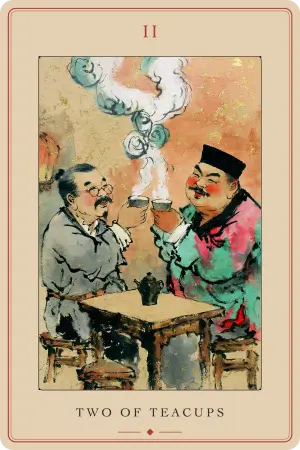
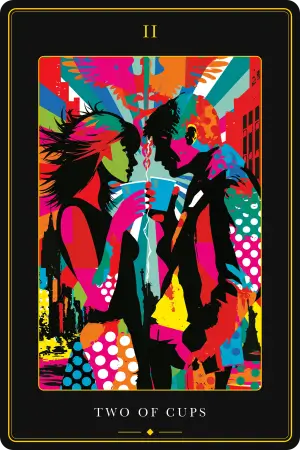
Two of Cups in each deck
Every deck reimagines the same archetype. Compare the art, then open a deck to read its full interpretation.
Imagery and symbolism
In the Rider-Waite-Smith image, a youth and a maiden stand facing each other outdoors, each raising a golden chalice to pledge their troth. The cups meet at equal height, a plain statement that this is a bond between equals. Both wear floral garlands and laurels, old symbols of victory and of affection coming into bloom. Their brightly coloured tunics sit over pure white undergarments, setting worldly desire against the sincerity of their inner intentions.
Hovering between them is the card's key emblem, the Caduceus of Hermes: a central staff wound by two rising serpents, crowned here by a red winged lion's head. The entwined serpents are the harmonizing of opposing forces, the masculine rod and the feminine serpent energy meeting and balancing. The staff lifts human connection from a purely biological pull toward a spiritual exchange. The winged lion adds courage and primal fire directed by spirit, a hint that true union creates a third force stronger than the two apart, and that merging one life with another carries real risk as well as reward.
Core meaning
The Two of Cups is the meeting of two into a harmonious whole. The Golden Dawn named it the "Lord of Love," placing it at Chokmah, the outward-reaching creative force, expressed here through the water of feeling. It is the active will to unite: the urge to cross the distance between self and other and form a genuine bond.
At its heart the card is mutual attraction and reciprocity. The exchange runs both ways, with neither person dominating or draining the other. It is the daily practice of loving another human being rather than a fated, once-in-a-lifetime event, which is why readers trust it as a sign of a healthy connection. What it describes can be romantic, but the same reciprocal energy fits a friendship, a partnership or the reconciliation of two people who had fallen out of step.
Upright meaning
Upright, the Two of Cups is a warm omen of harmony and connection. It signals mutual attraction, emotional reciprocity and a deepening bond in which both people feel seen. Often called the "soulmate" card, it points to a real meeting of hearts, though it promises the quality of a connection rather than a guaranteed lifelong marriage.
In love. Two people drawn together on equal footing, with feeling that flows both ways. It is passion and tenderness in balance, the spark of a new relationship or the renewal of an existing one, and sometimes the mending of a rift.
In career. A strong sign for partnership: a business alliance, a co-founder dynamic or a collaboration where complementary skills make the pair worth more than either alone. Agreements rest on mutual trust, and the rewards are shared fairly.
In finances. Money matters governed by this card do well through shared resources and honest, hand-shake understanding rather than adversarial contracts. It favours pooling effort with someone you trust so that gains come to both sides.
In health. A note of balance and support, the steadying effect of a caring relationship during recovery. Symbolically tied to harmonious union and receptive gestation, it can also carry a gentle, positive charge in readings about conception and the home.
Reversed meaning
Reversed, the card's balance is lost and its connective flow is blocked or spilled. It commonly reads as a disconnect, a misunderstanding or a real incompatibility between two people, a bond where equal give-and-take has curdled into drain, dominance or a slow emotional cold war. Turn a full cup over and the contents spill: the feeling may still be there, but the containment has failed.
In love. Tension, poor communication or a one-sided attachment. It can mark a breakup or a relationship in which one person leans on the other to fix them, a codependent pull that fills an inner void rather than meeting as equals.
In career. A partnership out of alignment, with mistrust or unequal effort undermining the shared work. It asks whether the collaboration still serves both parties or only one.
In finances. Shared arrangements strained by broken trust or uneven contribution. It warns against pooling resources with someone when the exchange has stopped being fair.
In health. In medical cartomancy the reversal can point to the body struggling to host or merge with another, and in pregnancy readings it is a signal handled with care, as it can indicate physical strain or rejection. On the emotional level it reflects the stress a broken connection places on well-being.
Historical notes
Before the Rider-Waite-Smith scene of two lovers, the Tarot de Marseille told the card in the language of alchemy. Its older image sets the two cups above a subterranean chamber where angelic figures work at an alembic, a distillation vessel in which a phoenix undergoes fiery rebirth, topped by a strange flower sprouting fish heads. This is the hermetic "Chemical Wedding," in which the union of two people becomes a sacred vessel for transforming the soul.
The RWS deck, drawn by Pamela Colman Smith under A. E. Waite, moved the scene above ground into a pastoral pledge and introduced the Caduceus and winged lion. Crowley and Lady Frieda Harris's Thoth Tarot took a third path, dropping the human figures for two chalices fed by a lotus, with twin dolphins of silver and gold entwined around its stalk, the lunar and solar currents joined. Modern decks keep adjusting the emphasis: the Morgan-Greer version gives the man a more dominant posture, and decks such as This Might Hurt stress that although this is the "marriage" card, no card can promise forever.
Correspondences
Number. Two: the first division and pairing, the reaching outward from a single point toward another. In the suit of Water it becomes the impulse to love.
Astrology. The card is the first decan of Cancer (0 to 10 degrees), ruled by Venus. Venus, the planet of attraction and harmony, set inside the nurturing, protective sign of Cancer produces a deeply personal, rooted affection rather than fiery passion.
Element. Water, the element of emotion, intuition and relationship.
Kabbalah. On the Tree of Life all the Twos belong to Chokmah, Wisdom, the second sphere and the first active outpouring of force. In Water this outward reach is felt as the desire to connect and recover unity.
Elemental dignity. A Water card, it sits well with Earth and can temper Fire, while restless Air tends to unsettle its balance.
Psychological perspective
Psychologically, the Two of Cups is love experienced as mirroring. The feeling it describes is validated by being reflected back: it is love as it is shown and returned, which is why the card belongs to early recognition rather than mature, self-contained emotion. Two people see themselves in each other and feel met.
The card also has an inward reading. Tied to the alchemical vessel, it can mark the reconciliation of two parts of a single psyche, the conscious mind meeting the submerged unconscious, or inner worth aligning with outer expression. That internal union tends to come first. The capacity to extend love outward is rooted in receptivity toward the self, so the card often says inner conflict is resolving and a person is becoming whole enough to connect cleanly with someone else. Its shadow is projection: pulling this card again and again for someone unavailable can reflect the querent's own longing for union more than the reality of the bond.
The Two of Cups across decks
The foundational decks each carry the card differently. In the Tarot de Marseille the two cups sit above an alchemical furnace, the phoenix and the alembic making union a work of spiritual distillation rather than romance. In the Rider-Waite-Smith deck it is the pastoral pledge of a youth and maiden beneath the Caduceus and winged lion, the version this page follows.
In the Thoth deck, Crowley and Lady Frieda Harris replace the figures with two chalices on a calm sea, fed by a lotus around which silver-and-gold dolphins twine, an image of overflowing joy and of lunar and solar forces joined. Crowley tied it to his axiom "Love is the law, love under will," and to the equation 0 = 2, unity dividing into two balanced opposites and love as the act of recovering that lost oneness. Modern decks range from the more dominant posture of the Morgan-Greer to reinterpretations that keep the snakes and winged lion while cautioning that no card guarantees permanence.
In combination and context
The Two of Cups is often confused with The Lovers, but the two work on different scales. The Lovers is a Major Arcana card of fated, karmic choice and internal alignment, sometimes intense yet short-lived. The Two of Cups is the Minor Arcana reality of daily emotional exchange, the more dependable sign of a healthy bond because it rests on active participation rather than destiny. Within its own suit it is the foundation the Ten of Cups builds on, while the following Three of Cups breaks the insular pair open into wider friendship and celebration.
In reconciliation readings the card invites care. Surrounded by cards of moving on or departure, such as the Six of Swords or the Eight of Wands, it can show the former partner forming a new bond with someone else rather than returning. Beside the Hanged Man it may mark a reunion that would mean sacrificing hard-won independence. Many readers treat it, in that context, as an invitation to reconcile with oneself. Position matters too: as advice it says meet the other halfway and let the exchange be equal; as an outcome it promises a connection built on genuine reciprocity.
Questions for reflection
- In my closest connection right now, is the exchange truly equal, or is one of us pouring more than we receive?
- Where might I be seeing a reflection of my own longing rather than the real person in front of me?
- What inner reconciliation would make me whole enough to meet someone else as an equal?
Most common combinations with Two of Cups
The pairs readers meet most often with this card, read with both cards upright. Open one for the reversed readings.

The Lovers
HarmoniousMutual love, chosen with the heart and lived as an equal exchange.

Ten of Cups
HarmoniousA two-person bond grows into a settled home, family plans or a wider circle that holds together.

Three of Cups
HarmoniousA bond worth celebrating: the couple or partnership is welcomed by friends and the wider circle.

King of Cups
HarmoniousAttraction settles into emotional maturity: a bond that is equal, calm and moving toward commitment.

Six of Swords
HarmoniousA bond of mutual support carries you out of a hard stretch toward calmer water.

The Hanged Man
MixedThe connection is genuine and mutual, but its next step is on hold while both people take stock.

Eight of Wands
HarmoniousA mutual attraction or partnership develops quickly, with lively talk and a shared sense of direction.
Combinations are common patterns, not rules
The readings here describe how a pair most often reads. Check each one against two things before you apply it. The first is the question: the same pair says one thing about a relationship and another about a job offer, and the question decides which side of the pair matters. The second is the background, meaning what the querent already knows about the situation, the position each card holds in the spread, and the cards around the pair. When the question or the background points another way, go with them over the general reading. Each pair page lists the exceptions that come up most often.
The general meaning follows the Rider-Waite-Smith reading, the reference used across Tarot Academy. Open a specific deck above for its own interpretation.
Frequently asked questions
What does the Two of Cups mean in tarot?
The Two of Cups is the card of mutual attraction, partnership and reciprocal love. Named the "Lord of Love," it stands for two people meeting as equals and forming a harmonious bond, whether romantic, platonic or professional.
Is the Two of Cups a yes or no card?
Upright, the Two of Cups is a yes, especially for love, partnership and reconciliation. Reversed, it leans to no, pointing to imbalance, disconnection or a bond that has fallen out of step.
Does the Two of Cups mean a soulmate?
It is often called the soulmate card because it shows a deep, reciprocal connection where both people feel seen. It promises the quality of that bond in the present rather than guaranteeing a permanent, lifelong marriage.
What does the Two of Cups mean in love?
In love the Two of Cups is mutual attraction and emotional reciprocity, feeling that flows both ways between equals. It can mark a new relationship, the renewal of an existing one, or the mending of a rift.
What does the reversed Two of Cups mean?
Reversed, the card's balance is lost. It points to disconnection, miscommunication, a one-sided attachment or codependency, and can mark a breakup or a partnership where the give-and-take has turned into drain.
How is the Two of Cups different from The Lovers?
The Lovers is a Major Arcana card of fated, karmic choice and inner alignment. The Two of Cups is a Minor Arcana card about the everyday practice of loving another person, making it the more reliable sign of a steady, reciprocal bond.
Explore the Tarot
Latest Posts
Discover the ancient wisdom of tarot cards and unlock the mysteries of your spiritual journey. Our blog is your gateway to understanding the rich symbolism, meanings, and practical applications of tarot reading.

















