
 EN (English)




Major Arcana · IX
The Hermit
Solitary seeking, the inward retreat where you carry your own light one step at a time.
Read the complete guide: The Hermit Tarot Card: A Complete Guide to Symbolism and Meaning
Card at a glance
- Numerology
- IX
- Element
- Earth
- Astrology
- Virgo · ruled by Mercury
- Kabbalistic path
- Yod (Chesed → Tiphereth)
- Timing
- Winter · Virgo season
- Yes / No
- Maybe · not yet
Upright
introspection
solitude
inner guidance
wisdom
soul-searching
reflection
self-discovery
discernment
Reversed
isolation
loneliness
withdrawal
avoidance
spiritual bypassing
overthinking
disconnection
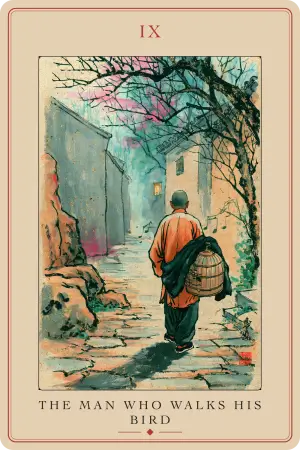
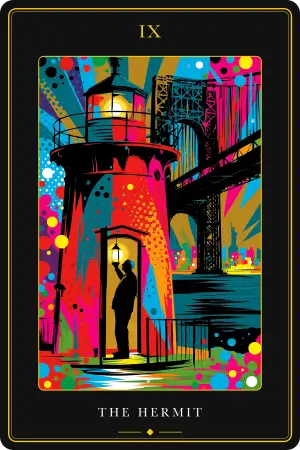
The Hermit in each deck
Every deck reimagines the same archetype. Compare the art, then open a deck to read its full interpretation.
Imagery and symbolism
The Rider-Waite-Smith Hermit is a tall, bearded elder in a plain grey hooded cloak, standing alone on a snow-covered mountain peak. He raises a lantern in his right hand and leans on a wooden staff in his left. His whole figure faces left, toward the past and the inner world, the pose of someone at the end of a long cycle turning to draw meaning out of everything lived.
The lantern is the heart of the card. It does not light the whole landscape, only the next step on the path, a sign that the journey is walked incrementally and on trust. Inside it burns a six-pointed star, the Seal of Solomon, whose upward triangle of fire and spirit and downward triangle of water and matter together mark the synthesis of opposites he has reached within himself. The staff, tied to Saturn, gives him the discipline and structure to sustain the search without drifting into delusion.
His grey cloak lets him blend into the mist and stands for a neutral, ego-free view of life, and the snowy summit is an apotheosis reached only after a long climb, its white a cleared and quieted mind. He holds the lamp up rather than hiding it, offering it as a guiding star. As Waite read the gesture, the Hermit does not hoard his light but says, where I am, you also may be.
Core meaning
The Hermit is the Sage, the card of introspection and the solitary search for inner truth. He withdraws from the noise of the crowd to dig down into the quiet depths of the soul, insisting that some answers can only be found away from other people's opinions. Waite called him a card of attainment, and the beacon he lifts is an open invitation to any seeker willing to make the same climb.
His number, IX, is the last single digit, the culmination of a cycle just before it resets. Like the nine months of gestation, it carries the sense of a womb: a necessary spell of darkness and isolation in which ideas ripen and a person prepares to be reborn into a new phase. This is hermitude as an active verb, a disciplined choice rather than a passive withdrawal from life.
Upright meaning
Upright, The Hermit marks a deliberate turn inward, a solemn but positive season of self-reflection. It says the answers you are chasing cannot be found in the outer world or borrowed from friends; they have to be excavated from your own depths. This is a time for patience and discretion, for becoming a calm, neutral observer of your own life rather than launching ventures or working the room.
In love. Often a partner who is prioritizing their own individuation and needs real space to sort out their values before they can turn toward anyone. Asked whether an ex will return, the Hermit usually says they are on a solitary healing path, not plotting a reunion.
In career. Deep, focused, independent work over networking and self-promotion. It favors research, study, and solitary projects, the domain of scientists, analysts, developers, and mentors, where progress comes from concentration.
In finances. A time for careful analysis and patience rather than bold moves. Study the ground thoroughly and let considered, unhurried decisions do the work.
In health. Rest, retreat, and restoration, the quiet winter the body and mind need. The card supports therapy, reflection, and a disciplined slowing-down to recover clarity.
Reversed meaning
Reversed, the Hermit's solitude sours into one of three shadow states. It can be painful, forced isolation, real loneliness and a sense of being left out in the cold, a withdrawal that has curdled and needs to be gently reversed by rejoining others. It can be the opposite, a fear of being alone with your own thoughts that drives constant socializing and digital noise to drown out the silence. Or it can be spiritual bypassing, using "I need space to figure myself out" as cover to dodge responsibility, overthinking a situation into total paralysis and calling the stuckness wisdom.
In love. The other person feels disconnected or lonely and may be isolating to avoid compatibility problems, or the card holds up a mirror and shows that obsessive questioning is blocking your own growth.
In career. Either you have stayed in the inward phase too long and now need to share what you have learned, or you lack the preparation and experience the role demands and are hoping for an unearned break.
In finances. Overthinking to the point of paralysis, or moving on a plan you have not actually prepared for.
In health. Isolation that has tipped into harm. Human beings are social by nature, and the reversed card warns that solitude stretched too far starts to erode wellbeing.
Historical notes
Waite built his Hermit partly by arguing with the occultists before him. He rejected Court de Gébelin's flat reading of the card as merely a wise man seeking truth and justice, and he dismissed Éliphas Levi's version, in which the Hermit stood for occult isolation and the guarding of personal magnetism from the profane. That idea of hoarding secrets had passed into French Martinism as the "Silent and Unknown Philosophy."
Against all of this Waite set a different claim. For him the Divine Mysteries protect themselves, since the unprepared simply cannot grasp them, so there is no need for a human gatekeeper hiding the light. His Hermit is a figure of attainment who lifts his lamp deliberately as a guiding star. The archetype does not keep its illumination back; it declares that where the Hermit stands, any willing seeker may also come.
Correspondences
Number. He is IX, the final single digit and the completion of a cycle before it resets to ten. Every nine in the deck carries isolation or the limit of an experience, and his ties to the nine months of gestation give the card its womb-like sense of ideas ripening in the dark. As a person he is the humanitarian who has set personal ambition aside, the monk, teacher, or dedicated activist.
Astrology. Virgo rules him, the analytical, service-minded earth sign that seeks truth through patient, careful observation. Its ruler Mercury shows up here in disguise, the solitary Hermes who wandered the earth as a ragged old man to watch and learn, an investigator rather than a messenger.
Element. Earth, the grounded, methodical soil in which the Hermit's slow work takes root.
Kabbalah. His Hebrew letter is Yod, the hand, the small seed from which all the other letters grow, and he holds the path from Chesed (Mercy) to Tiphereth (Beauty). For timing, his snowy scene points to winter and Virgo season, his moonless sky to the New Moon, and his number to spans of nine days, weeks, or months.
Elemental dignity. Beside Swords his analytical edge sharpens toward study; as a yes or no he tends to answer "maybe, not yet," a pause for more reflection before deciding.
Psychological perspective
Modern readers often worry that The Hermit means depression, and the picture of a man alone in the cold dark makes the leap easy. The elemental detail argues otherwise. His staff belongs to the suit of Wands, to Fire and willpower, so his solitude is active and chosen, a disciplined retreat undertaken to synthesize experience and seek clarity. Clinical depression reads instead through Water and Swords, the drowning emotion of The Moon or the mental anguish of the Nine of Swords, an involuntary withdrawal born of suffering. The Hermit is executing a discipline, while depression is an illness that overtakes the will. The honest caveat, and the warning of the reversed card, is that people are social creatures and solitude held too long can still corrode the mind.
The archetype has found a second life online as "Hermit Mode" or a "Hermit Era," a deliberate season of switching off social media, skipping the superficial events, and pouring energy into rest and creation. Commentators frame it accurately: this is not a permanent misanthropy but a necessary winter of the creative cycle, the quiet phase that has to precede a return to the world, much as Brian Eno leaned on deep retreats to make his ambient records.
The Hermit across decks
Tarot de Marseille. L'Ermite is a wrinkled old man with a red staff and a red flame in his lantern. That flash of red, the color of vitality, says his inner fire still burns fiercely beneath the withdrawn exterior.
Crowley-Thoth. Crowley abstracts the figure almost past humanity. His Hermit carries a faceted lantern holding a small sun, an Orphic egg wound with a serpent rests before him, and Cerberus crouches at his feet as guardian of the underworld of the unconscious. A stylized spermatozoon crawls up his leg, the raw seed of life, tying him to the Hebrew letter Yod, the hand and the seed of all letters. Here the Hermit is a magician of seeds who knows they must be planted in darkness to grow.
Across traditions. However the figure is drawn, the constant is a single lifted light in the dark and a solitary walker who trusts it to show the next step.
In combination and context
The Hermit is most often set beside The High Priestess, since both are cards of silence and hidden knowledge, and novices mix them up. Their methods are opposite. She works through the subconscious, Water and Moon, and already holds the answers within, a passive knowing that asks why you keep questioning when you already know. He works through the conscious mind, Earth and Mercury, and has to seek the truth actively, walking the path step by step and lighting it as he goes.
With The Fool the pairing looks like a contradiction and resolves into a synthesis. The Fool is the blind leap of pure potential; the Hermit is the careful study of every step. Together they call for the methodical mystic, someone ready to pioneer something wild while carrying hard-won wisdom, or in love to take a real leap only after the solitary healing that keeps old mistakes from repeating. Reversed together they warn of the trap instead: hiding in isolation to avoid a new start, or throwing that wisdom away in a reckless impulse.
His energetic opposite is the Page of Wands, all forward-facing, impulsive fire, which faces right where the Hermit faces left, a reminder of just how far inward this card asks you to turn.
Questions for reflection
- What answer are you seeking from other people that only your own solitude can give you?
- Is your withdrawal a chosen retreat that restores you, or an avoidance dressed up as wisdom?
- What single next step is your inner light showing you right now?
Most common combinations with The Hermit
The pairs readers meet most often with this card, read with both cards upright. Open one for the reversed readings.

The High Priestess
MixedA season of retreat in which the answer comes from within, slowly and on its own schedule.

The Fool
MixedPrepare in quiet, then leap: a new start that works only after time alone to think it through.

Four of Swords
HarmoniousRetreat fully: rest, meditation and quiet reflection are what this moment requires.

Death
HarmoniousSomething ends, and a quiet stretch alone lets the querent understand it before starting again.

Eight of Cups
HarmoniousWalking away from a hollow situation opens a period of solitude and real searching.

The Lovers
HarmoniousChoose after reflection: time alone shows what the heart wants before the next step.
Combinations are common patterns, not rules
The readings here describe how a pair most often reads. Check each one against two things before you apply it. The first is the question: the same pair says one thing about a relationship and another about a job offer, and the question decides which side of the pair matters. The second is the background, meaning what the querent already knows about the situation, the position each card holds in the spread, and the cards around the pair. When the question or the background points another way, go with them over the general reading. Each pair page lists the exceptions that come up most often.
The general meaning follows the Rider-Waite-Smith reading, the reference used across Tarot Academy. Open a specific deck above for its own interpretation.
Frequently asked questions
What does The Hermit tarot card mean?
It stands for introspection, solitude, and inner guidance: a deliberate turn away from the crowd to seek truth within. Upright it favors patience, reflection, and trusting your own light to show the next step.
Is The Hermit a yes or no card?
It usually answers "maybe" or "not yet." The card acts as a pause button, saying you do not yet have enough information or inner clarity to decide, and should reflect before choosing.
What does The Hermit mean for an ex or a love reading?
It most often shows the person is on a solitary path, focused on their own healing and needing space rather than plotting a reunion. Reversed, it can mean they feel disconnected and are isolating to avoid compatibility issues, or that your own obsessive questioning is blocking your growth.
What is the reversed Hermit's meaning?
Reversed, it points to painful, forced isolation and loneliness, or to avoiding necessary inner work by drowning out the silence, or to spiritual bypassing, using the need for space as an excuse to dodge responsibility and overthink into paralysis.
Does The Hermit mean depression?
Not usually. His staff belongs to Fire and willpower, so his solitude is chosen and disciplined, while depression reads through Water and Swords, an involuntary withdrawal born of suffering. The reversed card does warn that solitude held too long can start to harm wellbeing.
What are The Hermit's astrological and elemental correspondences?
He is ruled by Virgo, an analytical earth sign whose ruler Mercury appears here in its solitary, investigative guise, and he carries the element Earth. On the Tree of Life he holds the path from Chesed to Tiphereth under the Hebrew letter Yod, meaning "hand."
Explore the Tarot
Latest Posts
Discover the ancient wisdom of tarot cards and unlock the mysteries of your spiritual journey. Our blog is your gateway to understanding the rich symbolism, meanings, and practical applications of tarot reading.

















