
 EN (English)


Minor Arcana · Swords (Air)
Ten of Swords
Rock bottom and the mathematical certainty that follows: the worst has happened, and dawn is already breaking on the horizon.
Read the complete guide: The Ten of Swords in Tarot: A Complete Guide to Symbolism and Meaning
Card at a glance
- Numerology
- Ten
- Element
- Air
- Astrology
- Sun in Gemini (third decan)
- Kabbalistic path
- Malkuth (Kingdom)
- Timing
- Late Gemini season, June 9 to 20
- Yes / No
- Upright no, Reversed leaning yes
Upright
painful ending
rock bottom
betrayal
collapse
finality
exhaustion
ego death
surrender
Reversed
recovery
survival
slow healing
rebirth
resisting closure
clinging on
prolonged pain
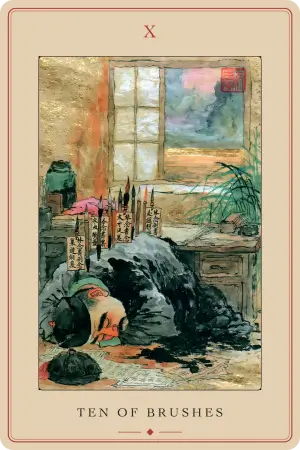
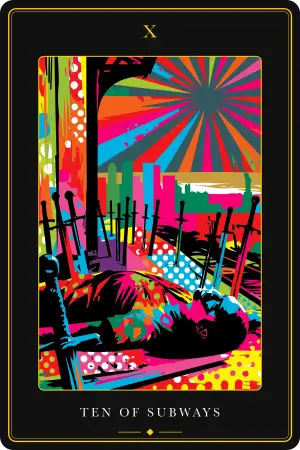
Ten of Swords in each deck
Every deck reimagines the same archetype. Compare the art, then open a deck to read its full interpretation.
Imagery and symbolism
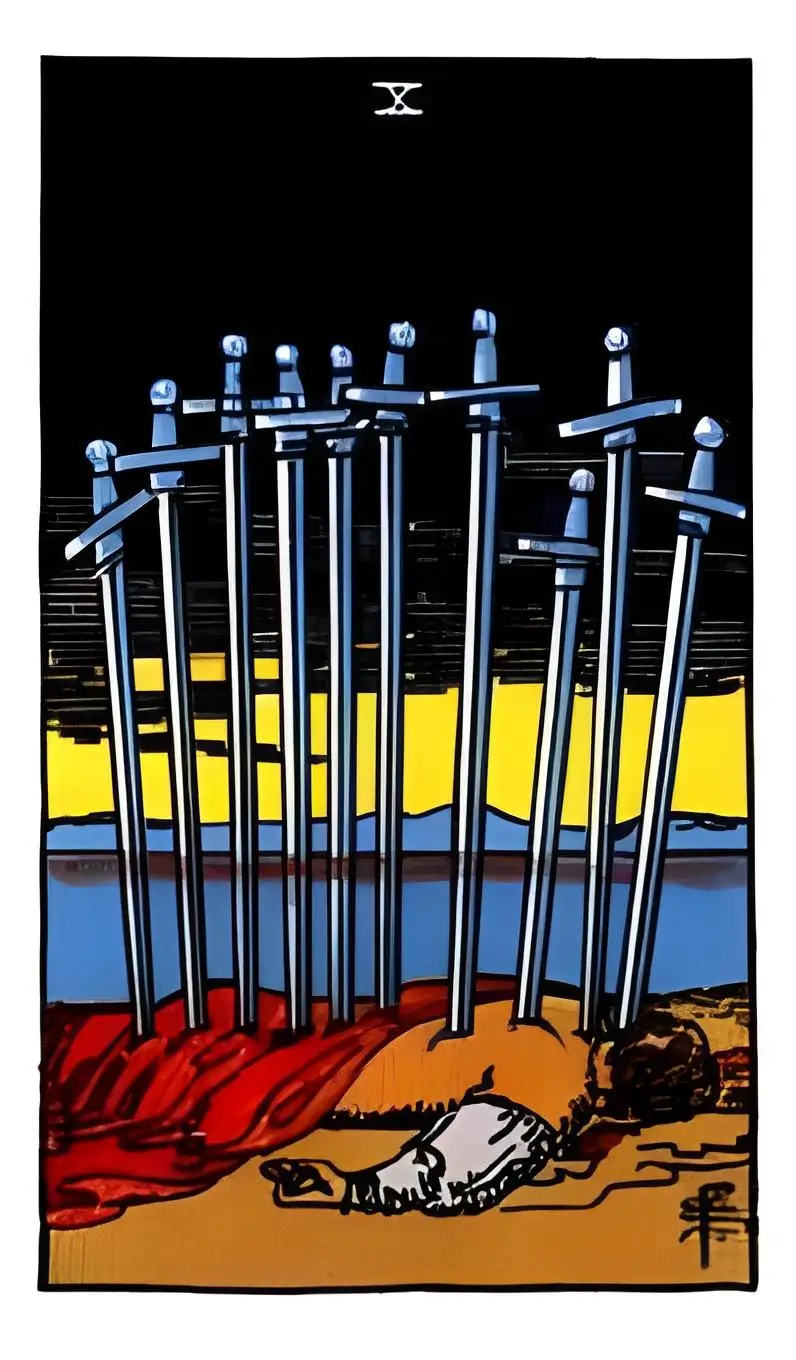
The Rider-Waite-Smith card shows a figure lying face down on a desolate shore, draped in a red cape, with ten swords driven in a neat line down the spine from head to lower back. The image reads instantly as catastrophic failure, but the composition folds a promise of renewal into the horror.
The overkill of ten swords. One blade ends a life, so ten is deliberate theatrical exaggeration. Since Swords are the element of Air and the mind, the physical death is a metaphor for the mind torturing itself into exhaustion and the death of the ego.
The red cape. The red fabric over the lower body is the passions and physical life force, surrendered or subdued. Red also carries courage, so it lends the fallen figure a dignity, the sign of a real battle fought before the fall.
The still water. In earlier Swords cards the water is turbulent with ongoing unrest. Here the ocean is completely flat, mirroring the stillness of the body and the silent peace that follows the end of a long struggle.
The dawn on the horizon. The sky above is a heavy black mass, the dark night of the soul, but a bright golden band breaks along the horizon. This is the card's key mitigating symbol: the worst has peaked and the sun is rising, so the ending carries the certainty of a new cycle.
The hand. The dead man's right hand is curled in a gesture many read as the papal benediction of The Hierophant, a state of grace at the moment of death, while others see an Eastern mudra of fearlessness. The debate itself shows the card working as a mirror over physical suffering and spiritual surrender.
Core meaning
The Ten of Swords is the Golden Dawn's Lord of Ruin, the absolute nadir of a cycle. It is the point of maximum saturation, mathematically the one place from which the only trajectory left is upward. The card marks a definitive, non-negotiable ending: the current arrangement cannot be salvaged, and trying to resuscitate it only prolongs the agony.
It is worth separating from the Death card. Death (Major Arcana XIII) is natural, sweeping, external transformation you cannot avoid. The Ten of Swords is a localized, often self-inflicted mental collapse, the mind refusing to surrender until it crushes itself. By dragging you to the bottom it strips away the ego and the paralyzing anxiety that preceded the fall. There is no eleventh sword. The threshold of suffering has been reached, and rebuilding starts now.
Upright meaning
Upright, the card indicates a cycle that has run its full course with no salvaging the current form. It is devastating and exhausting, and its counsel is surrender: accept the ending, grieve, and stop fighting a battle that is already lost. Waite described the figure as prostrate, pierced by all the swords belonging to the card, a state of absolute submission.
In love. A painful breakup, infidelity, or a final argument that crosses a line and prevents any return. The dynamic is entirely dead, and efforts to revive it only extend the hurt. The card honors the ending as a necessary clearing for truth.
In career. A firing, bankruptcy, a spectacular project failure, or falling victim to vicious office politics. It marks a professional rock bottom where you cut your losses and accept that a full rebuild from scratch is required.
In finances. A financial low point, a debt or loss that has bottomed out. The relief is that it cannot get worse, so the task is to stop the bleeding and start again.
In health. Absolute burnout, chronic fatigue, or illness tied directly to severe mental stress. It is a blunt biological warning that the body is shutting down because the mind refused to rest.
Reversed meaning
Reversed, the focus shifts from the moment of impact to the long aftermath, and it splits in two directions. In its healing sense you are surviving the tragedy, slowly pulling the swords out of your back and realizing you lived through an ordeal you were sure would destroy you. It is resilience and the slow return of hope.
In its warning sense you are clinging to a dead situation, playing the martyr or refusing an inevitable ending out of fear of the unknown. That resistance turns a clean death into a prolonged, zombified state of suffering. The reversal asks whether you are genuinely healing or only refusing to let the swords fall out.
In love. Grieving a relationship that has truly ended and beginning to recover, or staying attached to a partnership that is already over and reopening the wound.
In career. Rebuilding after a professional collapse and finding your footing, or nursing a grievance and a victim narrative long after the situation has closed.
In finances. Steadily recovering from a low point, or dragging out old losses instead of drawing a line and starting fresh.
In health. Slowly regaining energy after burnout, or ignoring the warning and letting exhaustion deepen.
Historical notes
The visual leap for the Minor Arcana traces to the Sola Busca Tarot, made around 1491 in Ferrara or Venice, the earliest complete seventy-eight-card deck and the first with fully scenic pip cards. Waite and Pamela Colman Smith studied black-and-white photographs of it at the British Museum, donated by the Busca-Serbelloni family in 1907, while designing the Rider-Waite-Smith deck published in 1909.
Colman Smith borrowed selectively. She used the Sola Busca's Three of Swords directly, but its Ten of Swords showed a figure sheathing blades, so she repurposed that posture for her Ten of Wands instead. The impaled man on the desolate beach was an entirely new scene built to fulfill the Golden Dawn's astrological parameters and its title, the Lord of Ruin. Mary K. Greer traced the imagery further, to the Grail and Masonic mysteries that influenced Waite, including the murdered Master Builder and the sword that shattered beyond repair, and to Waite's own notes linking the figure to a severe chastisement that distills a purer spiritual essence.
Correspondences
Number. Ten, the completion of a cycle and the end of the line for the suit. On the Tree of Life all Tens fall to Malkuth, the tenth sphere.
Astrology. The third decan of Gemini, roughly June 9 to 20, ruled by the Sun. When the Sun's singular heat hits the scattered final degrees of Gemini the result is total intellectual burnout, an unblinking spotlight that exposes the futility of endless overthinking and forces the mind to shut down.
Element. Air, the intellect, here so overloaded that it crushes the thinker.
Kabbalah. Malkuth, the Kingdom, the densest material sphere, within Yetzirah, the formative world of the rational mind. This is Malkuth in Yetzirah: airy, formless intellect forced into rigid matter, which shatters under the pressure. Because Malkuth is also the root of the Tree, that destruction becomes the foundation for the leap back to the Ace of Swords and a new intellectual cycle.
Elemental dignity. A Sword among Swords, doubly Air, the mind with no other element left to steady it.
Timing and yes/no. It leans to late Gemini season and early summer. As a yes or no it is a no upright, a cycle collapsing, softening toward yes reversed as recovery begins.
Psychological perspective
Crowley called this card 'reason run mad,' the disruption of stable energy that follows when the intellect operates with no balance from heart or spirit. Endless analysis leads to the loss of hope and belief, and the mind paralyzes itself with existential dread. Mary K. Greer's research on emotional responses to the deck found the Ten of Swords overwhelmingly triggered words like hopeless, overwhelmed, and despair, confirming its place as one of the most viscerally disturbing cards.
Modern discourse debates the card openly. Some readers frame it through catastrophizing, a gentle admonishment that you are making a large drama out of something minor and running a self-fulfilling prophecy of doom. Trauma-informed readers push back hard, arguing that dismissing real pain as melodrama invalidates genuine suffering. Both readings meet in the same relief: this is the anticipated disaster of the Nine of Swords finally arriving, the worry made real, and you survived. The card validates that things really are as bad as they seem while promising the pain cannot increase, so the ego completes its necessary death and rebuilding can begin.
Ten of Swords across decks
Tarot de Marseille. A non-scenic design where eight curved blades form an ovoid and two straight swords cross down the center. Paul Marteau read it as forces held in rigid equilibrium, the alchemical stage of fermentation, old psychic patterns dying so a higher consciousness can be born, the blades restraining disorder rather than piercing outward.
Crowley-Thoth. Painted by Lady Frieda Harris, the card drops the human figure for aggressive geometry: nine swords driving inward to shatter a central blade against a fractured background. Crowley named it ruin outright, the collapse of harmonious energy. Even so a solar symbol presides at the top, the sign that from this destruction the pure spark of the Ace of Swords will be reborn.
Modern and cultural echoes. Ithell Colquhoun reimagined the card in 1977 in abstract enamel inks, purple slicing through yellow to convey psychic destruction without gore. The card has become cultural shorthand for ruin and endings, from the AMC series Halt and Catch Fire naming its finale after it to metal bands borrowing its despairing energy, always pointing at the total exhaustion of a resource followed by the promise of dawn.
In combination and context
The Ten of Swords closes the arc that runs from the Eight and Nine. The Eight is paralysis, feeling trapped by outside forces. The Nine is the sleepless anticipation of disaster. The Ten is that disaster arriving, and readers often meet it with relief because the waiting is finally over and the suspense collapses into stillness.
Context sharpens it. Beside rigid structural cards like The Emperor or The Hierophant it can mark the painful, necessary end of an era of secrecy or duty, the social rock bottom that precedes living authentically. In a 'how someone sees you' spread it says the other person views you as having been through it, carrying old wounds, or as the final nail in a relationship where communication has entirely cut off. In a yes or no reading the upright card is a no, a cycle ending, while its dawn on the horizon insists the next cycle is already on its way.
Questions for reflection
- What ending are you still fighting that has, in truth, already happened?
- If you accepted that this cycle is over, what would you finally be free to stop carrying?
- Where can you see the golden light on your own horizon, even from the bottom?
Most common combinations with Ten of Swords
The pairs readers meet most often with this card, read with both cards upright. Open one for the reversed readings.

Nine of Swords
ChallengingThe feared ending arrives: dread gives way to collapse, and only after it can rest begin.

Eight of Swords
ChallengingA trap the querent felt unable to leave ends in collapse, and the old situation is finished.

The Tower
ChallengingA sudden collapse ends a cycle completely: rock bottom, and the clean slate that comes with it.

Death
MixedA painful chapter closes for good, and the finality is what finally lets the querent rest.

Judgment
MixedSomething has ended for good, and the call to begin again comes once that is accepted.

The Emperor
MixedSomething has ended for good, and the task now is to take charge of the rebuilding.

The Hierophant
MixedA painful ending arrives, and tradition, counsel and community help the querent carry it with dignity.

Four of Swords
MixedSomething has ended painfully, and the only sound response is rest before any new start.
Combinations are common patterns, not rules
The readings here describe how a pair most often reads. Check each one against two things before you apply it. The first is the question: the same pair says one thing about a relationship and another about a job offer, and the question decides which side of the pair matters. The second is the background, meaning what the querent already knows about the situation, the position each card holds in the spread, and the cards around the pair. When the question or the background points another way, go with them over the general reading. Each pair page lists the exceptions that come up most often.
The general meaning follows the Rider-Waite-Smith reading, the reference used across Tarot Academy. Open a specific deck above for its own interpretation.
Frequently asked questions
What does the Ten of Swords tarot card mean?
It means a painful, definitive ending, rock bottom, and the collapse of a cycle that cannot be salvaged. Because Swords rule the mind, the ten blades read as the mind torturing itself to exhaustion and the death of the ego. The dawn on the horizon promises that from this bottom a new cycle begins.
Is the Ten of Swords as bad as it looks?
It looks like the worst card in the deck, but many readers feel relief when it appears. It marks the absolute nadir, which means the pain cannot increase, there is no eleventh sword. The suspense of the descent is over, and the golden band on the horizon guarantees a new beginning.
What does the Ten of Swords mean in love?
Upright it points to a painful breakup, a betrayal, or a final argument that ends any hope of return. The dynamic is dead, and trying to revive it only prolongs the agony. Reversed it can mean slow recovery from that ending, or a warning that you are clinging to a relationship that is already over.
What is the reversed Ten of Swords meaning?
It shifts to the aftermath and forks in two. In its healing sense you are surviving the ordeal and slowly pulling the swords out of your back. In its warning sense you are clinging to a dead situation and playing the martyr, which turns a clean ending into prolonged suffering.
How is the Ten of Swords different from the Death card?
Death is natural, sweeping, external transformation you cannot avoid. The Ten of Swords is a localized, often self-inflicted mental collapse, the intellect crushing itself. Both are endings, but the Ten is specifically the ruin of an overworked mind that refused to surrender.
What are the Ten of Swords correspondences?
It belongs to the suit of Swords and the element Air, and on the Tree of Life it sits in Malkuth, the material Kingdom, giving Malkuth in Yetzirah, formless intellect forced into rigid matter until it shatters. Its astrology is the third decan of Gemini ruled by the Sun, the burnout of a mind that has analyzed every angle.
Explore the Tarot
Latest Posts
Discover the ancient wisdom of tarot cards and unlock the mysteries of your spiritual journey. Our blog is your gateway to understanding the rich symbolism, meanings, and practical applications of tarot reading.

















