
 EN (English)


Minor Arcana · Wands (Fire)
Ten of Wands
A man carries all ten staves at once, clutched to his chest and fanned out across his own face, so that he cannot see the town waiting for him a short walk ahead.
Card at a glance
- Numerology
- Ten
- Element
- Fire
- Astrology
- Saturn in Sagittarius, third decan (approximately December 13–21)
- Kabbalistic path
- Malkuth (Kingdom) in Atziluth
- Timing
- The end of a long cycle, the third decan of Sagittarius running into the winter solstice
- Yes / No
- Upright no, or yes at a cost you have not counted · Reversed mostly no, the energy is spent
Upright
Burden
Overload
Responsibility
Burnout
Endurance
The final stretch
Refusal to put it down
Reversed
Release
Delegation
Relief
Collapse
Avoidance
Shed obligations
Guilt at letting go
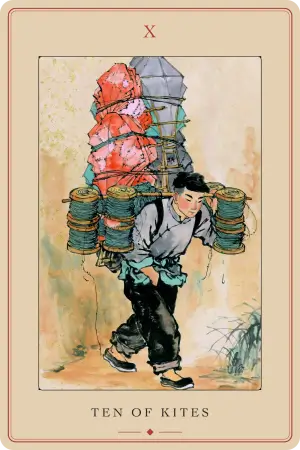
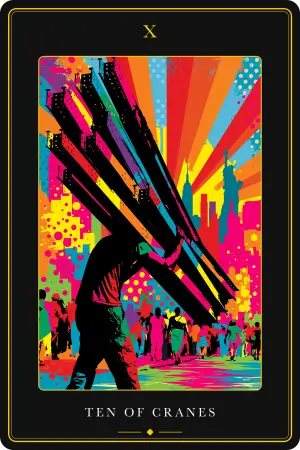
Ten of Wands in each deck
Every deck reimagines the same archetype. Compare the art, then open a deck to read its full interpretation.
Imagery and symbolism
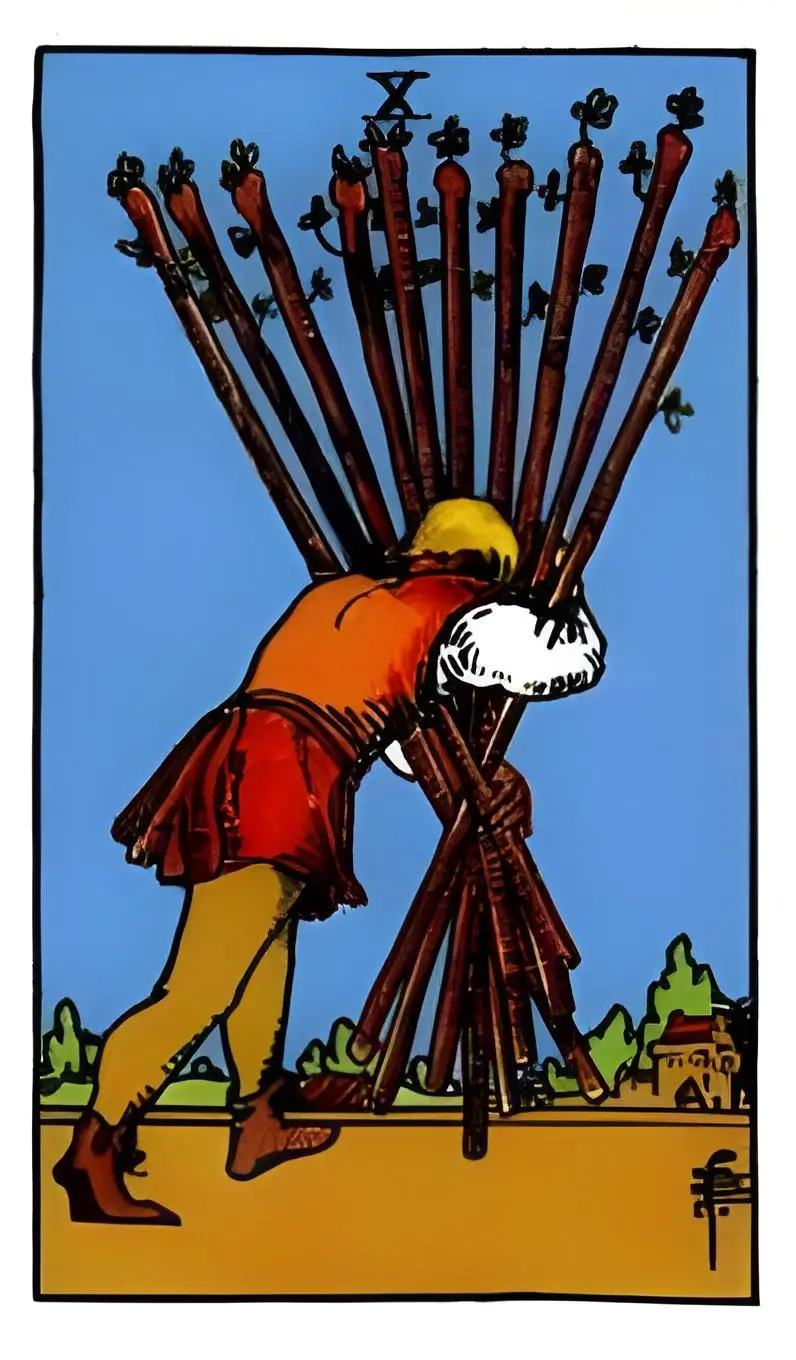
Pamela Colman Smith drew the card for Waite in 1909 and made one decision that has governed every reading since: she turned the figure around. He walks away from the viewer, bent almost double, a bundle of ten heavy staves clutched to his chest. You never see his face, because the wands themselves are in the way.
That is the whole card in one stroke. The staves fan out directly in front of his eyes, so he cannot see the ground under him or the road in front of him. Someone carrying too much loses the wider view and gets swallowed by the tactical demands of the load, blind to the strategic picture. Smith did not have to write that down. She simply put the burden between the man and his own sight.
The posture carries the strain. His back arches, his head bows, and this deck is precise about what that means: the sheer heaviness of the load, his focus narrowed onto the immediate task, a loss of overall vision and perspective. What it does not mean is defeat. He is still marching, and this deck reads that as inner persistence, a drive to meet his destiny and a refusal to surrender. The exhaustion and the stubbornness are the same gesture.
The wands have changed jobs. Earlier in the suit they were tools of creation and shelter, poles for building and staking a claim. Here they are work, obligations, projects and ideas that have become burdensome through their number and their scale. The harvest came in; the size of the yield is now breaking the harvester. Behind the image sits the suppression of personal desire in favour of fulfilling obligations.
The ground he walks on is solid, and this deck treats that as stability. He stands firmly on his feet under the weight, which reads as inner strength and a determination not to give up in the face of difficulty. The load has not put him on his knees.
The house in the distance is the detail most readers miss and the one this deck insists on. A large building sits ahead of him, the destination he is aiming for, hope and the coming reward for difficult work. He is close, almost there. The relief of nearly finishing is spoiled by the fact that he is still carrying everything, and by the fact that with his head down he cannot see how near he already is. This is why the Rider-Waite Ten of Wands is the final grueling stretch of a marathon and not a Sisyphean sentence.
The clothing and the light create the friction that gives the card its edge. Some commentators describe the landscape as desolate to underline the loneliness of carrying a burden unsupported, but the original art is relatively sunny, and this deck reads the figure's clothes as simple and practical, one more sign of hard work and heavy responsibility. Waite's own note pushes the other way, that the card shows fortune and gain which nonetheless bring their own oppression. Read together: the day is bright, the destination is in view, and the man in the middle of it is having a terrible time.
Core meaning
In this deck the Ten of Wands is responsibility, overload, and the carrying of a heavy burden. It is the terminal point of the Wands, where fiery ambition crystallizes into material weight. The Golden Dawn titled it the Lord of Oppression, and the Rider-Waite treatment is what translated that title from a metaphysical claim into something a person recognizes about their own week.
What makes Smith's version particular is where she located the oppression. Book T described a cruel and overbearing force applied to material and selfish ends, an abstract congestion of energy. Smith drew a man on a sunny road who has taken on more than he can hold and will not stop. This deck reads the card as speaking to the subconscious and emotional side of human nature, specifically around the realization of tasks, ideals and goals. The oppression is not something happening to him from outside. It is the shape his own ambition has taken.
Ten supplies the mechanism. In this deck's numerology ten is cyclicality, the completion of one stage and the start of another, a full circle that is both an ending and a fresh start. It is an advanced form of the One, and because 1+0=1 it still contains leadership, beginnings, creativity and individuality, which is why new projects become possible once the current load is discharged. Its shadow is excessive responsibility, too many things begun, business left unfinished. Fire meeting that completion produces a paradox: Cups and Pentacles arrive at their tens fulfilled, and the fiery suit rebels against being weighed down, so its completion reads as a load rather than a reward.
Upright meaning
Upright, this is overload, or a burden that has become unbearable. Work demands heightened effort, a hobby has turned labor-intensive, obligations have been placed on your shoulders. You may feel as though you are shouldering a mountain. A great deal depends on your effort and your sacrifices right now, and this state cannot continue indefinitely without severe energy depletion. This deck's instruction is direct: recognize that the weight can end in total exhaustion, reassess the situation, rethink your priorities, ask for help or distribute the load, and lighten what you carry enough to keep work and life in balance.
In love. A period of hard work and resistance, and a time to take responsibility for the relationship, which is genuinely difficult. The bond may feel exhausting, and real growth tends to come through exactly these trials. This often attaches to moving to another level, living together, marriage, some long-term commitment. Learn to say no, set personal boundaries, and do not pile problems on yourself. Under the weight sits something worth naming: the burden also represents achieved success, deep commitment, readiness to fight for shared goals, and pride in what the two of you have built. Keep the relationship and your own well-being in balance so the whole thing does not exhaust you.
In career. The heavy burden of tasks and duties, obligations that weigh you down by their sheer bulk. Intensive effort, a constant drive for success, overtime, extreme overload, and sometimes friction with colleagues. This level of workload can be strategic, and the reward can be substantial if everything is finished well and on time, which is why the card is not simply a warning to quit. If the commitments have outgrown you, the move is to discuss delegating to your team. In business it reads as significant projects requiring real strength, with most difficulties already behind you and a high risk of overload ahead, so pause to reassess goals and priorities and allocate your energy deliberately. It marks success achieved at the cost of great effort.
In finances. Significant responsibility and heavy obligations: large sums to manage, more financial tasks taken on, a stretch of hard work and stress aimed at securing stability. Diligent work and planning matter here, and this is a real opportunity for financial success. The caution is against letting the responsibilities tip into physical and moral overburdening, since the card warns plainly about burnout and fatigue under an overwhelming load.
In health. Physical challenges that feel insurmountable, exhaustion that makes ordinary things like exercise or eating well feel like another chore. It can also point to excessive concern with appearance, weight or shape: fatigue from constant workouts, an unbalanced eating routine, a strict diet followed without joy, several sessions a day inside a routine that has cost you your balance. The body is demanding rest. Take a more humane attitude toward yourself and put recovery first.
Reversed meaning
Reversed, the wands tip toward the ground and the burden goes down with them. This deck holds two readings at once. The constructive one is the ability to delegate responsibility or release what no longer serves you, and it carries relief along with guilt or fear about the letting go. The other is neglecting duties or refusing burdens that were genuinely yours. Time and resource management sit at the center of both. The advice covers the pair: accept that you cannot do all of it alone, treat delegation as wisdom rather than weakness, take the vacation or simply rest so you can return with enthusiasm, and if guilt or fear surface, look at them honestly instead of working through them.
In love. Relief, release, or an inability to cope with the pressure. It can mean letting go of feelings, commitments, or a relationship that had become too heavy and draining, sometimes a decision to cut ties. Read positively it is a chance to start again free of what the past was costing you. It also points to exhaustion from too many commitments inside the relationship creating an oppressive atmosphere, often because you took on more than you had strength for without checking first. In a stagnant or toxic situation the card is a signal to free yourself. Self-care and boundaries matter more than usual now.
In career. Easing work responsibilities and re-evaluating priorities, the moment when saying no to excessive commitments becomes necessary. Stepping away from exhausting activity can open opportunities you could not see before, and there is potential release from workplace pressure and unnecessary stress from management. It can also mean you have already shed some duties successfully. The shadow reading is a reluctance to take on responsibility at all, which breeds conflict with colleagues. In business it signals that things now run more smoothly and the project can progress without your constant presence, with a warning attached: problems avoided rather than solved will return larger, so address them immediately.
In finances. The lifting of burdens and relief after intense work, a crisis passed. Guard against recklessness and poor decisions made in the flush of that freedom, because financial management still requires a thoughtful approach. The reversal also shows exhaustion from excessive financial obligations, ineffective resource management, energy poured into fruitless projects, and possible losses. Recognize your actual capacity, reassess your priorities, and lower self-imposed expectations. Delayed results and lingering obstacles are common here.
In health. Fatigue and overload combined with a readiness to be free of them. The body starts recovering after a strict routine or diet, and the work is to keep hunting for a real balance between activity and rest with more flexibility and objectivity. A steadier lifestyle may be forming. This is also where obsessive stereotypes about beauty and health break: accepting yourself and appreciating your natural appearance is where physical harmony begins.
Historical notes
Smith and Waite inherited a card whose meaning had been argued over for decades, and their 1909 deck settled it by drawing a picture nobody could misread. In 1888 Mathers gave the Ten of Wands a fairly positive upright reading, confidence, security, honor and good faith, holding treachery, subterfuge and duplicity back for the reversal. As the Golden Dawn's system matured and its teaching was codified in Book T, the card was fixed as the Lord of Oppression: a cruel and overbearing force applied to material and selfish ends, a failure in a matter where the opposing forces are simply too strong to control, often traceable to ego or selfishness at the start of the project. The sphere was associated with cruelty, malice, revenge and injustice. Ill-dignified it brought slander, envy, obstinacy and swiftness in deceit; well-dignified, that same immense effort could produce generosity, self-sacrifice, and success in law, religion or philosophy.
Waite kept the warning about deception when he set the modern image in his 1910 Pictorial Key. He wrote that the card can indicate fortune and gain while inevitably bringing the crushing oppression of those very things, classified it under false-seeming, disguise, deceitfulness and untrustworthiness, and added one very specific prediction: appearing in a matter of law, it signals certain loss. Smith's bent-backed carrier and Waite's text are pulling in slightly different directions, and the tension between the honest laborer in the picture and the deceit in the book is part of why this card generates so much commentary.
A.E. Thierens tried to reconcile the two in 1930. He broke with the assignment of Wands to Fire, argued for Air instead, and tied the Ten to the tenth house of Capricorn, the house of public position, official duty and red tape. Strong characters, he said, accept that pressure as karma and manage it. Weaker ones cannot withstand the official burden and resort to duplicity and deceptive appearances to escape it, which supplies a psychological route from overwork to dishonesty. Paul Foster Case, founder of the Builders of the Adytum, later read the card as the fullness of power and the opening of hidden sources of power, with the caution that it degrades easily into ostentation and dogmatic pride.
Correspondences
Number. Ten: cyclicality, the completion of one stage and the beginning of another, the full circle that is at once an ending and a fresh start. It is an advanced form of the One, and because 1+0=1 it retains leadership, beginnings, creativity and individuality, so new projects or a new path become possible once previous difficulties are cleared. Some readings pair the ten with zero to mark a zero moment, a stretch of calm and cleansing before the next cycle. Its shadow is excessive responsibility, overload, too many things started and left unfinished.
Astrology. Saturn in the third decan of Sagittarius, approximately December 13–21, running into the winter solstice and the handover to Capricorn, which Saturn rules. Sagittarius is mutable fire under Jupiter: enthusiasm, philosophy, far-sighted vision, an appetite for the open horizon. Saturn is the taskmaster, cold and confining, the ruler of boundaries, time and discipline. Together they produce the sensation of wanting freedom while pinned by heavy responsibility. This deck reads the pairing more generously than most: Saturn as teacher and sage, placing obstacles on the road to truth and rewarding those who clear them with dignity, and the decan itself as intellectual freedom, great responsibility, and a Sagittarius pushing deeper into knowledge. The same friction runs through the Phoenix myth attached to this decan, where the newly reborn bird must carry its own heavy nest from India to Heliopolis and lay it on the temple steps to put the Sun to rest at the solstice. Hardship immediately before rebirth.
Element. Fire in its extreme form, the destructive and transformative end of the element rather than the creative spark. Fire rises by nature, so when it is forced down into matter it loses its lightness and turns into a grinding weight. Reaching a dream still needs the passion of Fire, and it now also needs the patience and endurance of Saturn.
Kabbalah. Malkuth, the Kingdom, the tenth and densest sphere, here in Atziluth, the archetypal world of Fire. Volatile Atziluthic fire poured into that earthly vessel solidifies and sours: ambition that has grown materially powerful and lost its spiritual lightness, the passionate vision that becomes a bureaucratic nightmare, the joy of creation replaced by the tyranny of maintenance. The divine name of the sphere is Adonai Malekh, the Power of Earth as a King. Because each Tree gives rise to the Kether of the world below, this oppressive energy must disintegrate to feed the Ace of Cups, passing from the Kerub Metatron to Sandalphon, from fiery oppression into watery renewal.
Elemental dignity. Overloaded Fire that drags on its neighbours. It weighs down lighter Wands and Fire courts, and beside Swords or Pentacles it tends to read as sheer heaviness rather than heat.
Psychological perspective
The person this card describes upright overextends through excessive commitments or a massive workload. They are ready to take responsibility and badly need better prioritization. They look like tireless workers who take on too much, and it usually ends in burnout. Their reliability and dedication are real and are also the trap: proving both at work is precisely what makes the burden heavy. This deck lists their traits as high independence, stress resilience, strong will, and stubbornness, with the persistence to go all the way in poor conditions and the habit of handling whatever gets set in front of them.
Modern reading has taken Smith's image and turned it into a diagnosis. Where the old texts described cosmic and bureaucratic oppression, contemporary practice treats the card as a self-inflicted wound, known colloquially as the card of getting in your own way. The argument rests on a detail of the artwork: he is not only carrying too much, he is carrying it badly, fanning the wands across his face instead of bundling them, which makes the load far heavier than it needs to be. The transition from the Nine tells the rest. He started with one wand, a single idea or commitment, and accumulated ten, believing each was manageable when he picked it up.
Underneath sits the assumption that if you want something done right you have to do it yourself. The person takes on duties that are not theirs, driven by difficulty trusting or delegating and by the illusion that the world collapses if they drop a single wand. Readers name this martyrdom: suffering for achievements the exhaustion then ruins. It maps directly onto hyper-independence, recognized in psychology as a trauma response where someone refuses help and insists on total self-reliance to avoid vulnerability, and onto the eldest-daughter role of silently absorbing a family's systemic weight. Such a person basks in their self-sufficiency and pays for it by carrying the world alone, blocking collaboration because they look too self-contained to need it. The exit is the maturity of the Queen of Wands, whose independence includes the ability to lean on someone.
The Ten of Wands across decks
The Tarot de Marseille and the older tradition give the card as geometry, ten staves in a dense lattice with no laboring figure and no story. The bent-backed carrier is a Rider-Waite invention.
The Golden Dawn worked from a different diagram again. Book T, penned by MacGregor Mathers and Harriet Felkin, describes four hands holding eight crossed wands while a fifth hand holds two more upright through the junction, with flames issuing from the congested crossing. It is a metaphysical traffic jam: so much fiery energy forced through one intersection that it catches fire.
The Thoth Tarot of Crowley and Lady Frieda Harris develops that schema and titles the card Oppression outright. Crowley wrote that the fires of the wands have done their job so completely that nothing but ashes are left. To mark Malkuth, the material realm governing all the tens, the design incorporates the Ouroboros shaped into a Möbius strip. It answers the lemniscate above the Magician in the Rider-Waite deck, and where that one promises infinite potential, this one is an inescapable loop of material responsibility the spirit cannot break out of. Set the two decks side by side and the difference is a human being: Smith gives you a man who could put the wands down and will not, Harris gives you a closed system with nobody in it.
Modern decks mostly argue with Smith's figure rather than replace him. Some picture the burden as visibly chosen instead of imposed, others draw the moment of setting it down that the Rider-Waite card withholds. Pop culture has done its own mapping: online threads pair the card with the eldest-daughter archetype and Taylor Swift's tolerate it, emotional labor performed for someone who merely tolerates it, and Persona 5 players attach it to Yusuke carrying Madarame's fraudulent workload, a legacy delegated unjustly onto the last disciple.
In combination and context
Read it against the Nine of Wands first, since that is where the figure came from. The Nine is the scarred sentinel, still capable, aware of what he has left, actively managing his defenses. The Ten is what happens when that sentinel refuses to rest or reassess and resilience curdles into stubbornness. Together they trace the thin edge between heroic endurance and toxic overextension: the Nine holds the line, the Ten is buried by it.
Against the Ten of Swords the contrast is Fire against Air. The Ten of Swords, titled Ruin, is acute, intellectual and final, the fight over with nowhere to go but up. This card is the grinding physical agony of continuation. He is not on the ground, he is on his feet pushing against his own limits, the last screaming repetitions of a heavy set. The Ten of Swords at least offers the relief of an ending; the Ten of Wands offers the protracted reality of ongoing responsibility.
Among the tens the pattern is just as clear. The Ten of Cups is perfected success and family harmony, the Ten of Pentacles is wealth and generational security, because Water and Earth settle comfortably into Malkuth. Fire rebels against it, so its ten deteriorates into obligation and ash rather than arriving fulfilled.
Surrounding cards move the reading considerably. Drawn with the Hanged Man in questions about spiritual development, the standard community advice is blunt: stop being a martyr, talk to your supervisor, ask for help, do the scary thing. Pulled for career alongside The Star reversed, readers take it as a hard reminder to enforce work-life balance, and as a sign the querent is on the wrong path and wasting real talent on controlling every detail of the current role. Reversed beside the Queen of Pentacles reversed and the Eight of Swords in a how-does-he-feel spread, the usual reading is a partner who is drained by the dynamic and hopes that walking away will lighten the load. Beside planning cards like the Hierophant reversed or the Two of Wands reversed, the reversal turns constructive: step back, look at it rationally, find the less costly route, and remember you can rewrite the terms you agreed to.
Questions for reflection
- Smith put the wands between the man and his own eyes. Which of my responsibilities is currently blocking my view of where I am actually going?
- This deck says the house in the distance means the goal is close. If I lifted my head right now, how much of the road would turn out to be already behind me?
- He fans the staves out instead of bundling them. Where am I making a load heavier by the way I insist on carrying it?
The general meaning follows the Rider-Waite-Smith reading — the reference used across Tarot Academy. Open a specific deck above for its own interpretation.
Frequently asked questions
Explore the Tarot
Latest Posts
Discover the ancient wisdom of tarot cards and unlock the mysteries of your spiritual journey. Our blog is your gateway to understanding the rich symbolism, meanings, and practical applications of tarot reading.




















































