
 EN (English)


Minor Arcana · Wands (Fire)
Page of Wands
Pamela Colman Smith gave this boy salamanders that reach for their own tails and miss, and a living staff that has grown taller than he is.
Read the complete guide: Page of Wands in Tarot: A Complete Guide to Its Symbolism and Meaning
Card at a glance
- Numerology
- Page
- Element
- Fire
- Astrology
- The fire signs Aries, Leo and Sagittarius; Golden Dawn timing seats the Page in the fullness of summer under Leo
- Kabbalistic path
- Malkuth (Kingdom), in Assiyah, the world of action
- Timing
- Fast and impulsive, days rather than months, since Wands is the quickest suit
- Yes / No
- Upright a curious yes that favours exploring · Reversed a delayed or blocked yes, which some readers take as a flat no
Upright
Inspiration
Curiosity
Exciting news
Creative spark
Free spirit
Readiness for action
Beginner's enthusiasm
Exploration
Reversed
Scattered focus
No follow-through
Creative block
Recklessness
Imposter syndrome
Loss of interest
Delayed plans
Flightiness
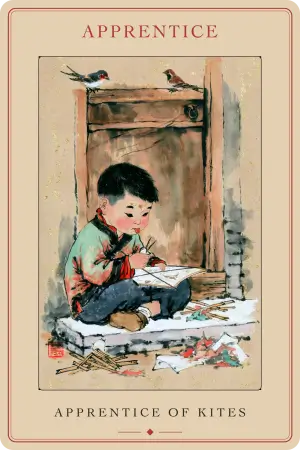
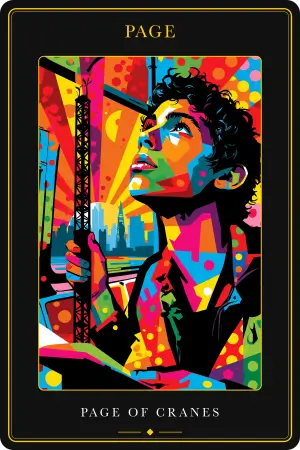
Page of Wands in each deck
Every deck reimagines the same archetype. Compare the art, then open a deck to read its full interpretation.
Imagery and symbolism
Waite conceived the card and Pamela Colman Smith drew it, and her decisions are what every modern reading of the Page of Wands rests on. She put a lavishly dressed youth alone in an arid yellow desert, gave him a staff substantially taller than himself, and then made him stand completely still.
The height disparity does the first piece of work. The boy has to physically look up to see the top of his own wand, which puts the object of his fascination above his current reach. It is a destiny or a level of maturity he has not attained yet. The staff is not a polished instrument either: green leaves sprout from the top, so the tool is alive and still growing, the way the idea it stands for is still growing. This deck reads those shoots directly as growth, renewal, and the opening of a fresh phase.
The posture is the detail that separates this Page from every other Wands figure. He grips the staff with both hands, plants it on the ground, and takes no step. Analytical readers treat this stillness as the line between fascination and momentum. He is captivated by the potential of the idea and has not yet moved to execute it, which makes the card pure potential at zero velocity, a state of intense observation. This deck adds the other half: planting the wand is itself the gesture of a person ready to act and to express their individuality.
The red plume on his hat is nearly identical to the feather worn by The Fool, and the borrowed iconography is deliberate. It marks a shared psychological state of optimism, an absence of worldly cynicism, and a willingness to walk into the unknown on instinct instead of a calculated strategy.
The desert sets this suit apart from the rest of the deck. Cups gets fluid water and Pentacles gets tilled fields; Wands gets scorched yellow ground, which in the RWS tradition stands for the fierce resilience of life and the untamed heat of fire. This deck also reads the emptiness as opportunity: open terrain stretching to the horizon, a path that clears itself once the walking actually starts.
On the horizon stand three pyramids, monumental achievement raised in a wasteland. They are a promise made to the Page, that enough willpower and applied creativity can build something lasting in the harshest ground available. This deck reads the distant heights in the same landscape as the trials and obstacles waiting on the road to any goal, and as a statement about endurance: the capacity for steady, persistent progress over a long stretch.
The salamanders on his tunic are the most esoteric mark on the card and the one worth slowing down for. In classical alchemy the salamander is the creature of fire, mythologised by Paracelsus among others as able to walk through flame without being consumed, and Smith placed it on the garments of exactly three figures: the Page, the Knight and the King of Wands. The posture changes as the rank matures. On the Page's tunic the salamanders are drawn with heads and tails apart, forming broken circles, reaching for their own tails and failing to catch them. On the King's robe the same creatures have closed their jaws on their tails into the Ouroboros, the sign of completion and total command of the element. The Page's unfinished circles say that the cycle of fire, inspiration through sustained execution to mastery and rebirth, has barely started for him.
The colour finishes the argument. His yellow tunic blends into the desert behind him, tying the figure to the world he stands in, and this deck reads the yellow as energy, vitality and confidence. In esoteric colour theory the same yellow belongs to Manipura, the solar plexus chakra that governs willpower and personal power. The bright orange leggings and red accents carry the sacral and root registers: passion, danger, and raw life force.
Core meaning
This deck calls the Page of Wands a messenger of energy and inspiration announcing a new creative period, and that framing is more particular than it sounds. The card is not the project. It is the spark of enthusiasm that arrives just before a project or a hobby begins, the surge that has no destination attached to it yet.
The Page is where Fire first meets a human being. The Ace of Wands is the divine spark offered by the universe, a hand out of a cloud holding a sprouting branch, with no mass, no movement and no ego. The Page is the first person to take that spark and internalise it, testing how it feels and what adventure it might open. If the Ace is the lightbulb going on, the Page is the excitement of sketching the idea onto a napkin.
He occupies the foundational rank of the court, which is why the card sits at the intersection of unshaped potential and nascent action. In the Golden Dawn scheme that position has a formula, Earth of Fire: the exact moment the ethereal spark collides with the material plane and becomes something a person can act on. Fire is volatile and upward-seeking; earth is stable and downward-seeking; the Page is where they meet.
What this deck emphasises above the archetype is the messenger function. The card carries the symbolism of heralds, of connection and the transfer of information, and the person it describes is a vessel for ideas and spiritual perspectives more than an executor of them. Its closing note in this deck is untapped potential: the start of a journey and a passionate wish to express creativity, with the outcome still entirely open.
Upright meaning
Upright, new thoughts and ideas come into view. This deck reads it as renewal, a growing awareness of your own abilities, and vitality returning after a flat stretch. Fresh perspectives appear, sometimes as new approaches to problems you had already given up on, and they arrive asking for activity, a quick response, and real energy. It is a period for active engagement and for expressing individuality, and it frequently describes a person rather than an event: someone enthusiastic, ready for adventure and exploration. The counsel is to experiment, take initiative, and direct energy and confidence at your goals and your learning. Bravery and a creative approach are rewarded here, so trust your instincts and bring the ideas out where they can be seen.
In love. The beginning of a passionate, inspiring connection. This deck points to a new lover who brings freshness and vitality, to growing enthusiasm and flirtation, and to a romance carrying real energy. Sexual energy rises and the attraction to a new partner is strong, with adventure built into the connection. In an existing relationship it marks the start of a dynamic new phase, an interesting and highly emotional stretch. The pull is curiosity and appetite, and modern readers hear it as the warm, bold reach-out, the message sent out of genuine spontaneous interest.
In career. Growth and new beginnings: a new project, a fresh idea, or an opportunity that has not existed before. This deck asks you to meet change openly, act with energy, and show initiative, and it often marks the launch of a venture where your creativity has room. Quick thinking, quick action, openness to new experience and a willingness to lead are what career success asks for now. If a plan is still on paper, the card predicts a successful launch. It can also mean a new enthusiastic colleague arriving, or a return of passion for work you already do, a surge that quickens your pace and makes varied tasks easy. In business the reading is beginnings, initiative, optimism and passion: a promising and engaging proposal, a rigorous new project or an expansion, creative energy waking up in a way that makes even a plain venture feel worth doing. Effort and calculated risk are named as the price.
In finances. The birth of new ideas about money, the moment when the first thought about a project or an earning opportunity arrives. Fresh ideas here can lead to real financial growth, and the period is rich in prospects and well suited to planning projects or investments. New financial strategies, plans for a different job, or a profitable endeavour may come into view, and pursuing them takes energy and genuine passion. Obstacles notwithstanding, starting the new venture eventually pays off. It can also indicate investing in new technology or exploring unfamiliar territory to improve your position.
In health. A drive toward self-improvement and fitness, with conditions excellent for sport, training, and pushing your physical limits. Experimenting with a routine brings satisfaction and vitality; you may want to change how you eat, try new workouts, or simply live more actively. The card supplies the strength for whatever the physical undertaking is, running, yoga, or better food. Take the time to evaluate your habits, listen to your body, and find out what it can now do. The standing advice from the wider tradition applies: channel the burst, and avoid burning the spark out in the first week.
Reversed meaning
Reversed, the harmony between fire and ground breaks. Either the enthusiasm survives without the grounding it needs to manifest, or the fire goes out entirely and leaves frustration behind. This deck describes the state as confusion, tangled thoughts and indecision, with more time needed before a new idea can develop at all: low energy, poor planning, doubt about your own abilities, disorganisation, no focus. Plans fail to materialise because behaviour is unpredictable or the direction was never clear. Expect delays and uncertainty about what comes next. The recommendation is to protect your ideas from unwanted influence and wait for the right moment, to slow decisions down and pay attention to what you feel, and to treat this as a stretch for self-examination and reassessing goals. Assess your actual resources, and consider spending the time on study instead.
In love. Immaturity, hasty decisions, and action driven by passion with reason left out. This deck warns of an unstable partner who lives in the moment and avoids commitment, and of a wish to jump between relationships without looking for stability or purpose. Quick flings offer short-term euphoria and fade fast. At worst it points to playing with a partner's feelings, which ends painfully. The wider tradition names this the player: high passion and low commitment, energised by the chase, retreating the moment stability or emotional labour is required. When a confusing suitor is sending erratic messages, readers take the card as someone testing the waters out of boredom, wanting attention now with scattered intentions. The card asks for self-reflection and a more responsible approach to your emotional life.
In career. Low energy and lost enthusiasm at work, often tied to burnout or to interest draining out of your current duties. Motivation, ideas and creativity run thin. Concentration fails, one task cannot be held, effort is wasted and projects go unfinished, and there is a risk of being undervalued in the role. Stagnation may come from delays or obstacles nobody planned for, and a fear of starting anything new holds the rest in place. In business the card warns of impatience and a project that turns out dull and insufficiently stimulating, of reckless action taken before the plan was thought through, and of misunderstandings with partners that carry consequences. The wider reading is the scattered dreamer: a dozen things begun, none finished, a head full of beginnings without the discipline for the middle. Reassess plans carefully and be deliberate about decisions.
In finances. Scattered ideas, unfinished projects, and an inability to put plans into action, with destructive enthusiasm and burnout from juggling too many at once. The potential to succeed may be real, and attention spread across everything finishes nothing. Without determination, consistency and patience the chance to improve your finances can pass. The card also points to uncertainty and a loss of control, to opportunities missed through doubt, weak self-belief or fear of change, and often to nothing more complicated than poor planning.
In health. Weakness, low energy, exhaustion. You may be neglecting your condition, or swinging to the opposite extreme with too much exercise or a severe diet that produces fatigue, stress and illness. Balance is the whole instruction: watch your habits, work out what depletes you, and deal with it, staying with your own body instead of chasing fashionable regimes. Apathy, poor nutrition, and a flat unwillingness to move at all are all in range, as is feeling too uncertain of your abilities to try. Restoring health here takes a conscious, measured approach.
At its most psychological the reversal is the imposter, someone holding a genuinely good idea and unwilling to manifest it out of a hidden fear of failing or a sense of not being ready yet.
Historical notes
The card Smith drew in 1909 sits on top of an argument about what a court card even is. Before the Golden Dawn, interpreters such as Jean-Baptiste Alliette, working as Etteilla, read the court as a plain medieval hierarchy: a King and Queen ruling, assisted by a Knight and his apprenticed Page. Accessible, and with no cosmology holding it together.
The Hermetic Order of the Golden Dawn, a late-nineteenth-century occult society, threw that structure out. S.L. MacGregor Mathers and W. Wynn Westcott mapped the court onto the Tetragrammaton, the four-lettered name of God, Yod-Heh-Vav-Heh, and renamed the ranks King (or Knight), Queen, Prince and Princess for Father, Mother, Son and Daughter. The Page of Wands became the Princess of Wands. In that system she is Earth of Fire, and she lives in Malkuth, the tenth and lowest sephira, the physical world, the Olam of Assiyah where action happens. As the final Heh she is the Daughter who consolidates the Father's fiery will, the Mother's watery love and the Son's airy intellect into material form. Liber Theta describes the Princesses as an "inertia of irresistible momentum", a paradox of energy that is permanent and volatile at once and is the throne of Spirit.
Waite and Smith kept the older title and the older figure. Their Page is a youth on foot, not an Amazon, and the deck's authority since 1909 is the reason most English-speaking readers still say Page rather than Princess and still picture a boy looking up at a leafing staff. The Golden Dawn language survives underneath as the correspondence system, which is why a card that looks entirely secular carries a Qabalistic address.
The historic Tarot de Marseille shows what Smith was working away from. Its Valet of Wands stands in a field of sprouting plants with an air of uncertainty and keeps the wand resting on the ground, sending the fire of the staff downward into the earth to feed the flora around him. The Marseille card asks what catalyst will eventually make the youth raise the wand. Smith answered by raising it for him and putting three pyramids on his horizon.
Correspondences
Rank. Page, the foundational rank of the court and the apprentice of the suit. This deck records no numerology for the card, so the rank carries the weight instead: the Page is the student and the messenger, holding grand theory with little executive power, which is exactly why the wand towers over him. Where the wider court numbering is used, Pages are assigned the number eleven, read in occult numerology as a master number of high intuition and raw youthful potential, illumination and visionary leadership, fitting a figure whose job is to open the querent's eyes to what they had not seen.
Astrology. This deck calls the card a personification of Fire and ties it to all three fire signs together. Aries supplies new beginnings, activity and self-assertion, the cardinal spark and the headlong rush. Leo brings pride, scale, the pull toward leadership and recognition, and the charisma the Page exerts on other people. Sagittarius contributes the curious mind, continuous development, exploration and the search for a deeper truth, which is where the wanderlust comes from. The combination gives the card an unrelenting enthusiasm pointed at spiritual growth and new knowledge, with a warning attached: excess passion turns into impulsiveness, so the card asks for moderation and maturity in how the fire gets used. Classical Golden Dawn timing assigns the Pages to quadrants of the year and the fixed signs, placing this one over the fullness of summer under Leo.
Element. Fire, in its first and least refined form: strength, dynamism, initiative, and beginnings. The esoteric formula is Earth of Fire, the grounding edge of the suit, which is what makes the Page the point where inspiration stops being ethereal and becomes an idea somebody can work with.
Kabbalah. Malkuth, the Kingdom, tenth and lowest sphere, in Assiyah, the world of action, the seat of all four Princesses in the Golden Dawn arrangement. The placement is why the Page reads as the most material and the least abstract of the Wands court.
Timing. Wands is generally treated as the fastest suit, standing for sudden developments that arrive without warning, and the Page in particular suggests immediate and impulsive movement, events unfolding across days instead of months.
Elemental dignity. As the earthy part of Fire the Page steadies nearby Wands and Fire courts, strikes sparks beside airy Swords, and tends to fizzle or steam when set against Cups.
Psychological perspective
The people this card describes upright are full of passion and enthusiasm. This deck reads them as young, goal-oriented and energetic, crowded with ideas and plans for the future, believing in their own capability and willing to work for it. Their willpower is strong and they are constantly hunting for a way to express creativity. They act quickly and decisively, and their initiative is contagious enough to move the people around them. They are tireless, curious, and open to whatever they have not tried, unafraid of risk and quite willing to challenge a social norm. An inner fire keeps them moving, and they like developing, learning, and telling other people what they think.
Reversed, the same person has lost the thread. This deck describes courage and persistence draining away: indecisive, unclear in their actions, putting off important choices, afraid of taking responsibility. Carelessness produces hasty decisions with outcomes nobody wanted. Inspiration is simply absent. Underneath sits chaos and uncertainty about their own ideas, an internal struggle that feels like having lost direction, showing up as frustration, fear of commitment and inner turmoil. Without enthusiasm they postpone, miss what was available, and watch the original spark go out.
The deeper shadow work the card supports concerns your relationship with beginnings. Its chronic pattern is starting things as a way of avoiding finishing them. The first spark of an idea is intoxicating and perfectly safe, because unmanifested potential cannot fail and cannot be criticised; the middle and end of a project demand discipline and carry a real risk of failure. So the perpetual beginner leaps from idea to idea, or from one relationship to the next, as a sophisticated avoidance tactic that keeps commitment permanently out of reach. The question the card puts is whether the hunger for beginnings is genuine enthusiasm or a way of staying beyond the reach of accountability.
The second shadow is imposter syndrome, and Smith drew it into the composition. The Page is acutely aware that the wand is much larger than he is, a calling or a skill level he has not reached. The suppression follows: creative impulses get dismissed as impractical, or filed behind serious responsibilities, or postponed until some future point of readiness. The card's answer is that the conditions for creation will never be perfect, so you begin anyway, accept the awkwardness of being an amateur, and let the spark lead while the logical mind catches up. Homer Rice is quoted in connection with this card to the same effect: you can motivate by fear and you can motivate by reward, but both are temporary, and the only lasting thing is self-motivation.
The Page of Wands across decks
The Tarot de Marseille gives the card as the Valet of Wands, drawn with simple clarity. He stands in a field of sprouting plants, looks ahead with an air of uncertainty, and rests the wand on the ground so its fire runs downward into the soil and feeds the growth at his feet. The Marseille version is the earthy, grounding face of the Page, and it leaves the reader with a question about what will eventually move him.
The Golden Dawn and Thoth line renames the figure entirely. Crowley's Princess of Wands departs sharply from the hesitant youth of the older decks: an unrestrained naked Amazonian figure crowned with the double Uraeus serpent, rushing forward with a tiger caught by the tail, dragging the creature of earth into the flames of a burning altar as fuel. Crowley gives her an insatiable hunger for life, explosive passion, and a complete absence of responsibility, the unbridled freedom of the feminine. Her shadow, in his own writing, runs to cruelty, theatricality, and a numbing emptiness masked by constant motion, the habit of burning down the object of desire and forgetting it the instant a new obsession appears. Set her beside Smith's stationary boy and the gap is the whole point: one card is appetite already in flight, the other is appetite that has not yet taken a step.
Modern decks mostly negotiate with Smith rather than replace her. The youthful, exploratory register survives while the medieval page is traded for whatever idiom the deck is working in, an adventurer, a young creative at the first stir of an idea. The living wand, the salamander and the desert horizon recur often enough to be the card's signature. The archetype has also travelled well outside occultism: third-party tabletop publishers building Tarot classes such as the "Cardcaster" hang abilities called "Seeds of Possibility" and "Sprout of Curiosity" on this card, and the Sonic the Hedgehog "Fortune Cards" map court personalities onto themes of Dark, Hero and Fire to express recklessness and ambition.
In combination and context
Start with the two cards the Page is most often confused with, since that is where the reading is usually decided. Against the Ace of Wands the difference is ownership. The Ace is the elemental gift itself, raw opportunity with no mass and no human ego attached. The Page is the first human interaction with the gift, taking the potential and beginning to explore how it feels and where it might go. Drawn together they are the strongest green light in the suit, a flood of creative energy arriving with the enthusiasm needed to channel it, and readers treat the pair as a powerful affirmative for launching a project or a business.
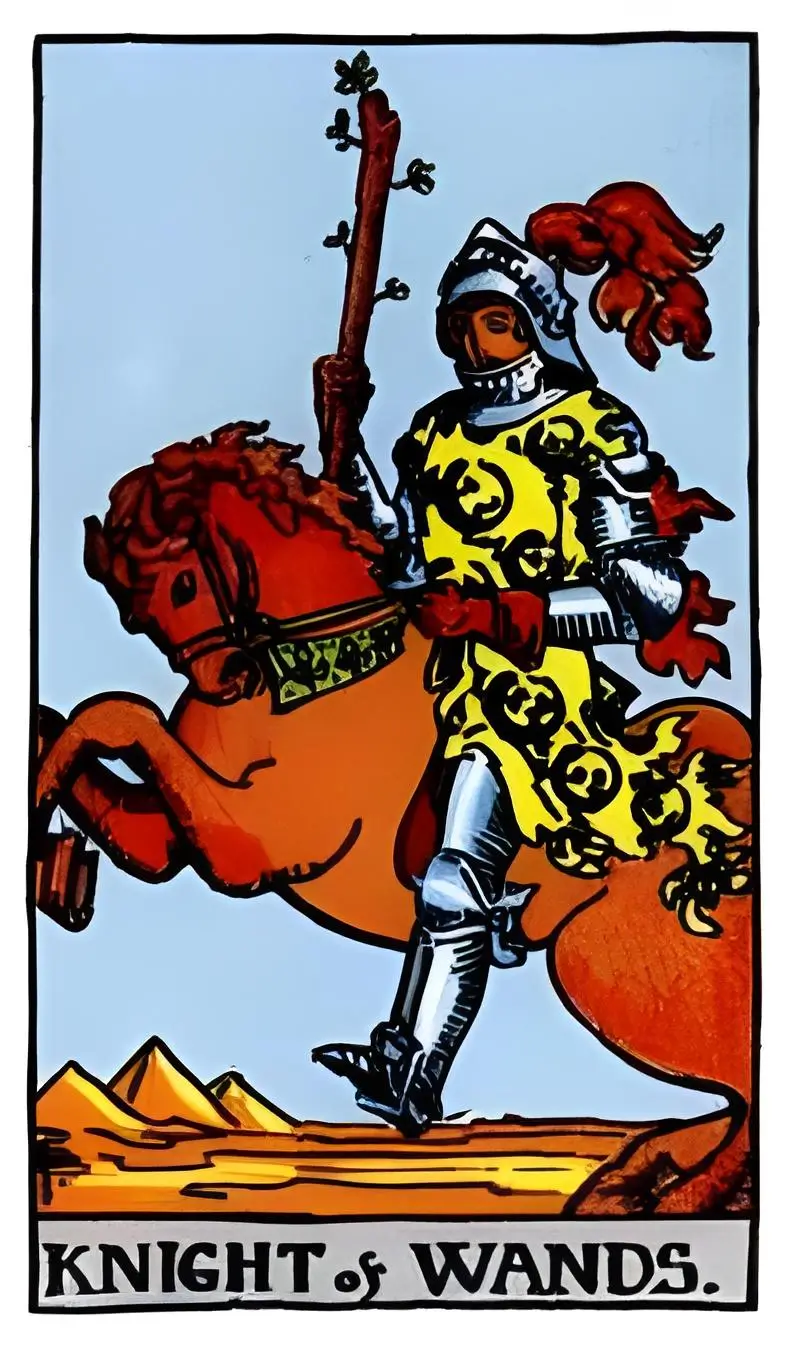
Against the Knight of Wands the difference is momentum. The Page is stationary in his desert, theorising about the adventure and looking up at the tool, without the autonomy or the resources to run a campaign. The Knight is on a rearing horse charging into the fray on instinct. Readers compress it neatly: the Page has grand theories and takes little action, the Knight takes massive action on very little theory.
The other Pages sort the rest. The Page of Swords is the scholar and the watcher, logical and detached, associated in modern practice with surveillance on social media and mundane logistical messages. The Page of Cups is the dreamer, sensitive and poetic, offering emotional vulnerability and puppy love. The Page of Pentacles is the student, slow and methodical, focused on study, money and long-term plans. This Page is the explorer: fast, spontaneous, risk-taking, charismatic, and physical. Beside the Page of Cups in a love reading the two blend into a romantic and whimsical new beginning, physical attraction meeting emotional depth, with the immaturity of the rank still attached to both.
Major Arcana neighbours change the scale. With The Fool the youthful fearlessness doubles into a total leap of faith, childlike wonder with conventional caution abandoned, which can read as brilliance or as recklessness depending on what else is on the table. With the Two or Three of Wands the spark grows up: the Page supplies the idea, and the Twos and Threes show the querent plotting the map, gathering resources, leaving the comfort zone and looking at the horizon to see how far the idea could scale. With The World the same spark has reached completion, the creative endeavour matured into fulfilment and recognition.
One pairing turns the card dark. With the Seven of Swords the Page's open enthusiasm becomes something exploitable, and the standard reading is a warning about intellectual property and hidden motives: protect the idea, look hard at who is being told about it. In a relationship spread the same combination is the manipulative player wearing the Page's charm.
Questions for reflection
- Smith drew the salamanders on this tunic reaching for their tails and missing, while the King's have closed the circle. Which of my own cycles is still open, and what would closing it actually require?
- The boy has to look up to see the top of his wand. What am I currently telling myself I am too small to pick up?
- This deck says the path clears once action begins. Where am I waiting for the road to appear before I start walking?
The general meaning follows the Rider-Waite-Smith reading, the reference used across Tarot Academy. Open a specific deck above for its own interpretation.
Frequently asked questions
Explore the Tarot
Latest Posts
Discover the ancient wisdom of tarot cards and unlock the mysteries of your spiritual journey. Our blog is your gateway to understanding the rich symbolism, meanings, and practical applications of tarot reading.




















































