
 EN (English)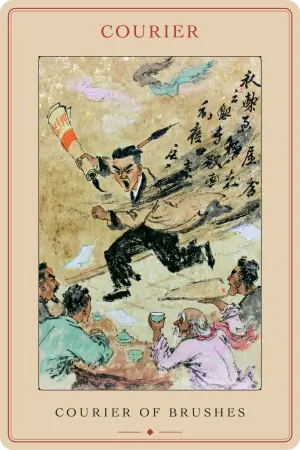


Minor Arcana ·
Matron of Brushes
The sharp-eyed widow of the hutong who settles a boundary dispute with one sentence both households will quote for years.
Card at a glance
- Numerology
- Matron of Brushes
- Element
- Air (Water of Air)
- Astrology
- 20° Virgo – 20° Libra · Libra ruled by Venus
- Kabbalistic path
- Binah (Understanding)
- Timing
- Early autumn · Libra season
- Yes / No
- Yes if you face the truth · Reversed no
Upright
clarity of judgment
honesty
clean boundaries
precision
independence
discernment
fair mediation
the one true sentence
Reversed
bitterness
sarcasm
fault-finding
cold objectivity
isolation
accurate gossip
grudges
one-sided verdicts
Matron of Brushes in each deck
Every deck reimagines the same archetype. Compare the art, then open a deck to read its full interpretation.
Imagery and symbolism
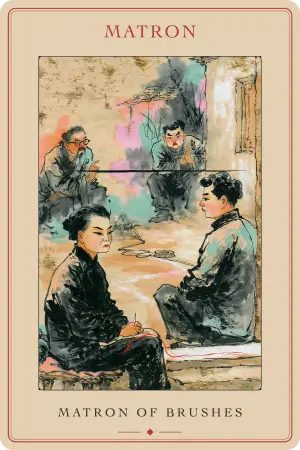
In the Tarot of Beijing the Queen of Swords keeps no throne and no stone hall. She sits on her own doorstep, on the threshold of her household, which is exactly where a hutong settles a boundary dispute: half inside her domain, half in the common lane, belonging fully to neither party. She is the sharp-eyed widow of the lane, and the whole scene has contracted to a woman, a needle, and one sentence not yet spoken.
She sews without looking at her hands. The needle is this suit's brush and sword in one, a fine steel point that joins what is torn and pricks what is false, and that she does not watch it means her skill has passed beyond attention. Her eyes are free for the real work, which is seeing. Her gaze meets you directly, level and unimpressed, the look of someone who has already heard both versions of your story.
The thread she draws is vermilion red, the single warm accent in her dark, ink-washed figure. It is her sympathy: bright and genuine, running through everything she does, but thin and controlled, always following the needle rather than leading it. The red thread trails across the doorstep toward a young man seated opposite her, the party awaiting judgment, binding the scene the way her verdict will bind the quarrel.
Behind her the dispute itself: two neighbors, an old scholar in spectacles and a young man with an angry face, gesture across a single hard horizontal line drawn straight through the picture. That line is the disputed boundary made visible, the only ruler-straight stroke in a card otherwise painted in soft Feng Zikai washes. Human feeling blurs and bleeds like the pink and teal clouds around the two men; the boundary, once she names it, does not.
A measuring tape lies unspooled on the ground between the parties, its ribbon zigzagging across the dust. Measurement is her element, since words and boundaries both must be exact, yet the tape rests on the earth while the verdict comes from the doorstep: the measuring is done by hand, the judging by mind. Her dress is the darkest ink in the deck, close to the examiner's black of the Master of Brushes but cut for a working woman, her hair drawn back without ornament. Her authority wears no crown. The warm kraft paper, flecked with gold, glows strongest around her, and a small red seal rests in the corner, the deck's quiet signature: what is stated truly is stamped forever.
Core meaning
The Matron of Brushes is Beijing's Queen of Swords, and the deck gives her one gift above all others: the single true sentence. She is a mind that sees through excuses without cruelty, names a situation exactly as it is, and settles a boundary between two households with one line both parties will quote, accurately, for the rest of their lives. Her clarity was earned rather than declared. Loss made her precise instead of bitter, and what survived is a discernment far harder to acquire than raw cleverness.
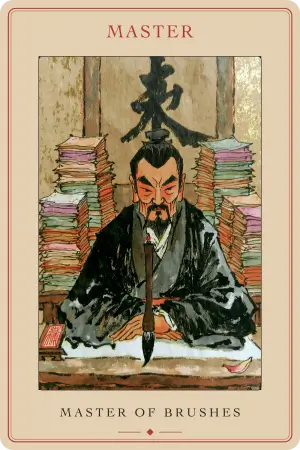
This is the Water of Air carried indoors. Where the Master of Brushes, her King, judges from the examination hall by pure logic, the Matron judges from her doorstep and stitches feeling through the ruling. Her sympathy is real, and it is disciplined: it arrives after the verdict, never instead of it, and never bribes the judgment. She keeps her word with the same exactness she demands of others, observes far more than she speaks, and when she speaks it is quotable. Independence is less her choice than her nature. She can live alone, decide alone, and stand alone, and her door stays open all the same.
Upright meaning
Upright, the card marks a situation that needs one clear sentence rather than ten soft ones. Somewhere in your question there is a dispute, between people, between options, or between what you know and what you wish were true, and the card says the boundary can be drawn fairly and finally if someone will look at the facts and speak plainly. It may point to a wise, direct woman whose judgment can be trusted precisely because she gains nothing from either side. Say the true sentence, and say it once. Do not pad it with apologies that dilute it or sharpen it with anger that discredits it. Set the boundary cleanly, then offer your sympathy, and it will mean more for coming after the verdict.
In love. Honesty on the doorstep: a relationship, or a person in it, that deals in true sentences rather than sweet ones. She can stand for a perceptive, independent partner, often a woman marked by earlier loss, who sees who you actually are and stays. The card favors naming what the bond is and drawing the line that has been chalked and rechalked for months. Expect less poetry and more truth, with the red thread stitched through it. A love that survives this plain speech has straight seams and will hold.
In career. The colleague or leader whose word settles things, whose competence is so established she no longer needs to display it. If the card is you, your judgment is trusted now: disputes will be brought to your doorstep, and your task is to hear both sides fully and rule once. It favors editing, review, law, mediation, teaching, and personnel decisions, and it may be the moment to state a boundary at work, your duties or your worth, in one sentence without heat that colleagues will quote correctly afterward.
In finances. Accounts as exact as her boundary line. The card indicates clear-eyed management: knowing precisely what is yours, what is owed, and where the line between them runs. This is the honest audit, reading the contract to the last character and questioning the charge that does not add up. It often signals a fair resolution of a money dispute, a settlement handled cleanly, or the counsel of an experienced, impartial woman. You gain by being the person in the room whose numbers are simply correct.
In health. Her own regimen: precision, honesty, and unhurried self-command. Look at your health and habits the way she looks at a boundary dispute, exactly, without flattery and without cruelty. The card favors measured practices over dramatic ones, the checkup attended and the diagnosis actually read, the small daily discipline sewn in stitch by stitch until it runs without supervision. It often marks recovered strength after a hard period, a body more exactly known for having been through something.
Reversed meaning
Reversed, the card shows the verdict without the sympathy. Sharpness curdles into sarcasm, insight into fault-finding, the one true sentence into a stream of cutting ones. The reversed Matron gossips instead of judging and wounds instead of clarifying, mistaking coldness for objectivity. Bitterness after loss, isolation behind a closed gate, rigidity, and a memory for wrongs that becomes a ledger no one can balance. The needle still moves, but now it only picks at seams, hers and everyone else's. Before you speak, ask whether your sentence is meant to end the dispute or to win it, and check whether old grief is writing your verdicts for you.
In love. Love conducted as litigation. Every quarrel is remembered verbatim, every fault quoted back with terrible accuracy, the boundary redrawn daily and disputed nightly. One partner may have become the cold judge of the other, verdicts always and sympathy never, or old grief may be presiding over a new relationship and sentencing it for another's crimes. Put down the needle you have been picking seams with, let the other person finish speaking, and if a verdict truly must come, deliver it once, exactly, without contempt.
In career. A workplace where sharpness has replaced judgment. There may be a supervisor or colleague whose criticism is precise, constant, and merciless, or the criticism may be yours. Office talk circulates with damning accuracy, and a boundary dispute festers over unclear duties or credit claimed across the line, kept alive because settling it would end the entertainment. You may be isolating yourself behind competence, the closed gate mistaken for professionalism. Judge openly or not at all, and let the measuring be done where everyone can see the tape.
In finances. The money quarrel is being fed instead of settled. A dispute over what belongs to whom, an inheritance or a shared wall or a joint account, where one party keeps moving the chalked line. Beware advice from someone with a hidden stake, contracts whose exactness serves only the other side, and your own bitterness pricing your decisions, refusing a fair settlement to punish someone. The card can also show pennywise coldness: an account that balances while the relationships around it go bankrupt. Separate the grief from the ledger before you rule.
In health. The judging eye turned on the body without mercy. Self-assessment becomes self-prosecution, every flaw catalogued with terrible accuracy, the mirror used as a courtroom where the verdict is always guilty. There may be a regimen so exact it has become punishment, or the opposite, a refusal to look at all, the curtain drawn on symptoms that need honest measuring. Measure honestly, rule once, and stitch sympathy through the regimen. The body is not the opposing household in the dispute. It is the household you live under.
Historical notes
The card behind the Matron is the Queen of Swords, and her history is a study in reversal. In cartomancy she answers to the Queen of Spades, long shackled to grim associations: widowhood, sterility, mourning, and separation. Arthur Edward Waite described her upright card in overwhelmingly melancholic language, denoting widowhood, female sadness, absence, and privation, and stated plainly that she does not represent mercy and is scarcely a symbol of power. His reversed meaning was wholly malignant: malice, bigotry, artifice, prudery, and deceit.
Modern practitioners have challenged that definition, noting the gap between Waite's words and the visual majesty Pamela Colman Smith drew, and the disparate treatment of the Queen against the King of Swords, who holds the same elemental mastery yet was celebrated as a wise judge. In contemporary practice she is reclaimed as an icon of boundaries and hard-won clarity, her familiarity with sorrow read as the source of her power rather than a sentence of powerlessness. The Rider-Waite-Smith image supports the reclaiming: an upright double-edged sword raised toward the sky, a severed rope tassel at her wrist that marks her as the same woman who escaped the Eight of Swords on her own, and a butterfly crown that shows transformation earned through hardship.
The Tarot of Beijing completes that arc. It keeps the widow but strips the throne, the crown, and the raised sword, and hands her a needle instead. The stone hall becomes a doorstep, the aerial judge becomes a woman of the lane, and the sword's double edge survives as a fine steel point that mends and pricks in the same stroke. What Waite read as sorrow, the deck reads as competence: a woman made precise rather than bitter by loss, who settles the lane's quarrels because her hands are clean of them.
Correspondences
Rank. Matron, the deck's name for the Queen, the mature receptive authority of the suit rather than a numbered pip. In the court she stands between the Courier of Brushes, her Knight, and the Master of Brushes, her King, holding judgment that is settled instead of charging or presiding.
Astrology. She governs the third decan of Virgo and the first two decans of Libra, from 20° Virgo to 20° Libra, roughly September 12 to October 12, and her home in the natural horoscope is the Seventh House of partnership, contracts, and open disputes. Libra, cardinal air of the scales, gives her the instinct for the exact midpoint between two claims and the initiative to end a quarrel rather than merely watch it. In this deck the scales stand one street away as The Hand Scale, the deck's Justice, and the Matron is that same balance carried onto a doorstep.
Element. Water of Air: sympathy joined to judgment, the tea in the cup added to the ink on the brush. She applies emotional intelligence to the analytical suit of Air, mastering the human weight of words rather than burning through problems the way her King does. Virgo's decan sharpens the needle, the exacting eye and the unspooled measuring tape, which is why she sews while she judges.
Kabbalah. As a Queen she belongs to Binah, Understanding, the Supernal Mother on the Pillar of Severity, associated with Saturn. This lends her a structural, faintly sorrowful depth, the wisdom that comes from grasping the fundamental limits of things.
Elemental dignity. Venus, ruler of Libra, supplies the red thread. Beneath the level gaze there is genuine care for the lane and for harmony between roofs that share the same weather, and it aims her verdicts at restored peace rather than victory.
Psychological perspective
The person of this card has let raw intellect be seasoned by real loss. Unlike the Courier who charges into argument, her sharpness has been tested against betrayal and grief, and what remains is a cognitive resilience harder to earn than cleverness. She appears when someone has processed a hard event, a bitter separation or a severe betrayal, without letting it damage their core self or curdle into nihilism. She is the clear-eyed witness who looks at the evidence directly and treats speaking the plain truth as the highest form of kindness.
The shadow is what happens when that grief is left unprocessed. Her discernment can degrade into cynical hyper-vigilance, the bitter certainty that she already knows how everything ends, applied to new people who have not earned it. She can use analysis as a shield against feeling, mistaking thought about an emotion for the emotion itself, until relationships go sterile. At the far edge she weaponizes accuracy, using honesty as a cover for cruelty and turning the needle outward to wound. The deck names the correction in one image: keep the red thread running, because precision without warmth is only a sharpened stick.
The Matron of Brushes across decks
Rider-Waite-Smith. The canonical Queen of Swords sits on a stone throne above the clouds, sword raised vertical and double-edged, a severed tassel at her wrist and butterflies on her crown. The Matron of Brushes keeps the earned clarity and the survived loss but trades the throne for a doorstep and the sword for a needle, bringing the aerial judge down into the lane.
Cartomancy and Marseille. In the older playing-card tradition she is the Queen of Spades, read through widowhood and sorrow, and the pip Marseille decks give the suit of Swords a spare, martial geometry rather than a portrait. Beijing keeps the widow at the center but reads her loss as the root of her competence, not the mark of her defeat.
Crowley-Thoth. Lady Frieda Harris painted her as the Queen of the Thrones of Air, driven by absolute independence and freedom of mind, and Crowley warned that without Earth and Fire she risks ungrounded idealism and, if corrupted, a charming cruelty. The Beijing reversed card meets that same shadow as the widow who gossips instead of judging and sews grievances into every seam.
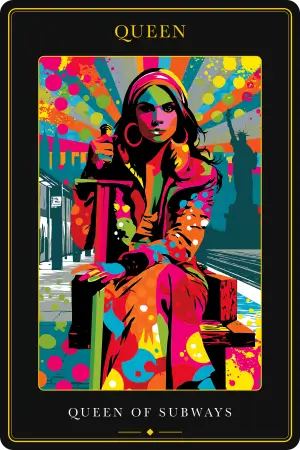
Modern reframings. Recent decks work to free the Queen from the powerless-crone label and restore her as an emblem of boundaries and self-worth. The Tarot of Beijing belongs to that movement, its answer a widow on her own threshold whose authority needs no crown, only a clear eye and one exact sentence.
In combination and context
The Matron of Brushes pulls a spread toward judgment, honesty, and the drawing of clean lines. Beside The Hand Scale, the deck's Justice, she doubles the theme of fair measure, the balance held high in the market now carried onto a private doorstep. With the Master of Brushes, her King, she forms an intellectual power couple, two minds that respect each other's autonomy, though the pairing can warn of a bond gone clinical and short on warmth.
Her own suit tells a chronological story around her. Near the Three of Brushes, the suit's heartbreak, she confirms that her present clarity was forged by a real past wound and that its owner survived it intelligently. Near the Seven of Brushes, the card of stealth, she advises using intellect to guard against a deceptive person and keeping one's own counsel. With the deck's Fool she marks the tension between demanding evidence and taking a leap, advising you to hold the boundary yet allow a calculated risk, and with the High Priestess she joins gut instinct to spoken truth, the knowing and the naming at once.
When she keeps returning to your readings, treat her as a mandate more than a portrait: draw the firm line you have been letting others trample, stop trying to save people who refuse to help themselves, and stop shrinking your own voice to keep others comfortable. Say the one true sentence, say it once, and keep the red thread in it.
Questions for reflection
- Where in your life is a dispute waiting for one clear sentence, and what has stopped you from saying it?
- When you deliver a hard truth, does the sympathy arrive after the verdict, or not at all?
- Which grievances have you been sewing into every seam, and what would it take to unpick them yourself?
The general meaning follows the Rider-Waite-Smith reading — the reference used across Tarot Academy. Open a specific deck above for its own interpretation.
Frequently asked questions
Explore the Tarot
Latest Posts
Discover the ancient wisdom of tarot cards and unlock the mysteries of your spiritual journey. Our blog is your gateway to understanding the rich symbolism, meanings, and practical applications of tarot reading.




















































