
 EN (English)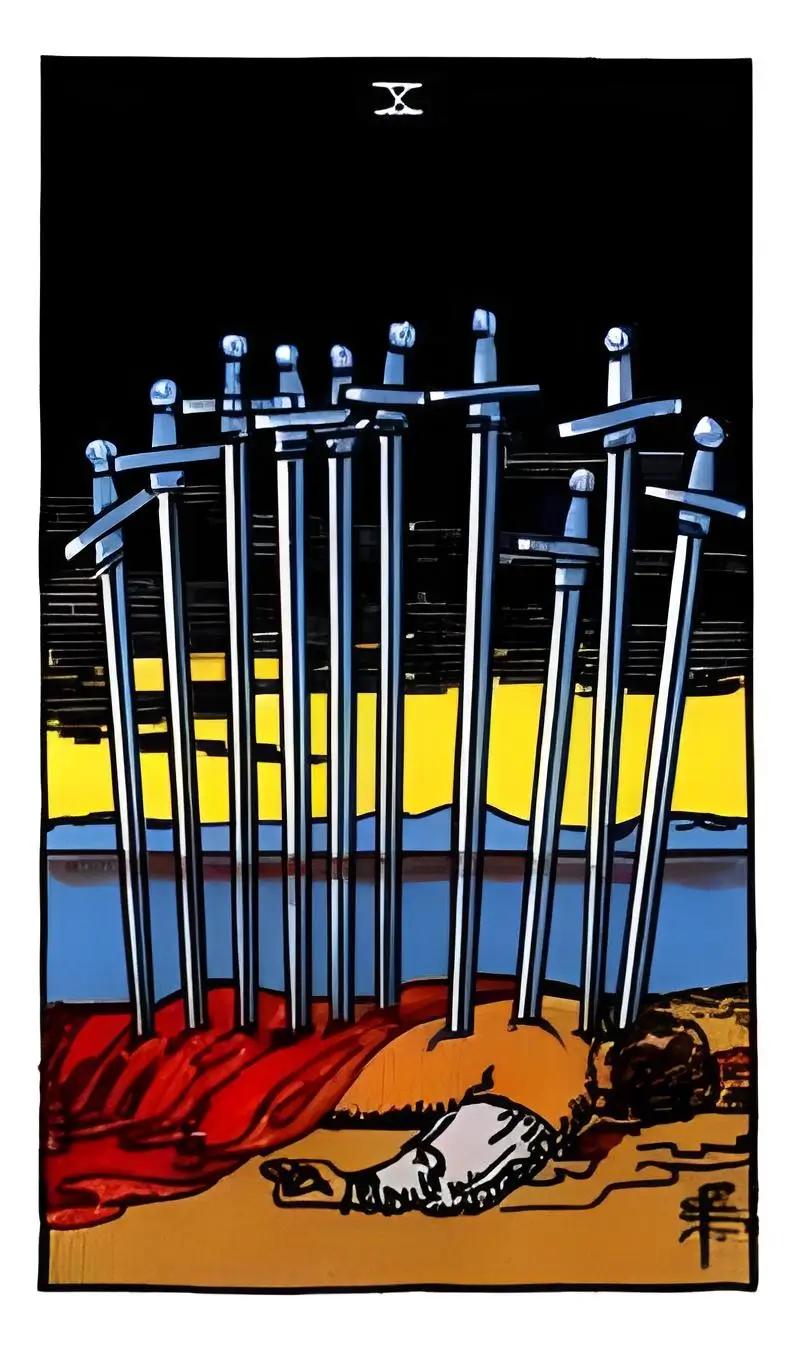



Minor Arcana · Swords (Air)
Page of Swords
Smith's wind-blown watcher: a young mind on a ridge, sword raised, alert and hungry for a truth it has only begun to chase.
Card at a glance
- Numerology
- Page
- Element
- Air (Earth of Air)
- Astrology
- Gemini, Libra, Aquarius (the Air signs)
- Kabbalistic path
- Malkuth in Yetzirah
- Timing
- News in transit, often slower than expected
- Yes / No
- Upright a conditional yes, Reversed no
Upright
curiosity
vigilance
new ideas
truth-seeking
communication
mental energy
beginner's mind
watchfulness
Reversed
paranoia
analysis paralysis
miscommunication
gossip
scattered focus
caustic words
lurking
deceit
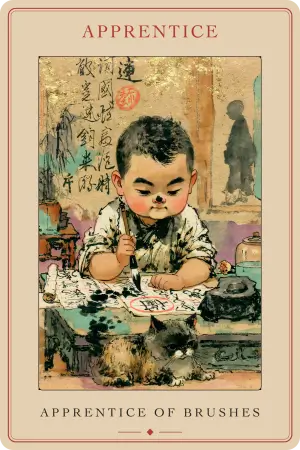
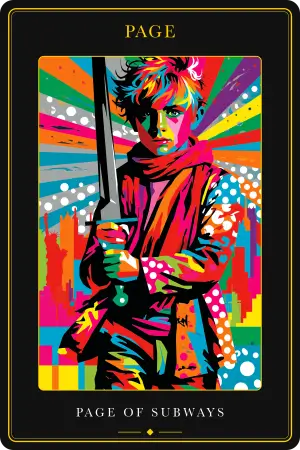
Page of Swords in each deck
Every deck reimagines the same archetype. Compare the art, then open a deck to read its full interpretation.
Imagery and symbolism
Pamela Colman Smith drew this card for the 1909 Rider-Waite deck under A. E. Waite's direction, and her rendering fixes the Page of Swords as a specific scene rather than a generic type. A young figure stands on a rocky, uneven hilltop, gripping a sword upright in both hands, caught mid-stride as if pausing to watch something far off. Wind drives through the hair and clothing, fast clouds cross the sky, and a flock of birds wheels in the distance. Where the Ten of Swords ends the suit in exhaustion, Smith opens the court with pure kinetic energy: the restless, unstable movement of Air made into a person.
The raised sword. Pointed straight up, it reads as a sharp mind, clear thought, and readiness to engage. It stands for knowledge and rational analysis. But because this Page is still learning and gathering experience, Smith lets the same blade carry a warning, the improper use of wisdom or wisdom disregarded by someone who has not yet earned it.
The posture. The body and the sword lean one way while the head turns sharply the other, holding a vigilant, almost defensive watch. This is an intellect alert and ready to pounce, yet uncommitted to any final direction. The upturned earth underfoot is ideas in their nascent, untested stage, seeds thrown into the wind to see what catches.
Wind, clouds, and birds. The wind that lifts the hair and stirs the tree branches is change itself, the pull to see familiar things from a new angle. The clouds run white and swift for pure intentions and quickness of thought, though their drift also hints at immature thinking and sudden turns. The birds set the bird's-eye view the Page reaches for, an overarching perspective on the whole field.
Color and dress. Red and yellow dominate the clothing. The yellow leggings and undergarment are mental stimulation and the illumination of the mind, while the red boots are a burning passion for the quest, so the cold intellect runs on hot fuel. The light, unencumbered attire resembles a fencer's costume and gives the Page agility to keep pace with its own quick thoughts. The ground beneath the feet shows a wish to stand firm and hold to one's principles, and the bright background tones carry the card's lightness and reach. In The Pictorial Key to the Tarot, Waite defined the figure as authority, overseeing, secret service, vigilance, spying, and examination.
Core meaning
In this deck the Page of Swords is a new beginning in intellectual growth and learning, the youngest emissary of the suit and the pure form of curiosity. It is the mind fully awake and thirsty for information, standing at the point where observation is about to become action. Elementally it is the Earth of Air, the restless work of grounding swirling abstract thought into something workable, taking a fleeting idea and turning it into a spoken sentence, a written text, or an organized file.
In the suit sequence the Page rises straight out of the Ten of Swords, the card of mental exhaustion and rock bottom. That gives it the quality of a resurrection, a fresh curious intellect unburdened by past failure and eager to learn from scratch. Smith's young seeker carries the beginner's mind, willing to explore many avenues before settling on one, refusing to assume the answer before the question has properly been asked.
Upright meaning
Upright, the card marks a period of data collection and active thinking. You are observing closely, asking incisive questions, and refusing to settle for vague or contradictory answers. It is the energy of the diligent researcher, the investigative journalist chasing a scoop, the apprentice diving into a new subject. Ideas arrive in a flood, and the card asks you to channel that airy inspiration into careful, grounded planning rather than leaping. As a messenger it points to news, texts, documents, and legal paperwork, though the earthy component often slows the transmission, so strategic patience is the counsel: use the wait to prepare your mind for the news instead of feeding anxiety.
In love. A dynamic built on intellectual connection, flirty and fast-moving conversation, and genuine curiosity about a partner instead of complacency. The risk is that it stays cerebral, wary of emotional conflict and reluctant to be vulnerable. Asked about a prospect's feelings, it can mean interest is budding while the person guards themselves closely. If you are single, it advises socializing more actively and warns that awaited news about a romantic prospect will likely be delayed.
In career. A learning sprint. You are the apprentice of the mind, eager and watchful, absorbing information fast at the start of a new project. The advice is to act like a workplace detective, take meticulous notes, ask probing questions, and avoid the pretense of knowing what you do not yet understand.
In finances. A call for vigilance. Read the fine print twice before signing, analyze contracts and investments objectively, and stay informed rather than leaning on hope or intuition alone.
In health. The nervous system and mental clarity. The card points to settling the internal chatter through journaling, cognitive work, or honest conversation that quiets the mind.
Reversed meaning
Reversed, the intellect turns into a weapon against the self and others. Healthy vigilance curdles into paranoia, and the fog of Earth and Air thickens into an impenetrable miasma. You may overthink obsessively, feel perpetually unprepared, and glance over your shoulder for hidden attacks that are not there. It is also the card of analysis paralysis, too many open tabs in the mind, endless research used as a stalling tactic to dodge the responsibility of acting.
Its sharpest shadow is language corrupted. Rapid assumptions replace listening, and the tongue turns caustic, cynical, or vengeful. This is the archetype of the internet troll and the toxic gossip, spreading rumors and picking arguments for the thrill of drama, all vicious talk and empty bravado with no real follow-through.
In love. Charming banter devolves into petty bickering and exhausting mistrust. Words fly faster than feelings can process, and one party may weaponize their wit to wound. The card flags possible deceit and advises verifying facts before reacting to an emotional trigger.
In career. Office gossip, the premature sharing of unverified opinions, and eroded professional trust. It warns against acting on misinformation and against endless research that never becomes action.
In finances. Poor research and risky decisions made on incomplete data, with a real danger of scams, fraud, and misleading advice.
In health. Mental restlessness that drains the body, information overload showing up as scattered focus, anxiety, and disturbed sleep. The remedy is elemental: move the body to ground and land the racing mind.
Historical notes
The Tarot began in early fifteenth-century northern Italy and reached southern France after the French took Milan and Piedmont in 1499. In the Tarot de Marseille the card was the Valet d'Epees, and the earliest surviving cards of the definitive Marseille pattern were made by Philippe Vachier of Marseille in 1639. In decks like Jean Dodal's, the Valet looks deliberately to the left, the direction of the past and of wariness, and holds the sword in the left hand, an image that carried secretive, watchful overtones, as if the figure might offer a handshake with the right hand while hiding a blade in the left.
That gave the figure its founding character as the investigator and the spy, and cartomantic texts from the Bologna tradition attributed surveillance, secret service, revelation, and the search for truth to it. Waite and Pamela Colman Smith fixed the modern scenic Page in 1909, turning the wary Valet into the restless, wind-blown intellect keeping watch on a ridge. Court de Gebelin's eighteenth-century claim that the cards descended from an Egyptian Book of Thoth, later disproven by Egyptologists, still colors the esoteric reading of the truth-seeking Swords.
Correspondences
Rank. The Page, youngest of the court, the emissary and student who lacks the King's mastery and the Queen's integrated wisdom and makes up for it with raw hunger to learn.
Astrology. As a card of Air, the Page connects to the three Air signs, Gemini, Libra, and Aquarius. Gemini lends its quick, curious, sociable mind and easy movement between topics; Libra its pursuit of truth, balance, and fair judgment, with the sword standing for justice; Aquarius its innovation, foresight, and progressive read on emerging trends. Esoteric sources sharpen this to Venus in the Air signs, so the Venusian pull toward connection and the beauty of ideas is reached through debate and fact-checking rather than soft consensus.
Element. The Earth of Air, the meeting of two incompatible elements. The airy mind wants to fly everywhere at once while the earthy rank demands focus on a single observable point, and their friction produces both the card's jittery energy and the fog it peers through to uncover hidden motives.
Kabbalah. Pages sit in Malkuth, the tenth sphere and material Kingdom, within Yetzirah, the formative world of Air, which casts the Page as the initiator who grounds intellectual concepts into physical reality. Advanced tarot numerology reads it as 11, the card following the 10 of Swords, marking the mind's resurrection after that collapse.
Timing and yes/no. It leans to a windy, news-gathering stretch when awaited information runs slower than you would like. As a yes or no it is a conditional yes upright, a yes to learning and exploring while you gather more, and a firm no reversed when focus and accurate data are lacking.
Psychological perspective
The Page of Swords is the beginner's mind, what Zen calls Shoshin, an intellect that knows it has not arrived and stays open because of it. Modern readers cast it as the protagonist at the start of a hero's journey, figures like Arthur as a boy or Frodo at the onset of the quest, inexperienced but flexible and willing to step into the unknown. Its great strength is refusing to assume the answers before the questions are properly asked.
Its guardedness is the psychological knot worth naming. The Page fiercely protects its ideas, autonomy, and vulnerabilities, an effective shield against manipulation that can harden into an emotional fortress. It is the part of the psyche that resists being seen and lashes out in defense of intellectual pride when triggered, relying on cold logic to sidestep the messy work of intimacy. In the digital age this same watchfulness has been reborn as the lurker and the cyber-sleuth, the person who stands at a safe vantage point, gathers data unseen, builds a whole narrative in the mind, yet lacks the courage for genuine, vulnerable contact. The work is to balance self-protection against the openness real connection requires.
The Page of Swords across decks
Smith's 1909 Page sits between an older abstract original and a later esoteric reinvention, so it reads best against both.
Tarot de Marseille. The Valet d'Epees, drawn with the suit's abstract curved blades, looking to the left with the sword in the left hand, the wary investigator watching for unseen threats rather than the scenic figure on a ridge.
Crowley-Thoth. Aleister Crowley and Lady Frieda Harris replaced the Page with the Princess of Swords, the earthy child of the element, the wind over the grounds of Assiah. Where Waite's Page stands and observes, the Thoth Princess moves with force, often shown near a war chariot. At her best she is practical, clever, and rigorous, able to pierce illusion for absolute clarity. At her shadow she turns stubborn, cruel, and destructive, a child lacking morality who lashes out when results fail to please, the Earth and Air in her nature breeding an insecurity she must overcome.
Modern decks and readings. Contemporary practice has recast the card for the information age. The old physical spy has become the social media lurker, the obsessive analyzer of every text, and at its worst the internet troll. Online readers treat it as the base signifier of watching from a distance, an act of intellect rather than physical pursuit, someone monitoring a profile without the maturity to reach out for real.
In combination and context
The Page of Swords works as a reactive modifier, sharpening or disrupting the cards around it. With the Ace of Swords its nascent curiosity meets raw power, a razor intellect cutting straight through a problem into decisive action. With The Magician the willpower to execute frees it from unproductive loops and turns thought into motion. With The Chariot its static vigilance is mobilized, processing vast information at speed toward a defined goal. Against the Knight of Pentacles the fast, swirling thoughts collide with slow, methodical earth, trapping a person between quick ideas and the inability to act on them.
In the modern reading of surveillance the pairings grow specific. With the Seven of Swords it becomes the sneak using fake accounts and active deception. With The Devil or the Nine of Swords the watching mutates into obsessive, anxious attachment that cannot look away. With The Moon it is the delusional watcher projecting false narratives onto what they see. With The Emperor it is controlling, ownership-driven surveillance, and with The Hanged Man it is the creepy sense of being observed by someone suspended out of sight. In a yes or no spread the upright card is a qualified yes that asks you to gather more first, while reversed it is a clear no.
Questions for reflection
- What are you genuinely curious about right now, and where is that curiosity asking you to look closer?
- Where has your gathering of information stopped being research and turned into a way to avoid acting?
- When do you reach for sharp words or cold logic to keep from being truly seen?
The general meaning follows the Rider-Waite-Smith reading — the reference used across Tarot Academy. Open a specific deck above for its own interpretation.
Frequently asked questions
Explore the Tarot
Latest Posts
Discover the ancient wisdom of tarot cards and unlock the mysteries of your spiritual journey. Our blog is your gateway to understanding the rich symbolism, meanings, and practical applications of tarot reading.




















































