
 EN (English)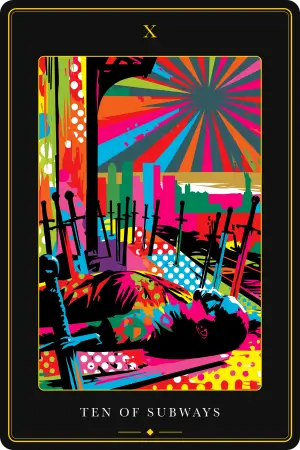


Minor Arcana ·
Page of Subways
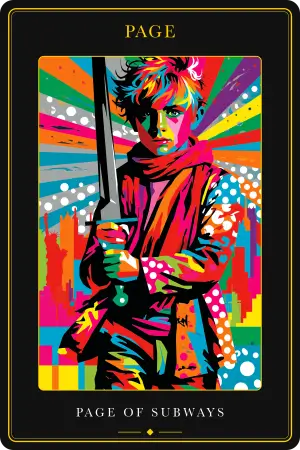
The kid on the subway platform who watches everything and takes your measure before you speak, sword up and scarf lifting in the wind of an approaching train.
Card at a glance
- Numerology
- Page
- Element
- Air
- Astrology
- Gemini, Libra, and Aquarius (the Air signs)
- Kabbalistic path
- Malkuth in Yetzirah
- Timing
- Spring winds, a stretch of gathering news
- Yes / No
- Upright a conditional yes, Reversed no
Upright
curiosity
watchfulness
new ideas
truth-seeking
communication
sudden news
beginner's mind
street-smart analysis
Reversed
overthinking
gossip
misread messages
hasty conclusions
defensiveness
scattered focus
cynicism
analysis paralysis
Page of Subways in each deck
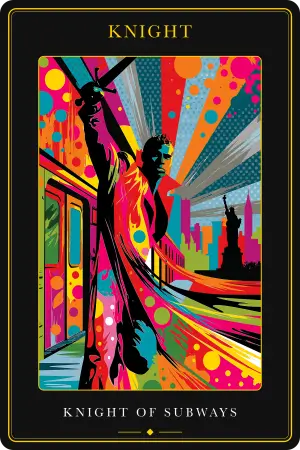
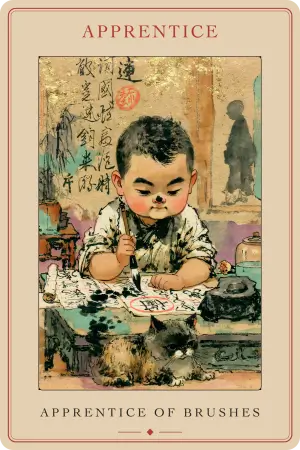
Every deck reimagines the same archetype. Compare the art, then open a deck to read its full interpretation.
Imagery and symbolism
In the Tarot of New York City the Page of Subways is a young boy holding a great sword upright before him in both hands, the classical blade of the suit of mind carried into pop-art streets. He does not brandish it. He holds it steady and close, the way a newcomer holds the one thing he is sure of, and the raised blade reads as a sharp young mind ready for truth, still liable to swing that sharpness clumsily while he learns.
The gaze. His eyes are the center of the card, steady and appraising, aimed straight out at you. This is the platform kid who watches everything and takes your measure before you have said a word. It carries the card's core note of honest assessment and a healthy distrust that checks before it believes.
The scarf and the wind. A scarf in hot pinks and reds streams from his neck like a signal flag. It stands in for the wind that animates the old card, the element of Air in motion, here turned into the gust of displaced air that announces a train before its lights show in the tunnel. Change is coming down the line, and the Page feels it first.
The sunburst and the halftone. Behind his head, rays of orange, green, blue, pink, and gold fan out like trains leaving a terminal in every direction at once, a mind switched fully on. Fields of halftone dots scatter across them, the pixel-grain of the information age and the thousand small signals his attention keeps sampling.
The skyline and Liberty. Along the lower edge runs the city in stacked color blocks, with the Statue of Liberty at his side. Liberty is the Page's patron here, the torch-bearer of enlightenment beside the torch-bearer of questions, and the skyline names what the young mind is actually studying: not abstractions, but the city, its systems, and its fine print. His clothing is a patchwork of every color in the deck because he has not yet chosen who he is, and the palette stays loud and joyful even in a suit known for hard truths, because at this stage thinking is still thrilling.
Core meaning
The Page of Subways is the youngest energy of the suit of mind, curiosity with its eyes wide open at the very start of its journey. In this deck the intellect runs underground: the current of information that moves the city, the rush of wind through the tunnel just before the train arrives. The Page is that intellect at its most electric, the beginner who has decided to question everything the city presents as settled.
Elementally he is the Earth of Air, the restless job of grounding swirling abstract thought into something you can use, taking a fleeting idea and turning it into a spoken sentence or a plan. He rises straight out of the Ten of Subways, the card of mental rock bottom, which gives him the quality of a fresh mind unburdened by old failures and eager to learn from scratch. His strength is the willingness to explore many lines before committing to one, and to ask the question before assuming the answer. The scope can look modest, one kid and one idea, but the card is tied closely to worldview, and one honest question asked at the right moment can change which line a whole life runs on.
Upright meaning
Upright, the card marks a period of active observation and data collection. You are reading the room, reading the platform, reading between the lines, asking incisive questions and refusing to settle for a garbled answer. Ideas arrive in a flood, and the work is to channel that airy inspiration into careful, grounded planning. As a messenger the Page brings sudden news, a message, or a document that demands quick, clear-headed processing, though the earthy side of the card can slow delivery, so the counsel is strategic patience: use the wait to prepare rather than fret.
In love. A connection that begins with wit and questions, the discovery that a person's mind is a place you want to keep visiting. It stays curious rather than complacent and prizes honesty over games. The risk is that it lives in the head while love does not, so let the analysis inform the feeling instead of replacing it.
In career and work. A learning sprint, the stage where every day on the job is also a class. Act like a workplace detective: watch how the good ones do it, take notes, ask how the system works, and avoid pretending to know what you do not. Honesty and early questions move you up faster than any shortcut.
In money. The reader of fine print. Check the lease clause, compare the fees, research the investment before a dollar moves, and read any statement all the way to the bottom. In a city where everyone has an angle, a healthy distrust is a financial asset.
In health. Youth and the restless urge to move, plus an investigative eye on the body. It favors trying a new activity, learning what a routine is actually for, and treating attention paid to the body as intelligence rather than vanity.
Reversed meaning
Reversed, the same sharp kid runs on bad information, reacting to the headline without reading the article or boarding the first train without checking where it goes. Watchfulness turns inward and sour: instead of reading the platform, the mind loops on old mistakes and imagined slights, the 3am replay of worst cases. It can mean hasty conclusions, immature thinking, or cleverness spent on point-scoring rather than understanding, and patience that runs out somewhere between stations.
Its sharpest shadow is language. Rapid assumptions replace listening, and the tongue turns caustic or cynical. This is the gossip carrying news one stop before it was verified, the argument pursued for the win rather than the truth, the bluntness that mistakes itself for honesty. Under it all is usually a young mind that got burned trusting something and decided never to be caught out again, so the defensiveness reads as arrogance but sits closer to fear.
In love. The message read three times, each reading finding a worse meaning, and the reply sent to the worst one. It points to jumped conclusions and anxiety doing the talking, when the silence often just means the other person was asleep.
In career and work. Carelessness dressed as speed, details overlooked, the task done twice because it was not understood once. Office gossip and information overload scatter the focus, and unverified opinion gets shared before it should.
In money. Decisions made at the speed of a closing door, a contract signed at the first station instead of the right one. Watch for scams, numbers that do not survive a second look, and advice from someone running their own angle.
In health. Energy stalled between stations, the plan abandoned at the first inconvenience, overthinking standing in for action while 3am anxiety burns the energy the morning needed.
Historical notes
The figure the Tarot of New York City reworks is centuries old. The Tarot began in early fifteenth-century northern Italy and reached southern France after the French took Milan and Piedmont in 1499. In the Tarot de Marseille the card was the Valet d'Epees, and the earliest surviving cards of the definitive Marseille pattern were made by Philippe Vachier of Marseille in 1639. In decks like Jean Dodal's the Valet looks deliberately to the left, the direction of the past and of wariness, and holds the sword in the left hand, an image with secretive, watchful overtones.
That founded the figure's character as the investigator and the spy, and cartomantic texts from the Bologna tradition attributed surveillance, secret service, revelation, and the search for truth to it. Waite and Pamela Colman Smith fixed the modern scenic Page in 1909, turning the wary Valet into a restless, wind-blown intellect on a ridge. New York keeps that watchful, truth-seeking core and moves it from the windy ridge to the subway platform. Court de Gebelin's eighteenth-century claim that the cards descended from an Egyptian Book of Thoth, later disproven by Egyptologists, still colors the esoteric reading of this truth-seeking suit.
Correspondences
Rank. The Page, youngest of the court, the emissary and student who lacks the King's mastery and the Queen's settled wisdom and makes up for it with raw hunger to learn.
Element. The Earth of Air, two incompatible elements meeting. The airy mind wants to fly everywhere at once while the earthy rank demands focus on one observable point, and their friction gives the card both its jittery energy and the fog it peers through. In this deck the Air runs underground, as wind through the tunnel and as the current of information moving the city.
Astrology. The three Air signs. Gemini gives the transit-map mind that switches topics the way a rider switches lines, with the endless questions and the appetite for news. Libra brings the scale to the sword, weighing the evidence before repeating the rumor and caring whether a sharp remark is also a fair one. Aquarius supplies the fascination with systems and the idealism under the distrust, the sense that seeing clearly is meant to change what you see.
Kabbalah. Pages sit in Malkuth, the tenth sphere and material Kingdom, within Yetzirah, the formative world of Air. That makes the Page the initiator who grounds intellectual concepts into the physical plane, following straight on from the Ten of Subways into a fresh mental cycle.
Timing and yes/no. A windy, news-gathering stretch of spring. As a yes or no it is a conditional yes upright, a yes to learning and exploring while you gather more, and a firm no reversed when focus and accurate data are missing.
Psychological perspective
The Page of Subways is the beginner's mind, what Zen calls Shoshin, the intellect that knows it has not arrived and stays open because of it. Modern readers cast it as the protagonist at the start of a hero's journey, inexperienced but flexible and willing to step into the unknown. In this deck the type is easy to spot: the new hire whose question makes the meeting go quiet, the neighbor who caught the discrepancy in the building notice first, the kid on the train who reads faces and fine print with the same appetite. Not knowing does not embarrass him; it motivates him.
His guardedness is the knot worth naming. The Page protects his ideas, his autonomy, and his soft spots fiercely, an effective shield against manipulation that can harden into a fortress. He can rely on cold logic to dodge the messy work of intimacy, and he lashes out in defense of intellectual pride when touched. Under the sharpness is usually a mind that trusted once, got burned, and resolved never to be caught out again. The work is to keep the distrust as a tool rather than a wall, and to balance self-protection against the openness real connection asks for.
The Page of Subways across decks
Tarot de Marseille. The Valet d'Epees, drawn with the abstract curved blades of the suit, looking left with the sword in the left hand, the wary investigator watching for unseen threats.
Crowley-Thoth. Crowley and Lady Frieda Harris replaced the Page with the Princess of Swords, the earthy child of the element, the wind over the grounds of Assiah. Rather than standing and watching she moves with force, often near a war chariot. At her best she is practical, clever, and rigorous, able to pierce illusion for clarity. At her shadow she turns stubborn, cruel, and destructive, the Earth and Air in her nature breeding an insecurity she has to overcome.
Rider-Waite-Smith and the modern reading. Smith's 1909 Page stands on a windy ridge, sword up, head turned to watch the distance. Contemporary practice recast that figure for the information age, from physical spy to social media lurker, the obsessive analyzer of every text, and at its worst the internet troll. The Tarot of New York City keeps the watching but changes the vantage point, trading the ridge for the platform and the flock of birds for the halftone dots of the feed.
In combination and context
The Page of Subways works as a reactive modifier, sharpening or unsettling the cards near it. With the Ace of Subways its nascent curiosity meets raw power, a razor intellect cutting straight through a problem into decisive action. With The Magician the willpower to execute frees it from unproductive loops and turns thought into motion. With The Chariot its still vigilance is mobilized, processing vast information at speed toward a defined goal. Set against the Knight of Pentacles, the fast swirling thoughts collide with slow methodical earth, trapping a person between quick ideas and the inability to act on them.
In the modern reading of watching, the pairings grow specific. With the Seven of Subways it becomes the sneak using fake accounts and active deception. With The Devil or the Nine of Subways the watching mutates into obsessive, anxious attachment that cannot look away. With The Moon it is the delusional watcher projecting false narratives onto what they see. With The Emperor it is controlling, ownership-driven surveillance. In a yes or no spread the upright card is a qualified yes, gather more first, while reversed it is a clear no.
Questions for reflection
- What in your day right now feels slightly off, the number or tone or promise that does not quite add up, and what happens if you look closer instead of away?
- Where has your gathering of information stopped being research and turned into a way to avoid getting on the train?
- When do you reach for a sharp remark or cold logic to keep from being seen?
The general meaning follows the Rider-Waite-Smith reading — the reference used across Tarot Academy. Open a specific deck above for its own interpretation.
Frequently asked questions
Explore the Tarot
Latest Posts
Discover the ancient wisdom of tarot cards and unlock the mysteries of your spiritual journey. Our blog is your gateway to understanding the rich symbolism, meanings, and practical applications of tarot reading.




















































