
 EN (English)



Minor Arcana · Cups (Water)
Eight of Cups
Smith turned the pip into a departure: a red-cloaked figure leans on a staff and walks away from eight neatly stacked cups toward the mountains, an eclipsed sky overhead.
Card at a glance
- Numerology
- 8
- Element
- Water
- Astrology
- First decan of Pisces (February 19–28), ruled by Saturn
- Kabbalistic path
- Hod (Splendor), where the Eights sit
- Timing
- The first ten days of Pisces, late winter
- Yes / No
- No to staying, yes to leaving
Upright
Walking away
Renunciation
Departure
Disillusionment
Soul-searching
Letting go
Seeking meaning
Pilgrimage
Reversed
Fear of change
Staying stuck
Avoidance
Clinging
Aimless drifting
Stagnation
Indecision
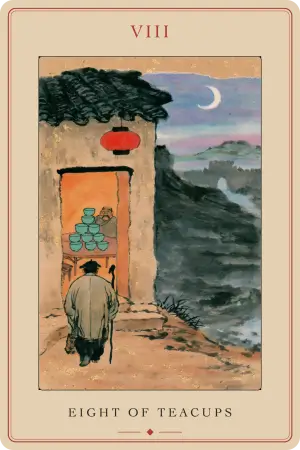
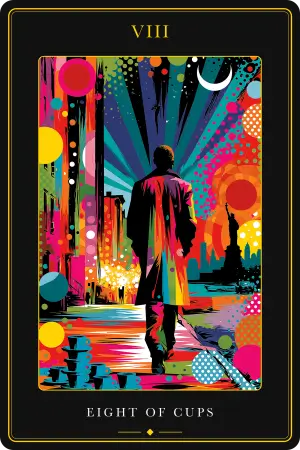
Eight of Cups in each deck
Every deck reimagines the same archetype. Compare the art, then open a deck to read its full interpretation.
Imagery and symbolism
Pamela Colman Smith drew this card as the moment a person turns their back on a finished life. In 1909, working under Arthur Edward Waite, she gave the pip a human protagonist and an atmospheric landscape where the Tarot de Marseille had only shown eight chalices in a pattern. A lone figure in a red cloak and red boots walks away from the viewer, leaning on a sturdy wooden staff as they climb from a marshy shoreline toward a range of craggy mountains. This deck reads the whole scene as the harsh path of self-discovery, the exact moment you leave a completed situation to search for something more.
The eight cups carry the first half of the meaning. They stand in the foreground perfectly ordered and fully stacked in a tiered, arch-like formation, none overturned, broken, or spilled. That intactness sets the card apart from the grief of the Five of Cups, where three chalices lie on their sides. This deck reads the stacked cups as fulfilled desires, material success, and stability, an established way of life that has stopped delivering meaning. And there is a structural anomaly the research fixes on: a gap in the top row where a ninth cup should sit. That gap is the psychological anchor. Despite the accumulated wealth, status, or security, something essential is absent, and it cannot be found by rearranging what is already there.
Smith's color language does deliberate work. The figure's red cloak and red boots read as passion, vitality, and earthly drive, so the departure takes burning courage rather than cold detachment. This deck says the red signals the enduring passion and raw stamina needed to survive the trek, and the staff proves the traveler is braced for the physical toll of the climb. The landscape shifts from water to stone. The figure leaves the fluid emotional world of the Cups suit, its river and calm water standing for attachment and the subconscious, and ascends into a barren, rocky wilderness that pictures how hard emotional detachment really is. The distant purple and grey mountains loom as barriers, the destination of the soul's odyssey.
Overhead sits the card's most debated symbol. This deck reads a prominent Moon dominating the sky, signalling that an internal phase has reached full maturity and the subconscious has forced an action, with the moonlight providing the only guide for the journey so the traveler must rely on intuition over logic. The image itself shows a face within a crescent that also encloses a full sphere, which many practitioners read as a full moon or a lunar eclipse. Waite contradicted the purely lunar reading in the Pictorial Key: "It is not actually night time, but a solar eclipse. It is daytime, yet feels like night." Under his gloss the rational solar mind is overshadowed and a deeper subconscious pull overrides logic to dictate the leaving. The word eclipse itself descends from Greek for "to abandon," a fitting root for a card about walking away.
Core meaning
This deck reads the Rider-Waite Eight of Cups as renunciation: the deliberate walk away from the familiar in search of sharper goals and a higher truth. Your satisfaction with the status quo has collapsed, forcing a conscious decision to alter the trajectory of your life. The departure is rarely easy, and this deck names its mechanics plainly, leaving the past behind in order to advance. The Golden Dawn behind the deck titled the card the Lord of Abandoned Success, and that phrase holds the paradox. Where earlier cups in the suit celebrate love, community, and emotional milestones, the Eight is the moment the soul realizes that material stability and apparent fulfillment are no longer enough. It speaks to the ache of outgrowing your own life rather than to sudden loss or external ruin.
Under the picture sits the weight of the number eight, which this deck reads as power, structural balance, and infinite cycles, here turned entirely inward. Within the Minor Arcana, eights mark the culmination of a phase and a test of mastery after real achievement. Poured into the fluid water of Cups, that rigid structure eventually feels stagnant, because water resists a static container and wants to flow. The mastery this card asks for is the discipline of knowing when to detach and pour yourself into a new vessel, not the mastery of accumulating more. The shape of the digit itself, an endless loop, points to a cycle of shedding a dead skin so the sequence can begin again.
Upright meaning
Upright, this deck reads a deliberate walk away from a completed situation, the courageous departure prompted by inner knowing rather than by a sudden disaster like The Tower or an inevitable ending like Death. You clearly understand that old ties, habits, and comforts no longer serve any purpose, and you are turning your back on something that looks fine on paper because it no longer feeds you. The recommendation attached is direct: gather the nerve to leave your safety net, practice saying no to people and obligations that have stopped returning value, map your exact next steps, then start walking. The transition will cost you immediate comfort in exchange for long-term leverage.
In love. A hollow attachment that must be severed. This deck reads a partnership that once defined you but where the baseline satisfaction has flatlined, so you leave in search of a heavier, more authentic emotional experience. Often the card forces a mandatory period of isolation, a hard reset where you figure out your own mechanics before engaging with anyone else. You hold out for a profound, structural unity and refuse to settle for less than you deserve. For singles, it means walking away from old patterns and past versions of yourself that no longer fit.
In career and work. A hard career pivot. This deck reads leaving a stable, lucrative, but spiritually draining position, quitting a comfortable job and walking away from an established network to advance to your next professional stage. Deep fatigue and severe dissatisfaction drive the exit, and the card frames it as prioritizing your own trajectory over company loyalty. The current ladder is leaning against the wrong wall, so you cut the dead weight and review your exact targets. The recognition underneath is that success without fulfillment is its own kind of failure.
In finances. A calculated exit from an income stream whose yield no longer justifies the effort. This deck reads cutting your losses on dead-end investments or hustles, decoupling your self-worth from minor material gains, and tearing down an old financial strategy to build a new one. The immediate transition triggers severe uncertainty, but the break is mandatory for your next stage of growth.
In health and the body. A hard audit of daily routines. This deck reads walking away from outdated habits and fitness methods that have flatlined, dropping toxic coping mechanisms and punishing diets, and pivoting toward restorative care aimed at recovery rather than punishment. Spiritually it heralds a pilgrimage, leaving old dogmas behind to follow your own inner guidance, even when the transition is physically uncomfortable.
Reversed meaning
Reversed, this deck reads a crippling hesitation. You recognize that you need to leave, but fear of loss keeps you paralyzed in place. The figure stops, looks back, and cannot bring themselves to move. This stalling leads directly to missed opportunities and chronic disappointment, and the card exposes an active refusal to move forward because the next step feels too uncertain. The recommendation is to stop, study your own resistance, name exactly why you are holding on, accept the anxiety of change, then finalize the break.
In love. Staying trapped in the wreckage of a dead relationship because the terror of being alone paralyzes you. This deck reads a stubborn refusal to pack your bags that locks both partners in deep stagnation, a secret doubt about your ability to find anything better keeping you chained to a broken dynamic out of cowardice or misplaced obligation. Going back to a toxic ex or staying out of habit only compounds the damage.
In career and finances. Severe stagnation driven by fear of the unknown. This deck reads clinging to the miserable certainty of a dead-end role, or clutching dead investments and obsolete income streams because they feel familiar, even as they drain your resources and block new opportunity. You may have already mapped your exit but keep delaying it. Sometimes this is golden handcuffs, financial security acting as a prison you are too afraid to leave.
In health and drifting. At the other extreme, the reversed card can mean aimless wandering: walking away from commitments too easily and jumping from one situation to the next without ever addressing the internal void that causes the dissatisfaction. This deck reads it as running from responsibility rather than moving toward truth, a lack of discipline that returns you to what was already outgrown. It also shows up as clinging to punishing, ineffective physical routines out of habit and ignoring warning signs the body is sending.
Historical notes
The departure scene is a Rider-Waite-Smith invention. Earlier European decks such as the Tarot de Marseille rendered the Minor Arcana through abstract, geometric arrangements of suit symbols, with no human protagonist and no journey. In 1909 Pamela Colman Smith, working under A. E. Waite, introduced a figure and an atmospheric landscape, turning the numbered pip into a small narrative that made the esoteric idea legible. The cloaked walker, the stacked cups, the missing ninth, and the eclipsed sky all belong to her hand.
The card's older meanings survive in Waite's Pictorial Key and in Golden Dawn material, where phrases like "temporary success" and a "thing thrown aside as soon as gained" suggest impermanence and a lack of follow-through. The Golden Dawn title Lord of Abandoned Success fixed the archetype. Aleister Crowley later sharpened it into something bleaker under the name Indolence, drawing on the same Saturn in Pisces attribution to recast the departure as an escape from decay rather than the hopeful pilgrimage Smith drew.
Correspondences
Number. Eight, which this deck reads as power, structural balance, and infinite cycles, focused inward by the emotional weight of Cups. In the Minor Arcana it marks the culmination of a phase and a test after real achievement. Poured into water, that structure turns rigid and stagnant, so the card's true mastery is the discipline of releasing the old before the new can take root.
Astrology. Saturn in Pisces, governing the first decan of Pisces, roughly February 19–28. This deck reads the placement as a fusion of the heavy emotional drift of Water, the grim stability of Saturn, and the deep sensitivity of Pisces. Pisces gravitates toward distant ideals and pure empathy and would drown in feeling, so Saturn steps in to force reality testing and calculated decisions over endless dreaming. The friction produces world-weariness and the hard lesson that earthly success can never satisfy the infinite yearnings of the soul. The tension is between Pisces' classical ruler Jupiter, which expands and seeks joy, and the decan's ruler Saturn, which restricts and takes away.
Element. Water, the suit's element of emotion, intuition, and the subconscious, here demanding a search of the soul and a willingness to break your current trajectory.
Kabbalah. The card sits with Hod, the sphere of intellect, splendor, and form, in the watery world of Briah. It holds Path 27, which links Netzach, the sphere of emotion and instinctual drive, with Hod, which introduces rational analysis. This is the moment the intellect examines the emotional achievements and finds them wanting. Hod's ruler Mercury adds a restless, critical mind that refuses to settle for shallow joy.
Elemental dignity. Beside cards of Water or Swords the disillusionment deepens toward analysis and withdrawal. As a yes or no, it says no to staying and yes to leaving.
Psychological perspective
Psychologically, the Rider-Waite Eight of Cups maps onto the hedonic treadmill, the human habit of chasing one milestone after another in the belief that acquiring them will finally yield lasting happiness. This card is the breakthrough where a person sees that external acquisition does not equal internal fulfillment. The disillusionment it pictures is an evolution in consciousness rather than a failure. This deck ties that shift to the eclipsed sky: an internal phase has reached full maturity, and the subconscious has forced an action the conscious mind would rather avoid.
It takes real maturity to recognize that a situation has served its purpose and to honor the grief of leaving something that is still partly good. The card asks you to tell comfort apart from alignment. Staying in a misaligned life out of obligation, habit, or fear of disappointing others leads straight to the emotional decay that Crowley's version of the card depicts. Practitioners sometimes work with it through a simple ritual of witnessing and releasing, especially around lunar eclipses, writing down resentments and fears and letting them go with a line like "I release what is complete. I trust the path ahead, even if I cannot yet see it." The core lesson is to make space for grief when leaving the past, but never let that grief halt the journey forward.
The Eight of Cups across decks
Each tradition lights a different facet of the departure. In the Rider-Waite-Smith deck, the version this page follows, it is the cloaked pilgrimage: the red-clad figure leaning on a staff, the eight stacked cups with their missing ninth, the eclipsed sky, and the mountains ahead, weighted toward courage and the spiritual calling of the leaving. In the Tarot de Marseille it is a formal arrangement of eight cups with no figure and no journey, an abstract pip that leaves the emotional narrative for the reader to supply.
Crowley and Lady Frieda Harris's Thoth deck retitles the card Indolence and goes grimmer than the RWS pilgrimage. Three rows of shallow, cracked cups sit in a muddy, toxic landscape, the upper row empty, while the lotuses above them droop and decay and the water they pour runs sluggish and dirty. Crowley wrote that it "is not exactly the morning after the night before; but it is very nearly that. The difference is that the night before has not happened." The success has rotted from the inside, which makes the departure a matter of survival rather than choice.
Modern decks strip the archetype to its instinct. Kim Krans's The Wild Unknown (2012) replaces the human figure with a solitary wolf leaving a shadowy forest, eight empty cups behind it. Stripped of medieval pageantry, the image reads as the raw, instinctual pull to detach from what no longer nourishes.
In combination and context
The Eight of Cups is often set against the Six of Swords, since both are journeys. The Six of Swords is a low-agency escape from objective harm, a flight to calmer waters that carries its mental baggage along in the boat, often a shared crossing with a ferryman. The Eight of Cups is higher agency and stranger: it abandons something that looks successful, a solitary leaving that keeps the physical cups intact while carrying the heavy emotional realization of a search still unfinished. There is no obvious villain, which is the quiet tragedy of the card.
The Four of Cups reads as its precursor. There the figure sits apathetic and bored, ignoring a cup offered from a cloud, a passive discontent. The Eight is the decisive action once that apathy becomes unbearable: the person has drunk deeply, found the water unsatisfying, and chosen to leave in search of a new source.
With The Hermit the resemblance is close, both solitary cloaked figures leaning on staffs and walking into desolate country. The difference is one of level. The Hermit is a conscious, structured withdrawal toward universal wisdom, lantern in hand to light the way for others. The Eight works at the level of the heart, walking into the dark guided only by the eclipsed sky, knowing what to leave without yet knowing where the road ends. It is often the painful separation that comes before the Hermit's clarity. As advice the card says gather your nerve and go; as an outcome it promises a departure already underway, with the quiet caution to track what actually pulls you forward.
Questions for reflection
- Smith stacked the eight cups in perfect order and left a gap where a ninth should sit. What have you built and filled with care that still leaves something essential missing?
- The figure walks from water into bare stone. Is the pull you feel a call toward something truer, or an urge to run from something you have not yet faced?
- The eclipsed sky gives only enough light to take the next step. If you trusted the direction your feet already want to walk, where would that step take you?
The general meaning follows the Rider-Waite-Smith reading — the reference used across Tarot Academy. Open a specific deck above for its own interpretation.
Frequently asked questions
Explore the Tarot
Latest Posts
Discover the ancient wisdom of tarot cards and unlock the mysteries of your spiritual journey. Our blog is your gateway to understanding the rich symbolism, meanings, and practical applications of tarot reading.




















































