
 EN (English)

Minor Arcana ·
Ten of Subways
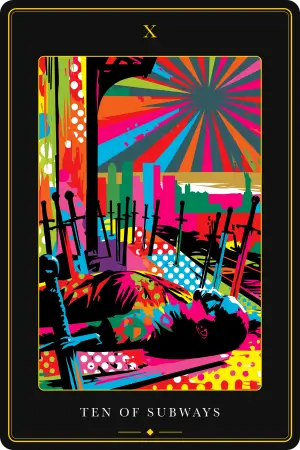
A rider flat on their back at the end of the line, ten sword-hilts spent around them, an enormous sunburst already blazing over eyes that have not yet opened.
Card at a glance
- Numerology
- 10
- Element
- Air
- Astrology
- Sun · Gemini (third decan)
- Kabbalistic path
- Malkuth (Kingdom)
- Timing
- Late Gemini · June 11 to 20
- Yes / No
- Upright no · Reversed leaning yes
Upright
end of the line
rock bottom
total defeat
collapse
betrayal
burnout
forced surrender
the dawn arriving
Reversed
slow recovery
survival
the first train back
refusing closure
clinging to a dead line
replaying the disaster
riding out of the tunnel
Ten of Subways in each deck
Every deck reimagines the same archetype. Compare the art, then open a deck to read its full interpretation.
Imagery and symbolism
In the Tarot of New York City the Ten of Subways stages rock bottom in the city's own language. A figure lies flat on their back across the tracks and the platform edge at the very end of an outdoor line, eyes closed, utterly still. This is not a corpse but a New Yorker who has finally stopped. The fight is over, so the body is not struggling; there is nothing left to struggle against.
The ten sword-hilts. Ten black hilts rise around and over the fallen figure, planted in the platform and the trackbed like a fence of finished arguments. They are the ten blows of the suit of mind: the layoff, the breakup, the eviction, the failure. These cutting thoughts and hard decisions have done all the damage they can, and now they stand spent. Nothing more can be taken, because the count is complete.
The end of the line. An elevated track structure and a dark steel beam curve overhead, the last station where the tunnel finally lets out into open sky. The train goes no further. Whatever comes next requires getting up and leaving the station.
The sunburst. Above everything, an enormous sunburst dominates the upper half of the card, its rays fanning out in red, pink, blue, and orange. This is the first train of the dawn rendered as pure light, and its size is the card's whole promise. The ending occupies the ground while the sky already belongs to what comes next.
The skyline and the halftone grain. On the horizon the skyline stands in flat pop-art color blocks of pink, green, and red, with the Statue of Liberty small against the water and a harbor light marking the border between the night just endured and the day arriving. The deck's signature halftone dots scatter across the platform and the color blocks, the print-screen grain of a city where even a private catastrophe happens in public. Saturated color laid over a scene of ruin is the card's essential tension: in New York, even rock bottom is loud.
Core meaning
The Ten of Subways is the end of the line. The train has gone as far as it goes, the doors open onto the last platform, and there is nowhere further to ride. It marks the conclusion of a long, grinding phase, the moment the thing you dreaded for months finally happens: the layoff lands, the lease ends, the deal dies, the relationship goes dark like a diner with paper over the windows.
Underneath the city imagery this is the tradition's Lord of Ruin, the absolute nadir of a cycle and the one point from which the only trajectory left is upward. What the deck adds is a specifically New York consolation: rock bottom here is famously solid ground, the one surface in the whole city nobody can pull out from under you. The card is total defeat and total release at once. The dread is over because the event arrived, so you can stop bracing for the doors to close. They closed. There is no eleventh sword, the threshold of suffering has been reached, and rebuilding starts from the platform.
Upright meaning
Upright, the Ten of Subways is a situation whose tolerance is spent to the last swipe on the MetroCard. Everything looks dark, and the dread has given way to the strange, flat calm of certainty. Its counsel is to stop fighting. The battle is finished, and continuing to swing only deepens the wounds. Lie still on the platform for a moment, use the time for rest and honest accounting, read the route map to see where this line started going wrong, and do not sign, launch, or promise anything in the first days after the collapse.
In love. The definitive breakup: the text read three times on the F train, the keys left on the counter, a relationship at its terminal station. The agonizing limbo of something kept alive past its life is finished, and that ending is the door to what comes next.
In career. The layoff, the walked-out-with-a-box morning, the contract not renewed, the project cancelled after consuming a year of nights. Often the burnout has simply completed itself, the body declaring the terminal station before the calendar did.
In finances. The account at zero, the credit maxed, the eviction notice and the final bill. The old money structure is finished, so the task is an honest accounting of what genuinely remains, not one more bet to win it all back.
In health. Burnout made physical, the collapse after months of bodega coffee and four hours of sleep. Even the subway shuts down for maintenance; the rider who never rests gets shut down instead. The card calls for the full stop.
Reversed meaning
Reversed, the Ten of Subways is the darkest hour before the first train, the stretch of night when the platform is empty and it feels like nothing will ever run again. It points to a hard period that seems endless but is already ending, and it forks in two directions depending on which way the rider is facing.
In its recovery sense the card is the first true movement upward: the escalator out of the station, the slow ride back, the morning you notice you slept through the night. The worst is behind you even if your body has not gotten the message yet. In its warning sense it is someone who cannot accept the ride is over, still standing at the closed token booth of a life that has moved on, still showing up in spirit to the job that ended or the person who left, pounding on doors that will not reopen.
In love. A couple rebuilding slowly after the near-breakup, trust reassembled ride by ride, or one person still circling the ex's neighborhood and narrating the split as if a better retelling could reverse it.
In career. The slow ride back through retraining and first interviews, or haunting a dead line, refusing to update the résumé because updating it would make the ending real.
In finances. Climbing out of debt with small deposits and patience measured in months, or keeping up appearances on credit while the hole quietly deepens.
In health. A recovery that plateaus and asks for patience, or deep fatigue dismissed as normal because everyone here is tired.
Historical notes
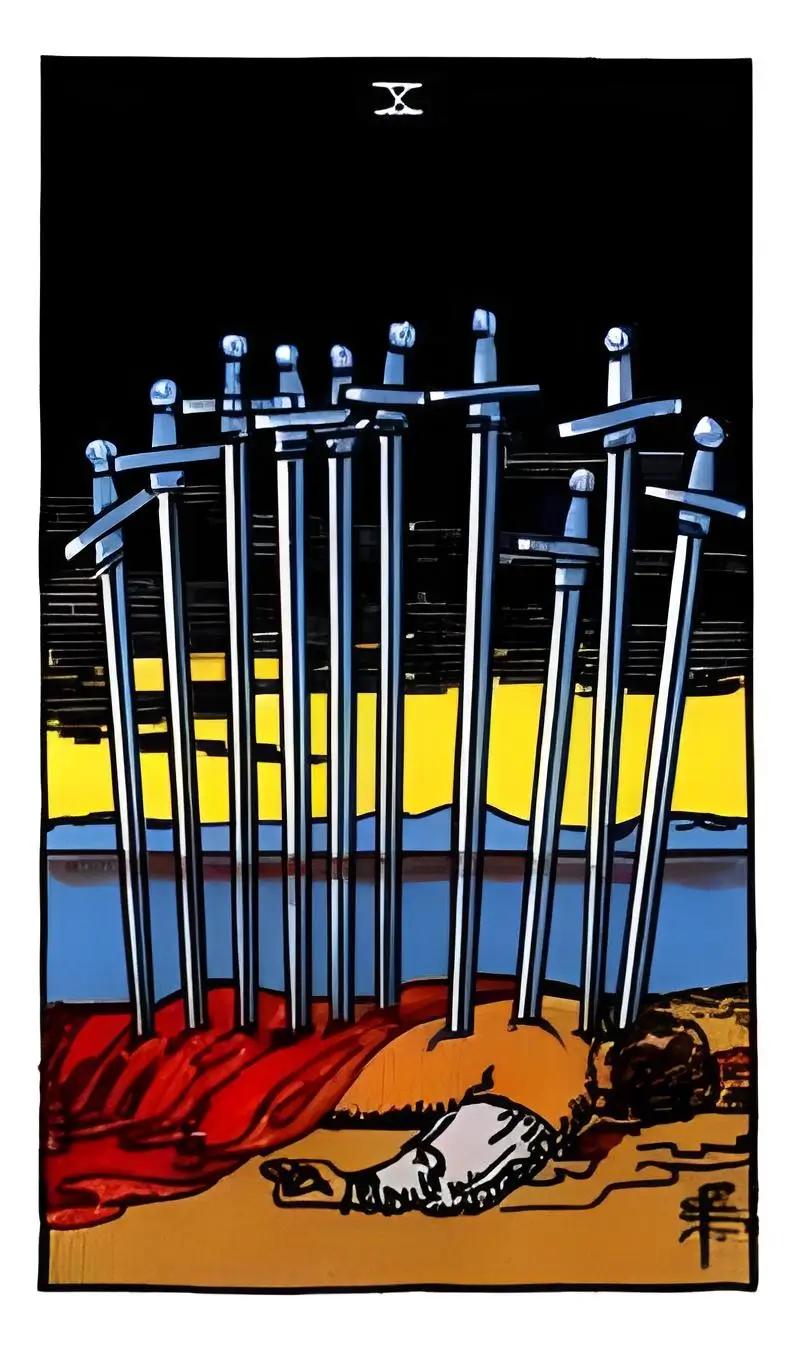
The scene this card translates is the Rider-Waite-Smith Ten of Swords, published in 1909, a figure lying face down on a desolate shore with ten swords driven in a line down the spine. The visual leap for scenic pip cards traces to the Sola Busca Tarot of around 1491, the earliest complete seventy-eight-card deck, which Waite and Pamela Colman Smith studied as photographs at the British Museum. Colman Smith borrowed selectively: the Sola Busca's own Ten of Swords showed a figure sheathing blades, a posture she repurposed for her Ten of Wands, so the impaled man on the beach was a new scene built to fulfill the Golden Dawn's title for the card, the Lord of Ruin.
Mary K. Greer traced the RWS imagery further, into the Grail and Masonic mysteries that shaped Waite, including the murdered Master Builder and the sword shattered beyond repair. The Tarot of New York City keeps that finality and relocates it. The desolate shore becomes the end of an elevated line, the ten swords become sword-hilts planted in the trackbed, and the golden band of dawn on the RWS horizon becomes the enormous pop-art sunburst filling the sky.
Correspondences
Number. Ten, the completed cycle and the last stop, closing the run from Ace to Ten the way a line closes at its terminal. Built from 1 and 0, it holds the Ace hidden inside every ending and the open circle of the Newcomer's pure possibility, so the worst arrival carries a departure already boarding.
Astrology. The Sun in the third decan of Gemini, roughly June 11 to 20. Gemini is the sign of two express tracks running side by side, ruling movement, information, and talk, the city's nervous system; its shadow is the mind that runs the 3am loop until the loop becomes the injury. The Sun over this collapse asks who is still lying on the platform when the job and the apartment are gone, and answers with its own returning light.
Element. Air, the mind, communication, and decisions, here so overloaded that the mental traffic finally crashes at its terminal station.
Kabbalah. Malkuth, the Kingdom, the densest material sphere, within Yetzirah, the formative world of the rational mind. Airy, formless intellect forced into rigid matter shatters under the pressure, and because Malkuth is also the root of the Tree, that destruction becomes the foundation for the leap back to the Ace of Subways.
Elemental dignity. A Sword among Subways, doubly Air, the mind with no other element left to steady it.
Timing and yes/no. It leans to late Gemini season and early summer. As a yes or no it reads no upright, a cycle collapsing, softening toward yes reversed as the recovery begins.
Psychological perspective
Crowley called the underlying card 'reason run mad,' the collapse that follows when the intellect runs with no balance from heart or spirit. Endless analysis exhausts hope, and the mind paralyzes itself. In this deck that shows as the Gemini mind's 3am traffic of worst cases crashing at last: the tenth thought, the last cut, the grind arriving at its terminal station.
Modern readers debate the card openly. Some frame it through catastrophizing, a gentle admonishment that you are making a big kerfuffle over something minor and running a self-fulfilling prophecy of doom. Trauma-informed readers push back hard, arguing that dismissing real pain as melodrama invalidates genuine suffering. Both readings meet in the same relief. This is the anticipated disaster of the Nine finally arriving, the worry made real, and you lived. The card validates that things really are as bad as they seem while promising the pain cannot increase, so the ego completes its necessary death and the rebuilding can begin. The city will let you cry on the train; everyone has.
The Ten of Subways across decks
The same ending appears in different settings across the tradition, and this deck's contribution is to move it to the end of a subway line. In the Rider-Waite-Smith deck the scene is a figure impaled face down on a desolate shore, ten swords down the spine, still water behind, and a golden band of dawn breaking on the black horizon.
The Tarot de Marseille strips out the figure: eight curved blades form an ovoid and two straight swords cross down the center, which Paul Marteau read as forces held in rigid equilibrium, the alchemical stage of fermentation where old psychic patterns die so a higher consciousness can be born. In the Thoth deck Crowley and Lady Frieda Harris drop the human figure for aggressive geometry, nine swords driving inward to shatter a central blade against a fractured background, ruin named outright, with a solar symbol still presiding at the top as the sign of rebirth. The Tarot of New York City keeps the archetype whole and swaps the shore for the last platform: the impaled man becomes a rider flat at the end of the line, the swords become hilts planted in the trackbed, and the golden dawn becomes the pop-art sunburst blazing over the skyline. The promise underneath stays the same. The night is over, and the first train of the dawn is already coming.
In combination and context
The Ten of Subways closes the arc that runs from the Eight and Nine. The Eight is paralysis, feeling trapped by outside forces. The Nine is the sleepless 3am anticipation of disaster. The Ten is that disaster arriving, and readers often meet it with relief because the waiting is over and the suspense collapses into the flat calm of the platform.
Context sharpens it. Beside rigid structural cards like The Emperor or The Hierophant it can mark the painful, necessary end of an era of secrecy or duty, the social rock bottom that precedes living openly. In a 'how someone sees you' spread it says the other person views you as having been through it, carrying old wounds, or as the final nail in a relationship where communication has entirely cut off. Watch the neighbors for direction: harsh cards deepen the collapse, while a bright card near the sunburst hurries the dawn. In a yes or no reading the upright card is a no, a cycle ending, though its light on the horizon insists the next cycle is already down the tunnel.
Questions for reflection
- What line in your life has reached the end of its track, and what are you still doing to keep the dead train moving?
- If you said the words 'it's over' out loud on the walk home, what would you finally be free to stop carrying?
- The sunburst is already blazing over the figure who has not opened their eyes. Where is your own light coming down the tunnel, even if you cannot hear it yet?
The general meaning follows the Rider-Waite-Smith reading — the reference used across Tarot Academy. Open a specific deck above for its own interpretation.
Frequently asked questions
Explore the Tarot
Latest Posts
Discover the ancient wisdom of tarot cards and unlock the mysteries of your spiritual journey. Our blog is your gateway to understanding the rich symbolism, meanings, and practical applications of tarot reading.




















































