
 EN (English)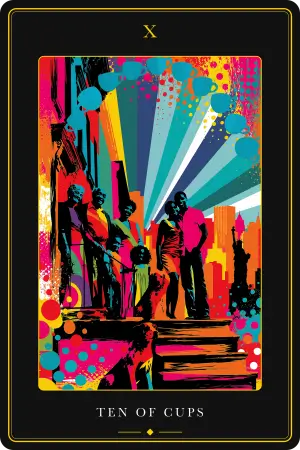


Minor Arcana · Cups (Water)
Page of Cups
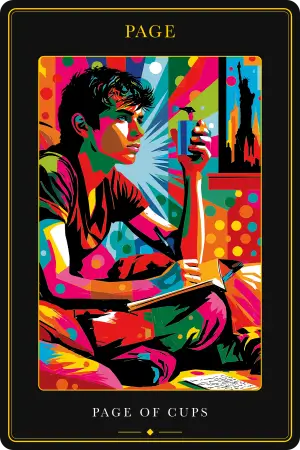
A young man on an apartment floor, notebook open, a fish peering out of his coffee cup: a soft new feeling testing the air before the city can make it cynical.
Card at a glance
- Numerology
- Page
- Element
- Water
- Astrology
- Water signs: Cancer, Scorpio, Pisces (Libra to Sagittarius in the Golden Dawn)
- Kabbalistic path
- Earth of Water (Malkuth, throne of the Ace)
- Timing
- New emotional beginnings
- Yes / No
- Upright yes, but stay clear-eyed. Reversed no
Upright
Openness
Intuition
Creative wonder
Sincerity
New feeling
Sweet messages
Inner child
Emotional beginnings
Reversed
Escapism
Emotional immaturity
Muted inner voice
Creative block
Premature cynicism
Withdrawal
Blocked feelings
Page of Cups in each deck
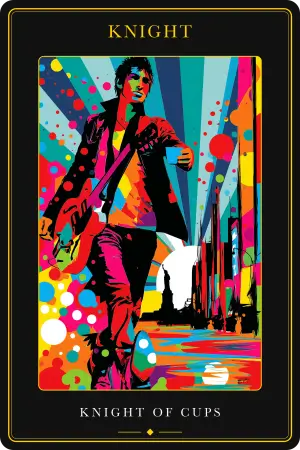
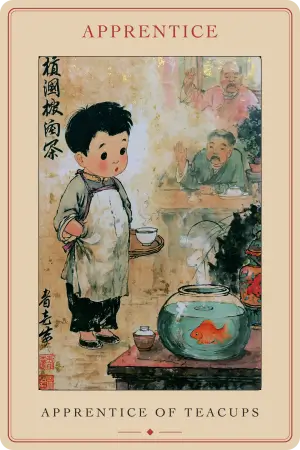
Every deck reimagines the same archetype. Compare the art, then open a deck to read its full interpretation.
Imagery and symbolism
The Tarot of New York City keeps the name Page of Cups and moves the whole scene indoors, into a small rented room, drawn in the deck's pop-art language of halftone dots and sunburst rays. A young man sits cross-legged on the apartment floor with an open notebook on his lap and a pen in his hand. These are the songs nobody has read yet. His gaze has lifted off the page, caught mid-thought, wondering rather than doubting.
In his raised hand he holds the deck's cup, and here it is the blue Greek "We Are Happy To Serve You" paper coffee cup, the humblest vessel in the city standing in for the suit's golden chalice. From its rim a fish peers out at him. This is the classic messenger of the subconscious, absurd and matter-of-fact at once, the same fish that surprises the youth on the Rider-Waite shoreline, now surfacing from a takeaway coffee on an ordinary morning. He does not flinch. He looks at it with curiosity, and that is the whole teaching of the card.
A burst of white rays radiates from the space between his eyes and the cup: the flash of inspiration, intuition made visible. Around the calmly seated figure the color runs riot, saturated blocks of pink, red, green and blue over fields of halftone dots. The contrast is the point. The emotion is abundant, not yet organized, and entirely unashamed of itself.
Through the window behind him stand the Statue of Liberty and the downtown skyline, the enormous city just outside a room where something quiet and new is being written. On the floor near him lies a handwritten note, the letter about to be slipped under a door, sincerity that has left the safety of the notebook. Where the Rider-Waite Page wears a whimsical beret and a blue tunic printed with water lilies, this Page wears nothing so costumed. The bohemian eccentricity has become a plain New York kid on a floor with a pen, and the vast rolling sea has become the harbor beyond the glass.
Core meaning
The Page of Cups is the first stirring of emotional life, the point where unformed feeling begins to demand expression. As the youngest court card of Water, the Page stands at the threshold between an emotion's childhood and its adulthood, the moment a feeling gains enough depth to want words. In this deck that threshold is literal: a teenager writing lyrics in a notebook, a note about to go under a door, the childhood of a feeling caught before it hardens.
The archetype is the same one the canonical card carries, the sweet, dreamy, intuitive youth who leads with the heart rather than the intellect. This deck sets it in a city of eight million guarded faces and makes the Page the one who still signs their name and means it. The card marks the beginning of an emotional or creative journey: openness to new ideas, fresh perception, art made for its own sake, the start of a sincere connection. Its defining move is receptivity. The fish arrives unannounced from the depths, and the Page's only task is not to look away.
Upright meaning
Upright, the Page of Cups is a soft new feeling testing the air. The querent is opening to an emotional or creative beginning, a budding romance, a first infatuation, a hunch worth following, a piece of work made purely for the joy of it. The card's counsel in this deck is plain: write the song even if nobody reads it, slip the note under the door, and listen for the inner voice underneath the noise. Sincerity here is not naivety. It is the whole strength of the card.
In love. A new romantic interest approaching, the crush that makes the whole commute feel different, pure and tender feeling in its opening bars. In an established bond it brings renewal, playful spontaneity, and a willingness to give and receive love with clear, sincere intentions.
In career and work. A message about new opportunity: the email you did not expect, the invitation to a project, the start of an internship or apprenticeship in a new field. Creativity rises and unconventional ideas find a hearing, which can open doors to advancement or a wider scope.
In finances. The beginning of a heartening financial idea, the first honest dollar earned from something you made. It can mark a small commission, a gift, or timely help from someone who believes in you. The card favors a first modest venture, though it promises genuine satisfaction and a flow of fresh ideas rather than fast profit.
In health. Feeling and intuition brought to self-care with freshness: a new routine tried out of curiosity, the walk across the bridge instead of the train, growing self-love and a kinder view of your own reflection.
Reversed meaning
Reversed, the tenderness curdles early into the city's practiced cynicism. The notebook stays shut, the note is crumpled instead of delivered, the inner voice is drowned out by the traffic. It points to problems with emotional maturity or the misuse of intuition and creativity: a dislike of reality, avoidance of problems, poor decisions made impulsively or under emotional instability. At the other pole it warns of hypersensitivity and fascination with unrealistic dreams of the big city, the fantasy version of the job or the person instead of the real one.
In love. Emotional misunderstanding and a reluctance to share feeling: the text drafted and deleted, the note never delivered. It can mean idealizing a partner and the letdown when the fantasy does not survive contact with the real person, or an imbalance where one gives everything and the other only takes.
In career and work. Frivolity, fading interest, the habit of starting many things and finishing none, a drawer of half-written songs. Communication problems may surface, and the card invites you to question whether the current position still fits.
In finances. Impulsive spending and the classic too-good-to-be-true offer this city manufactures daily. It warns of those who prey on the newly arrived and the openhearted, and it cautions against letting desire and feeling sign the checks.
In health. Neglect of the body and a refusal to listen to its needs: the skipped meals, the sleep sacrificed to the city's schedule, self-care postponed. It is a reminder to make physical well-being a priority rather than a luxury.
Historical notes
The fully pictorial Page of Cups most readers know is a Rider-Waite-Smith creation. First published in 1909 under A. E. Waite and illustrated by Pamela Colman Smith of the Hermetic Order of the Golden Dawn, the deck was the first modern one to give the Minor Arcana full narrative scenes. Waite's Page is a fair, "somewhat effeminate" youth on a shoreline, holding a golden cup from which a fish lifts its head. His blue tunic is printed with flowers often read as water lilies, a callback to the Ace of Cups and to beauty rising from muddy water.
The older Tarot de Marseille gives a different figure. Its Valet de Coupes has no ocean behind him and wears a crown of flowers rather than a beret; he holds an open cup in one hand and its lid in the other, hesitating between them. Alejandro Jodorowsky reads that hesitation as an emotional block, a person guarding the vessel of the heart out of fear of being hurt. In the Golden Dawn system the card is retitled the Princess of Cups, or Princess of Water, and coded with female pronouns, one root of the androgyny modern readers still find in the Page. The Tarot of New York City inherits this whole lineage and keeps the suit's name, then trades the shoreline for an apartment floor, the golden chalice for a paper coffee cup, and the printed tunic for a plain city kid with a pen.
Correspondences
Number. As a Page, the Princess-rank of the court, this is the earthly, material end of the suit: the throne of the Ace, where fluid emotion first takes tangible form. It is youth, the seed, the first conscious awareness of feeling.
Astrology. The Page embodies the element of Water and so carries the three water signs, Cancer, Scorpio and Pisces: Cancer's tender, changeable nurture, Scorpio's power to turn a private feeling into an act, and Pisces' intuition that joins the real and the illusory. In the Golden Dawn scheme the Princess of Cups rules the quadrant from zero degrees Libra through thirty degrees Sagittarius, linking her to Justice, Death and Temperance.
Element. Water, the suit's own element of feeling, imagination and love. In this deck it runs everywhere under the pavement, the harbor beyond the window, the rivers around the island, the feeling underneath the city's indifference, surfacing as the fish in the coffee cup.
Kabbalah. "Earth of Water," the Golden Dawn's title for the Princess: the earth element giving structure and containment to water's chaos, likened to water freezing into ice. As the throne of the Ace she sits at Malkuth, the sphere where spirit becomes material fact.
Elemental dignity. As a Water card the Page flows with Earth and meets tension with Fire, so the neighboring cards decide whether the tenderness is grounded or overwhelmed.
Psychological perspective
Read psychologically, the Page of Cups is the inner child, the unjaded part of the psyche that keeps its capacity for wonder. Once the tarot shifted from an occult system toward a mirror of the mind, under Jung's theory of archetypes and Jodorowsky's Tarology, this card became a working tool for inner-child healing. Drawing it is rarely a literal prediction. It reflects the querent's readiness for emotional vulnerability and their need to create without the paralysis of perfectionism.
The deck gives that state a face in its city kids: the one writing lyrics on the back of a receipt on the F train, the new arrival who still looks up at the buildings, the person who has not yet let the place harden them. The invitation is to quiet the inner critic and make something purely for the joy of it, the way a child paints an egg without judging the result. Kept occupied with that joy, the imagination stops conjuring monsters in the closet.
The card also surfaces around emotional regulation and old wounds. It appears when someone needs to bring softness to a monologue that has grown punishing, and it offers the cup as a safe container for feelings that were shamed or ignored early on. Before a person can master their emotions the way the King or Queen of Cups does, they first have to honor them with a child's acceptance.
The Page of Cups across decks
The core archetype holds while the imagery shifts. In the Rider-Waite-Smith deck the Page stands on a shoreline in a flowered blue tunic and beret, a fish rising to meet his gaze from a golden cup, the sea rolling behind him. In the Tarot de Marseille the Valet de Coupes wears a crown of flowers in an abstract, unmoored space, holding an open cup in one hand and its lid in the other, hesitant to open his heart. In the Golden Dawn and Crowley's Thoth system the card becomes the Princess of Cups, "Earth of Water," a dancing figure with a swan and a tortoise, the material grounding of emotional energy.
The Tarot of New York City keeps the name and the meaning and swaps the objects for the city's own. The shoreline becomes the floor of a small apartment, the golden chalice becomes the blue paper coffee cup, and the fish now surfaces from a takeaway coffee against a window full of skyline and the Statue of Liberty. The whimsical costume gives way to a plain kid with a notebook, and the vast RWS sea becomes the harbor beyond the glass. Under every version sits the same tender, receptive youth, the same fish carrying a message up from the depths.
In combination and context
The Page of Cups shifts with its neighbors because it describes a beginning rather than a fixed outcome. As the court's classic messenger, it often reads as incoming emotional news, a text, a DM, a note under the door, and community readers know it as the "apology card," someone reaching out to make amends, offering the fish from the cup as a quirky peace offering. That apology is sweet and heartfelt, but it may lack the mature accountability a King or Queen would bring.
Context sharpens it. Beside The Empress, The Sun or the Ace of Cups it can point toward conception, pregnancy or a much-wanted child. Around a returning ex it turns cautionary: the person may be emotionally immature, exploring a "what-if" or seeking an ego boost rather than a real commitment. Paired with the Seven of Cups the tender hope tips into fantasy, castles in the sky mistaken for facts.
Position matters too. As advice the card says stay open, follow the hunch, and let the work carry some of the notebook's sincerity. As an obstacle it is naivety itself, rose-colored glasses that overlook a plain red flag. Not every glittering offer on the avenue is trustworthy, so the Page asks you to stay curious and receptive while keeping one foot on the pavement.
Questions for reflection
- What is the note I have written but not yet slipped under the door, and what would it cost me to deliver it?
- Where in my life am I still able to be surprised, and where have I let the city talk me into being unimpressed?
- If a feeling surfaced today like a fish from a coffee cup, could I look at it with curiosity instead of trying to explain it away?
The general meaning follows the Rider-Waite-Smith reading — the reference used across Tarot Academy. Open a specific deck above for its own interpretation.
Frequently asked questions
Explore the Tarot
Latest Posts
Discover the ancient wisdom of tarot cards and unlock the mysteries of your spiritual journey. Our blog is your gateway to understanding the rich symbolism, meanings, and practical applications of tarot reading.




















































