
 EN (English)


Minor Arcana ·
Eight of Teacups
Rising from a good table while the tea is still warm, because good is not the same as enough.
Card at a glance
- Numerology
- 8
- Element
- Water
- Astrology
- Saturn in Pisces · first decan
- Kabbalistic path
- Hod (Splendor)
- Timing
- Late winter · Pisces season · February 19–28
- Yes / No
- No to staying · Yes to leaving
Upright
courteous departure
outgrowing comfort
walking away
seeking meaning
gratitude without attachment
clarity
liberation
chosen solitude
Reversed
fear of leaving
half-departure
clinging to comfort
missed hour
stagnation
delay
fixation on the past
conditional acceptance
Eight of Teacups in each deck
Every deck reimagines the same archetype. Compare the art, then open a deck to read its full interpretation.
Imagery and symbolism
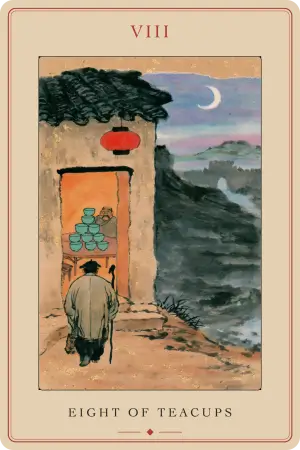
In the Tarot of Beijing the Eight of Cups becomes the Eight of Teacups, and the card holds one exact instant: a courteous, final departure from a teahouse at night. An old guest walks away from the door, seen from behind, leaning on a walking stick. We never see his face, and that is the first thing the card says. This leaving is not addressed to anyone in the room. It is a private agreement between the man and his own life, and his bent back over the stick admits the rest: leaving is hardest when it comes late, and he is doing it anyway.
Behind him, eight celadon cups stand in a neat pyramid on the table. Nothing is spilled, nothing is chipped, nothing is owed. Where the canonical Eight of Cups leaves a telling gap in the stack, a missing ninth cup, this deck stacks the eight in perfect order, because the point was never to overturn the table. The point was to stop sitting at it. The pyramid is the picture of a finished chapter: fulfilled bonds, honest hospitality, real warmth, all of it good and none of it enough.
In the doorway the innkeeper watches, puzzled. He is not a villain. He poured good tea. His confusion stands in for every voice that will ask, reasonably and uselessly, what was wrong. The doorway glows warm orange and a red lantern still burns above it, so the house does not go dark when the guest leaves. This is what separates the card from images of loss: the man is not fleeing a ruin, he is declining a comfort.
Ahead the lane climbs past a shadowed city wall with an open gate arch, into ink-dark hills drawn in heavy grey wash. The future here offers no lit interior, only passage. Above it hangs a thin crescent, a rising moon that gives just enough light to walk by and no more, so the traveler must rely on intuition rather than a map. In the deck's language of small human things, even the soul's great departure is only this: an old man, a stick, a lit door behind, a crescent ahead, and eight clean cups that no longer need him.
Core meaning
The Eight of Teacups is the deck's card of the good place left behind. It marks the moment a guest rises from a good table and leaves, not in anger and not in flight, simply because he is finished. Nothing on the table is broken. The tea was honest, the innkeeper was kind, and still the guest is walking out under the rising moon, because everything here was good, and good is not the same as enough.
That sentence carries the whole reading. Satisfaction with the situation has emptied quietly, cup by cup, until the meaning has gone out of the pot. You can refill the pot with hot water, but you cannot refill the meaning. So the card describes the courteous mechanics of renunciation: you settle the bill, you stack the cups neatly, you thank the house, and you leave the past in order without carrying it with you.
Compared with the canonical Eight of Cups, this deck softens the barren mountain wilderness into a familiar lane past the city gate and trades the solitary pilgrim's cold detachment for the warmth of a house genuinely loved. The departure is no less final for being gentle. It often points to a bond, a role, or a way of life that has been drunk to the bottom, honored fully and then left behind.
Upright meaning
Upright, the Eight of Teacups asks you to leave well. Do not wait for the place to turn bad so the going is easier to justify. A good place you have outgrown is reason enough. Say your goodbyes with both hands, the way a cup is offered, then actually cross the threshold. Do not turn back at the puzzled face in the doorway, because the innkeeper's confusion is not your compass. Take a walking stick, not a cart: travel light, decide your first three steps, and let the moon do the rest.
In love. The tenderest and hardest departure, leaving someone who did nothing wrong. The love was real, the two cups and the lantern over the door all counted, but the pot has been poured to the last leaf. This is the decision to end a bond out of truth rather than injury, with no betrayal to point at. It can also mean a chosen solitude, a deliberate walk into the moonlit lane to learn your own heart before offering the next cup. Leave gently and completely, gratitude spoken, no door slammed and none left ajar.
In career. The resignation written long before the letter. The position is decent, the colleagues are warm, the pay is steady, and the job has stopped teaching you anything. This is a departure made in clarity rather than grievance. Expect the puzzled innkeeper in every doorway, the manager and family asking what was wrong when nothing was. Hand over your duties like a stacked pyramid of cups, complete and easy for the next person to take up, then take your stick and go.
In finances. Walking away from an income that still pours but no longer nourishes. The stall is respectable, the ledger balances, and you are closing the shutters anyway, because the work has been drunk to the bottom. This is a settled account, not a reckless one. Leave the books in order, thank the old trade honestly, and accept that between the lantern you leave and the one you have not yet found, the road will be dark and your purse will feel it. The break is still right.
In health. Retiring routines you have outgrown, even the ones that served you well. Thank the old regimen like a good innkeeper and leave it stacked, not smashed. What follows is quieter and truer: rest taken seriously, long evening walks in place of punishments, care chosen for how it restores rather than how it looks from the street. This stretch is walked for your own body's sake, under a thin moon, with no one watching, which is what makes it honest.
Reversed meaning
Reversed, the Eight of Teacups shows the guest who has risen from the table but cannot make himself reach the door. You know the tea here has nothing more to say to you, yet the warmth of the room, the red lantern, and the familiar faces keep you seated in a life you have already inwardly left. This half-departure is the most tiring position of all, no longer present and not yet gone. Stop hovering at the threshold. Name honestly what keeps you: love for this place, or only fear of the dark stretch of road before the next lit doorway. If it is love, sit back down wholeheartedly. If it is fear, accept that the first hundred steps beyond the lantern are always walked in the dark, and walk them.
In love. Two people keeping a finished love warm out of fear of the cold. You have known for a while that the meaning has left the cups, yet the shared lane and the terror of the dark road alone keep you both at the table, being polite to a memory. Or it shows the leaver who cannot finish leaving, half out the door and returning at the first cold night, teaching the other person to hope and grieve in cycles. This limbo is crueler than an honest ending. Either choose this person again with your whole weight, or complete the departure you began long ago.
In career. Serving out a sentence at a job you finished long ago. Every morning you sit back down, pour the same cold routine, and tell yourself that leaving would be rash. A comfortable finished job produces only slow fading, never the anger that would push you out. Stop waiting for the workplace to wrong you badly enough to make the decision for you. It will simply keep being pleasantly insufficient for years. Set the date of your departure yourself, in writing, and start stacking the cups.
In finances. Money used as a reason not to live. You cling to a stale income or a dead investment purely because it is familiar, calling it responsibility when it is fear of the dark lane. By keeping your seat you block every better opportunity that cannot reach you while your hands are full of old cups. The steady trickle you are protecting has quietly become the most expensive thing you own. Count what this comfort actually costs you per month in postponed life, and decide whether the price is still acceptable.
In health. A body kept on an expired regimen out of fear of change. You continue the workout that now drains you and the diet that stopped working seasons ago, because dropping them feels like losing yourself, when in fact they are what is losing you. The fatigue you call laziness is often a finished routine still being served, cup after cold cup. Retire the obsolete methods with thanks, ask your body what it actually needs this year, and be willing to walk a while in the dark before the new routine's lantern appears.
Historical notes
The card the Tarot of Beijing rebuilds is the Eight of Cups, and its familiar shape is young. The Tarot de Marseille and earlier European decks drew the number eights of the Minor Arcana as abstract arrangements of suit symbols, eight cups laid out in a pattern with no human figure and no landscape. There was scenery to leave, but no one to leave it.
The walking pilgrim arrived in 1909 with the Rider-Waite-Smith deck, illustrated by Pamela Colman Smith under Arthur Edward Waite. Smith put a cloaked figure on the card, back turned, leaning on a staff and climbing away from eight stacked cups toward barren mountains under an ambiguous sky. Waite noted that the scene is not night but a solar eclipse, day that feels like night. That single image fixed the modern meaning of the card: a voluntary, world-weary departure from success that has gone hollow.
Aleister Crowley and Lady Frieda Harris took it darker in the Thoth Tarot, titling the card Indolence and drawing shallow, cracked cups over a stagnant pool with drooping lotuses. For Crowley the departure was less a calling than an escape from something rotting from the inside out.
The Tarot of Beijing keeps Smith's walking figure and Waite's eclipsed, in-between light, then moves the whole scene indoors and homeward. The barren mountains become a familiar lane past the city gate. The anonymous cups become eight celadon teacups on a teahouse table. A new character appears, the puzzled innkeeper in the lit doorway, and the departure keeps all its finality while gaining the warmth of a house the traveler genuinely loved.
Correspondences
Number. Eight, structure and cycles turning inward, here a stacked pyramid of cups. Eight is completion under pressure, two fours, an order so full it has no room left to grow. That is the problem the card paints: the eight cups are not a failure but a finished structure, and the only thing left to do with a perfect stack is to stop adding to it. The digit's shape is an endless loop, one circle flowing into the next, so the departure reads as a crossing between circles, the closed round of the teahouse and the open round of the road.
Astrology. Saturn in the first decan of Pisces, roughly February 19–28. Pisces supplies the water of the suit, feeling and memory and the longing for a farther shore, and left alone it would sit dreaming at the table forever. Saturn does not let it. Saturn strikes the hour whether or not you are ready and makes the dream stand up and put on its shoes, so longing hardens into a sober, weighed decision. The pairing produces the deck's particular grief with a straight back.
Element. Water, the element of the Teacups suit: feeling, memory, and the bonds steeped between people like leaves in a pot. Under the number eight the water reaches a rigid fullness it cannot grow past, which is why leaving becomes the only honest motion left.
Kabbalah. On the Tree of Life the card sits in Hod, the sphere of intellect and form in the world of Water, on Path 27 bridging Netzach and Hod. Raw emotional drive filled the eight cups; cold analysis now weighs those achievements and finds them lacking. Hod carries the restless, critical mind of Mercury, which cannot abide the stagnation of settled waters.
Psychological perspective
The person of this arcana is someone who leaves well. They can rise from the most pleasant table in the district without a scene, settle their accounts, stack their cups, and walk out into the night, not because they were wronged but because they are finished. Beneath a calm surface runs deep feeling and a fine intuition, and a stubborn honesty about their own heart: when meaning runs out, no amount of comfort can bribe them into pretending otherwise. They make grateful guests and poor prisoners.
The card names a psychological breakthrough that modern life rarely celebrates. The hedonic treadmill keeps promising that one more filled cup will settle the restlessness for good, and the Eight of Teacups is the moment a person sees that acquisition and fulfillment are different things. It asks for the maturity to tell comfort apart from alignment, and to honor the grief of leaving something that is still partly good. Staying misaligned out of habit or fear of disappointing others is how warmth curdles into the stagnation this suit dreads. The healthy version tolerates the loneliness of the road between one lit doorway and the next, trusting an inner compass more than the warmth behind.
Eight of Teacups across decks
Rider-Waite-Smith. A cloaked figure leans on a staff and walks away from eight stacked cups toward barren mountains, under a sky Waite called a solar eclipse. The stack shows a gap where a ninth cup should be, the visual anchor of the missing piece. The Beijing card keeps the walking figure and the in-between light but fills the gap, stacking eight celadon cups in perfect order to say the leaving is about meaning, not lack.
Tarot de Marseille. The older decks draw the eight of cups as a flat, decorative arrangement of chalices, no traveler and no road. Beijing supplies the human story the Marseille pip only implies, the guest who finally rises from the table those cups were set upon.
Crowley-Thoth. Crowley titled the card Indolence and painted shallow, cracked cups over stagnant water with decaying lotuses, the departure as flight from corruption. The Beijing teahouse meets the same stagnation only in the reversed card, where a finished love or job is kept warm past its life and the tea goes from cool to merely remembered.
Modern reframings. Kim Krans's Wild Unknown replaces the figure with a solitary wolf leaving a shadowed forest and eight empty cups, stripping the scene to instinctual departure. The Tarot of Beijing belongs to the same instinct but keeps the human courtesy, the settled bill and the stacked cups, so the leaving stays civil as well as necessary.
In combination and context
The Eight of Teacups pulls whatever spread it lands in toward departure, transition, and the search for something truer. Its meaning turns sharply on the cards around it, because the same walk can be brave or cowardly depending on what waits at each end of the lane.
Beside cards of new starts and open roads, the Ace of Teacups or the Fool of this deck, it reads as a clean beginning earned by an honest ending, the offered cup ahead answering the stacked cups behind. Next to cards of stagnation or fear it tips toward the reversed warning, the guest frozen at the threshold who confuses the warmth of the old room with proof of its future. With the Hermit it deepens into a genuine pilgrimage, the heart's leaving that precedes the mind's solitude, and beside the Star it promises that the dark stretch past the gate does lead to water again.
In love spreads, neighboring cards tell you whether the departure is release or avoidance, a finished bond honored or a living one abandoned too easily. When the card keeps returning in a reading, treat it as one question asked twice: which table have you already, inwardly, left, and what would it take to actually cross the threshold you keep standing at.
Questions for reflection
- Which of your comforts still feed you, and which do you keep only because they are familiar?
- If you are standing at a threshold, name honestly what holds you there: love for the place, or fear of the dark road before the next lit doorway.
- What would it look like to leave this table well, with the bill settled and the cups stacked, and no scandal to justify the going?
The general meaning follows the Rider-Waite-Smith reading — the reference used across Tarot Academy. Open a specific deck above for its own interpretation.
Frequently asked questions
Explore the Tarot
Latest Posts
Discover the ancient wisdom of tarot cards and unlock the mysteries of your spiritual journey. Our blog is your gateway to understanding the rich symbolism, meanings, and practical applications of tarot reading.




















































