
 UZ (Ўзбек)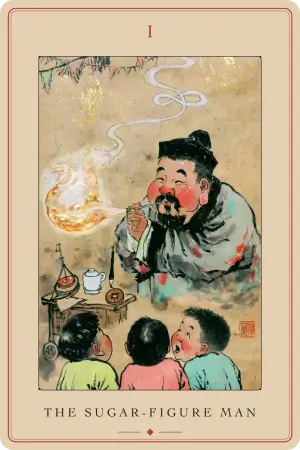


Major Arcana · 3
The Fortune-Teller Behind the Curtain
The old woman in the lane does not predict; she waits until you tell her what you already know.
Karta haqida qisqacha
- Numerology
- II
- Unsur
- Water
- Astrologiya
- The Moon · Cancer
- Kabbala yo'li
- Gimel (Kether → Tiphereth)
- Vaqt
- Lunar cycles · dusk, about a month
- Ha / Yo'q
- Maybe · not yet time to know
Upright
intuition
inner knowing
patience
discretion
listening
the closed almanac
receptivity
quiet
Reversed
blocked intuition
excessive secrecy
self-deception
superstition
manipulation
withdrawal
ignored instinct
Har bir to'plamda The Fortune-Teller Behind the Curtain
Every deck reimagines the same archetype. Compare the art, then open a deck to read its full interpretation.
Imagery and symbolism
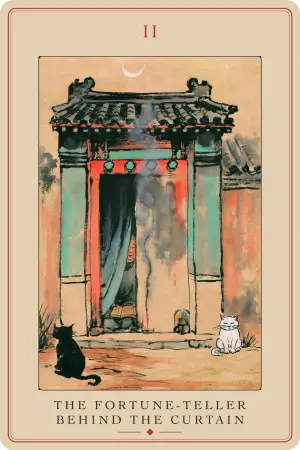
In the Tarot of Beijing the High Priestess becomes The Fortune-Teller Behind the Curtain (帘后先生), an old woman seated in a gateway in a lane beside the Lama Temple, a half-drawn blue curtain at her back. She does not read palms. She waits, and confirms what the visitor already knows.
The gate takes the place of the two temple pillars of the classic card. Its posts are painted in the deck's two accent colours, vermilion and teal, fire-red for what is spoken and water-green for what is kept. She sits on the threshold between them, belonging to neither the street nor the house.
A black cat and a white cat keep watch at either side of the door. They carry the meaning of Boaz and Jachin, the black and white pillars, put into hutong language: darkness and light, the known and the unknown, sitting calmly at one gate. Neither cat is hers; both have chosen her, and both face the street as she does.
The half-drawn blue curtain replaces the embroidered veil of pomegranates. Blue is the deck's colour of inward water, of feeling and the subconscious, and half-drawn is the whole doctrine of the card: you see exactly as much as you are ready to see, and no more.
On her knees lies a closed almanac, the Torah scroll of the old card turned into a Chinese book of days and hours. It stays closed because the knowledge that matters is not on the page; the page is only where you check what the heart has already decided. A thread of incense smoke rises through the middle of the scene and divides it in two, the deck's veil between worlds: one side stands in ordinary afternoon, the other in something older and quieter.
A pale crescent moon hangs above the roof tiles, the same moon that lay at the feet of the classic Priestess, marking cycles and knowledge that waxes and wanes. The stone step before the threshold is worn smooth by generations who stood on it, hesitated, and finally spoke. In one corner sits the maker's small red seal, a kept secret in plain sight.
Core meaning
The Fortune-Teller Behind the Curtain is the receptive principle turned into a discipline. She does not predict; she confirms. The answer you are chasing is already inside you, folded like the closed almanac on her knees, and her whole art is to let it come out intact.
In the deck's sequence she is the quiet counterpart to the Sugar-Figure Man, the Magician numbered 1, who makes the world out of breath and heat at the crowded fair. She sits in the empty lane and receives the world without moving a finger. He is the out-breath; she is the in-breath. Where he acts and speaks, she watches and waits, holding both halves of a matter without settling them into a verdict. Her message stays consistent: something essential is veiled for now, and it will show itself only to patience and quiet attention.
Upright meaning
Upright, the card asks for patience over pushing and for the first quiet impression over the tenth loud opinion. It marks a time to observe, note your dreams and premonitions, and let the answer surface rather than dragging it out. Do not force the curtain open; half-drawn is exactly how much you are meant to see. If you put a straight yes-or-no question to her, the usual reply is that it is not yet time to know.
In love. A bond that moves at the pace of the lane at dusk, built on listening and on things understood without announcement. For those alone, it can mark a valuable season of solitude behind one's own curtain, or a hint that someone quiet already stands at the doorstep, waiting to be recognised rather than pursued.
In work. Advancement comes from perception more than volume: the unwritten rules of the workplace, and the shift in a district's mood a season before it reaches the receipts. Confidential matters and quiet research are favoured, and you may be trusted precisely because you do not talk.
In money. Watch long before you buy, and trust the small wrongness you feel about a deal even when the numbers smile. Read a contract the way she reads a visitor, listening for what is not being said. Study your accounts in detail and consult one discreet advisor rather than the whole fair.
In health. The body speaks before the illness does. She favours attentive self-care, sleep kept like a ritual, and quiet practices such as meditation or tai chi in the park before the city wakes. Study your own cycles; a discreet, thorough check-up is favoured now, precisely because nothing seems urgent.
Reversed meaning
Reversed, the curtain has become a wall. The card points to neglected intuition, inner noise where there should be inner quiet, and a drift away from your own knowing. You may be paying for answers that flatter you, mistaking superstition for insight, or keeping a secrecy that no longer protects anyone. Stop outsourcing your knowing: return to your own doorstep, weigh what you have been told against what you have felt from the beginning, and where they differ, trust the feeling.
In love. The half-drawn curtain has been pulled shut from one side. Something essential goes unsaid, a partner withdraws, or warmth is performed at the gate while the courtyard behind it stands cold. You may be ignoring the small persistent signal that something does not match the words.
In work. An office thick with incense smoke and no clarity: corridor whispers and information hoarded as power. You may be shut out of what you need to know, or paralysed by endless observation without a single decision. Name the unnamed problem plainly at the right doorstep.
In money. The fog around your finances is danger now, not mystery. Someone may be keeping figures behind the curtain, so verify every claim and every seal before signing. You may also be the one refusing to look, avoiding the ledger and buying small comforts to postpone one honest count.
In health. A body speaking to someone who has stopped listening. You may be overriding fatigue or dismissing a recurring symptom, with sleep disordered and the inner clock out of step with the schedule. Stop reading omens and take the plain step of a proper examination.
Historical notes
Long before Beijing renamed her, this card was La Papessa, the Popess, one of the more provocative images in early Tarot. Medieval folklore of Pope Joan, a learned ninth-century woman said to have disguised herself as a man, risen to the papacy, and been exposed when she went into labour during a procession, shaped the early card. The eighteenth-century Tarot de Marseille shows a woman in the papal tiara holding a book, and Protestant countries used the figure to mock the Catholic Church.
Italian historians trace a more specific source. In the mid-fifteenth-century Visconti-Sforza deck, La Papessa wears the plain habit of an Umiliata nun and is identified as Sister Manfreda, a Visconti relative and figure in the Guglielmite sect, which prophesied a line of female popes. The Inquisition burned her at the stake in 1300, and memorialising her in the deck 150 years later read as a quiet anti-papal statement by her family. Later variants softened the sting, and Swiss Troccas decks rebranded her as Juno.
The universal archetype arrived in 1909. A.E. Waite dismissed the Pope Joan link, renamed the card The High Priestess, and tied her to Isis, Astarte, Artemis, and the Kabbalistic Shekhinah. The Beijing deck keeps that inward, oracular meaning and resettles it in a hutong gateway two lanes east of the temple.
Correspondences
Number. She is II, the number of duality, and the Beijing card is built from twos: two gateposts, one vermilion-warm and one teal-cool; two cats, one black and one white; two halves of a scene split by a single thread of incense. Where the Magician is a single point of will, two introduces the other, and the pause between question and answer.
Astrology. The Moon rules her, and the deck paints it plainly with a pale crescent riding above her gateway tiles, the only light in the lane. She also carries Cancer, which the Moon rules: home, ancestors, the past, the shell that protects soft things. Her gateway is a Cancer threshold, half shelter and half street, guarded by two cats instead of two claws.
Element. Water. The blue of her curtain and robes is the deck's inward water, the depth of feeling and the subconscious from which intuition rises.
Kabbalah. She holds the 13th path, the longest on the Tree of Life, running down the Middle Pillar from Kether to Tiphereth and across the Abyss through the hidden Da'ath. Her Hebrew letter is Gimel, the camel, the one beast that crosses the desert on its own stored water, an image for drawing on inner reserves rather than outside help.
Elemental dignity. Beside the watery Cups her intuitive register deepens; beside airy Swords the reading tilts toward secrets held in the mind.
Psychological perspective
The person of this arcana lives half a step back from the street. They keep a rich, ordered inner courtyard and receive the world the way the old woman receives visitors, one at a time and with full attention. They read between the lines by default, register the weather of a room on entering, and remember what you said three winters ago because they were actually listening. Their advice tends to arrive as a question that unlocks the answer you already carried, and they keep confidences absolutely.
The same stillness has a cost. The curtain can become a hiding place, and excessive passivity may keep them on the doorstep of their own life, always the consultant and never the traveller. Over-reliance on intuition can tip into suspicion, seeing an omen in every crossing cat.
Modern readers of the classic card add a sharper note that fits her exactly. They call the High Priestess a stalker card, the one that keeps turning up to tell an over-analysing querent to put the deck down because they already know the answer. Her silence, at its best, is self-possession: the moment you stop explaining yourself, secure that your inner knowing needs no permission, proof, or applause.
The Fortune-Teller Behind the Curtain across decks
Tarot de Marseille. The older La Papessa keeps her papal roots, seated in the triregnum with a book in her lap, the heretic pope of Renaissance imagination rather than a cosmic oracle.
Crowley-Thoth. Painted by Lady Frieda Harris, Crowley's Priestess wears a luminous veil of light rather than a cloth one, his argument being that for the high initiate even pure brilliance is one last screen over the formless spirit. A bow that doubles as a harp links her to Artemis, and a faint camel in the background names her path.
Modern decks. Kim Krans's Wild Unknown replaces the woman with a white tiger gazing from a starry dark, casting intuition as raw animal instinct. Lisa Sterle's Modern Witch Tarot keeps the pillars and pomegranate veil but hands her an open laptop, then has her look away from the screen.
Tarot of Beijing. The deck translates every one of these symbols into a lane beside the Lama Temple. The two pillars become vermilion and teal gateposts; Boaz and Jachin become a black cat and a white cat; the pomegranate veil becomes a half-drawn blue curtain; the Torah scroll becomes a closed almanac; and the veil between worlds becomes a single rising thread of incense. What every version guards, she guards from a worn stone doorstep.
In combination and context
The Fortune-Teller casts a veil of secrecy over the cards around her and asks for an intuitive reading of them. She is the receptive counterpart to the Sugar-Figure Man, the deck's Magician, and when the two appear together they mark an alignment of doing and knowing, the power to act joined to the sense of when.
She also opens a door in the deck's story. The Newcomer, the deck's Fool who stepped off the train at Card 0 with a paper address in his fist, meets in her the first door he cannot simply walk through: the Sugar-Figure Man showed him the city can be made, and she shows him it must also be listened to. With the Fool the pairing is a leap of faith guided by inner knowing.
Her other pairings sharpen the theme. Set against the Empress she is the mystic beside the mother, spiritual fertility beside physical creation. Against the Hierophant she is personal revelation beside established dogma. With the Devil she warns of toxic secrets or manipulation working out of sight, and with the Moon the veil thickens into illusion or paranoia, intuition either heightened or misfiring.
Fikr yuritish uchun savollar
- What does your gut already know that you keep talking yourself out of behind your own curtain?
- Where would sitting quietly on the worn stone step serve you better than gathering one more opinion?
- Which truth are you waiting for someone else to say aloud, when it was yours to speak all along?
The general meaning follows the Rider-Waite-Smith reading — the reference used across Tarot Academy. Open a specific deck above for its own interpretation.
Frequently asked questions
Tarotni kashf eting
So'nggi maqolalar
Taro kartalarining qadimiy donishmandligini kashf eting va ma'naviy yo'lingizdagi sirlarni oching. Blogimiz taro o'qishning boy ramziyligi, ma'nolari va amaliy qo'llanilishini tushunishga eltuvchi darvozadir.




















































