
 UZ (Ўзбек)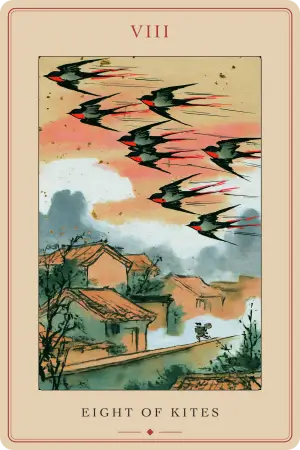


Minor Arcana ·
Nine of Kites
The veteran flyer at dusk: wounded, watchful, and unbeaten, guarding the last kite still able to fly.
Karta haqida qisqacha
- Numerology
- Nine
- Unsur
- Fire
- Astrologiya
- Moon in Sagittarius · 2nd decan (10°–19°)
- Kabbala yo'li
- Yesod (Foundation)
- Vaqt
- Dusk · the last push before completion
- Ha / Yo'q
- Upright yes, if you hold the line · Reversed no
Upright
resilience
boundaries
perseverance
the last stand
vigilance
hard-won experience
holding your position
recovery
Reversed
burnout
paranoia
exhaustion
giving up too early
walls too high
stubbornness
depleted reserves
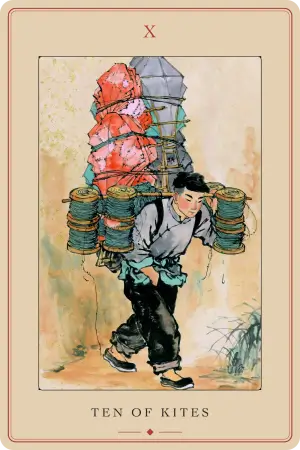
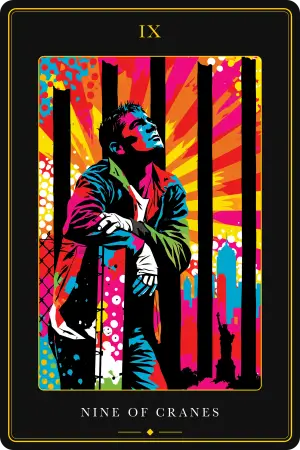
Har bir to'plamda Nine of Kites
Every deck reimagines the same archetype. Compare the art, then open a deck to read its full interpretation.
Imagery and symbolism
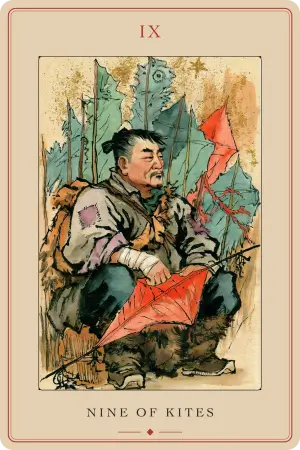
In the Tarot of Beijing the Nine of Wands becomes the Nine of Kites, and the wounded warrior is a kite flyer at dusk. He sits low on a straw bundle at the edge of a hutong lane. Behind him rises a palisade of tall, tattered kites on bamboo spars, teal sails torn by the wind, one still carrying a painted fish's eye that watches the sky he no longer needs to watch. These are the kites the gale has taken, his hard-won ventures, battered but planted upright like a fence around him.
Across his knees he holds the one kite that still flies, a vermilion swallow, the single burst of warm color in the picture. His hand rests on its spine firmly rather than tenderly, the grip of a man guarding rather than admiring. It is the only kite that matters now.
His right wrist is wrapped in a white bandage, the mark of the string that cut him and of the effort it took to reach this point. The wound did not send him home. It taught him how the wind fights. His jacket is patched, a lilac square sewn over the shoulder and fur showing at the collar, a garment mended as many times as his kites. In this deck patches are records of battles survived, not signs of poverty.
He looks at neither the viewer nor his kite. His gaze goes sideways along the wind line, watchful and slightly narrowed, the look of a man listening for the next gust. He appears weary, yet his posture is settled rather than slumped. Above the torn palisade, one red kite with a ragged tail still hangs in the gold-flecked dusk, hope or provocation or simply proof that flight is still possible tonight. The gold dust scattered across the aged paper sky is this deck's way of saying the evening is not over.
Core meaning
The Nine of Kites is Beijing's card of resilience, and it states its whole argument in one image: a flyer who has lost much, kept the essential, and is not going home. You have achieved real successes, but obstacles rise before the task is fully complete. This is the last stand of the suit of Fire, the moment when the initial passion has burned down to a concentrated, defensive ember and the only thing left to do is hold the line.
Where the canonical Nine of Wands leans on a staff as a crutch, the Beijing flyer leans on experience. Every torn string and patched sail behind him is exactly what will carry him through the final gust. The card honors the unspectacular heroism of endurance, of staying upright after the easy victories have passed. Its conflict is quiet and internal. This is not the open battle of earlier cards but the harder work of sitting with exhaustion, guarding a perimeter, and refusing to wind in the string when the wind that took the others cannot last all night.
Upright meaning
Upright, the Nine of Kites tells you the finish line is close but the weariness is real. You are battered from pressure yet still standing, and the card promises the outcome is reachable if you gather your remaining courage and hold your position. Keep the last kite in hand and your eye on the sky. Caution and vigilance are the keys here, along with the readiness to reassess when a fresh obstacle appears. Do not answer every sharpened line that rises against you. Choose what deserves your effort and let the rest blow past.
In love. A bond that has ridden out the storm and solidified. The relationship has withstood real challenges and is ready for its next stage, often shown as a partner's dedication to shield the one they love, the flyer's firm hand on the last vermilion sail. You may feel tired from past struggles, but you understand the connection's value, and lingering fears carry little weight. Persistence in the relationship will soon be rewarded.
In career. The final stage of a long, draining project. A last push is needed, the last stretch of string before the kite settles into steady wind. Expect to defend your ideas and hold your ground while rival strings rise from below. Stay alert and do not give up, since the greatest difficulties often come in the last hour of daylight, immediately before success. In business the card is a defensive stance built on real strength: you have the resources to move to the next stage, provided you are ready to protect your interests.
In finances. An almost completed task just before a financial goal, the kite high and the spool nearly played out. You may be fatigued from prolonged work, but this is not the moment to stop. The card signifies active self-defense against threats to your wealth, other people's sharpened lines rising toward what you have lifted. You are in a strong position to protect and strengthen your standing, often through new ideas that clear the barriers ahead.
In health. A period of active recovery. The bandage on the flyer's wrist is there so the hand can hold the string again tomorrow. Direct your energy toward restoring strength after prolonged emotional or physical stress, through a mindful diet, self-care, long walks along the lake, or slow morning exercise in the park. Great effort has gone in, but it is nearly complete, and well-earned rest is near.
Reversed meaning
Reversed, the defensive energy of the card either collapses or curdles. The fatigue only hinted at upright has overwhelmed the flyer completely, and the sentinel is close to giving up too early with his willpower spent. This is total burnout: the arms simply refuse to hold the spool any longer. Its remedy is plain. Rest and recharge before continuing, because even the best flyer rewinds his spool at night, and let go of the kites that will never fly again.
In love. Exhaustion, and the realization that your efforts to keep the relationship aloft are not yielding results. The card can point to distrust or resentment, or to flying guardedly, keeping the string short so the other person never sees how high the feeling could go. Recurring conflicts saw against each other like two crossed lines and cause emotional burnout. Take time to rest and recover, and consider seeking outside help.
In career. Powerlessness and emotional overload. You may lack the strength to see long-term projects through, defending the whole sky single-handed when it is causing more harm than good. It is time to acknowledge the fatigue and take a break, to assess your capabilities and ask your team for help. In business the warning is that you might lose what you have achieved simply for lack of strength to keep the line taut, so caring for your health and resources becomes the central requirement.
In finances. Abandoning your plans out of fear of unexpected obstacles, furling the sail because the sky looks threatening. Expect delays, indecision, and intensified fears of failure. The situation is temporary and the wind that grounded you tonight will not blow forever. The card often shows exactly where money is slipping away, where the string is fraying, and asks you to balance active effort with careful protection of what you hold.
In health. A neglect of the body: skipped rest, a disordered routine, ignored signals, a kite flown too long in too hard a wind with its frame straining at every joint. This can surface as deep fatigue or reliance on bad habits. The card asks you to change the routine, balance the diet, and allow yourself the rest your body is calling for, since even the strongest string must be rewound at night.
Historical notes
The card the Beijing deck renames has one of the more mutable histories in the Minor Arcana. The late fifteenth-century Sola Busca Tarot, the first deck with fully illustrated pips, gave the Nine of Wands a brutal image: two wands piercing a woman's heart with no visible exit, tied to the deck's secret numerical code as a symbol of sealed internal wounding. The Tarot de Marseille reverted to geometry, showing eight wands crossing one another with a central ninth planted securely through them, read as tension, alertness, and resistance to negative events.
The globally familiar version arrived with the 1909 Rider-Waite-Smith deck. Waite designed the card to signify strength in opposition, and Pamela Colman Smith codified the wounded-warrior archetype: a bandaged figure leaning on his staff before a palisade of eight wands, looking warily over his shoulder. In 1943 Crowley and Lady Frieda Harris stripped the human figure out entirely in the Thoth Tarot, painting nine wands as arrows, eight lunar ones descending around a central wand that links the Moon below to the Sun above, and titled it Strength.
The Tarot of Beijing keeps the wounded warrior but swaps his weapons for kites. The eight planted wands become the torn palisade of taken kites, the staff-crutch becomes the last vermilion swallow held across the knees, and the bandaged head becomes a bandaged wrist cut by the string. The lush field waiting behind the RWS barricade survives here as the gold-flecked dusk that says the evening, and the fight, is not over.
Correspondences
Number. Nine, the number of near-completion. The nines are the final test before the culmination of the tens, and this threshold is the hardest part of the cycle. In this deck it is the last kite of the season, the final watch before the wind dies, the flyer who has lost eight kites and so knows the wind better than the boy launching his first.
Astrology. The Moon in Sagittarius, the mutable fire sign ruled by Jupiter, specifically its second decan (10° to 19°, roughly December 3–12), which the Moon rules. The Golden Dawn titled this the Lord of Great Strength. The pairing gives a strength that bends rather than stiffens, strength amid change like an archer drawing a bow, with the Moon adding instinct and fluctuating energy: the flyer's wordless sense of where the next gust will come from.
Element. Fire, here the fire of will that lifts a paper sail and holds it against the wind. It is the vital spark sustaining an exhausted body, passion banked into a defensive ember rather than an open flame.
Kabbalah. Yesod, the Foundation, in the world of Atziluth, the suit of Yod. The esoteric title is the Foundation of the King, the maxim that true sovereignty rests on sheer, unyielding strength. Yesod is the lunar sphere of the subconscious, which is why this Fire card carries so much instinct and hidden endurance.
Elemental dignity. Fire among the nines reads as strength held in reserve. Beside watery cups it can dry into defensiveness, while beside airy swords it sharpens into vigilance, the guarded flyer scanning for sharpened lines.
Psychological perspective
The person of this card is often the wounded healer, a figure who has walked a path of pain and betrayal and built high walls around the heart as a result. They possess a quiet, steadfast pride, the dignity that holds its ground rather than the loud kind that lashes out to defend a bruised ego. Their strength is the sort that stays on the wall when everyone else has wound in their string, hands calloused by the line, reading the wind before others feel it.
At their best they transmute hard-won pain into personal power and hold firm boundaries without cruelty, saying no when they mean no and standing up to both external bullies and the internal critic. The shadow is hypervigilance hardened into paranoia, walls built so high that nothing good can enter, mistaking benign newcomers for old enemies. The exhaustion can calcify into stubbornness, the flyer hunched over his last kite guarding it from a wind that has already died down, still fighting when the sky is empty and no battle is necessary.
Nine of Kites across decks
Rider-Waite-Smith. The bandaged warrior leans on his staff before eight upright wands, glancing over his shoulder at an unseen threat. Beijing keeps the pose and the palisade but recasts the wands as torn kites and the staff as the one swallow kite still able to fly.
Tarot de Marseille. Eight wands cross in tense geometry around a central ninth, read as resistance and extreme alertness. The Beijing flyer's watchful sideways gaze along the wind line carries that same braced vigilance without the abstract lattice.
Crowley-Thoth. Harris painted nine wands as arrows, eight lunar shafts around a central wand joining Moon and Sun, and Crowley named it Strength drawn from a passage through darkness. The Beijing dusk, lit only by scattered gold, is that same darkness the flyer has nearly crossed.
Modern reframings. The After Tarot shows the RWS figure being offered a helping hand, arguing that the isolation of the nine is temporary and support is the next step. The Beijing card holds the earlier moment, the flyer still alone on his straw bundle, though its gold-flecked sky quietly promises the same relief is near.
In combination and context
The Nine of Kites colors a spread with endurance and guarded anticipation, so its neighbors tell you whether the defense is wisdom or a trap. Beside cards of rest, departure, or completion it reads as a mature figure holding a line before a well-earned finish, one last watch before the season ends. Beside cards of conflict it can warn that the fight has curdled into a chip on the shoulder, energy spent guarding a perimeter no one is attacking.
With stagnant or hoarding cards, such as the deck's Four of Coins, the reversed shadow deepens toward walls too high for love or opportunity to pass. Placed against the deck's Five of Swords, the contrast is instructive: the Nine of Kites is the embattled party trying to hold a boundary, while that card is the aggressor who enjoys the conflict, and the advice is to hold the line without taking the bait. In the Hopes and Fears position of a Celtic Cross, it reveals a drive paralyzed by the fear of being wounded again and a silent hope that the current defenses will hold.
When it keeps returning, treat it less as a warning than as validation. It confirms that the struggle has been real, that the scars are proof of flights survived, and that the wind checking your resolve one more time is not cruelty, only the last gust before nightfall.
Fikr yuritish uchun savollar
- Which of your torn kites are you still guarding as failures, when they are really proof of the winds you have already flown in?
- Where are your defensive walls keeping out threats, and where have they grown so high that nothing good can reach you either?
- The wind is testing your resolve one more time before the task is done. What would it look like to hold the string rather than wind it in?
The general meaning follows the Rider-Waite-Smith reading — the reference used across Tarot Academy. Open a specific deck above for its own interpretation.
Frequently asked questions
Tarotni kashf eting
So'nggi maqolalar
Taro kartalarining qadimiy donishmandligini kashf eting va ma'naviy yo'lingizdagi sirlarni oching. Blogimiz taro o'qishning boy ramziyligi, ma'nolari va amaliy qo'llanilishini tushunishga eltuvchi darvozadir.




















































