
 LV (latviešu)



Mazie Arkāni · Zobeni (Air)
Zobenu septītnieks
Pamela Colman Smith's thief tiptoeing from the camp: strategy, ingenuity, and the narrow line between clever survival and self-deception.
Kārts īsumā
- Numeroloģija
- 7
- Elements
- Gaiss
- Astroloģija
- Mēness · third decan of Ūdensvīra
- Kabalas ceļš
- Netzach (Victory)
- Laiks
- Mid-February; slow, months rather than days
- Jā / Nē
- Taisnā pozīcijā nē · Reversed leaning jā
Taisni
Stratēģija
Stealth
Ingenuity
Cunning
Prioritising
Self-preservation
Hidden agenda
Independence
Apgriezti
Exposure
Confession
Coming clean
Release
Failed plan
Ending self-sabotage
Vindication
Zobenu septītnieks katrā kavā
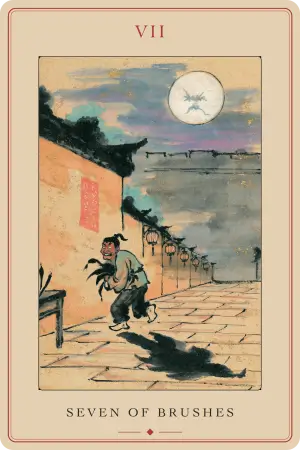
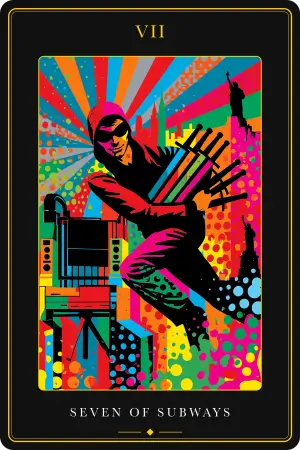
Katra kava to pašu arhetipu interpretē citādi. Salīdziniet mākslas darbus, tad atveriet kavu, lai izlasītu pilnu skaidrojumu.
Tēlojums un simbolisms
Pamela Colman Smith gives the Seven of Swords a full scene where older decks gave only crossed blades. Her figure wears a polka-dot tunic, a fez, and soft red boots, and he tiptoes away from a military camp on the balls of his feet. He carries five swords bundled against his body, grasping them by the bare blades, and he turns his head back over his shoulder with a faint smirk toward two swords still planted upright in the ground. Behind him, three small figures stand talking near the tents, oblivious to what is leaving the camp.
Smith's colour choice does much of the work. The predominant yellow reads as energy, activity, and the courage that decisive action needs, which lends the scene nerve rather than shame. The tents themselves are shelter and protection, so lifting swords out of one reads as a breach of trust, not a fair fight. The split of the swords into two groups, five carried and two left, points to the ability to weigh what matters and prioritise it, taking the useful and leaving the rest.
Several details keep the moment unstable. His body moves forward while his head looks back, past and future pulling in opposite directions. His grip on the naked blades divides readers: some see a strategist skilled enough not to be cut, others see impulsive greed that wounds him as he goes and a plan less airtight than he thinks. The two swords left behind echo the Two of Swords, the honest negotiation he has turned his back on. A diagonal line runs from his foot to the topmost sword, as if hesitation were tugging him backward toward the camp he is robbing.
Pamata nozīme
You already have the archetype from the canonical page: stealth, deception, strategy, and getting away with something. What the Rider-Waite-Smith card adds is a reading of that archetype as competence under pressure. This deck frames the Seven of Swords around determination, ingenuity, and the skill of turning circumstances to your advantage, of devising a strategy when a direct approach will not work. The man does not blunder; he plans, he prioritises, and he moves while nobody is watching.
The darker current runs alongside it. On the Tree of Life the sevens sit at Netzach, the sphere of desire and emotion, and pressed against the cold logic of Swords this makes a divided mind, action taken while part of the self doubts or undermines it. The Golden Dawn called the card 'Unstable Effort' and the Thoth deck named it 'Futility'. So the Smith image holds two possibilities in one frame. The stealth can be genuine self-preservation, the quiet gathering of resources and planning of an exit in a rigged situation. It can also be a way of avoiding a truth the querent would rather not face. The card asks which one is actually in play.
Taisna pozīcija
Upright, the Rider-Waite Seven of Swords points to acting alone and out of sight: a plan run in secret, an advantage taken by wit rather than force, or a warning that someone nearby is being less than straight. It rewards the strategist who works around a blocked front door, and it cautions against showing every card too soon. Study the situation more deeply, since an unconventional solution usually exists, and pay close attention to detail so you are not the one deceived. The honest edge of the card asks whether the sneaking is clever survival or a way of circling the truth.
In love. Rarely active malice, more often an avoidant partner keeping their cards close to the chest. Someone may feel real affection yet hide behind mental walls and dodge hard conversations to protect themselves from being hurt. It counsels pacing and firm boundaries until trust is earned.
In career. Office politics and underhanded dealings. Read the fine print, be wary of a colleague claiming credit for shared work, and hold your plans back until the strategy is ready. It is the card of the quiet job search and the carefully planned exit.
In finances. Caution around contracts and hidden costs, with a nudge toward inventive, backchannel routes when the usual paths are closed. Money reached this way can raise ethical questions, so weigh personal gain against the wider picture.
In health. Something hidden or misdiagnosed, and a prompt to seek a second opinion and dig deeper. It also flags the physical toll of carrying secrets and living in constant anxiety.
Apgriezta pozīcija
Reversed, the swords are dropped and the concealment breaks down. The most traditional reading is a lie exposed, or a conscience grown too heavy, so the querent feels pushed to confess. It marks the shedding of toxic baggage and a return to honesty, and for anyone who has been on the receiving end of deceit it brings relief and vindication as the hidden agenda comes to light. As a card of strategy, the reversal can instead mean a plan poorly conceived or outsmarted, the unstable effort collapsing, the fool's gold of a shortcut that led nowhere. Read psychologically it often turns positive: the end of self-sabotage and the recognition that hiding the true self out of fear costs more than it saves.
In love. Truth surfacing, an avoidant partner finally opening up, or a deception uncovered along with the relief that follows.
In career. A scheme unravelling, whether the querent's own rushed plan or a rival's, and an opening to return to straight dealing.
In finances. A hidden cost or bad-faith arrangement coming to light, or a shortcut that fails and forces an honest reset. Money earned quickly can be lost just as quickly.
In health. A missed cause finally found, or the exhaustion of secrecy giving way to authenticity and relief.
Vēsturiskās piezīmes
The card's older forms are far less literal than Smith's. In the Tarot de Marseille the Seven of Swords is a non-scenic pip, a central sword crossed by six others with flowers blooming at the intersections, read esoterically as a futile love and as the paralysis of analysis, the thinker who plots every outcome yet never picks up the sword at all. The Astrolabium Planum had already drawn the third decan of Aquarius as a sneaky figure hiding something under his coat, a direct ancestor of the camp thief.
Pamela Colman Smith fixed the modern image in 1909, working under A.E. Waite's direction for the deck published by Rider & Company. A curiosity survives in Waite's own 1910 Pictorial Key to the Tarot: he gives the card meanings of 'design, attempt, wish, hope, confidence' and 'a plan that may fail', then adds a stray positive note promising 'a country life after a competence has been secured'. That pastoral reading clashes with the thief Smith actually drew and is almost never used today. It suggests Smith, herself a Golden Dawn initiate, embedded her own esoteric narrative into the artwork and let the picture outrun Waite's text. In Crowley and Harris's Thoth deck the same card is titled 'Futility', a single solar sword battered and chipped by six smaller planetary swords, one noble idea worn down by a restless, overactive mind.
Atbilstības
Number. Seven, the number of reflection, assessment, and a restless quest for knowledge. Turned on the mind it produces a 'yes-but' frame, and under the emotional pull of Netzach a mind divided against itself.
Astrology. The Moon in the third decan of Aquarius, roughly 20 to 29 degrees, about February 9th to 18th. The Moon's fluctuating, illusory nature washes out the rigid scaffolding of Aquarian logic, so a person can delude themselves as readily as they mislead anyone else.
Element. Air, the suit of intellect and communication, here bent toward schemes, discretion, and hidden knowledge.
Kabbalah. The card sits at Netzach, Victory, the seventh sphere of desire and emotion, within Yetzirah, the formative world of mind. Feeling disrupting logic in that place yields the 'Unstable Effort' of a compromised plan.
Elemental dignity. As a slippery Air card it unsettles certainty in the cards around it. In cartomancy it maps to the slow Seven of Spades, a winter suit, so questions of timing point to delay measured in months rather than days.
Psiholoģiskā perspektīva
The Seven of Swords works as a mirror for self-deception. When it recurs as a 'stalker card', turning up in pull after pull, community wisdom points the suspicion inward rather than outward, asking where the querent is sneaking around their own truth or what mask they wear to feel safe. It names covert people-pleasing, saying everything is fine while quietly seething at a crossed boundary, a way of managing one's own reality to avoid conflict. It also names imposter syndrome plainly. The sense of getting away with something is the fraud's dread of being unmasked, and the card presses the querent to stop stealing from their own potential by playing small.
The mythic figures behind this decan sharpen the theme. Odysseus is the wily, resourceful mind that treats every obstacle as a puzzle for guile. Don Quixote loses himself to the Moon's phantasms and mistakes delusion for vision. The lesson sits between the two: cunning is a real survival art in rigged systems, yet the same intellect can talk a person out of feeling what is true. The card warns as well against spiritual bypassing, using esoteric practice to skip past real psychological wounds, and it calls for embodiment over clever avoidance.
Zobenu septītnieks dažādās kārtīs
The Rider-Waite-Smith version this page follows is the thief slipping from the camp, the single image that fixed stealth and calculated risk in the modern imagination. Set it beside the other traditions and its emphasis stands out.
The Tarot de Marseille pip reads as futile love and analysis paralysis, all planning and no action, with no thief in sight. In Crowley and Harris's Thoth deck the card is 'Futility', a noble solar sword chipped away by six restless smaller ones, the mind's own chatter eroding a single good intention.
Modern decks soften or reframe the Smith scene. The Wild Unknown shows a fox asleep on a sword with one eye open, shifting theft toward secrecy and guarded peace. The Shadowscapes raven warns against stealing other people's ideas. The Light Seer's figure walks a tightrope between taking only what you need and lying to yourself. Everyday Tarot leans into imposter syndrome and the 80/20 rule. Across all of them the swords stay concealed under a cloak rather than wielded in the open.
Kombinācijās un kontekstā
The Seven of Swords sharpens against its neighbours. Beside the Five of Swords the difference is method: the Five is an open, brutal, public battle of egos, while the Seven is a covert battle of wits, a surprise ambush that learns from the Five's ruin that a rigged game sometimes has to be outmanoeuvred rather than met head-on. Against the Page of Swords it is the guarded, secretive cousin of that open curiosity, hiding facts where the Page hurries to speak them.
Major Arcana pairings deepen it. With The Tower, both governed by Uranus, a hidden flaw becomes the trigger for an unavoidable collapse. With the High Priestess it confirms that a gut feeling about a hidden agenda is accurate. With The Moon it is delusion and deception at full strength, reality so obscured that no fact can be trusted. In timing it runs slow, months rather than days. In a yes-or-no reading the upright card generally answers no, calling for caution and strategy; reversed, as the truth comes out, it eases toward yes.
Jautājumi pārdomām
- Where in my life am I sneaking around my own truth, and what am I afraid would happen if I said it plainly?
- Is my strategy here clever self-preservation in a rigged situation, or am I quietly deceiving myself to dodge a harder path?
- What am I carrying by the blade, cutting myself in the process, that I could set down or approach more honestly?
Vispārējā nozīme izriet no Raidera-Veita-Smita skaidrojuma, kas ir pamata atsauce Tarot Academy. Atveriet konkrētu kavu augstāk, lai iepazītos ar tās interpretāciju.
Biežāk uzdotie jautājumi
Izpētīt Taro
Latest Posts
Atklājiet seno Taro kāršu gudrību un atveriet garīgās ceļojuma noslēpumus. Mūsu blogs ir jūsu vārti uz Taro lasīšanas bagātīgās simbolikas, nozīmes un praktiskās pielietošanas izpratni.




















































