
 LV (latviešu)



Mazie Arkāni · Kausi (Water)
Kausu bruņinieks
Smith put a knight on a white horse at a walking trot, raised his visor so you can see his face, and gave him one gold cup held out toward someone the picture never shows.
Kārts īsumā
- Numeroloģija
- Knight
- Elements
- Ūdens
- Astroloģija
- 21 degrees Ūdensvīra through 20 degrees Zivju (Golden Dawn), twelfth house
- Kabalas ceļš
- Fire of Water, the Thoth Prince of Cups
- Laiks
- Mid-February to early March, and fluid: Cups count in months
- Jā / Nē
- Taisnā pozīcijā jā if the follow-through checks out, apgrieztā nē
Taisni
Romance
Imagination
Charm
Diplomacy
Creative inspiration
Emotional message
Idealism
Deep perception
Apgriezti
Unrealistic fantasy
Emotional immaturity
Instability
Deceit
Infidelity
Shattered dreams
Inaction
Drama
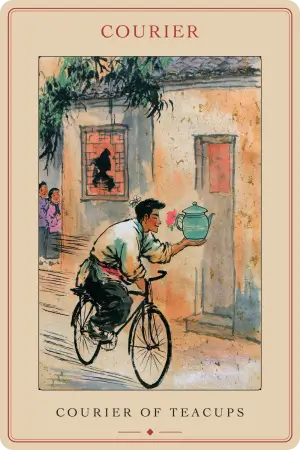
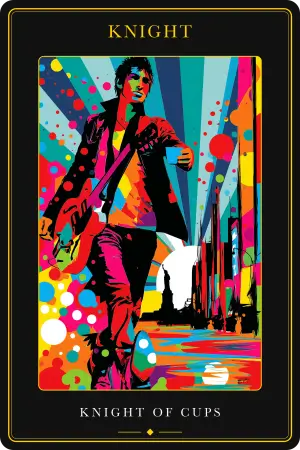
Kausu bruņinieks katrā kavā
Katra kava to pašu arhetipu interpretē citādi. Salīdziniet mākslas darbus, tad atveriet kavu, lai izlasītu pilnu skaidrojumu.
Tēlojums un simbolisms
The pacing is the argument. Pamela Colman Smith drew every Knight of the Minor Arcana at a different speed: the Knight of Swords at full gallop, the Knight of Wands on a rearing horse, the Knight of Pentacles on a heavy draft animal that has stopped entirely. The Knight of Cups moves at a measured trot. He is going somewhere, and he is in no hurry to arrive. This deck reads that gait as the rhythm of emotional currents rather than the urgency of combat, and the white of the horse as purity, innocence, and a striving toward higher values.
Smith undressed the soldier. The armor is casual, closer to ceremonial than to anything built for a battlefield, and the beaver of the helmet, the lower face guard, is raised so his face shows. That single detail carries the card's disposition: he arrives without a defensive barrier up. This deck reads the armor itself as spiritual and intellectual richness, decorated with the fish that swim across his red and blue tunic. Fish are the animal of the Water element in esoteric and early Christian symbolism, and here they stand for wisdom and the ability to process deep feeling rather than merely have it.
The wings on his helmet and boots belong to Hermes, the messenger who moves between the divine and mortal worlds. This deck reads them as the capacity to rise above the material and give an idea a body. He is a courier, and what he carries is emotional news.
In his right hand, one golden chalice, extended outward. The gesture echoes the hand emerging from the cloud in the Ace of Cups, and the contents are hidden, which is the point: the cup holds an offer whose value has not been established yet. This deck reads it as an open heart ready for new emotion and a vessel for spiritual knowledge. He offers it before asking for one in return.
The ground behind him completes the reading. A shallow river winds across the landscape, small enough that the horse crosses it unbothered, and this deck takes it as a mirror of his unconscious: he is not afraid to go into the water. Compare the Five of Cups, where the river is wide and forbidding. The trees signify life and growth. Behind everything sit the jagged peaks that also appear in The Fool, the initiations and hardships nobody rides around. He faces them. And where the older Tarot de Marseille turned the Knight east, toward the past, the Rider-Waite-Smith card turns him west, toward the future.
Pamata nozīme
This deck states him plainly: romance, intuition, and a spiritual quest, a messenger in motion bringing news of love and soulful realizations. The archetype behind that is the Fire of Water. Cups are Water throughout, but the Knight's rank is Fire, so this figure cannot sit with a feeling the way the Queen of Cups does. His fire takes the amorphous inner emotion and pushes it out into the world, which produces steam rather than stillness.
What this deck emphasizes is the quality of the motion, not just the fact of it. The Knight of Cups marks a period of emotional well-being, creative inspiration, or deep infatuation, with a strong pull toward art, culture, and spirituality. Its instruction is to listen to your dreams and feelings closely, because in this stretch of time they are reliable navigation. An important emotional message may be arriving, or an event that brings vivid new sensations. Unexpected meetings and conversations are worth treating as signs.
The balance is delicate in both directions. Let the fire dominate and he burns through one infatuation after another, leaving damage behind because his appetite for the spark outruns the depth that would sustain it. Let the water put the fire out and he becomes stagnant, oversensitive, paralyzed by imagined slights, unable to execute the visions he keeps having. Held together, the two produce a charismatic person who acts decisively and still notices how the action lands on everyone else.
Taisna pozīcija
Upright, this deck reads romance, delicacy, and an affinity for others: sophistication, diplomacy, and the ability to find common ground with almost anyone. It names inner balance, sensitivity, compassion, receptiveness to beauty and art, and a drive toward self-development. The standing advice is to be open to new values, let intuition guide your actions, express your feelings openly, and use creativity for self-expression. This is a time to follow your emotions boldly.
In romance. A surge of emotion, kindness, and sensuality, and a dreamy person fully capable of deep intimacy. A romantic proposal or a date invitation may be near. This deck expects intense tenderness and the thrill of falling in love, along with someone ready to open up completely and share their joys and sadness honestly. Romance shows up in ordinary daily life here, in emotional openness and thoughtful acts. Expect pleasant surprises, and show your own feelings rather than waiting.
In relationships more broadly. Generosity, sincerity, and smooth collaboration, with an ability to accept people exactly as they are. This deck describes the conversational energy as highly diplomatic: it reads the mood intuitively, adapts to the room, and creates warmth, which suits situations that need a delicate approach. Your circle widens simply because you stay receptive. Interactions run on mutual aid and emotional understanding, and valuable information may come from people eager to share it.
In work. Tact, diplomacy, and excellent rapport with colleagues, with issues resolved through patience and attentiveness. This deck expects stronger interpersonal skills, new business connections, and a positive team atmosphere. Communication sits at the center of professional growth now, and the calm environment lets you concentrate on the quality of your output. It also asks for emotional investment in the tasks themselves and a creative approach to them. If you are job hunting, let intuition weigh in.
In business. Inspiration, creativity, and deep emotional involvement, with projects driven by genuine enthusiasm and strategies that come out of intuitive insight. Bold innovation and an unusual approach can attract clients. This deck points to new partnerships and open dialogue, with clear openings for negotiations with potential investors, and it flags an offer worth considering even if it looks unconventional at first. Above all it calls for diplomacy and compromises that secure mutual benefit. Keep an eye on the practical details while you follow the intuition.
In money. Favorable agreements and profitable offers, and a strong sign to invest in something you actually love. Because the Knight patronizes the arts, creative ideas may become earning ideas. New income often opens through valuable contacts, so communication and personal connections are the keys to material success right now. You may take a mediating role where your ability to deal well with people adds real value. This deck is specific about the pace: investments here tend to be slow, reliable, and stable in the end. Let intuition guide the decisions without skipping the planning and the drafting of proposals.
In the physical realm. Harmony and internal balance, with physical well-being resting heavily on how well your emotions are organized. This deck says that addressing emotional needs is the most effective route to overall health, and it suggests simple pleasures: walks in fresh air, relaxing baths, meditation. Internal healing here leads naturally to external improvement, a new haircut, a different skincare routine, outdoor jogging. Physical beauty reflects the inner state and flourishes when you are in harmony with yourself.
Apgriezta pozīcija
Reversed, this deck points to deceptive dreams and unfounded illusions, with emotion so romanticized that contact with reality slips. It reads as a loss of emotional control in either direction: feelings that cannot be managed, or feelings suppressed out of fear. Narcissism, instability, unrealistic expectations, insecurity, deceit, infidelity, and drama all sit here, along with unrealized potential and ideas that never get implemented. The recommendations are concrete. Work on understanding your emotions so they stop steering. Hold a firm balance between the outer world and your inner life. Look at the facts, apply logic and common sense, and be entirely honest with yourself about what you actually want.
In romance. Emotional overload, unhealthy dependence, and a severe lack of balance. You or your partner may be acting purely on emotion and disregarding the situation as it is. This deck names unmet needs and an idealized notion of love that ends in disappointment. Romance has likely gone, replaced by emotional exhaustion, with misunderstandings and communication blocks because one person stopped opening up. The connection has cooled and true feelings stay unsaid. Interference from a third party is possible. Modern readers know the wider archetype as the "sensitive fuckboy," the figure who uses vulnerability as a snare, love-bombs with rapid declarations and future-faking, then goes quiet when sustained commitment is asked for.
In relationships more broadly. Communication problems driven by excessive emotion. Interactions get blocked either by hypersensitivity and sentimentality or by a total failure to register what other people feel. This deck reads indecision and a habit of avoiding problems instead of facing them, with disharmony and misunderstandings likely. Expect stress, irritability, and resentment from mismatched expectations, and an underlying difference in worldview that hurts feelings easily. Honest dialogue and more patient engagement are what stop the escalation.
In work. Diplomacy breaks down badly, sometimes into aggressive or unprofessional behavior, and open conflict with colleagues damages the team. Unmanaged emotion spills into the actual output. This deck warns that failure to handle small details and daily duties leads to larger mistakes, and it expects a tense period of emotional outbursts and potential burnout, with an overloaded schedule adding pressure. Reconsider how you communicate, then build an action plan on rational grounds and leave the volatility out of the office.
In business. Unrealistic expectations and a lack of practicality. The plan may rest on optimistic forecasts rather than solid data, which produces a stretch of uncertainty about the path you chose. Enthusiasm is no longer enough here; this deck asks for a mature approach based on cold calculation. It frequently points to an unreliable partnership or an idea that yields nothing, and it allows for suddenly losing interest in a project or stalling on internal fear. Some proposals will fall flat. Rebuild the strategy on reality.
In money. Inflated expectations and unachievable financial dreams, with attention drifting toward romanticized ideas about getting wealthy. When fantasy overshadows sensible management, money goes to impulsive spending and hopes of a quick payout. This deck names failed investments and expenses made with no long-term plan, overestimated capabilities, and reckless conduct in business. An attractive offer may prove deceptive. Seek expert advice and avoid spontaneous decisions.
In the physical realm. Emotional imbalance surfacing in appearance and health, often through poor diet, a sudden drop in activity, or neglected self-care. This deck describes a body worked too hard while the emotions run on edge, which produces deep exhaustion. The inverse fails too: obsessing over external appearance while the inner turmoil goes unaddressed makes the health problems larger. Balance work with leisure and give real time to rest.
Vēsturiskās piezīmes
The court cards began as aristocratic placeholders in Renaissance playing decks and became psychological signifiers only through the occult revival. The Knight of Cups shows the transition clearly. In the fifteenth-century Sola Busca deck he is Natanabo, that is Nectanebus, the mythical pharaoh and magician of the Alexander Romance who approaches Olympias in serpent form, which puts beguilement and disguise into the archetype long before anyone called it romance. In the Tarot de Marseille he rides east, toward the past.
The Golden Dawn built the machinery this card still runs on. It titled him Lord of the Waves and the Waters, and King of the Hosts of the Sea, assigned him a thirty-degree span of the ecliptic, and tied him to hexagram 54 of the I Ching, The Marrying Maiden, thunder over the lake, a figure of sudden and sometimes chaotic romantic influx. S. L. MacGregor Mathers then realigned the court titles to the Tetragrammaton and the Four Worlds of Kabbalah.
Waite and Smith published in 1909, and Waite kept the traditional medieval nomenclature for a mass-market deck while Crowley followed Mathers. That fork is the source of a persistent confusion. Crowley's Knight of Cups corresponds to the Rider-Waite King of Cups; the Rider-Waite Knight of Cups corresponds instead to Crowley's Prince of Cups, the Air of Water. It is worth knowing which card you are actually looking up, because the Thoth Knight is a short explosive burst of energy and the Thoth Prince is directed movement toward a goal. The Prince mapping also explains the winged Mercury helmet Smith drew and the chariot-like momentum readers feel in this figure.
Smith's own contribution was the turn. Facing the Knight west instead of east reoriented the whole card from memory toward what has not happened yet, which is why this deck reads him as someone who moves effortlessly between the material and the spiritual rather than someone looking back at either.
Atbilstības
Number. No pip number. His rank is the correspondence: Knights carry the Fire of their suit. In the standard court matrix, Pages are Earth, Knights are Fire, Queens are Water, and Kings are Air, so this figure is the Fire of Water, the active force that takes feeling and moves it outward.
Astrology. He rules from 21 degrees Aquarius through 20 degrees Pisces, which is the last decan of a fixed sign plus the first two decans of the mutable sign that follows. Each third has a card behind it. Aquarius III belongs to the Seven of Swords, Lord of Futility, ruled by the Moon, and it supplies humanitarian vision, social cleverness, and the charm of a people person, along with a shadow tendency toward escapism when the pressure rises. Pisces I belongs to the Eight of Cups, Lord of Indolence, ruled by Saturn, and it supplies the restlessness that keeps him searching and willing to leave stagnant situations. Pisces II belongs to the Nine of Cups, Lord of Happiness, ruled by Jupiter, which is the goal he is riding toward. This deck adds that in the natural horoscope he is primarily associated with the twelfth house of mysticism and secrets, and that Pisces gives him grace, generosity, charm, and visionary imagination, together with inconsistency, forgetfulness, and a carefree streak.
Element. Water, the suit's element of emotion, intuition, and receptivity, in its active form. This deck describes him as viewing the world through a watery haze that reflects back the distant hopes of the people around him.
Kabbalah. Under the Mathers restructuring he corresponds to the Thoth Prince of Cups, the Vau, the Air of Water, the Son riding in a chariot toward a specific goal. That airy, communicative face of Water is what lets him articulate feelings most people cannot put into words.
Timing. Cups traditionally count in months, and the mutable Piscean attribution makes the timing fluid, often an event closing a cycle or a span running three months or longer. In the strict Golden Dawn decan reading, the window falls between mid-February and early March.
Elemental dignity. Fire inside Water is the card's own internal friction, and the two are capable of obliterating each other. He is strengthened by Earth cards, Pentacles or a structured Major such as The Emperor, which supply the grounding his offer needs to survive past the honeymoon phase. Upright he answers yes to questions about romance, art, and heart-led endeavors, provided the follow-through is real. Reversed he answers no and flags illusion.
Psiholoģiskā perspektīva
The people this deck attaches to the upright card have sensitive natures and endear themselves easily. They empathize deeply, gravitate toward art and beauty, and their dreamy temperament leads them to idealize both people and situations. Compassion and a real understanding of others form the core of the character. They seek harmony, draw inspiration from the world, and pass that feeling on to everyone they meet. They are always ready to help, and they attract people through enthusiasm and evident joy in living. This deck defines the type by one willingness in particular: to dedicate themselves entirely to a romantic idea or relationship and set practicality aside to express what they feel.
Reversed, the same sensitivity turns inward and sours. These people struggle to enjoy life, dramatize situations, and suppress what they actually feel. Their unrealistic romantic dreams cause trouble in friendships and relationships, and by neglecting reality in pursuit of an ideal they set up their own disappointment. Apathy and indifference come easily, decisions do not. Impossibly high expectations keep satisfaction permanently out of reach. They are unstable in emotional matters, avoid responsibility where they can, and let mood swings do the choosing.
The classic trap for this figure has a name in relational psychology: the White Knight. He seeks out partners in distress because his support might save them. The intent is noble, and the mechanics are those of a lifeguard and a panicking swimmer, where the thrashing victim can pull the rescuer under. It slides into codependency, since the role requires a broken partner to validate it, and interest can fade once that partner heals and stands on their own. Modern culture has largely pathologized the hopeless romantic, reading instant infatuation and self-focused emotional highs as love-bombing and poor regulation rather than devotion. The card has not changed; the zeitgeist reading it has. His development runs the other way: stop skimming the surface on a moving horse and actually inhabit the depth he keeps chasing, which is the maturity the Queen and King of Cups already hold.
Kausu bruņinieks dažādās kārtīs
Rider-Waite-Smith. The version on this page, and the one nearly every modern reader pictures. Smith's specific choices are the white horse at a trot, the raised visor, the fish tunic, the winged helmet and boots, the single extended chalice, the shallow river, and the westward turn. Everything this deck says about romance, intuition, and a spiritual quest is carried by those details rather than by the rank alone.
Tarot de Marseille. The Knight faces east, toward the past, in an older courtly image without the oceanic staging Smith built around him. The reversal of that orientation in 1909 is the single clearest difference between the medieval card and the modern one.
Sola Busca. The fifteenth-century deck names him Natanabo, the magician-pharaoh who approaches a queen in serpent form. The layer this adds is enchantment used as approach, which reads uncomfortably close to what contemporary readers flag in the reversed card.
Crowley-Thoth. Crowley's court follows the Tetragrammaton, so the figure equivalent to this card is his Prince of Cups, riding a chariot as the Air of Water, directed momentum toward a chosen goal. Crowley's own Knight of Cups is a different card entirely, corresponding to the Rider-Waite King.
Conceptual modern decks. The Tarot of Baseball maps the court onto positions on the field and renders him the Pitcher of Gloves, with Cups becoming gloves and mitts for their receptivity, keeping wings on the cap as a nod to Smith. Some critics find the translation of a Water suit onto a baseball diamond an odd fit, which is a useful reminder of how much of this card lives in its water imagery.
Kombinācijās un kontekstā
Position changes him more than most cards. Drawn for how someone feels, the upright Knight says the person is deeply infatuated and seeing the querent through the rose-colored glasses of intense attraction, a genuine pull even when it is overwhelming. Drawn for intentions or actions, he intends a romantic proposition or a creative collaboration and favors bold movement. Readers consistently attach one caution to that: the intention is sincere in the moment, and the long-term action needs grounding Earth cards or a structured Major such as The Emperor to survive past the honeymoon phase.
Beside the Ace of Cups he is pure emotional inception, a formal engagement or a genuine romantic or artistic proposal. Beside the Two of Cups he is mutual attraction and a bond forming. With The Chariot, which shares his armored rider and his wings of Hermes, the theme of movement runs to its maximum: tunnel vision toward a romantic or creative goal, a flow state nothing gets in front of. With Death, two horsemen in armor, the reading turns karmic, a love that has to have its illusions stripped away before a more durable connection can appear. Practitioners cite the Knight of Cups with Death, the Two of Cups, and The World as the signature of a bond that runs across lifetimes.
The shadow pairings are sharp. With The Devil the chivalry is replaced by obsession and bondage, a dangerous lover using charm and trauma-bonding for control, and the pairing can also point to substance abuse used to manage emotional volatility. With the Seven of Cups he is lost in fantasy, building castles in the sky about a partner who does not exist as imagined, or juggling options and enchanted by the swipe. With the Three of Cups reversed, known in forums as the affair card, the combination leans toward infidelity from someone who talks convincingly about commitment. The Seven of Pentacles is subtler: a person working hard at the relationship, keeping the feelings below the surface, and quietly resenting that the effort is not matched.
Among the court he is the middle of a sequence. The Page of Cups, Earth of Water, is startled by the fish coming out of his own cup, a crush theorized rather than acted on. The Knight has taken that theory and mounted a horse with it. The Queen of Cups sustains the feeling instead of delivering it, and the King of Cups holds objective boundaries around the same compassion. If the Page is the youth discovering poetry, the Knight is the poet publishing the work.
Jautājumi pārdomām
- This deck reads the river as a mirror of the unconscious, shallow enough that the horse crosses it without noticing. What feeling have you decided is too deep to enter, and is it actually as deep as you have been telling yourself?
- The Knight offers his cup before asking for one back, with the contents hidden. When you last made an offer like that, were you offering out of generosity or to be needed?
- Smith turned this Knight west, toward the future, where the older decks had him facing the past. Which direction is your own attention pointed right now, and what would change if you turned it?
Vispārējā nozīme izriet no Raidera-Veita-Smita skaidrojuma, kas ir pamata atsauce Tarot Academy. Atveriet konkrētu kavu augstāk, lai iepazītos ar tās interpretāciju.
Biežāk uzdotie jautājumi
Izpētīt Taro
Latest Posts
Atklājiet seno Taro kāršu gudrību un atveriet garīgās ceļojuma noslēpumus. Mūsu blogs ir jūsu vārti uz Taro lasīšanas bagātīgās simbolikas, nozīmes un praktiskās pielietošanas izpratni.




















































