
 EN (English)




Minor Arcana · Cups (Water)
Ten of Cups
Emotional arrival: the rainbow moment of belonging, home, and shared love.
Read the complete guide: The Ten of Cups in Tarot: A Complete Guide to its Symbolism and Meaning
Card at a glance
- Numerology
- Ten
- Element
- Water
- Astrology
- Mars in Pisces (third decan)
- Kabbalistic path
- Malkuth (Kingdom)
- Timing
- Late Pisces season · before the spring equinox
- Yes / No
- A resounding yes
Upright
domestic bliss
harmony
belonging
family
emotional fulfillment
contentment
gratitude
Reversed
family rifts
disconnection
performed harmony
broken home
misaligned values
disillusionment
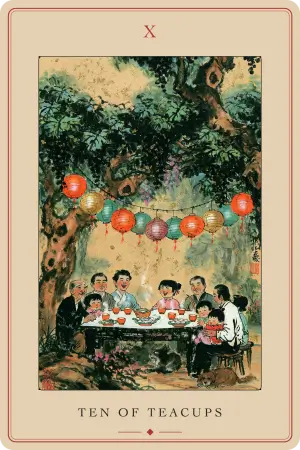
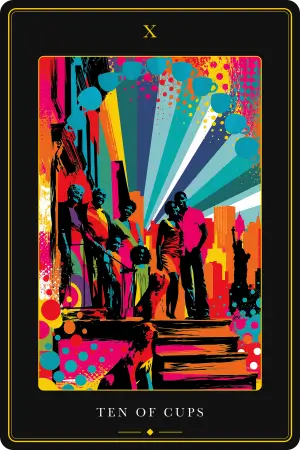
Ten of Cups in each deck
Every deck reimagines the same archetype. Compare the art, then open a deck to read its full interpretation.
Imagery and symbolism
The Rider-Waite-Smith Ten of Cups is one of the suit's calmest images. A rainbow arcs across a clear blue sky, ten golden cups suspended in its band of color. Beneath it a man and a woman stand with their backs to us, arms raised toward the sky as they hold each other, while two small children dance in a circle nearby, lost in the moment. A modest cottage sits on a green hillside, framed by trees, with a river winding past.
The rainbow is the card's key. Made where water, the suit's element, meets light, it reads in Western tradition as a divine covenant, a promise of peace after the storm. It also carries the card's central paradox: a rainbow is beautiful and fleeting, an appearance that cannot be grasped or kept. That is the nature of the joy shown here, a peak of belonging that is real and naturally transient, which is exactly what makes it worth holding with gratitude.
The rest of the scene grounds that idea. The couple's raised arms read as surrender and openness to receive. Esoteric readers map the family onto the Tetragrammaton, with the father and son in red for the fiery masculine principle and the mother and daughter in blue for the watery feminine. The cottage is deliberately modest, not a castle, which says the fulfillment rests on emotional security rather than status. The river shows emotion circulating in a healthy, flowing state, and the couple viewing their home from a distance captures the value of stepping back to appreciate what they have built.
Core meaning
The Golden Dawn titled this card the Lord of Perfected Success, and in the Qabalah it is Malkuth in Briah. The emotional current that began as a single divine drop in the Ace of Cups has descended the Tree of Life and reached its final, physical form in the tenth sphere. The cups are full to the brim and the waters rest in their grounds; the emotional ideal has become a lived reality.
As the numerical end of the Cups journey, the Ten is the suit's clearest picture of arrival: domestic harmony, belonging, and a heart at peace after the storms of the Five and the Eight. It is fulfillment that includes other people, the warmth of family and chosen family rather than a private, solitary contentment. Because it is a ten, it also sits at the edge of a cycle, the point where fullness must eventually pour out and begin again at the Ace.
Upright meaning
Upright, the Ten of Cups is one of the most auspicious cards in the deck. It marks emotional fulfillment shared with others, the deep ease of belonging and a life in harmony with the people around you. It speaks of storms weathered and a sanctuary reached.
In love. For committed couples it points to mutual understanding and a partnership maturing into a shared life, the card of marrying and building a home together. For singles it promises a connection with lasting stability and soul-level resonance, and it favors serious bonds over casual flings.
In career. It shifts the focus from ambition to alignment. Often it shows a workplace that feels supportive and family-like, and work that supports the life you actually want rather than consuming it.
In finances. Stability and a sense of generational abundance, the kind of security that buys safety and the ability to care for the people you love, valued above status symbols.
In health. A signal of well-being through belonging. It emphasizes the mind-body connection and suggests that efforts to improve your health, supported by community, will bear fruit.
Reversed meaning
Reversed, the idyllic surface cracks and the strain underneath shows.
In love. Family rifts, disconnection, and the disintegration of a support system. It often flags performed harmony, going through the motions of a happy family for the sake of appearances while the real feeling has gone cold. The card urges you to name the cracks before the facade shatters on its own.
In career. Work is eating the home. The balance has tipped so far toward the job that the private life it was meant to support is starving, and priorities need a fast reset before the rainbow fades.
In finances. After a loss or a divorce, the temptation to perform a quick, inauthentic recovery instead of doing the deep repair the situation actually needs.
In health. The strain of clinging to a white picket fence fantasy that does not match reality. The card can hold up a mirror and show that you are idealizing an incompatible situation because you are attached to the potential rather than the truth of it.
Historical notes
Earlier decks such as the Tarot de Marseille render the Ten of Cups as a formal arrangement of ten vessels with no scene, leaving the meaning to the numerology of ten. In 1909 Pamela Colman Smith, under A. E. Waite, replaced the abstract pip with the rainbow, the couple, and the cottage, giving the card its lasting image of domestic arrival and setting it in deliberate contrast to the grief of the Five and the confusion of the Seven.
The Hermetic Order of the Golden Dawn fixed the esoteric title, the Lord of Perfected Success, and tied the card to the third decan of Pisces. Aleister Crowley took the same placement in a darker direction, naming his version Satiety to stress that absolute fullness carries its own danger.
Correspondences
Number. Ten is the completion of the suit, the point where emotional energy reaches its densest, most tangible form and then must cycle back to the Ace. It is fulfillment and, at the same time, the edge of an ending.
Astrology. Mars in Pisces, governing the third decan, the final ten days of the zodiac before the spring equinox. Mars and Pisces look mismatched, the warrior in the dreamer's ocean, but Mars is the triplicity ruler of water, so Pisces cools its aggression into warmth rather than extinguishing it. Here the warrior stops conquering and rests in the sanctuary he fought to build.
Element. Water, the suit's element of emotion, intuition, and the subconscious.
Kabbalah. Malkuth, the Kingdom, the tenth and lowest sphere, the world of physical manifestation, set in the watery world of Briah. The emotional ideal has landed in reality.
Elemental dignity. As a yes or no, it is a full-hearted yes, especially for questions about home and family.
Psychological perspective
The Ten of Cups ties physical and mental well-being to a sense of belonging, honoring the lineage of love that has held a person up. In modern practice it has also become a mirror for our uneasy relationship with the idea of perfect happiness. When it appears in the middle of heartbreak or depression, the picture of flawless domestic bliss can feel dismissive, and readers increasingly interpret it in that context as projection: a white picket fence fantasy the seeker is clinging to rather than a promise about their actual life.
In a challenge or "what to let go of" position, the card asks you to surrender the pressure of perfection, not happiness itself. The cultural script of the flawless family creates real stress, and the Ten in this spot advises dropping rigid ideas of how love should look so you can find contentment in the messy, imperfect version that is actually available. The rainbow makes the same point on its own. The joy is meant to be appreciated fully and held with gratitude in the present, because the wheel will turn and this particular chapter will give way to the next.
The Ten of Cups across decks
Tarot de Marseille. Ten cups in a formal geometric layout, no figures, the meaning resting entirely on the number and its sense of completion and well-being.
Crowley-Thoth. Retitled Satiety, this version arranges ten cups in the exact pattern of the Tree of Life, clean water falling from the top cup through the whole structure like a fountain, against a fiery red Martian background with a broad red lotus of universal love behind them. The cup handles are shaped like the horns of the Aries ram, hinting at the shift from watery Pisces into fiery Aries that follows this decan. Some of the cups tilt and sway, a sign that this fullness is precarious and ready to tip. Satiety means stuffed to capacity, the warning that too much of a good thing ends growth.
Across traditions. However the card is drawn, the constant is completion at the emotional level, a fullness that has reached its limit and must eventually pour out to renew.
In combination and context
The Ten of Cups is most often set beside the Ten of Pentacles, since both are suit finales that picture family. The difference is the ground of the fulfillment. Cups is Water: chosen family, soul bonds, and a warm but ephemeral joy that rises and falls with emotional weather. Pentacles is Earth: bloodline, inheritance, property, and a legacy built to outlast the individual. A person can have one without the other, the love without the security or the security without the love.
Against The World the contrast is one of scale. The World is the Fool's whole journey completed, a cosmic, self-contained wholeness. The Ten of Cups is a localized chapter of relational bliss inside the ordinary world, happiness that comes from harmony with the people close by.
Its neighbors sharpen it. With The Lovers it becomes the apex of romance maturing toward commitment; with The Empress it leans toward pregnancy and a nurturing home; with The Sun it is unclouded, transparent joy. The shadow pairings are just as telling. The Tower shatters the domestic scene, though if the harmony was only performed, that demolition clears the way for something honest. The Devil warns that a picture-perfect front may be hiding codependency. The Three of Swords cuts through the rainbow to insist that an unhealed grief underneath cannot be papered over by a stable home.
Questions for reflection
- What in your life right now is the rainbow, real and beautiful and not meant to last forever, and are you letting yourself feel it?
- Where might you be performing harmony instead of living it, and what would it cost to name the cracks?
- Is your idea of a perfect life helping you build one, or keeping you from the imperfect happiness already within reach?
Most common combinations with Ten of Cups
The pairs readers meet most often with this card, read with both cards upright. Open one for the reversed readings.

Ten of Pentacles
HarmoniousLove and lasting security in one household: a family happy in feeling and settled in its means.

The Lovers
HarmoniousA wholehearted choice of partner grows into a shared home and family happiness.

The Empress
HarmoniousA happy home grows: family, love and comfort reinforce each other.

The Sun
HarmoniousHappiness at home is real and in plain sight: a close family, a secure bond and a goal reached.

The World
HarmoniousInner wholeness and a happy home arrive together as a long chapter closes well.

The Tower
MixedA sudden blow hits the household, and the family's real closeness carries it through.

The Devil
MixedThe family looks happy, and underneath, money, habit or control holds part of it together.

Three of Swords
MixedA good life carries a fresh grief, and the people close to you are where it can be felt.
Combinations are common patterns, not rules
The readings here describe how a pair most often reads. Check each one against two things before you apply it. The first is the question: the same pair says one thing about a relationship and another about a job offer, and the question decides which side of the pair matters. The second is the background, meaning what the querent already knows about the situation, the position each card holds in the spread, and the cards around the pair. When the question or the background points another way, go with them over the general reading. Each pair page lists the exceptions that come up most often.
The general meaning follows the Rider-Waite-Smith reading, the reference used across Tarot Academy. Open a specific deck above for its own interpretation.
Frequently asked questions
What does the Ten of Cups tarot card mean?
It means emotional arrival: domestic harmony, belonging, and a heart at peace after the storms of the suit. It is the card of family, chosen family, and a life lived in warmth with the people around you.
Is the Ten of Cups a yes or no card?
It is a resounding yes, one of the most affirmative cards in the deck, especially for questions about home, relationships, and family. The desired outcome is strongly favored.
What does the Ten of Cups mean in a love reading?
For couples it points to mutual understanding and a partnership maturing into a shared life, the card of marrying and building a home. For singles it promises a stable, soul-level connection and favors serious commitment over casual dating.
What does the reversed Ten of Cups mean?
Reversed, it points to family rifts, disconnection, and "performed harmony," going through the motions of happiness while the real feeling has gone cold. It can also warn that work is eating the home, or that you are clinging to an idealized fantasy that does not match reality.
What is the difference between the Ten of Cups and the Ten of Pentacles?
Both are suit finales that picture family, but the Ten of Cups is Water: emotional, relational, chosen family, and somewhat ephemeral. The Ten of Pentacles is Earth: bloodline, inheritance, property, and a lasting material legacy.
What are the Ten of Cups astrological and elemental correspondences?
It carries the element Water and is ruled by Mars in Pisces, in the third decan, the final days before the spring equinox. On the Tree of Life it sits at Malkuth, the Kingdom, the sphere of physical manifestation, in the watery world of Briah.
Explore the Tarot
Latest Posts
Discover the ancient wisdom of tarot cards and unlock the mysteries of your spiritual journey. Our blog is your gateway to understanding the rich symbolism, meanings, and practical applications of tarot reading.

















