
 EN (English)


Minor Arcana · Swords (Air)
King of Subways
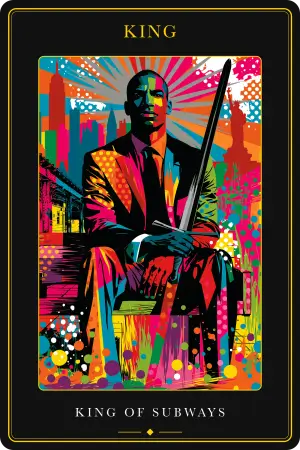
A Black man in a dark suit sits on the city's own hard seating, sword raised straight up, the subway trackwork and skyline roaring behind him, and his face stays perfectly composed at the center of it all.
Read the complete guide: King of Swords Tarot Card: A Complete Guide to Symbolism and Meaning
Card at a glance
- Numerology
- King
- Element
- Air
- Astrology
- Aquarius, ruled by Uranus (Air of Air)
- Kabbalistic path
- Chokmah (Wisdom)
- Timing
- Deep winter, Aquarius season
- Yes / No
- Yes to what withstands logic
Upright
Intellectual authority
Clarity under pressure
Impartial judgment
Strategy
Honest speech
Composure
Leadership through reason
Discipline
Reversed
Coldness
Manipulation
Abuse of power
Cynicism
Rigidity
Cruel logic
Contempt
Tyranny
King of Subways in each deck
Every deck reimagines the same archetype. Compare the art, then open a deck to read its full interpretation.
Imagery and symbolism
In the Tarot of New York City the King of Swords becomes the King of Subways, rendered in the deck's pop-art language of sunburst rays, halftone dot fields, and saturated color blocks. He sits squarely facing you, a Black man in a dark tailored suit and tie, his gaze direct and steady, tilted slightly up. It is the look of someone who does not flinch from hard truths. There is no throne of cushions and no train seat either. He sits on the hard, angular seating of the city itself, upright and at ease, because his authority needs no decoration.
The raised sword. In his right hand he holds a long sword, blade pointed straight up. It is the one traditional weapon this suit keeps, which marks him openly as the heir of the King of Swords. The vertical blade is clarity of thought and decisiveness, intention held upright and ready to cut through confusion. His left hand rests flat and open on his knee, the gesture of judgment already delivered with nothing hidden.
The halo and the sky. Behind his head a sunburst of rays fans out in silver, red, and orange, the deck's recurring halo of significance. Here it reads as a mind at full power, and it stands in for the open sky of air that sat behind the Rider-Waite king.
Infrastructure instead of clouds. On the left rises an elevated subway station and its iron trackwork, the engine of the suit itself. This king rules the underground and the elevated alike: the network of thought, the daily grind, and the movement of millions of decisions through the dark. Where the older card set him among clouds, this one surrounds him with the machinery of the collective mind. The Manhattan skyline stands behind him in blocks of pink, red, and blue, the Empire State Building at his left shoulder, and the Statue of Liberty in silhouette on the right. Liberty and justice, the two ideals his suit answers to, keep watch over his verdicts.
Static, data, signal. Halftone dots scatter across his suit and the ground like signal traffic, the free flow of thought and information that the traditional card drew as birds in flight. His face is split into planes of green, yellow, red, and blue, one man carrying every borough and every point of view in a single balanced head. The dark suit and tie are his real crown, the uniform of judgment worn in the courtroom, the boardroom, and the office at the end of the line. That composure amid the loudest possible background is the card's central statement: a mind so clear that the whole roaring city arranges itself around it.
Core meaning
The King of Subways sits at the top of his suit, the mind mastered and turned outward on the world. In this deck the suit of Swords becomes the Subways, the swords' element of intellect and conflict moved underground into the city's tunnels of thought, and the King is the one who runs the whole system instead of the one who panics on the platform. He reads the situation from above the map, sees every line at once, where they cross and where they stall and where the clean route runs, and he does it without being pulled into the noise and heat of rush hour.
His governing principle is simple and demanding: decide on facts and logic, and keep mood and momentary emotion out of it. When he appears, the situation is asking for clear thinking, objectivity, and a straight answer. He carries real leadership energy, the wise and exacting authority who uses power confidently and fairly. The judge of the moment is fair, precise, a little cold, and exactly what the moment needs. At his highest he is the critical thinker who tests inherited assumptions, the one who asks whether a settled belief is actually true or only a comfortable habit of thought, and his authority holds because it answers to evidence rather than ego.
Upright meaning
Upright, he sets a tone of high standards and objective evaluation. Let the mind lead the heart for this ride. Study the whole map before you commit to a line, think your steps through, and build a sound strategy. Say what you mean plainly, the way truth arrives on this suit: doors open, stated once, no apology. Be the calm authority on the platform, not another voice in the argument.
In love. He points to intellectual attraction, honesty, and directness, two sharp minds who fell for each other's conversation first. The bond runs on long talks over long rides, debates neither person wants to end, and the pleasure of being genuinely understood. Things are said plainly and decisions are made after real thought, since in this suit the kind lie is the crueler cut. He often describes a partner who acts from logic: fair, determined, reserved with feelings but unshakably reliable, the calm one in every crisis and steady as the system itself.
In career. He reflects competence, professionalism, and leadership, the person who has ridden every line of the daily grind and now runs it. He holds authority and respect among colleagues, and when things get loud everyone looks to him because he stays exact while others get emotional. The work rewards a developed analytical mind and decisions made with the head and stood behind afterward. Sometimes he points to legal, educational, or government work, the fair and exacting judge of the dispute.
In finances. Handle money the way the city runs its trains, on a schedule, by a map, with cold precision. Organize the accounts, plan ahead, and run rational calculations instead of sentimental ones. He favors sound management of a business or large project and profit from well-reasoned investment. The card values accuracy and rigor, though it never guarantees you are right, since everything still depends on whether the line you chose actually goes where you need it to.
In health. He treats the body the way he treats the system, on a schedule and by a plan, the daily grind converted into steady strength. Expect a focus on discipline and willpower, firmer command over habits, and structure over fads. New routines take patience, but the long-term results reward it the way the city quietly rewards the ones who grind. Let the mind lead the body, read the facts honestly, and improve your form through common sense.
Reversed meaning
Reversed, the intellect either takes over completely or goes missing altogether. On one side the mind runs express past every human stop, cold and merciless, the coldness that comes from mistaking detachment for wisdom. On the other the system is simply down, signals crossed, and the person in charge either will not decide or decides only to protect himself. Either way the balance between logic and understanding has broken.
In love. Coldness, detachment, and intellectual manipulation, a partner who runs the relationship like an express train, deciding the stops without asking who wanted off where. Emotion gets dismissed as a delay in the schedule, and decisions get made without weighing the other person's feelings. At its worst it is the turnstile jumper of the heart, taking without paying, winning every argument and slowly losing the person. The card asks him to turn his real strengths, clarity and honest speech, toward listening and repair before the last train of goodwill leaves.
In career. Tyranny, the harsh leader who runs the workplace like a stalled system nobody can complain to. He misuses power, judges too severely, and wins arguments by being crueler without ever counting what the victory costs the team. Watch for authority turned abusive, intellect bent to personal advantage, and a strictness that shuts down cooperation, read here as the closed booth and the unanswered intercom.
In finances. A lack of strategy and organization, money run like a system in breakdown, schedules ignored and cash leaking through the turnstiles. Rash decisions and poor planning cost real opportunities. It can also flag a slick operator working the angle at your expense, the fare-beater of your budget, gone three stops before you notice the loss.
In health. Overexertion and overload, the body pushed past its maintenance schedule until something in the mechanism gives. Too-strict diets, training past every limit, and discipline hardened into self-punishment drain more than they build. Even the system that never sleeps closes lines at night for repair, so treat rest and recovery as seriously as the goals, and listen to the body's actual signals instead of overriding them with the schedule.
Historical notes
Long before this suit became a subway map, the archetype was the Man of the Law. In older decks such as Etteilla's he was the Homme de Robe, the magistrate, his stone throne standing in for the judicial bench, which is why the New York card still seats him forward-facing in a courtroom-grade suit. The modern structure comes from the Hermetic Order of the Golden Dawn, which fixed the King of Swords' astrological and Kabbalistic coordinates.
A note on names matters here. The Golden Dawn and Crowley restructured the court into Knight, Queen, Prince, and Princess, so in the Thoth deck the energetic equivalent of the Rider-Waite King of Swords is titled the Knight of Swords, the Lord of the Winds and Breezes, still the active outward mastery of the intellect. Waite and Pamela Colman Smith gave the enthroned, forward-facing figure its definitive form in 1909, the image the Tarot of New York City rebuilds out of trackwork and skyline.
Correspondences
Rank. King, the aligned leadership and outward mastery of the element, used to shape the world outside rather than only the world within. Where the Queen of his suit masters air inside herself, the King imposes it on the environment, using logic, communication, and authority to structure the people and institutions around him.
Astrology. This deck reframes him as the rare pairing of air with air and assigns him to Aquarius, ruled by Uranus. He governs the third decan of Capricorn and the first two decans of Aquarius, and his natural home is the eleventh house of social groups, collective movements, and the crowd, fitting for the system that carries millions of strangers together every day. Aquarius thinks in networks more than individuals, exactly as this king thinks in lines and transfers rather than single stations, and Uranus gives him the reformer's nerve to reroute what everyone assumed was fixed. The traditional Golden Dawn attribution of the King of Swords runs instead from 20 degrees Taurus to 20 degrees Gemini, roughly May 11 to June 10.
Element. Air, the suit's element of mind, communication, and conflict, moved underground here into the city's tunnels of thought. The deck reads him as air of air, intellect at its most concentrated.
Kabbalah. All Kings sit in Chokmah, the second sphere on the Tree of Life, Wisdom, here operating within Yetzirah, the formative world of air. He is the prime mover of thought, the spark that organizes chaos into a system you can actually ride.
Timing and yes or no. In this deck he leans to deep winter and Aquarius season. As a yes or no he is conditional: yes to whatever holds up under clear, honest reasoning, and no to what falls apart the moment you test it.
Psychological perspective
The King of Swords is the archetype of the System, the authority figures and structures that quietly dictate how people behave. At his best he challenges paradigms, pressing you to examine the assumptions, prejudices, and fears absorbed in childhood and to ask whether they are factually true or just old habits of thought. People fear what they do not understand and resist questioning conclusions they reached long ago, so that inner rigidity yields only to real evidence and sound reasoning, never to an emotional argument.
His central warning is the danger of too much logic. Pushed to the extreme, clear-headedness turns emotionally barren, the systematic suppression of the heart, reason used to bypass feeling entirely. The New York card stages that risk directly: a mind so clear the whole city organizes around it, one wrong turn from the coldness that mistakes detachment for wisdom. The king who runs express past every human stop eventually loses the loyalty of everyone he carries. Readers have long split him two ways: the executioner who treats attachment as an inefficient distraction and severs ties without devastation, and the fierce protector who does feel but refuses to let feeling steer, guarding his heart precisely because he knows his own vulnerability. The aim of his growth is empathetic authority, honest and firm yet genuinely kind about how the words land.
The King of Subways across decks
Etteilla and older traditions. The Homme de Robe, the Man of the Law, the magistrate whose stone seat doubles as the judicial bench, an authority of rules and verdicts.
Crowley-Thoth. Because Crowley renamed the ranks, this energy appears as the Knight of Swords, the Lord of the Winds and Breezes, painted by Lady Frieda Harris, still the active outward mastery of intellect. The change is one of title, not essence.
Comparative readings. Practitioners sharpen the King against his peers. Against the Queen of his suit, who masters air within herself, he imposes air on the environment, wielding logic and law to manage others. Against the King of Cups, who honors emotion, he suppresses it to hold objectivity, and the pair maps the old head-versus-heart divide. Against the Knight of Swords he is the strategist who writes the orders the Knight recklessly carries out.
Tarot of New York City. The deck keeps every one of those functions and swaps the objects for the city's own. The stone throne becomes the hard seating of the platform, the open sky of air becomes the pop-art sunburst behind his head, the clouds become the elevated station and its trackwork, and the birds in flight become halftone dots of static and signal. Under all of it sits the same mandate: hold the whole roaring network in one clear head and rule it by reason.
In combination and context
The King brings his clinical detachment to whatever sits beside him. With the Three of Swords he can mark intellectualized grief, over-analyzing a heartbreak and replaying conversations to reason a way out of the pain, a warning that a feelings problem has no thinking solution. At his highest, though, he grants the nerve to look at a betrayal squarely and set the boundaries that keep it from repeating. With The Tower he turns catastrophe into calculated disruption, deliberately dismantling a broken structure to rebuild on solid ground. With the Seven of Cups his blade cuts straight through illusion and temptation to a clear choice.
In love his friction with the watery cards tells the story. Beside the Ace or Two of Cups he feels real new affection yet refuses the rose-colored view, holding love and firm boundaries at once. Beside The Lovers he keeps even a deep bond strictly analytical, making the choice on rigorous logic rather than passion. Beside The Devil or the Ten of Swords his shadow lights up, an intelligent authority enforcing toxic contracts and manipulative control. Paired with the Queen of his suit the two form the ultimate mind trust, a mature, no-nonsense couple whose bond can still run short on warmth.
Position sharpens him further. As a significator he is the person the whole operation runs on, the one everyone turns to when something goes wrong on the platform. As an outcome he promises the matter settles through a clear and determined head, and that the rider who studied the whole map before choosing a line is the one who arrives where they intended, on time.
Questions for reflection
- Which belief have you never actually tested against the evidence, only inherited and kept riding?
- Where are you using clean logic to avoid feeling something you need to feel?
- Can you tell the whole truth, plainly, and still be kind about how it lands on the people riding with you?
The general meaning follows the Rider-Waite-Smith reading, the reference used across Tarot Academy. Open a specific deck above for its own interpretation.
Frequently asked questions
Explore the Tarot
Latest Posts
Discover the ancient wisdom of tarot cards and unlock the mysteries of your spiritual journey. Our blog is your gateway to understanding the rich symbolism, meanings, and practical applications of tarot reading.




















































