
 EN (English)


Minor Arcana · Pentacles (Earth)
Ace of Tokens
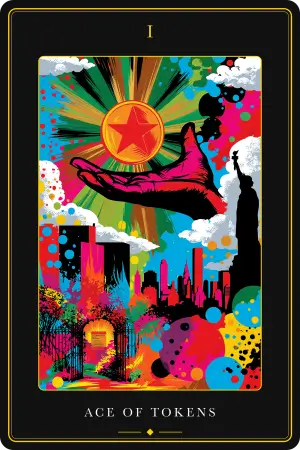
A subway token offered from the clouds over the city: the first solid seed of prosperity, handed to you but not yet planted.
Read the complete guide: Ace of Pentacles Card in Tarot: A Comprehensive Guide to Its Symbolism and Meaning
Card at a glance
- Numerology
- Ace
- Element
- Earth
- Astrology
- Taurus, Virgo, Capricorn (root of Earth)
- Kabbalistic path
- Kether (Crown) in Assiah
- Timing
- Winter, or the opening of a new material cycle
- Yes / No
- Upright yes · Reversed not yet
Upright
new opportunity
seed of prosperity
the fare paid
financial security
a foothold in the city
new venture
grounded new start
seed capital
Reversed
missed opening
the seed spent
financial instability
delay
poor planning
fear of taking the offer
scarcity fixation
greed
Ace of Tokens in each deck
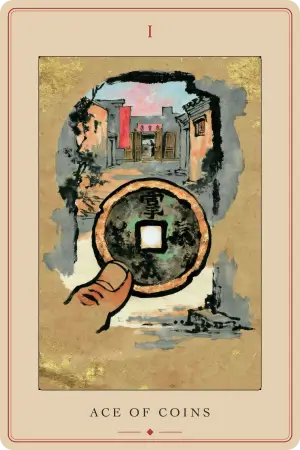
Every deck reimagines the same archetype. Compare the art, then open a deck to read its full interpretation.
Imagery and symbolism
In the New York deck the pentacle becomes a token, the coin of the turnstile and the price of entry. At the center of the card a great hand reaches out of a bank of clouds and holds up a single golden token stamped with a five-pointed star. The token hovers just above an open palm. It has been offered, not yet taken, and that small gap is the whole card.
Behind the token, sunburst rays in gold and green explode across the sky in the deck's screen-print style. Gold is the money itself; green is the growth the seed is capable of. The rays radiate outward the way light spreads from the coin in the classic image, so the opportunity becomes the sun of the scene and everything else stands in its light.
On the right, the black silhouette of the Statue of Liberty raises her torch. She does the work the distant snow-capped mountains do in the traditional card, marking the long view and the high goal. She is also the promise made to everyone who arrives with nothing, which is why the seed offered here is the same one held out to every newcomer who ever came to build a life. The skyline cut in red and black behind her is what planted seeds eventually become.
At the lower left stands the deck's version of the flowering arch: an iron gate to a community garden, vines and blossoms climbing the fence in reds, pinks, and golds. The gate is open, and through the archway a small poster glows like a lit doorway, a job listing rendered as the most New York form a golden opportunity can take. The garden gate keeps the traditional meaning of the rose arch, a firm threshold between potential and its realization with a clear path leading through. Halftone dot-fields scatter across the whole scene like the ticker tape of a win that hasn't happened yet. The card reads as one sentence: here is your token, the fare is paid, the gate is open, the garden is planted, and the skyline is waiting.
Core meaning
The Ace of Tokens is the moment the city hands you something solid. It is a job offer landing in the inbox, a check that finally clears, or keys to a place with rent you can actually pay. Whatever the form, it is a single seed of prosperity dropped into your open palm.
What matters most is that this is a beginning and not a completion. The Ace is the first month's rent, not the brownstone; the offer letter, not the corner office. Like every ace it promises potential rather than a guaranteed result, though the ground under this one is unusually firm. The token in the palm is a fare, not a destination. It gets you through the turnstile, and the ride is still yours to take.
The instruction folded into the card is simple. Take the thing being offered, then treat it like a seed rather than a scratch-off win. A windfall consumed is gone by the first of the month. A windfall planted and tended becomes the floor you stand on.
Upright meaning
Upright, the Ace of Tokens marks a genuine and favorable material beginning. A new income source, a new home, a new venture, or a real improvement in circumstances is available right now, provided you close your hand around it. The card rewards one concrete, grounded move today over a grand plan for someday: sign the lease, accept the offer, open the account, or put the first real dollar into the plan.
In love. The relationship puts down roots. This is a partnership with long-term weight, or an existing one moving onto firmer ground, sometimes literally by merging finances or signing a lease with both names on it. The love it describes shows up and pays its share rather than staging grand gestures.
In career. Often the offer letter itself. It marks a new job, a promotion, a raise, a first serious freelance contract, or the moment long effort converts into money and standing. In business it is the stamped permit, the signed first contract, or the seed round that actually lands. Show up, do the reps, and be reliable, because here that approach compounds.
In finances. One of the most welcome cards in the deck: a new source of money, a windfall through ordinary practical channels, or the first real money of a venture that keeps paying. The prosperity is the compound kind, built from a solid start plus steady tending. A favorable moment for foundational moves like opening savings, making a deposit, or investing in something that grows slowly and holds.
In health. The body treated as the first asset. It marks a grounded new regimen, such as the gym membership actually used, cooking at home, physical therapy begun, or a checkup finally booked. Small regular deposits of sleep, movement, and food compound the way money does. Start small, start solid, and don't break the streak.
Reversed meaning
Reversed, the Ace of Tokens is the opportunity that slipped: the apartment that went to the applicant with the cashier's check ready, the offer sat on until it expired, or seed money spent on a good weekend. It can signal financial instability, a venture that stalls at the starting line, or a contract with a problem buried in the fine print. Sometimes it turns inward, showing that the offer is right there but fear keeps your hand closed, or that a fixation on money has crowded out everything money was supposed to be for.
In love. Material strain leaks into the bond. There may be fights about money, an unequal split of rent and labor, or a couple stuck at the threshold, unwilling to take the concrete step that would root things. At the extreme, security itself becomes a substitute for intimacy, with a good apartment standing in for the actual connection.
In career. The opportunity fumbled or the ground giving way: the offer that goes to someone who answered faster, the promotion that stalls, or hard work without fair compensation. In business it is the deal that dies in due diligence or the budget built on best-case arithmetic. Sometimes the block is external, like a hiring freeze; just as often it is hesitation, with applications not sent and negotiations not attempted.
In finances. The seed spent or the seed missed. Money leaks away on nothing in particular, an investment is made on vibes instead of numbers, or a lease is signed unread. Halt big purchases, audit honestly where the money goes, and rebuild the basics before reaching for anything ambitious. The card can also flag the opposite distortion, a grip so tight it produces constant anxiety and no real security.
In health. The physical foundation neglected: sleep sacrificed to the grind, meals grabbed standing up, the gym paid for and never entered, or a symptom ignored for lack of time. It is the city's classic bad trade, health spent to make money later spent recovering health. Reopen the account with one small, keepable commitment, and the body forgives a great deal once the payments resume.
Historical notes
The New York deck's Ace of Tokens carries forward a long lineage. In the early Tarot de Marseille the suit was Coins, tied to the merchant class and the literal exchange of currency. Its Ace of Coins was stark and geometric, a large symmetrical coin with four botanical flowers resting in isolation. Notably, it lacked the divine hand from the clouds, which the Marseille system reserved for the Aces of Wands and Swords. Earth was treated as the lowest and densest element, the immovable rock on which everything else is built.
The Rider-Waite-Smith deck, published in 1910 by Arthur Edward Waite and Pamela Colman Smith, reintroduced the hand. In its Ace of Pentacles a disembodied hand emerges from a grey cloud offering a golden coin engraved with a pentagram, above a cultivated garden of white lilies, a rose archway, and distant mountains. Waite described the divinatory meaning as perfect contentment and gold. Aleister Crowley's Thoth deck, painted by Lady Frieda Harris, renamed it the Ace of Disks and surrounded the central coin with helicopter seeds, aerodynamic vessels built for travel. The idea there is that a true foundation can move with the individual rather than staying set in the ground.
The New York deck follows the RWS synthesis and translates it into the city's own vocabulary. Pentacles become Tokens, the coin of the turnstile. The garden survives as a community garden gate, the mountains become the Statue of Liberty, and the divine offering arrives looking like a job listing pinned inside an archway.
Correspondences
Number. One. In numerology this is initiation: the first move, the single idea, the decision everything after refers back to. One carries leadership and self-reliance, so the Ace says the goal is reachable if you act first. What it does not promise is the outcome, since potential unclaimed is just a nice afternoon of imagining.
Astrology. As the root of the Earth suit, the Ace answers to the three earth signs, Taurus, Virgo, and Capricorn. Taurus lends endurance and the instinct for a sound deal, Virgo lends the precision that reads the fine print and keeps the budget honest, and Capricorn lends the long climb made floor by floor toward the skyline. Some traditional systems attach the card to Saturn for structure and discipline; others to Mercury in Capricorn for practical intelligence aimed at material goals.
Element. Earth, in its pure and undivided form: the root energy of the whole suit before it divides into rent, work, and legacy.
Kabbalah. All Aces correspond to Kether, the Crown, the first spark of creation. The suit of Pentacles corresponds to Assiah, the material world of making. The Ace is therefore Kether in Assiah, the highest divine energy injected into the densest matter. It is also called the Crown of the Princess, since without the earth to receive it the spark has nowhere to take root.
Elemental dignity. Being pure Earth, the Ace of Tokens strengthens and is strengthened by fellow earth cards, and it grounds the more volatile suits. It gives fire something to build, water something to hold, and air something to make real.
Psychological perspective
At its center this card is about the willingness to reach out and close your hand around a solid chance. The people it describes make it in the city because they treat every opening as something to build on. They are practical and self-reliant, they read the lease before signing, they keep a few months of rent in reserve, and they can turn a decent idea into a paying reality because they do the arithmetic others skip. They plan in years while working in days.
The reversed side names the shadow of the Earth element. When the connection to the ground is severed, a person may start many tasks and finish none, plagued by anxiety over scarcity. The card points to poverty-consciousness, to hoarding out of fear, and at the far end to avarice, an over-focus on gain at the expense of everything gain was meant to serve. Underneath the missed chances there is usually one quiet fear: of risk, of effort, of finding out whether you can actually do it. The doubt becomes self-fulfilling. What the card asks for is not luck but a decision, made and kept.
The Ace of Tokens across decks
Across traditions this card is the seed of the Earth element, and each deck plants it differently. The Tarot de Marseille shows an unadorned Ace of Coins with no hand from the clouds, an immovable rock demanding that you work directly with raw material. The Rider-Waite-Smith Ace of Pentacles restores the divine hand and sets it above a tended garden, an archway of roses, and distant mountains, framing wealth as a gift that still requires cultivation. Crowley's Thoth Ace of Disks turns the coin into a mobile helicopter seed, arguing that real security travels with the person rather than staying rooted in one place.
The New York deck renames the suit from Pentacles to Tokens and keeps the RWS structure while restaging it in the city. The coin becomes a subway token, the garden becomes a community garden gate, and the mountains become the Statue of Liberty holding her torch above the skyline. The divine offering arrives disguised as a job listing. The message is unchanged from the classic card, but it now speaks in fare, rent, and the promise made to everyone who steps off the bus with a suitcase.
In combination and context
The Ace of Tokens sharpens or bends depending on its neighbors. Alongside the Ace of Cups it points to a home filled with love, a start that offers both emotional fulfillment and material security at once. With the Empress its earthly potential is magnified toward stable growth, and in health or family questions this pairing has long been read as a sign of pregnancy, the seed taking root in fertile ground. Set against the Wheel of Fortune it becomes the classic windfall, a sudden surge of money that still has to be grounded fast before the wheel turns again.
The darker combinations come with the Devil, which shares Capricorn's earthy rulership. Here the divine gift risks corruption by base desire: a lucrative opening that quietly demands your freedom, or a slide into purely transactional relationships and the corporate grind. Court cards make the outcome granular. With the King of Pentacles the seed grows into an empire stewarded by an expert; with the Knight of Pentacles it rewards stubborn dedication to routine, the exam passed or the training completed. Position matters too. In a future slot the Ace is an opportunity approaching; in an advice slot it is a direct instruction to take the concrete step and plant what you're given.
Questions for reflection
- What solid thing is being offered to you right now, and what is keeping your hand from closing around it?
- If the token in your palm is a seed and not a prize, what would planting it actually look like this week?
- Where are you spending the seed instead of tending it, and what small, keepable deposit could reverse that?
The general meaning follows the Rider-Waite-Smith reading, the reference used across Tarot Academy. Open a specific deck above for its own interpretation.
Frequently asked questions
Explore the Tarot
Latest Posts
Discover the ancient wisdom of tarot cards and unlock the mysteries of your spiritual journey. Our blog is your gateway to understanding the rich symbolism, meanings, and practical applications of tarot reading.




















































