
 EN (English)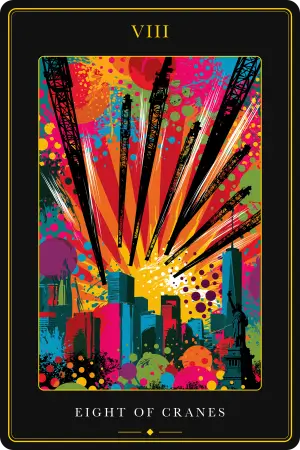


Minor Arcana ·
Nine of Cranes
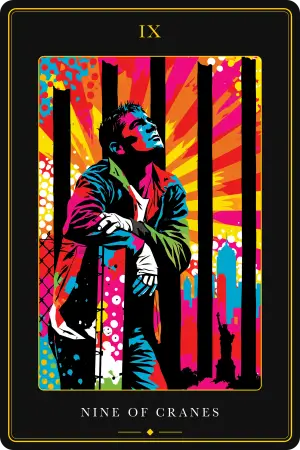
A bruised builder leaning on the ninth steel beam at the site fence, one fight left in the tank, still refusing to leave.
Card at a glance
- Numerology
- Nine
- Element
- Fire
- Astrology
- Moon in Sagittarius (second decan)
- Kabbalistic path
- Yesod (Foundation)
- Timing
- Fire tempo held in check, a long period of waiting and defense
- Yes / No
- A guarded yes if you hold the position, reversed no
Upright
resilience
holding the site
boundaries
the last stretch
hard-won experience
vigilance
endurance
almost topped out
Reversed
burnout
siege mentality
depleted reserves
stubbornness
walls too high
quitting one floor short
old grudges
Nine of Cranes in each deck
Every deck reimagines the same archetype. Compare the art, then open a deck to read its full interpretation.
Imagery and symbolism
In the Tarot of New York City the Nine of Wands becomes the Nine of Cranes, and the wooden staves become the steel that raises the city. A man stands at a construction fence, leaning his weight on an upright girder while a row of dark beams rises around him like the columns of an unfinished frame. In this deck the cranes and beams do the work the traditional wands do: each one is a project fought for, a battle already survived, a piece of the build he now guards. He leans on the ninth beam the way the Rider–Waite–Smith figure leans on his staff, using what he built to hold himself up.
His hand and forearm are wrapped in white bandages, the deck's direct echo of the bandaged fighter. They are the wounds of past construction battles, the failed inspections, the lost bids, the sleepless months. The injuries did not break him. They are the receipts of experience.
His face is turned upward, weary but lit. He is not looking at the ground he might collapse onto but at the top of the structure he has not yet finished, the gaze of someone measuring the distance left rather than the distance fallen. The chain-link fence at his side is the site perimeter, the line between what is his and the city that would take it, and it stands for the watchfulness this card demands.
Behind him the sunburst rays and halftone dots of the deck's pop-art language blaze in red, orange, and yellow. This is the fire of the suit of Cranes, ambition still burning through the fatigue, and the explosion of color behind a battered figure is the card's central tension: outwardly bruised, inwardly still ignited. Far below stand the silhouettes of the skyline and the Statue of Liberty, the city he is building into and the reminder of why anyone endures this much.
Core meaning
The Nine of Cranes marks the stage of a build when almost everything has been raised and almost everything has been spent. The Golden Dawn called the parent card the Lord of Great Strength, and the strength it means is endurance rather than force. You have taken hits, a lost bid, a partner who walked, months behind on sleep, and you are still standing at the site fence, refusing to leave. It honors the unspectacular heroism of staying upright after the easy victories are gone.
The number holds the same message. Nine is the last single digit, the ninth floor before the tenth, the last mile of the marathon through the boroughs. It carries the accumulated weight of every stage before it, the stamped permit of the Ace, the defended high ground of the Seven, the sprint of the Eight, all stacked inside the figure who now leans, bandaged, on the ninth beam. Poured into the fire of the Cranes, that weight stays on its feet at the fence. The card's counsel is plain and demanding: the goal is close, the resources are nearly gone, so gather the last of your strength and hold the position a little longer, because that is how the building goes up.
Upright meaning
Upright, the Nine of Cranes is the last stretch before topping out. The goal is near, the reserves are low but sufficient, and the city keeps testing whether you actually mean it. Competitors circle, imitators copy, the schedule slips, and one more challenge appears just when you thought the hard part was over. The card asks you to guard what you built and spend your remaining strength with strategy, since not every provocation deserves a response and not every rival is worth a fight. The bruises are proof you know how to survive this city, not evidence that you cannot.
In love. A relationship that has been through it, the long distance, the money stress, the tiny apartment, and is still standing. It honors battle-tested love, partners who learned the other one does not leave when it gets hard. It can mark the last stretch before a new level, moving in or reconciliation, and it warns of one final test. For those dating after heartbreak, it notes gently that armor which once protected can start to imprison, so stay watchful but leave a gate in the fence.
In career. The final stage of a long project or a long climb, the last sprint before the launch, the closing weeks before a promotion decision. Your experience is now your sharpest tool, and one more push closes it. Protect your work from credit-takers, document your contribution, and do not concede the argument you are about to win or resign in the last mile.
In finances. Holding the line under pressure. Defend what you have accumulated, read every contract twice, refuse the tempting shortcut, and expect one more test, an unexpected bill or a rival offer, met with experience rather than panic. Persistence here converts into security.
In health. The body that has carried you through the grind, asking to be treated like the veteran it is. It often marks the final phase of recovery. Keep the discipline that got you here, but build in rest as deliberately as effort, because in this deck even construction sites go quiet at night.
Reversed meaning
Reversed, the Nine of Cranes describes a hustle that has burned through its fuel. The struggle is now mostly internal: fear of the next blow, doubt that the project was ever worth it, resentment that the city takes so much and acknowledges so little. It can point to a person guarding a site that no longer needs guarding, fighting old battles and treating every phone call as an attack, unable to lower the defenses even when help arrives. It may also signal genuine depletion, the ninth all-nighter, the temptation to paper over the windows and walk away one floor short of finished.
In love. A connection that has shifted from love to trench warfare, guarded and bracing and keeping score. It warns of defensiveness that no longer matches reality, punishing a present partner for a past partner's crimes, or giving up one honest conversation short of the repair. For singles it often shows the fence with no gate, a heart so well-defended that nothing gets in, and calling that safety.
In career. Burnout on the job, the state where the grind has consumed the purpose. Feedback lands as attack, colleagues look like rivals, and someone is tempted to quit a role one step from the payoff, purely from exhaustion. It can also flag working in isolation, refusing help and carrying loads never meant for one person.
In finances. Financial exhaustion, the budget defended so long that the defense itself became the drain. Watch for spending driven by depletion, the late-night purchases that empty the reserve you fought for, and for abandoning a sound plan one step from success because the fatigue finally won.
In health. A body pushed past its warnings, running on caffeine and willpower with sleep treated as a luxury. The recurring headache, the injury that will not close, the exhaustion a weekend no longer fixes. The advice is blunt: put the load down before it puts you down.
Underneath the pathology the reversal carries a cure. Admit the exhaustion honestly instead of dressing it up as toughness, and let someone else hold the site for a night. In this city, accepting help is a skill, not a defeat. A pause is not surrender when the reserves are truly gone. It is how you make sure someone is still standing when construction resumes.
Historical notes
The Nine of Cranes inherits five centuries of change carried by the Nine of Wands. The late fifteenth-century Sola Busca, the first fully illustrated pip deck, gave the card a brutal image: two wands piercing a woman's heart, tied to a hidden numerical code that read it as sealed, internal wounding. The Tarot de Marseille returned to geometry, showing eight wands crossed with a ninth planted securely through them, and read it as tension, resistance, and extreme alertness that ultimately holds.
The modern wounded warrior belongs to Arthur Edward Waite and Pamela Colman Smith, whose 1909 deck showed a battle-weary figure with a bandaged head, leaning on one wand while eight more stand planted behind him like a fence. Waite designed it to signify strength in opposition, a figure built to meet any onslaught boldly. Crowley and Lady Frieda Harris reinterpreted it again in 1943, stripping out the human figure and painting nine wands as arrows, eight lunar arrows descending around a central shaft that links the Moon below to the Sun above.
The Tarot of New York City takes that inheritance and gives it an address. The bandaged head becomes a bandaged forearm, the wands become steel beams, the planted barricade becomes a chain-link construction fence, and the lush landscape waiting beyond the wall becomes the skyline the builder is fighting to join. The wounded warrior's last stand becomes the developer's, the tenant's, the founder's, the stubborn conviction that the one still standing at dawn wins the block.
Correspondences
Number. Nine, the last single digit and the last test before the completion of the ten. On the Tree of Life the nines belong to Yesod, Foundation, and here that is Yesod in the suit of Fire. It carries the accumulated weight of every earlier stage of the build, experience bought at retail price and paid in bruises.
Astrology. The Moon in the second decan of Sagittarius, roughly December 3 to 12. Sagittarius contributes the long view, the belief in the skyline that does not yet exist, the immigrant's optimism and the developer's horizon. The Golden Dawn named the parent card the Lord of Great Strength.
Element. Fire, and in this deck the fire of ambition, construction, and the hustle. Not the bright flare of the Ace's stamped permit but the banked, stubborn heat that keeps a project alive through the winter of setbacks.
Kabbalah. Yesod, the ninth sphere and the sphere of the Moon, which governs the subconscious, instinct, and the machinery under the material world. Fire poured into this lunar foundation becomes a deep, instinctual reserve of willpower, the psychic base that keeps a builder standing in the dark. The Moon is why the figure is a tired sentinel rather than a triumphant one, feeling everything, guarding everything, running as much on instinct as on plan.
Elemental dignity. As Fire, the Nine of Cranes supports other Cranes and Fire-sign court cards. Its guarded, defensive tone can harden alongside the Swords, and its exhaustion is soothed or worn down further by neighboring Water and Earth.
Psychological perspective
The Nine of Cranes is the survivor of the city, the person who came up the hard way and carries the proof of it. The contractor who has been underbid, sued, flooded, and shut down, and still opens the gate at 6am. The founder on her third company, the tenant who outlasted three landlords. They are watchful and a little guarded because experience taught them to be, they read a room and a contract and a handshake for the catch, and they protect what they built with a fierceness that can look like suspicion but is really earned prudence. Under the toughness there is deep endurance rather than aggression. They do not start fights, they finish projects.
The deeper danger is that the same vigilance that once kept them alive now runs on autopilot. The Moon that rules this decan brings the 3am doubts on the empty site and the tidal fatigue that rises and falls with the city's rhythm. When defense hardens into distrust, every colleague becomes a rival and every offer of help a trap, and the walls built to protect the heart start to enforce its loneliness. The work of this card is to keep the fence without becoming the fence, to stay guarded enough to survive and open enough to eventually let the siege end.
In sequence, the card is the threshold before the ten. It knows the cycle is nearly over and braces for the burden that arrives just before the rebirth. The task is to assimilate the lessons of the earlier eight beams and transform raw passion into disciplined, enduring strength.
The Nine of Cranes across decks
The Nine of Cranes is one deck's answer to a card every tradition draws differently. In the Tarot de Marseille it is a geometric pip, eight wands crossed in a lattice with a ninth planted through the center, no wounded figure and no landscape, only the structural image of a defense that holds. In the Rider–Waite–Smith deck Pamela Colman Smith painted the wounded warrior, a bandaged man leaning on one wand with eight more planted behind him like a fence, glancing over his shoulder for an ambush across a sterile gray floor with green land waiting beyond the barricade.
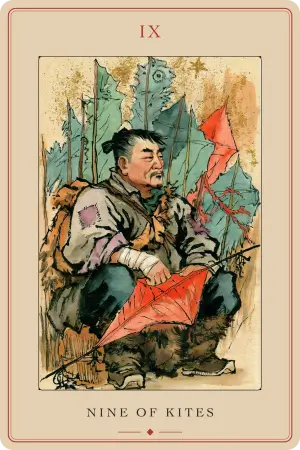
In Crowley's Thoth deck, titled with the theme of great strength and painted by Lady Frieda Harris, the human vanishes entirely. Nine wands appear as arrows, eight lunar arrows descending around a central wand that joins the Moon to the Sun, read as one of the most ritually loaded cards in the deck, the indomitable will of a lone survivor passing through darkness. Modern artists keep iterating on the core symbols. The After Tarot shows the moment just past the RWS scene, the weary figure being offered a helping hand, and other independent decks dress the sentinel in red to mark the inner fire that keeps him upright.
The Tarot of New York City keeps the wounded resilience and swaps the objects for the city's own. The bandaged head becomes a bandaged forearm, the eight wands become steel girders rising around a construction site, the barricade becomes a chain-link fence, and the green land waiting beyond the wall becomes the downtown skyline with the Statue of Liberty standing watch. The warrior looking back over his shoulder becomes a builder looking up at the unfinished top, measuring the floors still to raise.
In combination and context
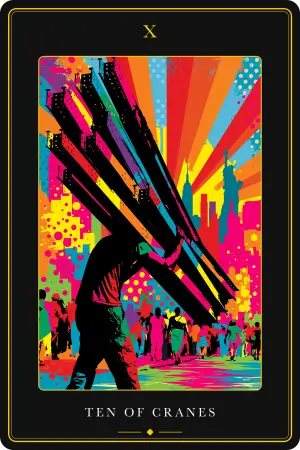
The Nine of Cranes is best read next to its neighbors in the suit. The Seven of Cranes is active defense, the physical exertion of fighting off visible challengers on the high ground, while the Nine is passive endurance, the silent battle of holding a perimeter with no fight to swing at. The Ten of Cranes is what waits one step ahead, the crushing burden of overcommitment, exactly what the exhausted sentinel is bracing against.
Context colors it further. Beside a card of grounded success it can read as being admired and set on a pedestal, the veteran operator who has seen every trick and does not rattle. Beside stagnant or possessive cards it warns against clinging to old walls and mistaking a new person or opportunity for an old enemy, fighting last year's competitor while this year's walks in the front door.
Wherever it lands, the message holds. The finish is near, so protect what you have won, separate the real threats from the ghosts of past fights, and endure the last of the night. In this city, difficulties are tuition. Take the lesson, hold the line, and top out the build.
Questions for reflection
- What position are you exhausted from defending, and is the fence still protecting something precious or just keeping everything out?
- Where are you treating a new person or opportunity as an old enemy because a wound from an earlier fight has not closed?
- You are close to topping out. What would it take to admit the fatigue honestly, take the rest you can get, and hold the site one more stretch?
The general meaning follows the Rider-Waite-Smith reading — the reference used across Tarot Academy. Open a specific deck above for its own interpretation.
Frequently asked questions
Explore the Tarot
Latest Posts
Discover the ancient wisdom of tarot cards and unlock the mysteries of your spiritual journey. Our blog is your gateway to understanding the rich symbolism, meanings, and practical applications of tarot reading.




















































