
 EN (English)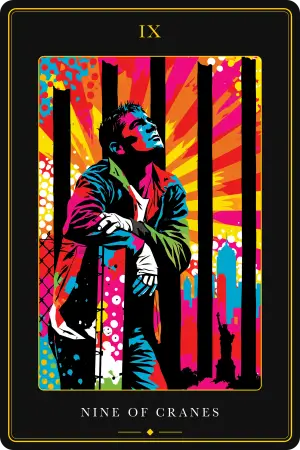

Minor Arcana ·
Ten of Cranes
Ten steel I-beams on one shoulder, the whole build carried across town by the person who never asked for help.
Card at a glance
- Numerology
- 10
- Element
- Fire
- Astrology
- Saturn in Sagittarius (third decan)
- Kabbalistic path
- Malkuth (Kingdom)
- Timing
- The end of a long build, near the winter solstice
- Yes / No
- Upright no, or yes at a steep cost, reversed mostly no
Upright
burden
overload
the build
hyper-independence
burnout
last hard stretch
responsibility
hauling it alone
Reversed
setting it down
delegation
relief
collapse
avoidance
recovery
dropped commitments
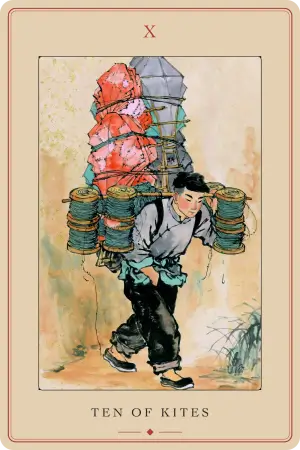
Ten of Cranes in each deck
Every deck reimagines the same archetype. Compare the art, then open a deck to read its full interpretation.
Imagery and symbolism
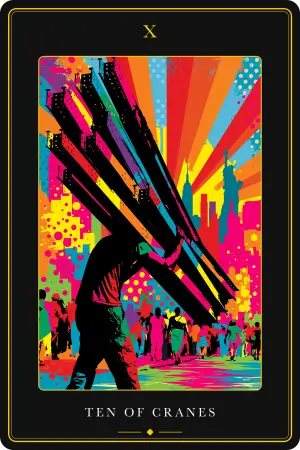
In the Tarot of New York City the ten wooden staves become ten steel I-beams, the literal bones of the buildings this deck is obsessed with. A lone figure in full black silhouette carries all of them across one shoulder, bent under the weight, pushing through a crowded street while the skyline blazes behind him in the deck's pop-art palette of saturated color blocks, halftone dots, and sunburst rays. The suit of Wands is renamed Cranes here, and its element is still Fire: the build, the hustle, the drive to make something rise out of bedrock. The Ten is what that fire looks like when it has said yes too many times.
The beams cross directly in front of the figure's face, so the man raising the skyline can no longer see it. That is this deck's translation of the bowed head in the Rider-Waite image, where the wands fan across the carrier's eyes: focus narrowed to the next step, the larger vision lost behind the load. Each beam was once an Ace, a fresh permit, a spark gladly picked up. Carried one at a time any of them would be light. Carried all at once they blot out the sky.
The silhouette makes the burden anonymous and therefore universal. He could be an ironworker, a founder, a mother of three, anyone on the block. His back is bent but his stride is unbroken, the legs still moving and the grip still holding, and that persistence at the edge of the tank is the card's dignity. Behind him the Empire State Building and the Statue of Liberty stand radiant in the distance. The destination is visible to everyone in the scene except the one person carrying toward it. Around him a crowd of silhouettes flows past carrying nothing, parting and closing like water, because the city does not stop for the loaded-down. The burden is his alone, not because no one could help, but because he has not asked. The sunburst behind the skyline says the cycle is closing: one more block and the beams come off the shoulder.
Core meaning
This is the card of ambition turned into freight. In the New York deck the fire of the build raises steel, and the Ten of Cranes is the moment that same fire says yes to the extra shift, the side project, the favor, the build, until all of it is riding on one back at full speed through a city that will not slow down to help. The Golden Dawn titled the underlying card the Lord of Oppression, and the reading holds: this is overload, the price of overextension, and the edge of burnout. The weight is not proof of worth. It is just weight.
The number tells you how it happened. The journey from the Nine to the Ten is a warning about accumulation: you started with one beam, one commitment, sure each new one was manageable, and somehow ended up with ten. Ten is completion at the densest, heaviest point of the cycle, and for Fire that completion is a paradox. Cups and Pentacles reach their tens fulfilled, at home in the material world. Fire is not at home there. Its nature is to rise, so pinned to the street it reads as a load rather than a reward. The work is real and the destination is real, but the load has grown so heavy the carrier can no longer see over it.
Upright meaning
Upright, the Ten of Cranes is the most loaded-down figure on the block, the person working two jobs and a side hustle, the reliable one whose reward for finishing work is more work. It describes a heavy workload, deadlines stacked on deadlines, and the slow slide from dedicated to depleted. Some heavy stretches are strategic, the crunch before the launch or the season that makes the year, so if the destination is genuine and near, endure deliberately. Take inventory of what you are carrying and ask which beams are actually yours, because some were handed to you by people who never meant to take them back. Delegate, renegotiate, or set something down before the load decides for you.
In love. The relationship is in its heavy-lifting phase, the season of real commitments: merging two leases into seven hundred square feet, planning a wedding, raising children, carrying a partner through illness. The love is genuine but it currently takes the form of labor, and often one person hauls most of the beams while the other walks unencumbered beside them. Say what you are carrying out loud, because a partner cannot take a beam they cannot see.
In career. The founder carrying the whole company across town, or the go-to employee loaded precisely because the strong back never complains. Success here is real but expensive, and the current structure, everything routed through one person, does not scale. Make the invisible labor visible and open the conversation about distributing it.
In finances. Money earned the heavy way, two jobs and stacked overtime, real financial responsibility like a mortgage or a family depending on your income. The progress is genuine, but watch for the point where hauling income is the only thing you do and you never look up at the life it was supposed to buy.
In health. The physique of the overloaded New Yorker, the tight shoulders and the lower back that keeps score, the fatigue coffee will not fix. The tension is data, a load reading from the body itself, and it calls for rest as a structural necessity.
Reversed meaning
Reversed, the beams tip toward the ground and the burden comes off the shoulder, which cuts more than one way depending on the cards around it.
In its better sense the reversal is relief, and the relief is physical. You delegated, quit the extra job, let the crew do their part, or walked away from obligations that were never yours to bear. No one builds a city alone, and handing off work is a skill rather than a failure. If you have earned a rest, take it properly, a real break instead of a slower kind of carrying. The strange emptiness after chronic stress is just the sensation of a back that is finally straight.
The darker version is the load dropped in the middle of the avenue, promises left on the sidewalk for someone else to trip over. Here the reversal is collapse or avoidance: cracking under the pressure and scattering the beams, or throwing off duties that were genuinely yours and refusing to face what remains. Unpaid rent compounds, and so do abandoned obligations. Sort the honest relief from the avoidance and act accordingly.
In love. Setting the burden down together after the crisis passes, the imbalance finally named and corrected. Or the harder release, the recognition that the relationship itself has become the load one partner has hauled alone for too long, and that letting go is the only honest option left.
In career. The project shipped, the crunch ended, systems put in place so the operation runs without your constant presence. The warning is that problems avoided rather than solved during the heavy stretch tend to compound, the deferred maintenance and the postponed conversation building toward a crisis.
In finances. A debt cleared, an expense dropped, the relief after a long haul. But sudden lightness is exactly when careless spending happens, so keep managing the money, and if the load became impossible, the answer is restructuring rather than dropping it in the street.
In health. The body starting to unclench, sleep returning, the joyless diet or punishing regimen set down. The caution is against swinging to the other extreme and abandoning care entirely in the name of rest.
Historical notes
The New York image is the latest turn in a long argument about this card, and the underlying meaning carries centuries behind it. In 1888 Mathers first offered a fairly positive upright reading, confidence and honor, with treachery reserved for the reversal. As the Golden Dawn's teaching matured in Book T, the card was fixed as the Lord of Oppression, a cruel and overbearing force applied to material and selfish ends, a failure where the opposing forces are simply too strong to control.
Waite kept the warning of deception when he set the modern image in 1910. He described fortune and gain that inevitably bring their own crushing oppression, and tagged the card with false-seeming and untrustworthiness, adding the specific note that in a lawsuit it signals certain loss. In 1930 A.E. Thierens explained the old link to deceit differently, tying the card to bureaucratic official duty and arguing that weaker characters, unable to bear the pressure of responsibility, resort to duplicity to escape it.
Crowley and Lady Frieda Harris reinterpreted it for the Thoth deck under the title Oppression, saying the fires of the wands have burned so completely that only ashes remain. To mark Malkuth, the material realm that governs all the tens, they worked the Ouroboros into a Mobius strip, an inescapable loop of material duty the spirit cannot break out of. The Tarot of New York City keeps that full meaning and recasts the wooden staves as structural steel, the burden of ambition rendered in the city's own material.
Correspondences
Number. Ten, completion at the densest point of the cycle. In this deck it is the topped-out building, the final walkthrough, the last beam swung into place before the crew moves to a new lot. Ten is the One raised to a higher register, since 1 plus 0 returns to 1, the number of beginnings and individual will. Inside every Ten of Cranes there is still the Ace, the single stamped permit, which is exactly why the load exists at all. The zero also matters, the cleared lot and the pause between demolition and groundbreaking, the rest that has to happen between cycles.
Astrology. Saturn in the third decan of Sagittarius, roughly December 13 to 21, leading into the winter solstice and Capricorn. Sagittarius is the archer aiming past the skyline, expansion and optimism and the belief that one more project is always possible. Saturn is the city inspector of the zodiac, structure and limits and the bill for every yes. Saturn does not forbid the build; it makes you carry the materials yourself and stamps the permit only after you have earned it.
Element. Fire, the fire of the build, but Fire forced down into matter. Its nature is to rise, so pinned to the ground it loses its lightness and turns into a grinding weight.
Kabbalah. Malkuth, the tenth sphere, the Kingdom and the densest point of manifestation. Volatile Atziluthic fire poured into this earthly vessel solidifies and sours into oppression, ambition that has grown materially powerful but lost its spirit. The Golden Dawn assigns the divine name Adonai Malekh, the Power of Earth as a King.
Elemental dignity. As overloaded Fire, the Ten of Cranes drags on the cards around it. It can smother lighter Cranes and the Fire courts, and read as sheer heaviness beside the airy Swords or the earthy Pentacles.
Psychological perspective
In this deck the card is a portrait before it is a lesson. It describes the person who opens and closes the shop personally, answers messages at midnight because it is faster to do it myself, and gets handed everyone's beam precisely because everyone knows the grip will hold. Their independence, stress resilience, and stubbornness are real, and so is the quiet resentment underneath the pride. Their peripheral vision has narrowed to the next step and the next deadline, and they have forgotten what the skyline looks like even though they are the ones building it.
Modern reading names the pattern directly. This is the hyper-independence card, the trauma response that refuses help to avoid feeling vulnerable, and it maps onto the eldest-daughter role of silently managing everyone else's weight. Underneath is the belief that if you want something done right you have to do it yourself, and the conviction that the world will collapse if you drop a single beam. The community reads this as a kind of martyrdom, suffering for achievements that are then spoiled by the exhaustion needed to keep them.
The way out is the maturity of the Queen of Cranes, who holds her own fire and still knows how to lean on other people. This city pretends to run on self-reliance, but it actually runs on crews, and handing someone a beam is how anything taller than one story ever gets built. The card asks for the wisdom to see what is actually worth carrying and the courage to set the rest down.
The Ten of Cranes across decks
Tarot de Marseille. The older tradition shows the card as a geometric arrangement of ten staves rather than a scene, a dense lattice with no laboring figure. The narrative image of the bent-backed carrier is a later invention.
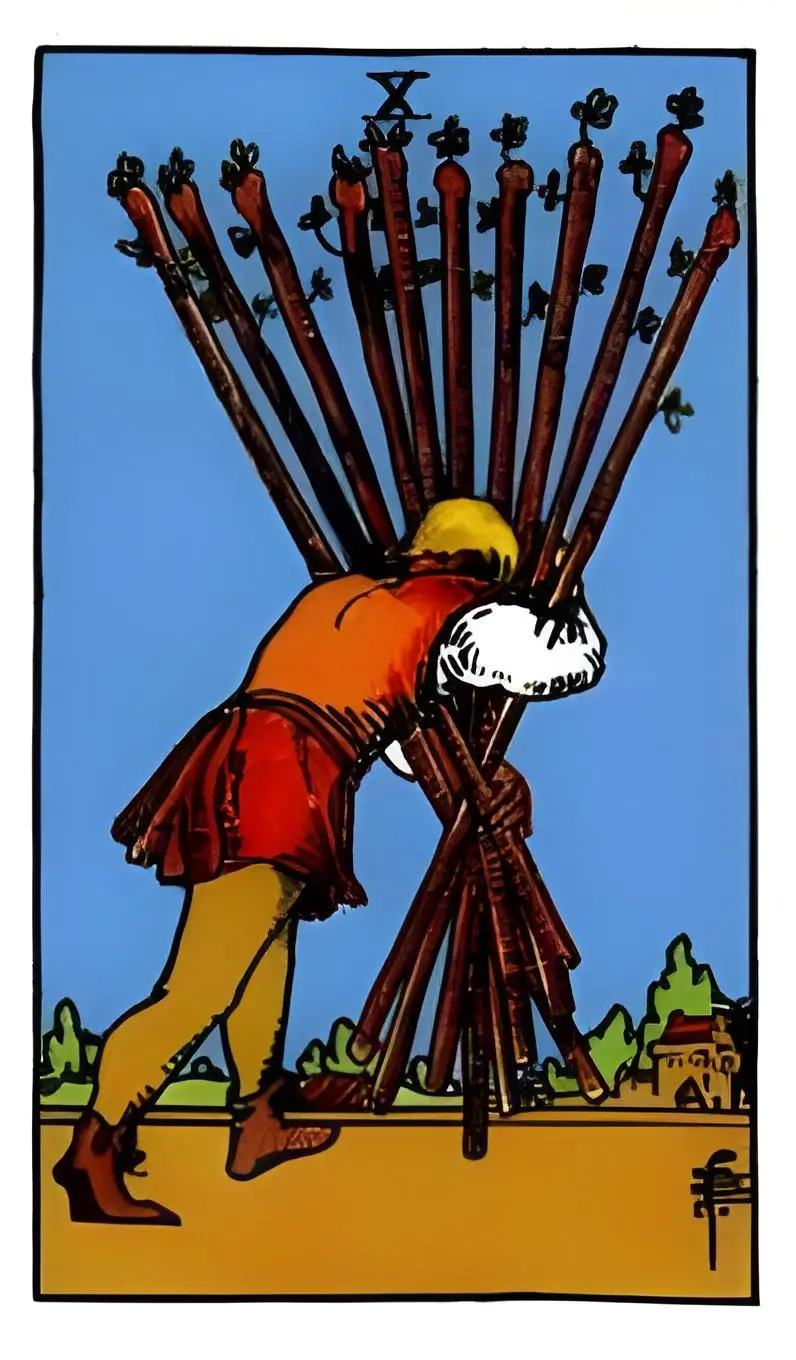
Rider-Waite-Smith. Pamela Colman Smith's 1910 card set the modern scene the New York deck adapts: a man bent double under ten heavy wands fanned across his face, marching toward a town on a sunny road, his fine clothing marking the success that has become a prison.
Crowley-Thoth. Titled Oppression and painted by Lady Frieda Harris, the Thoth card drops the human figure for eight crossed wands with two more driven through the junction, flames bursting from the congested crossing. Crowley said the wands have done their work so completely that only ashes remain, and set the Ouroboros as a Mobius strip beneath to mark the closed loop of material duty.
The Tarot of New York City. This deck keeps the full Ten of Wands meaning and pours it into structural steel, replacing the wooden staves with ten I-beams and the country road with a crowded avenue under a blazing skyline. The bowed head becomes beams crossing the face, and the distant town becomes the Empire State Building and the Statue of Liberty, radiant and one block away.
In combination and context
The Ten of Cranes is clearest read against its neighbors. The Nine of Cranes is resilience, the scarred sentinel still capable and managing their defenses. The Ten is what happens when that sentinel refuses to rest or reassess and the resilience curdles into stubbornness. Together they trace the thin edge between heroic endurance and toxic overextension: the Nine holds the line, the Ten is buried by it.
Set beside the Ten of Swords the difference is the difference between Fire and Air. The Ten of Swords, titled Ruin, is an acute and final ending, the fight over with nowhere to go but up. The Ten of Cranes is the grinding pain of continuation, still on your feet and pushing against your own limits, the last screaming reps of a heavy set rather than the clean relief of an ending.
Among the tens the contrast is just as sharp. The Ten of Cups is emotional fulfillment and the Ten of Pentacles is settled wealth, because Water and Earth are at home in the material world, while Fire deteriorates into obligation. In this deck's own reading, drawing the Ten of Cranes with a card of rational planning, like the Two of Cranes reversed, suggests stepping back to find a less draining route across town. Drawn with the Hanged Man, the advice is blunt: stop being a martyr, ask for help, and do the scary thing for the greater good.
Questions for reflection
- Which of the ten beams on your shoulder are genuinely yours, and which did you pick up because you did not trust anyone else's grip?
- Where are you making the load heavier by carrying it badly, fanned across your face instead of handed to a crew?
- The skyline you are building is a block away and blazing. What would let you set the beams down able to actually see it?
The general meaning follows the Rider-Waite-Smith reading — the reference used across Tarot Academy. Open a specific deck above for its own interpretation.
Frequently asked questions
Explore the Tarot
Latest Posts
Discover the ancient wisdom of tarot cards and unlock the mysteries of your spiritual journey. Our blog is your gateway to understanding the rich symbolism, meanings, and practical applications of tarot reading.




















































