
 EN (English)


Minor Arcana ·
Four of Cranes
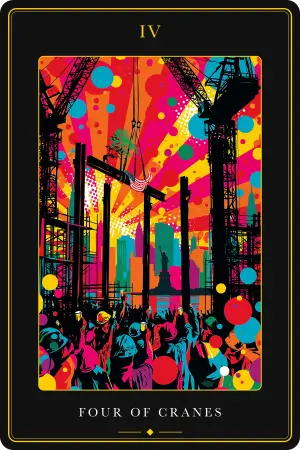
The topping-out ceremony over New York Harbor: the last beam going up with a tree and a flag on it, and the crew stopping to mark what they built.
Card at a glance
- Numerology
- Four
- Element
- Fire
- Astrology
- Venus in Aries
- Kabbalistic path
- Chesed (Mercy) in Atziluth
- Timing
- Mid-April, third decan of Aries
- Yes / No
- Upright yes · Reversed no
Upright
Topping out
Celebration
Stability
Foundations
Community
Homecoming
Milestones
Reversed
Delays
Instability
Cancelled ceremony
Crew conflict
Feeling unmoored
Restless overwork
Four of Cranes in each deck
Every deck reimagines the same archetype. Compare the art, then open a deck to read its full interpretation.
Imagery and symbolism
In the Tarot of New York City the harvest scene becomes a topping-out ceremony, rendered in the deck's pop-art language of saturated color blocks, halftone dot fields, sunburst rays, and black silhouette linework. Four dark steel columns rise from the street, and between them a crew hoists the final beam with a small evergreen tree and an American flag fastened to it. This is the real construction-trade ritual: when the last beam goes up, a tree and a flag ride with it, and the crew signs their names on the steel. The tree stands in for the Rider-Waite laurel wreath, a living green emblem of victory and good fortune crowning the finished frame, and the flag does the work of the garland strung between the original card's wands, announcing the celebration and marking the structure as claimed.
The four columns echo the four wands of the source card. Together with the beam they frame an open doorway of girders, a house not yet walled in, which is the whole promise of the number four here: the foundation is set and the order of things is sound even though the walls are still to come. Two tower cranes lean in from the left and right edges like heralds, their cables meeting at the beam. In this deck the crane is the suit emblem itself, standing for fire and the will to build, so a pair of them bowing toward one beam reads as cooperative effort rather than competition.
Behind the site the Statue of Liberty rises over a colored skyline, taking the place of the castle on the hill in the Rider-Waite image. She is the fixed point of security and aspiration, the promise that drew everyone on this site to the city, and her torch lifts like the crew's raised cups. The harbor water between the site and the statue reflects the celebration back and doubles it. In the foreground a crowd of workers in hard hats raise glasses of beer toward the beam, the deck's version of the two celebrants with bouquets. That it is a whole crew and not a pair is the New York inflection: nothing here is built alone. Their silhouettes come in pink, blue, orange, and green for the many trades and boroughs in one workforce, and overhead the sky bursts with sunrise rays pouring off the beam itself, as if the finished structure were the source of the light. The floating halftone dots read as confetti and champagne bubbles while also being the deck's signature print texture.
Core meaning
The Four of Cranes is the moment effort turns into something that stands. The Golden Dawn named this card the "Lord of Perfected Work," and the New York deck keeps that reading and grounds it in steel: the topping-out, when the skeleton is whole even though the building is far from done. The number four takes the restless fire of the suit, here the ambition that raises towers, and holds it in a right-angled frame of columns and beams.
That makes it a card of the deliberate pause rather than a finish line. It asks you to stop long enough to honor what has been built, to let the milestone land before the work pushes on. In a city that starts the next tower the same afternoon the first one tops out, the instruction is almost countercultural: mark the beam, raise the cup, and stand under what you made with the people who raised it. The stability is real, but it is the topping-out and not the ribbon-cutting, a stable and honorable pause on the way to the rest of the job.
Upright meaning
Upright, the Four of Cranes is a clear sign of stability, harmony, and a milestone reached. In a yes-or-no reading it is a yes. Its core is the invitation to acknowledge a success instead of sprinting past it: hold the ceremony, sign the beam, and gather the people who carried the load with you. It honors the big events, a wedding or a housewarming or a launch, and equally the smaller ones, the lease signed on a place that finally feels like yours, the stoop that knows your name. The milestone only counts if you stop long enough to feel it.
In love. Stability, mutual respect, and a shared structure with a real frame. It points to marriage, moving in together, or a long romance where both partners build equally, two names signed on the same beam and the same lease. The wider circle is part of it, the engagement party on the rooftop and the family met and welcomed.
In career. The successful completion of a project or a phase, often with a promotion, an award, or recognition from the people you work with. It is the after-work round where the whole crew, for once, is not talking about the next deadline, and the pride of seeing effort turn into something that casts an actual shadow on the street.
In finances. Consolidation and steady footing: profit from a venture that has topped out, rent covered with something left over, savings that hold. It is permission to pause and enjoy the prosperity you built rather than immediately pouring the next foundation.
In health. A body built the way the card's structure was built, consistently and on a good foundation. It favors sustainable routines and earned, visible results, the habit that finally topped out into a way of living.
Reversed meaning
Reversed, the stability wobbles on its columns. Read as yes or no it turns to no. In its most direct form the building topped out but nobody came, or the beam never made it up at all: the ceremony postponed, the funding shaky, the inspector finding something. It can warn that you are celebrating too soon, since the frame is not actually finished, or that effort is not converting into visible progress.
In love. Tension or conflict in the shared structure, one partner ready to top out while the other is still reading the blueprints. It can show a fear of commitment, misaligned goals, or a sense that one person is doing all the building while the other just visits the site. The card asks for patience and honest talk before any beam goes up.
In career. A volatile workplace, friction on the crew, or the feeling that hard work is not being rewarded: you raised the beam and nobody came to the ceremony. It also names the New York trap of working to afford a city you are never awake in, and the drift that follows when a project stalls at the skeleton stage.
In finances. Instability where there looked to be security, a space once thought safe now feeling exposed, the building that costs more than it will ever rent for. It advises checking the foundation before adding floors and bracing for delays.
In health. Maintenance deferred until the problems compound, the way a building's do when the inspections get skipped. It reads as skipped meals, sleep sacrificed to the grind, and the gym membership held as pure theory, with the reminder that the body is the one structure you cannot move out of.
Historical notes
The card the New York deck adapts is the Rider-Waite-Smith Four of Wands, drawn by Pamela Colman Smith and Arthur Edward Waite in 1909: four garland-topped staves, two figures waving bouquets, and a castle beyond a moat. Its canopy borrows from the chuppah, the Jewish wedding canopy, which is why the source card is tied to marriage and rites of passage. The New York deck swaps that canopy for the raised beam, the garland for the flag and the evergreen, and the castle for the Statue of Liberty.
Behind the Waite-Smith image lies an older, more abstract tradition. The Tarot de Marseille showed the card as pure geometry, four batons woven into a lattice with flowers pushing out of the gaps to say that rigid order breeds growth rather than a dead end. The Golden Dawn's Book T described it more grandly still, angelic hands clasped in a secret grip holding four flaming wands marked with Venus and Aries. Crowley's later Thoth deck kept the geometry and titled the card "Completion," tipping its crossed wands with the Ram of Aries and the Dove of Venus around one contained flame. The New York deck answers them in its own idiom: the crossed batons become crossed crane cables, and the contained flame becomes the sunburst pouring off the finished beam.
Correspondences
Number. Four, the square of structure and endurance, linked in the trumps to The Emperor. In this deck it is rendered literally, four columns of steel carrying the beam, and it echoes outward to the four outer boroughs ringing the center, the four corners of a city block, and the four legs of a tower crane's base.
Astrology. Venus in Aries, the third decan of Aries, roughly 11 to 20 April, governed by Venus. Venus is the planet of love and harmony set on the martial ground of Aries, where she sits in detriment, which gives the card's joy its loud, immediate quality. In the deck's terms, drive raises the beam and Venus is the one who signs it, garlands it, and pours the round afterward.
Element. Fire, the suit of Cranes, standing here for ambition and the will to build, in the world of Atziluth.
Kabbalah. Chesed, Mercy, the fourth Sephirah, in Atziluth. Chesed is the first step of manifestation below the Abyss, where divine will begins to organize into an ideal structure, which is why the Golden Dawn called this the perfected work.
Elemental dignity. A Fire card that strengthens beside Air and meets tension with Water, so its neighbors color whether the frame holds or the ground shifts.
Psychological perspective
Psychologically, the Four of Cranes is about letting a milestone genuinely land. Driven, fiery temperaments sprint from one finished task to the next and burn out on the way, and this card interrupts that with a mandate to rest and take real pleasure in what is done. It also pushes you to share the moment: the person at ease at the topping-out party, hard hat pushed back and genuinely proud, knows the difference between the grind and the milestone, which in this city is a rare kind of wisdom.
Its shadow is the one who cannot stop. Reversed, the card describes the developer who tops out one building and is pouring the next foundation before the paint dries, never celebrating and never home, mistaking motion for meaning. Fire held in a frame too long without new fuel goes out, and the safety of the structure can start to feel like a place you are stuck rather than housed. The task is to inhabit the arrival fully, then move on before the stability curdles into routine.
The Four of Cranes across decks
The archetype holds while the picture changes. In the Tarot de Marseille the card is four crossed batons in a flowering lattice, order read through geometry rather than a scene. In the Golden Dawn Book T it is angelic hands clasping flaming wands marked with Venus and Aries, divine resolution and the alchemical reddening. Crowley's Thoth deck titles it "Completion" and balances the aggressive Ram of Aries against the peaceful Dove of Venus in a closed, high-tension circuit of grounded fire.
Modern decks push the theme outward. Patrick Valenza's Deviant Moon makes the four wands the literal pillars of a couple's new home, and Lisa Sterle's Modern Witch swaps the harvest for a group of friends pausing to celebrate, foregrounding chosen family over the wedding scene. The Tarot of New York City belongs to this modern lineage: it keeps the Rider-Waite meanings intact and relocates the whole ceremony to a construction site, turning the four wands into steel columns, the celebrants into a hard-hatted crew, and the distant castle into the Statue of Liberty over the harbor.
In combination and context
The Four of Cranes is easy to confuse with the Three of Cups, the other great celebration card, and the difference is elemental. The Three of Cups is Water, fluid and social and emotionally expressive, the joy of the gathering itself. The Four of Cranes is Fire grounded in structure, focused on the permanent foundation being laid: the wedding that builds a family, the lease that makes a place yours, the venture that finally stands on its own frame. One celebrates the feeling of the party; the other celebrates staying put and building something that lasts.
Context sharpens it. As advice the card is plain: stop, mark the milestone, and let yourself enjoy it before the next lift begins. As an outcome it promises a stable arrival, with the Statue of Liberty in the distance a reminder that the larger journey is still on. Reversed beside cards of conflict or delay, it reads instead as a ceremony postponed and a frame left waiting, the crew talking past each other on the scaffold instead of raising the beam.
Questions for reflection
- What have you recently topped out, some frame you finished, that you have not yet stopped to celebrate?
- Is the stability around you a real foundation, or a structure you are performing for the people across the harbor?
- Where have you been mistaking motion for meaning, pouring the next foundation before the paint on the last one has dried?
The general meaning follows the Rider-Waite-Smith reading — the reference used across Tarot Academy. Open a specific deck above for its own interpretation.
Frequently asked questions
Explore the Tarot
Latest Posts
Discover the ancient wisdom of tarot cards and unlock the mysteries of your spiritual journey. Our blog is your gateway to understanding the rich symbolism, meanings, and practical applications of tarot reading.




















































