
 EN (English)


Minor Arcana ·
Ace of Cranes
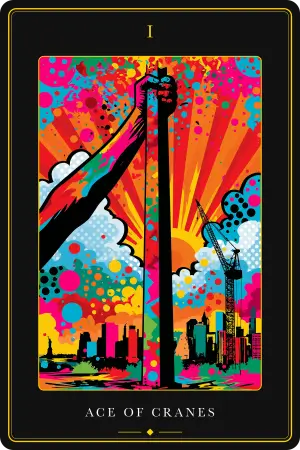
A fist closed around a crane mast at dawn: the permit finally stamped and the first beam swinging up over an empty lot.
Card at a glance
- Numerology
- Ace
- Element
- Fire
- Astrology
- Root of Fire · Aries, Leo, Sagittarius
- Kabbalistic path
- Kether (Crown) in Atziluth
- Timing
- Groundbreakings, and fast once begun
- Yes / No
- Upright yes · Reversed no
Upright
Ignition
New venture
Initiative
Ambition
Bold action
Creative fire
Green light
Potential
Reversed
Delays
Red tape
False starts
Burnout
Lost nerve
Creative block
Scattered energy
Stalled build
Ace of Cranes in each deck
Every deck reimagines the same archetype. Compare the art, then open a deck to read its full interpretation.
Imagery and symbolism
In the Tarot of New York City the Ace of Wands becomes the Ace of Cranes, drawn in the deck's pop-art language of halftone dots, sunburst rays, and saturated color. A powerful arm rises over the harbor, its fist closed around the mast of a construction crane as if gripping a wand. The old Ace handed the seeker a staff. Here the hand does not receive the crane, it seizes it, and the suit's living wood is rebuilt in steel.
Behind the fist the sun explodes across the sky in bands of orange, red, and gold, the sunburst of dawn on a work site when the first shift begins and the day is still unspent. The pop-art clouds, stippled with halftone dots, carry what the Rider-Waite clouds once did: inspiration arriving from somewhere above street level, sudden and unearned, the idea that appears while you wait for the light to change.
Colored dots scatter across the sky like ticker tape thrown in advance, the city celebrating a victory that hasn't happened yet. This is the card's promise and its warning in one image. The parade is potential, not a guarantee. The energy is given, and the building is up to you.
At the horizon a second crane stands latticed and patient over the skyline, the work already underway, proof that the fire in the fist becomes real structure once it is aimed. The mast in the hand and the crane on the horizon are the same force at two moments, the impulse and its realization.
The skyline runs low across the bottom of the frame, with the Statue of Liberty small at the water's edge. Her raised torch quietly rhymes with the raised fist above it, two arms lifting fire over the same harbor. The vertical mast, dead center, holds the whole card upright against a sky that is all noise and color: one idea, one purpose, one beam.
Core meaning
The Ace of Cranes is the root of Fire staged as a groundbreaking. The Golden Dawn titled the card the Root of the Powers of Fire and seated it at Kether, the Crown, in Atziluth, the highest of the four Kabbalistic worlds. This deck gives that abstraction an address. It is the moment the permit finally clears, when after months of waiting and obstruction the city says yes and the first steel swings up over the lot.
What the card marks is the true beginning of something: a project, a venture, a creative undertaking, a bold new chapter arriving on a surge of ambition. The energy is at its peak and the idea is still pure, not yet ground down by budgets or committees. It is the spark before anyone has told you no.
Because an Ace is potential rather than a finished outcome, the fire it offers is volatile and unformed. It supplies the propulsion to leave the starting block, and it will not carry anyone to the finish without sustained work. Fire builds and fire burns. The same force that raises a tower can gut a block, so the spark has to be aimed and fed, or the opening fades back into a vacant lot.
Upright meaning
Upright, the Ace of Cranes is the stamped permit and the first beam at dawn, and in plain yes-or-no terms it is the green light. It counsels decisive action over further study: take the offer, sign the lease, start the build while the energy is hot and the window is open. New York never provides perfect conditions, so risk is favored now and boldness is rewarded.
In love. A new attraction arriving with the force of the city itself, the spark on a crowded platform, a first date that runs four hours past the reservation. This is a groundbreaking rather than a slow burn, chemistry strong enough to reorganize your week, and it may escalate quickly into something with real structure. For established couples it is the revival card, the crane returning to a building everyone thought was finished: rekindled desire, a shared new project, a trip or renovation that puts the partnership under construction again.
In career. A powerful surge of professional energy and a rare institutional willingness to let you use it. It can mark the first day on a new job, a new direction, or leadership taken on for the first time, and it favors the person who volunteers for the ambitious assignment over the one who waits to be told. Advancement can be rapid, and effort converts visibly into results, the frame of a building going up in weeks after months of invisible foundation work.
In finances. The check that clears the way for the build: seed capital, a first investment, funding that has been waiting for months. It opens a new stream of income tied to your own initiative and favors the entrepreneurial move over the safe deposit. This is money as fuel, and the one demand it makes is timeliness, because the funding window in this city closes fast.
In health. The body's own groundbreaking, a genuine surge of physical energy and the ignition of a new regimen. Vitality rises, strength and stamina respond quickly to effort, and the early results arrive fast enough to feed the fire that started them. The counsel is to begin concretely and pick the practice you will still be doing in the winter.
Reversed meaning
Reversed, the Ace of Cranes is the permit stuck in the system. The idea is real, but nothing is moving, and the energy that should be lifting steel leaks away into waiting rooms and second-guessing. The card points to delays, red tape, indecision, or a loss of nerve at the threshold of a venture. Sometimes it warns that the timing genuinely isn't right, that the foundation isn't ready or the funding isn't real.
In love. The spark that doesn't catch, the promising connection that stalls after three good dates, the chemistry that looked structural and turned out to be scaffolding. In an existing relationship it points to cooled fire, routines running on schedule while desire waits for a permit that never comes. The counsel is honesty before heat: name what has gone quiet rather than forcing intensity out of desperation.
In career. The project greenlit and then quietly shelved, the promotion promised and postponed, the new role that turns out to be the old one with a longer title. It flags blocked initiative and scattered focus, too many small tasks and no build. Most seriously, it warns of burnout on the near horizon, the fire of the suit turned inward and consuming its own worker.
In finances. Financing that falls through at the last minute, capital that exists on paper but never arrives on site. It can also mean the opposite fault, money committed impulsively to a venture with no foundation, the financial equivalent of building on landfill. This is the moment to re-run the numbers honestly before another dollar moves.
In health. The gym membership as a monthly donation, intention without ignition. It points to stagnation and low vitality, or to simple depletion in a body that has been run like a 24-hour city and now needs rest before it can be asked for effort. Rebuild the way engineers do: rest first, then one small structural habit installed and kept.
Historical notes
The steel crane sits on top of a much older wooden staff. In the traditional Tarot de Marseille the card is the Ace of Batons, a single sturdy wooden club sometimes held by a bare hand, with none of the scenic landscape of later decks. Marseille readers judged it by weight and size, treating the Ace as the largest and most concentrated reserve of the suit's raw resources.
The layered version most readers now picture came from the occult revival at the turn of the 20th century. The Hermetic Order of the Golden Dawn anchored the Tarot to a web of Kabbalistic and astrological correspondences, and Pamela Colman Smith, working under Arthur Edward Waite, rendered those ideas as a sprouting wand raining eighteen Yod-shaped leaves, published in 1909. Through gematria the number eighteen spells Chai, meaning life, so the falling Yods read as life-force pouring into the physical world. Aleister Crowley's Thoth deck pushed the same root into abstraction, replacing living wood with a blazing torch of ten Yod-shaped flames. The Tarot of New York City inherits that lineage of the outstretched hand and the raw first spark, then swaps the branch for a crane mast and sets it over the harbor.
Correspondences
Number. One, the Ace, seated at Kether, the Crown and primal source from which all later emanation arises. In this deck it is the number of the first permit, the first beam, the first dollar the venture ever makes, the vertical numeral written on the sky by the crane mast. Everything the Suit of Cranes becomes, from the partnership of the Two to the overloaded Ten, is compressed here into a single point of ignition.
Astrology. As a root the Ace rules no single decan. It governs the whole fire quadrant of the zodiac: Aries, Leo, and Sagittarius, with their rulers Mars, the Sun, and Jupiter. Mars is the jackhammer planet of initiation and the courage to break ground, the Sun is the visibility and confidence to put your name on a project, and Jupiter is the zoning variance of the heavens, the expansion and lucky break that insists the building can go higher than anyone thought.
Element. Fire, in its purest and least manifested state, corresponding to Atziluth, the World of Emanation.
Kabbalah. Kether in the world of Atziluth, the first Sephirah of the highest world. Esoteric texts name its divine breath Eheieh, meaning "I AM," the creative outbreathing at the very start of the descent through the four worlds.
Elemental dignity. As a Fire card it strengthens alongside Air and meets tension with Water, which damps its heat, so the neighbouring cards decide whether the spark catches or is smothered.
Psychological perspective
Read psychologically, the Ace of Cranes is a sudden upwelling of libido in the broad Jungian sense: primitive life force, the drive to exist and to act on one's surroundings. It arrives as confidence and enthusiasm, the feeling that the ground is about to move and something must begin.
The deck gives that drive a human face in its igniters, the people who see a vacant lot and can't stop seeing the tower. They run hot, restless and allergic to stagnation, and their creative drive is generative rather than merely wishful, because they don't just dream, they file the paperwork. Standing next to one, you find yourself wanting to build something too.
Its difficulty is the same as its gift. The energy is potential, not achievement, so it can flare and vanish if it meets no discipline. Reversed, the psychology inverts into burnout and apathy, the person with a notebook full of brilliant plans and no filings who has been about to start for three years. The developmental task is to keep the raw enthusiasm alive while giving it enough structure to survive past the first rush.
The Ace of Cranes across decks
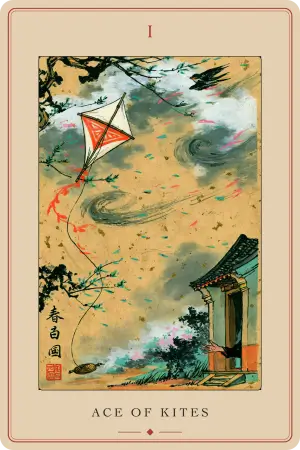
The core archetype holds steady while the imagery shifts. In the Tarot de Marseille it is the Ace of Batons, a bare structural club with no narrative scene, read for concentrated force. In the Rider-Waite-Smith deck a luminous hand grips a sprouting wand that rains eighteen Yod-shaped leaves toward a distant castle. In Crowley's Thoth deck the wand becomes a fiery torch bearing ten Yod-shaped flames for the ten Sephiroth, described in the Book of Thoth as a lightning bolt of untamed natural force before it has been harnessed. Kim Krans' Wild Unknown strips away every human figure and shows a single burning match against consuming darkness, an internal wildfire and a symbol of personal empowerment.
The Tarot of New York City keeps each of those functions and swaps the objects for the city's own. The living wand becomes a crane mast, and the hand seizes it rather than receiving it. The RWS castle on the horizon becomes a second crane over the skyline, the divine sunlight becomes a pop-art sunburst, and the falling Yods of life-force become confetti of colored dots thrown like ticker tape. The guardian who once stood at the Fool's heel returns here as the Statue of Liberty, her torch lifting the same fire the fist lifts above her. Under every version sits the same root of Fire and the same unformed beginning.
In combination and context
The Ace of Cranes shifts sharply with its neighbours because it describes a catalyst rather than a fixed result. With The Magician it signals the skilled launch of a new business idea, the founder who has the mastery to overcome previous stagnation. With The Chariot the project takes off at speed toward a swift, decisive win. With The Fool it reads as extreme impulsiveness, and if The Empress joins them the combination becomes a classic marker of an unplanned pregnancy. With The Devil it warns of a purely sexual attachment stripped of love, and with The Tower it points to a disruptive start that can overturn a life or end a fresh project before it settles. Paired with the Two of Cups, the solitary spark finds a receptive vessel and lust matures into mutual romance. Beside another Ace it shows a wholly new spirit entering the querent's life, pulling on large reserves of power.
Position sharpens it further. As advice it says stop wishing and start doing, break ground on the smallest concrete step today. As an obstacle it can be impulsive haste with no foundation, or grand plans the budget cannot carry. In a fertility spread it acts only as the seed and the instigator, and it needs maternal cards such as The Empress or the Ace of Cups nearby to confirm anything on its own. Because it is the ignition of the whole Suit of Cranes, its appearance frames the reading as a departure story, a situation caught at the moment its potential is highest and its evidence lowest.
Questions for reflection
- What have I been waiting for a permit to begin, and what is the smallest beam I could lift this morning?
- Where is my fire aimed, and where is it just a bright accident looking for a place to happen?
- If the funding window closed tomorrow, would I move today, or admit the plan needs more foundation first?
The general meaning follows the Rider-Waite-Smith reading — the reference used across Tarot Academy. Open a specific deck above for its own interpretation.
Frequently asked questions
Explore the Tarot
Latest Posts
Discover the ancient wisdom of tarot cards and unlock the mysteries of your spiritual journey. Our blog is your gateway to understanding the rich symbolism, meanings, and practical applications of tarot reading.




















































