
 EN (English)


Minor Arcana · Swords (Air)
Eight of Subways
A blindfolded man held between stations by a train whose doors were never locked, with Liberty burning in the harbor just past the tunnel mouth.
Read the complete guide: Eight of Swords Tarot Card: A Complete Guide to its Symbolism and Meaning
Card at a glance
- Numerology
- 8
- Element
- Air
- Astrology
- Jupiter in Gemini (first decan)
- Kabbalistic path
- Hod (Glory)
- Timing
- Gemini season, late spring (about May 21-31)
- Yes / No
- Upright no, Reversed leaning yes
Upright
stuck between stations
self-imposed confinement
fear
powerlessness
paralysis of choice
negative thinking
passivity
no exit
Reversed
liberation
doors sliding open
the lights coming back on
regained confidence
new route
release from loops
determination
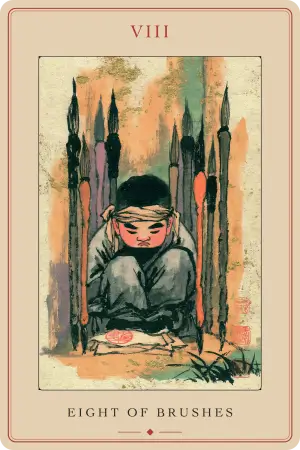
Eight of Subways in each deck
Every deck reimagines the same archetype. Compare the art, then open a deck to read its full interpretation.
Imagery and symbolism
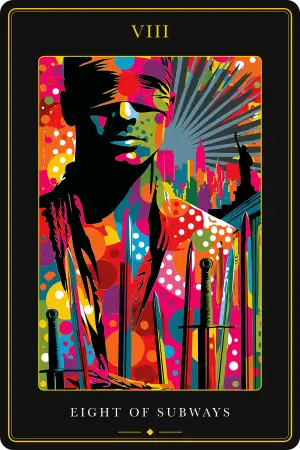
The Tarot of New York City renders the Eight of Subways in the deck's pop-art language. A man stands as a black silhouette flooded with halftone dots and saturated blocks of pink, orange, green, and blue, as if the noise of the city were printed onto his skin. He is blindfolded, a bright band tied across his eyes, and that blindfold is the heart of the card. He sees the situation only as his fear paints it, not as it is.
The blindfold. His perception is narrowed to the dark of the stalled tunnel. He refuses, or is unable, to look at what stands in front of him. This is the deck's version of the classic Eight of Swords focal point: willful ignorance standing in for real constraint.
The torn silhouette. His shoulders are ragged, the outline frayed like a worn poster on a station wall, the mark of the trials that brought him here. His face beneath the blindfold stays calm and composed, so the strength to move is already in him, waiting on the decision to use it.
The blades. Around him, blades rise from below like a fence, the deck's echo of eight swords planted in the ground. They read at once as swords and as the gleaming steel of the rails and the picket of turnstile bars: thoughts, fears, and misconceptions standing upright between him and the exit. They surround him but never touch him. The cage has gaps, and nothing in the picture binds his hands.
The subway car. To his right the car waits with its doors closed, the situation he believes he is locked inside. The card shows no lock, because there is none. In this tunnel the doors were never locked, only untested.
The skyline and Liberty. Beyond the tunnel mouth the skyline burns in full color. The Empire State Building, the stacked rooftops, and the Statue of Liberty lift her torch inside a gray sunburst of rays. This is the deck's distant castle: freedom itself, visible and radiant, standing within sight of the man who cannot see her. The rays promise the light is already breaking. Only the blindfold keeps the scene dark.
Core meaning
The Eight of Subways is the card of the train stopped between stations. It carries the traditional Eight of Swords meaning of blockage and restriction, then moves it underground into the dark stretch of tunnel where the car has halted and the announcement never comes. It describes suffering and helplessness, the sense of being trapped and held on every side, with no way forward and no way back.
Most often the walls are psychological rather than real. The person is certain the doors are locked when they were never locked at all. The mind assembles a cage out of fear, old failures, and the conviction that nothing can be done, while the city keeps moving overhead and makes the stillness feel absolute. The message underneath is stubborn and hopeful. The restriction is a construction of perception, and what the mind assembled the mind can dismantle. The track continues past the dark, the doors are shut but not locked, and the blindfold can come off at any moment.
Upright meaning
Upright, the stasis is active and ongoing. You feel confined and powerless, held in place by obstacles that are mostly of your own making. The doors seem sealed, catastrophic thinking replays like a stalled announcement, and it becomes tempting to surrender your agency and wait for someone else to get the train moving. In modern practice the card works as a diagnostic: it points to the fact that you are acting as your own jailer.
In love. The relationship feels stalled between stations. You may cling to a connection that hurts out of fear of the empty platform, or sit side by side in the same car while blindfolded to each other, unable to speak your feelings. The card marks confusion, communication breakdowns, and a psychological tension that seems unresolvable, while insisting the doors are not actually locked.
In career. Professional stagnation, the career stalled in the tunnel. Duties feel impossible and the obstacles look insurmountable, yet most of them live in perception. This is the state of the commuter who has ridden the same grind so long the route feels like a cage. It often marks imposter syndrome, where the barrier is cognitive well before it is material.
In finances. Money feels frozen or out of reach, like a paycheck stuck in transit. The fare keeps rising while income stands still, the classic New York squeeze. The card points to debt, stalled deals, or delayed payments, and reminds you that the belief nothing can be done about money in this city is itself one of the blades in the ground.
In health. The grind schedule leaves no hour for rest, and the body's request for care goes unheard. Too little movement, food grabbed on the run, and sleep cut short accumulate into tension the commute leaves in the shoulders. Underneath it, anxiety and overthinking run their loop, and the harder you try to think your way out the more trapped you feel.
Reversed meaning
Reversed, the train lurches forward. The blindfold slips, the lights come back on, and the fears turn out to have been shadows on the tunnel wall. You recognize your limitations as self-built and start acting against them. Modern readers treat this as one of the most relieving reversals in the deck, a release from negative loops and the return of confidence. The realization of how much time was lost can carry a sting of regret, but the dominant energy is liberation, and the card urges you to act before self-doubt rebuilds the cage.
In love. After a long emotional standstill the train pulls out of the dark. A way opens out of an oppressive dynamic, or a decision arrives that leads to real change. New understanding appears between partners, and the relationship can move to a new station free of old fears.
In career. A barrier that constrained your ability has likely been overcome, and it feels like transferring off the stalled line onto a train that moves. Counterproductive mindsets loosen, self-confidence grows, and new opportunities that were out of view come into sight.
In finances. Relief from financial pressure and a way out of a difficult stretch, whether liberation from old debts, a job change that raises income, or the sober realization that uncontrolled spending has to stop. Circumstances begin to improve, though sound management is still needed. Remember the old loop clearly enough not to ride it again.
In health. The self-imposed limits dissolve. You return to regular movement after a long break, drop punishing systems that never worked, or trade the dreaded gym for walking the bridge. The body steps off the stalled train and starts to move again.
Historical notes
The Eight of Subways is a modern renaming of the Eight of Swords, and its meaning inherits centuries of that card's history. In the Tarot de Marseille, which took shape around 1650, the pip cards were non-scenic. The Eight of Swords showed eight curved blades interlocking in a tight, almost claustrophobic pattern, a geometry of compression and boundaries. The Marseille Eights drew tension from two trumps: Justice (VIII), cold and rational, and the Moon (XVIII), irrational and full of illusion, so the card sat where hard facts clash with the fears of the unconscious.
Etteilla, working in the late eighteenth century, assigned it keywords of unexpected occurrences and minor obstacles, while some variants linked its reversal to Hope and Support, an early hint of the liberation later readers would emphasize. Papus, in the 1890s occult revival, gave it an enemy whose victory is 'only partial,' leaving a window for escape. The Hermetic Order of the Golden Dawn systematized it in Book T as the 'Lord of Shortened Force,' warning of energy wasted in petty affairs. Pamela Colman Smith and Arthur Edward Waite fixed the modern scenic image in 1909, published by William Rider and Son, with a bound and blindfolded woman ringed by swords. Waite's 'temporary durance rather than irretrievable bondage' has defined the card ever since, and the New York deck carries that reading into the subway.
Correspondences
Number. Eight, the number of the endless loop line. In numerology 8 holds balance, infinity, and a closed cycle, its shape the track that returns to itself. In its positive aspect it means power and the force that runs a system as vast as the subway. In its shadow it tips into control and suppression, the same structure that organizes movement becoming the structure that forbids it, so the cycle hardens into a rut.
Astrology. The first decan of Gemini, roughly May 21 to 31. Gemini is the mutable Air sign of movement and mental agility, the most transit-minded sign of the zodiac and perfectly at home in a suit made of trains. Its decan ruler is Jupiter, the planet of expansion. Here Jupiter works two ways: it promises new openings past the dark stretch of tunnel, and it can also inflate fears into catastrophizing and the conviction that the delay is permanent.
Element. Air. In this deck the Suit of Subways is the suit of Air, the element of mind, communication, and the daily mental grind of the city. When thought meets an obstacle it turns inward into rumination and the loop of worst-case scenarios that runs through a stalled car at 3am.
Kabbalah. Hod, meaning Glory or Splendor, the eighth sphere at the base of the Pillar of Severity. Hod is the rigid structure of the mind, and when the boundless Air of the suit enters that realm the thoughts bounce back on themselves into a narrow mental prison.
Elemental dignity. As Air among Air it is doubly intellectual, the mind turned against itself with no other element to temper it.
Timing and yes/no. It leans to late spring and Gemini season. As a yes or no it reads as a No upright, since the energy is too constrained for a positive outcome, and softens toward yes when reversed and the grip loosens.
Psychological perspective
The Eight of Subways is the deck's portrait of anxiety and limiting belief. The blades are cognitive distortions, catastrophizing and worst-case projection that look razor-sharp and persuasive but are made of fear. The card captures the exact sensation of mental fog, when high anxiety impairs executive function and thinking harder only tightens the trap. When you cannot see clearly, fear fills the space that information should occupy, and at 3am in a dark tunnel fear is a very loud announcer.
At its center lies an abdication of personal power. The person truly believes they have no options and slips into a victim mentality, waiting for an outside rescuer instead of pressing against the door. It often surfaces when someone has internalized past failures or critical voices so deeply that they preemptively stop trying. The card does not blame you for where you are standing, because getting stuck in your own thinking is a very human thing and the city does it to everyone eventually.
The way out mirrors Cognitive Behavioral Therapy: name and challenge the limiting belief by lifting the blindfold, notice the perceived threat is manageable by seeing the gaps between the blades, reach for support, and take one brave, specific action to break the paralysis. Recognizing the trap is already the first step toward the platform.
The Eight of Subways across decks
The New York deck reworks a widely painted archetype, so its choices read clearly against the other famous versions of the Eight of Swords.
Tarot de Marseille. Eight curved blades woven into a tight geometric knot, no human figure, the meaning carried by compression and enclosure rather than narrative.
Rider-Waite-Smith. The 1909 scene the New York card adapts most directly: a woman bound head to toe, blindfolded, ringed by eight swords, with a shallow pool at her feet and a castle on a distant cliff. New York keeps her calm resilience and loose, escapable predicament while swapping the castle for the Statue of Liberty and the swords for rails and turnstile bars.
Crowley-Thoth. Painted by Lady Frieda Harris in 1943 and renamed 'Interference,' it drops the bound figure entirely. Two heavy swords point downward at the center, crossed by six smaller blades drawn from different cultures, a clash of contradictory ideologies. Crowley ties it to Jupiter in Gemini and calls the failure mechanical, the mind interfering with its own reasoning until it stalls.
Modern decks. Kim Krans's Wild Unknown shows a butterfly bound in webbing and hung from a single sword, isolating the suffocating stuckness. Lisa Sterle's Modern Witch keeps the loose ropes and adds a hand on the figure's shoulder, so unseen help is already present. Isabella Rotman's This Might Hurt draws on shibari, where the tied person keeps ultimate control. The New York deck lands in the same optimistic family: the doors are shut but not locked, and freedom is already in view.
In combination and context
Experienced readers treat this card as the blind spot: you are missing the obvious, simple solution because pride, stubbornness, or the drama of the predicament keeps the blindfold on. You already hold the tools for release and are choosing not to use them, so the exit you cannot see is usually a few steps away.
Context sharpens the reading. In a money spread it points to debt or delayed payments, though a renegotiated rent or an honest budget can be the key that opens the doors. In a work spread it marks the career stalled in the tunnel, easing when you attend to your own boundaries and energy. In relationships with others it signals temporary isolation, like riding the crowded car with headphones in, surrounded by people and connected to none of them, a signal that asks for patience with the silence rather than inventing the worst to fill it. Reversed alongside any of these, the whole line starts running again: perceived barriers fall, express routes appear where only the slow local was assumed, and the readiness to move returns. In a yes or no spread the upright card is a clear no until the perspective shifts.
Questions for reflection
- Where do you feel stuck between stations right now, and have you actually tested the door, or only assumed it was locked?
- If you lifted one corner of the blindfold and looked honestly, what obvious next step would you see?
- Where are you waiting on the platform for someone to rescue you from a situation you already have the power to change?
The general meaning follows the Rider-Waite-Smith reading, the reference used across Tarot Academy. Open a specific deck above for its own interpretation.
Frequently asked questions
Explore the Tarot
Latest Posts
Discover the ancient wisdom of tarot cards and unlock the mysteries of your spiritual journey. Our blog is your gateway to understanding the rich symbolism, meanings, and practical applications of tarot reading.




















































