
 EN (English)



Minor Arcana · Cups (Water)
Ten of Cups
Smith hung ten chalices inside a rainbow, turned the family away from us so we watch what they watch, and put a small house on the hill behind them.
Card at a glance
- Numerology
- 10
- Element
- Water
- Astrology
- Third decan of Pisces (March 11–20), ruled by Mars
- Kabbalistic path
- Malkuth (Kingdom), in the watery world of Briah
- Timing
- The last ten days of Pisces, the final stretch before the spring equinox
- Yes / No
- A resounding yes, reversed no
Upright
Completion
Family welfare
Domestic coziness
Emotional richness
Harmony
Mutual understanding
Fulfilled desires
Genuine inner peace
Reversed
Loss of harmony
False expectations
Family problems
Emotional dissatisfaction
Loneliness
Lost connection
Instability
Betrayed expectations
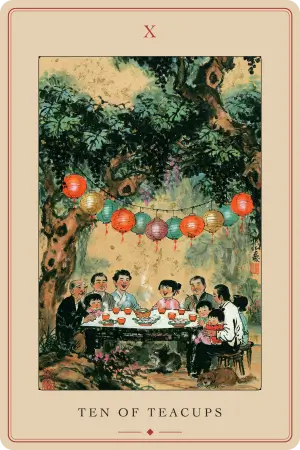
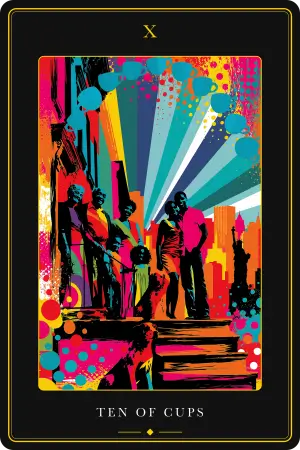
Ten of Cups in each deck
Every deck reimagines the same archetype. Compare the art, then open a deck to read its full interpretation.
Imagery and symbolism
The first thing Smith does here is turn everyone away from us. The man and woman stand with their backs to the viewer, arms raised toward a rainbow that carries ten golden chalices across a clear sky, so the reader is not looking at happiness but standing inside the same view. Two small children dance in a circle beside them, oblivious to the rainbow overhead, absorbed in the moment for its own sake. This deck reads that detail as the household's underlying safety: children only play like that where nothing is wrong.
The rainbow itself is the card's argument. It forms where water, the suit's element, crosses light, and this deck treats it as the traditional bridge between heaven and earth, joining spiritual peace to ordinary domestic reality. Western tradition adds the covenant reading, a promise of peace after the flood. Then there is the catch the image refuses to hide. A rainbow is an optical event that exists only under exact atmospheric conditions and cannot be grasped or kept. The joy in this card is real and naturally passing, which is why gratitude, rather than possession, is the response it asks for.
The embrace and the raised hands work as a pair. This deck reads the couple's gesture as familial warmth and security on one hand and open gratitude toward the sky on the other. Some esoteric historians note that comparable uplifted-hand postures in Egyptian hieroglyphics carried a sense of submission or being bound, which turns the pose into a willing surrender to the bonds of love rather than mere celebration. The family also maps onto the Tetragrammaton, YHVH, along the lines of the court cards: father as King (Yod), mother as Queen (Heh), son as Knight (Vav), daughter as Page (Heh final). Smith's colouring supports it. Father and son wear red for the fiery Martian masculine principle, mother and daughter wear blue for the watery feminine.
The ground and the background do the quiet work. The green lawn stands for life energy and abundance, and it matters that the happiness has something material under it rather than floating free. The house on the hillside is deliberately small, a cottage and not a castle or an estate, because this deck's claim is that contentment is found together in one's own space regardless of its size. The mountains in the distance are not scenery: they mark the historical challenges the couple crossed to reach this life. The river beside the property carries the continuous flow of life and the depth of their shared emotional world, water circulating cleanly instead of pooling. And the couple are looking at their own home from a distance, which is the card's practical instruction, since taking stock from a step back is what lets you see what you actually built. Above it all, each of the ten cups in the arch marks a milestone on the path to this stability.
Core meaning
This deck states it as peak harmony and emotional fulfillment: a successful conclusion in which deep inner balance has been reached. That can arrive as an ideal family dynamic, as a rock-solid friendship, or as a long-held personal dream finally realised. What the card describes is completeness in your personal life, domestic comfort, satisfaction with your results, and real serenity in the company of the people who matter most.
Behind the pastoral scene sits the esoteric placement. The Golden Dawn titled this card the Lord of Perfected Success, or Perpetual Success, and in the Qabalah it is Malkuth in Briah. The emotional current that began as a single divine drop in the Ace of Cups has descended the Tree of Life and reached its final physical form in the tenth sphere. The cups are full to the brim and the waters rest in their grounds. The emotional ideal has become a tangible reality.
The recommendations this deck attaches are unusually concrete for a card this exalted. Do not let minor distractions pull you away from the pleasures of this period. Relax with the people you love and communicate openly. Embrace the stability you built, open up your emotions, be vocal about your happiness, and allow yourself to celebrate what you achieved. Because ten is also an ending, that instruction has an edge to it: the fullness will eventually pour out and start again at the Ace, so the celebrating is not optional.
Upright meaning
Upright, this deck reads absolute contentment and an ideal outcome, a period of completeness marked by domestic coziness and satisfaction with your results. The struggle is over and the reward is present tense. The card is also one of the most affirmative in the deck for a direct question, delivering a full-hearted yes on matters of home and family.
In love. Absolute stability and mutual fulfillment. The partnership has settled into deep, unshakable reliability, with shared life goals, profound emotional closeness, and a functional domestic life. Both partners experience complete acceptance and unconditional trust, and they understand each other's core values. There is ample room here for both passionate love and grounded friendship. This deck treats it as the benchmark for relationship success, where mutual respect generates lasting peace. For singles the card leans serious rather than casual, promising a connection with lasting stability and soul-level resonance, and for anyone raised in a dysfunctional household it acts as a guide to break inherited patterns and use what they learned to build something healthy.
In career. Successful completion of major projects and total workplace harmony. Expect tangible rewards and recognition for past effort; the difficult grinds are finished and the current phase is secure and profitable. The team operates on the same wavelength and communication runs free of ego and friction, so goals get achieved efficiently. The wider reading is one of alignment: your work supports the life you actually want instead of consuming it.
In business. Peak operational harmony and high dividends. A major project has succeeded and generated well-being that reaches the whole team and their families. Partnerships are loyal and built on shared values rather than convenience, products or services are in heavy demand, departments cooperate smoothly, and decisions get made without friction. The business functions like a healthy family.
In finances. Total material satisfaction. You have hit your benchmarks and can safely enjoy the rewards, often through the purchase of real estate, profitable investments, or assets that directly improve family quality of life. It points to settling old debts and establishing a reliable baseline of wealth, and to a family business that is currently profitable and structurally sound. The money is secure because it was built through honest work and mutual support. The emphasis stays on domestic comfort rather than status symbols.
In relationships more broadly. Deep community support and group unity, often marking celebrations, weddings, or significant family gatherings. Interactions run on mutual respect and easy agreement, and the close-knit network around you functions as an extended family that provides emotional safety. This deck also stresses chosen family here, since friendships and community ties frequently supply the scaffolding people need to thrive.
In the physical realm. Absolute comfort in your own skin, a rare harmony between physical health and mental state. You accept your natural appearance out of healthy self-awareness rather than vanity, supported by consistent self-care and solid self-esteem. Aesthetically you have found a style that suits you; medically it points to a strong, symptom-free period. The mind-body connection is the operative principle, with vitality supported by belonging.
Reversed meaning
Reversed, the idyll fractures. This deck describes active trouble in close relationships, deep dissatisfaction with a partner, and an inability to enjoy time with family. Domestic conflicts, a looming breakup, or the sudden disruption of a previously peaceful home all sit here. Anxiety and discord take over and the disagreements everyone had been ignoring surface at once. The instruction is direct: address misunderstandings before they harden into resentment, listen closely to the grievances around you, seek compromises that genuinely account for everyone's interests, and stop ignoring the source of the friction. Flexibility and patience are what rebuild the peace.
This is also where the card's most modern reading lives. The reversal frequently exposes performed harmony, families going through the motions of happiness to maintain an appearance for society or social media while the internal reality has gone cold. It is a warning to name the cracks before the facade shatters on its own.
In love. A shattered domestic idyll: painful disappointments, constant friction, and the collapse of a shared dream. Trust and emotional closeness have eroded, and partners may be hoarding hurt feelings and refusing to forgive old slights. It often flags family issues bleeding into the romance, such as interference from in-laws or parenting disputes. The card warns that the relationship is heading toward a permanent break unless both people intervene, and repair means dropping the fantasy of a perfect life and doing the grueling, equitable work of real compromise.
In career. A hollow victory or a toxic environment. You may hit your targets and still hate the daily reality of the job, where the success does not justify the misery. The reverse case also appears: a team that gets along socially but fails to execute. Expect misalignment in shared goals, active conflicts, or an absence of recognition from management, with disappointment shadowing ordinary tasks. Work is eating the home, and priorities need a fast reset before the rainbow fades.
In business. Severe internal rot. Toxic conflicts, broken communication, and a hostile team culture, with an operation that may look fine from outside while quietly sliding toward bankruptcy. Deep disagreements over core strategy cause constant friction between partners, and unmanaged growth or broken promises have destroyed staff loyalty. The infighting damages your reputation and reaches client relationships. Overhaul the culture and sever the bad partnerships before the toxicity kills the company.
In finances. Acute financial stress inside the household: unexpected expenses, failed investments, or losses that disrupt family security. Bitter domestic discord over money is common, usually because expenses outpace income or because of ugly fights over an inheritance, and unresolved debts breed anxiety. Do not chase losses with rash investments. Acknowledge the structural problems, organise the baseline expenses, and stop the bleeding before the strain shatters the family's peace. After a divorce or a loss, the temptation is to perform a rapid, inauthentic recovery instead of doing the deep repair.
In relationships more broadly. Severe community or family discord, with tense communication, acute misunderstandings, and infighting. Unreasonable demands from your circle breed bitterness, and differences in core values trigger ugly disputes. It often points to a breach of family tradition or the sudden collapse of a long-standing friend group, with old grudges resurfacing while people reject outside perspectives and compromise stops being possible. Reassess who actually belongs in the inner circle. This is also the territory of the empty nest and of dreaded family gatherings.
In the physical realm. Severe dissatisfaction with your body and emerging complexes, often with negative thought loops about appearance. Health issues surface through chronic stress, exhaustion, or emotional overeating, and you are disconnected from what your body actually needs. Dressing comfortably or finding joy in movement becomes difficult. Stop treating your body as an enemy, overhaul the daily habits, and relearn practical self-care before the exhaustion deepens.
Historical notes
Earlier decks give this card no scene at all. The Tarot de Marseille renders the Ten of Cups as a formal arrangement of ten vessels, the meaning left entirely to the numerology of ten and its sense of completion and well-being.
The rainbow arrived in 1909. Working under the esoteric direction of Arthur Edward Waite, Pamela Colman Smith replaced the abstract pip with the family, the arch of chalices, and the cottage, and she placed the image in deliberate contrast to the emotional weather earlier in the suit, the grief of the Five and the confusing illusions of the Seven. This is the calmest picture in the Cups sequence, and it is the one nearly every modern reader sees when the card is named.
The Hermetic Order of the Golden Dawn supplied the esoteric title, the Lord of Perfected Success, and fixed the card to the third decan of Pisces under Mars. Aleister Crowley took the identical astrological placement in the opposite direction, retitling his version Satiety to stress that absolute fullness carries its own danger. The two readings sit on the same decan, which is why this card can be quoted as tarot's happiest image and as its subtlest warning without contradiction.
Correspondences
Number. Ten reduces to one, since one plus zero returns to the beginning. This deck reads that as absolute completion and the inevitable start of a new cycle at the same time, merging the driving essence of 1 with the limitless potential of 0. In the Ten of Cups the mathematics translates into emotional harmony: the exact moment an emotional journey finishes successfully, the struggle over, satisfaction secured, the slate wiped clean. Paired with Water, the ten synchronises the internal and external worlds, so the family's emotional health matches their secure material conditions.
Astrology. The third decan of Pisces, roughly March 11–20, ruled by Mars. These are the final ten days of the astrological year, leading directly into the vernal equinox. The pairing looks contradictory, since Mars is a hard, ambitious force of division and conquest while Pisces is mutable water, dreamy and compassionate. Traditional astrology resolves it: Mars is the triplicity ruler of the water element and has a special affinity with Cancer, Scorpio and Pisces, so the cool water tempers the aggressive edge off the blade instead of extinguishing the drive. Mars can express passion without the aggression that leads to conflict. This deck puts the point practically. Mars supplies the ambition and sheer energy required to secure this level of domestic peace, which proves that lasting harmony is actively built and defended rather than passively received. The decan also sits immediately before the equinox, where the earth needs Martian heat to melt the last snow and warm the ground for germination, so the card carries conception in a healthy environment and an embryo carried successfully through a full gestational cycle. In the Orphic hymns Mars finally yields to Venus and Bacchus, love and celebration. The warrior stops conquering and rests in the sanctuary he fought to build.
Element. Water in its most fulfilled state, governing deep empathy, intuition, and emotional completion. Under this decan the boundary between inner emotion and external reality becomes highly permeable, which heightens introspection and opens up hidden emotional currents.
Kabbalah. Malkuth, the Kingdom, the tenth and lowest sephirah, the dense physical world of action and reality, set inside Briah, the World of Creation associated with Water and the emotional faculties. The Ten of Cups is Malkuth in Briah, the point where the emotional ideal has landed in fact.
Elemental dignity. As a yes or no, a resounding yes, especially for questions about home and family. Reversed the answer turns negative.
Psychological perspective
The people this deck attaches to the upright card radiate genuine happiness anchored in gratitude and satisfaction. They keep warm, low-conflict relationships with family and close friends, and their lives run on mutual respect and steady affection. Emotionally balanced, they accept what they have and enjoy it thoroughly, find their deepest peace in domestic comfort, and have a proven record of building partnerships that last. They shape their environment deliberately around love and stability, and they do not take small joys for granted.
Reversed, the portrait inverts. These are people currently disconnected from joy, alienated from their surroundings and disappointed in their closest relationships. Their emotional lives are tangled, which produces chronic frustration, and they struggle to communicate with their own families in ways that spark constant friction. Moments of love still occur, but sustaining real satisfaction proves nearly impossible. Many are mourning the reality of a family life that falls far short of the ideal they envisioned, and this deck is specific about the consequence: the lingering despair over a broken domestic dream makes them indecisive and bitter.
That gap between the picture and the life is where the card has done most of its modern work. When the Ten of Cups turns up in the middle of heartbreak or depression, the flawless domestic scene can feel dismissive, and readers increasingly interpret it in that context as projection, a white picket fence fantasy the seeker is clinging to rather than a forecast. Beside a toxic partner it can mean someone is addicted to the potential of this card instead of the reality in front of them. In a challenge or "what to let go of" position, what the card asks you to surrender is not happiness but the pressure of perfection, the cultural script of the flawless family that generates so much of the stress. Drop the rigid parameters and the messy, imperfect version of contentment becomes reachable. The same position warns against the armchair dreamer, the person whose constant daydreaming about a distant future keeps them from the unglamorous work of building a stable present.
The Ten of Cups across decks
Tarot de Marseille. Ten cups in a formal geometric layout, no figures and no landscape, the meaning resting on the number and its sense of completion.
Rider-Waite-Smith. The version on this page, and the one that gave the card its cast. Smith's rainbow, embracing couple, dancing children and hillside cottage turned an abstract pip into a scene of domestic arrival, and this deck loads the setting with meaning: the green lawn for life energy grounding the joy in material stability, the distant mountains for the challenges already crossed, the river for the depth and continuous flow of shared emotional life, each of the ten cups for a milestone on the way. The house stays modest on purpose.
Crowley-Thoth. Retitled Satiety and painted by Lady Frieda Harris, this version drops the pastoral romance for geometry. Ten cups sit in the exact pattern of the Tree of Life, clean water falling from the top cup down through the whole structure as a functioning fountain, against a fiery red Martian background with a broad flat red lotus of universal love behind them. The cup handles are shaped like the horns of the Aries ram, a hint at the shift from watery Pisces into fiery Aries that follows this decan. Several cups tilt and sway, so the stability is visibly precarious and ready to tip. Satiety means stuffed to capacity with nothing more that can be absorbed, and Thoth practitioners read the state as heavy and potentially stagnant, water saturating everything without any other element to balance it. One esoteric commentary puts it bluntly: "as far removed as possible from the divine, void of spirit, mind or body... This is drowning. This is giving in. This is the bloating of the heart." Because no further upward move exists inside the suit, the Ten must destabilise and cycle back to the Ace.
Across traditions. Whatever the drawing, the constant is completion at the emotional level, a fullness that has reached its limit and has to pour out to renew. Smith shows that limit as a rainbow; Crowley shows it as a cup about to spill.
In combination and context
The Ten of Cups is most often set beside the Ten of Pentacles, since both are suit finales picturing family. The ground of the fulfillment is what separates them. Cups is Water: chosen family, soulmates, immediate emotional bonds, and an internal, experiential joy that is ephemeral and moves with emotional weather. Pentacles is Earth: extended family, ancestry, bloodline and tradition, tangible security, property and institutions built to outlast the individual. A seeker can hold the financial security of the Pentacles and still feel an emotional void, or hold the love of the Cups while lacking basic material necessities.
Against The World the difference is scale. The World completes the Fool's entire journey, a spiritual graduation and a wholeness achieved largely independent of other people, and it marks a permanent shift in consciousness. The Ten of Cups belongs to the Minor Arcana and stays local and earthly, happiness that comes from harmony with friends, family and immediate community, a chapter of relational bliss that may give way to new mundane challenges as the suit cycles back to the Ace.
The supportive pairings amplify it. The Lovers brings the apex of romance, soul-level attraction with enough emotional depth to carry into lasting marriage or renewed vows. The Empress adds fertility and maternal care, frequently signalling pregnancy, a birth, or a family expanding. The Sun guarantees the happiness is genuine and transparent, free of hidden shadows or the stagnation of satiety. The Chariot links emotional fulfillment to outward victory, with a supportive home supplying the fuel for ambitious worldly goals. Among the minors, the Ace of Wands injects fresh creative fire into domestic life so the scene does not go stale; the Three of Pentacles insists that a harmonious family is built by conscious teamwork and open communication rather than luck; the Four of Swords turns the home into a literal sanctuary for recovery from outside stress.
The shadow pairings are where this card earns its complexity. The Tower shatters the domestic scene through sudden revelation, infidelity or financial ruin, though if the harmony was only performed, that demolition is the necessary catalyst that forces everyone to confront the truth and rebuild on something authentic. The Devil suggests a picture-perfect front acting as a smokescreen for toxicity, control or a codependent loop where unhealthy chemistry gets mistaken for fulfillment; read in the other direction, moving from The Devil to this card is a narrative of liberation. The Three of Swords cuts through the rainbow to insist that a seeker with all the external markers, the stable marriage and the nice home, cannot reach peace while an unprocessed grief sits underneath. Death indicates that an idealised harmony has met its natural end, old family dynamics shedding to make room for a transformed way of relating. In questions about an ex, the card often reads pragmatically as confirmation to move on: that romantic cycle reached its culmination, and the fulfillment ahead is elsewhere.
Questions for reflection
- Smith put mountains behind the cottage for the difficulties the couple already crossed. What did you have to get through to reach the ordinary peace you currently have, and when did you last count it?
- The couple are looking at their own house from a distance. What in your life would look different if you stepped back far enough to see the whole of it?
- Where might you be performing harmony rather than living it, and what would it actually cost to name the crack before it widens?
The general meaning follows the Rider-Waite-Smith reading — the reference used across Tarot Academy. Open a specific deck above for its own interpretation.
Frequently asked questions
Explore the Tarot
Latest Posts
Discover the ancient wisdom of tarot cards and unlock the mysteries of your spiritual journey. Our blog is your gateway to understanding the rich symbolism, meanings, and practical applications of tarot reading.




















































