
 EN (English)


Minor Arcana ·
Ten of Teacups
Harmony as a full courtyard table: four generations, ten steaming cups, a teapot someone always refills.
Card at a glance
- Numerology
- Ten
- Element
- Water
- Astrology
- Third decan of Pisces · ruled by Mars
- Kabbalistic path
- Malkuth (Kingdom) in Briah
- Timing
- Late Pisces · March 11-20 · festival evening
- Yes / No
- Upright yes · Reversed no
Upright
completion
family harmony
belonging
domestic peace
emotional fulfillment
gratitude
reunion
abundance in circulation
Reversed
disappointment
domestic conflict
empty seat
performed harmony
broken idyll
alienation
loneliness in a full house
Ten of Teacups in each deck
Every deck reimagines the same archetype. Compare the art, then open a deck to read its full interpretation.
Imagery and symbolism
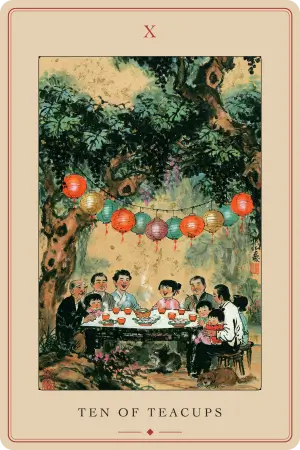
In the Tarot of Beijing the Ten of Cups arrives with its feet on the ground and its cups full of tea. There is no rainbow arched across a distant sky. The card's bridge of heaven is made by human hands: a string of paper festival lanterns in red, gold, teal, and rose, hung across a siheyuan courtyard between the old trees. Someone stood on a stool at dusk and strung them. That is the deck's quiet thesis made visible, the cosmic shown through the small and human.
Beneath the lanterns, four generations sit at one long table. The eldest holds the youngest, asleep in his lap, so the start and the end of the cycle rest in one another's arms. That is the number ten drawn in people. Ten cups of tea steam among plates of dumplings, and no cup stands apart or empty, because the teapot at the center is always being refilled by someone. Abundance here is not a stockpile but a circulation, which is the card's whole mechanism of happiness.
Overhead a grape trellis carries heavy clusters, the same fruitfulness the pomegranate gives The Empress: many from one, the family as a vine that keeps producing. A cat rests beneath the table and a dog lies by the stools, the household's smallest members at peace, proof that the safety of this home reaches every creature in it. Laughter is drawn on every face in the calm brush lines of Feng Zikai, vermilion and teal on warm kraft paper, and nobody is performing. The small red seal in the corner signs the scene like a family name on a letter: this happiness is witnessed and real.
Core meaning
The Ten of Teacups is the Suit of Cups arriving home. It marks peak harmony and emotional fulfillment, the long table under the grape trellis with every seat taken. Where the earlier cups navigate grief, illusion, and longing, the Ten is the successful conclusion, a deep inner balance reached and settled into an ordinary festival evening.
This deck states the meaning as one image rather than a promise: not a single triumphant moment, but a whole evening nobody wants to end. The completion is an ideal family dynamic, a rock-solid circle of friends, or a long-held personal dream finally realized. The card points to absolute contentment built on domestic comfort and satisfaction with what you have made.
The deck's own gloss is worth keeping in mind: this stability is not luck, it is architecture. The pot never empties because someone always refills it, and refilling someone else's cup before your own is how the happiness sustains itself. The canonical Ten of Cups can read as a rainbow that fades. Beijing grounds the same joy in labor and circulation, so it reads less as a fragile peak and more as a household ritual that keeps itself going.
Upright meaning
Upright, the card confirms that this is what you have been working toward. An emotional cycle has completed. A house has become a home, a relationship has deepened for good, or a tense family dynamic has settled into warmth. The advice is to stay present in it: sit down at the table you have set and stay there, be vocal about gratitude, and let yourself celebrate what your effort has made possible. Do not walk past your own lanterns because you are already scanning the sky for the next storm.
In love. Absolute stability and mutual fulfillment. The couple who once shared a single skewer of tanghulu now sit at the head of their own full table. There is shared life direction, deep emotional closeness, and room for both passionate love and grounded friendship, for festival evenings and quiet mornings. Each keeps refilling the other's cup without being asked.
In career. The successful completion of major projects and genuine workplace harmony, with tangible rewards for past effort. The hard grinds are finished and the team operates on the same wavelength, colleagues who share tea rather than just deadlines. You have reached a real career milestone, and the people around you have quietly become something close to family.
In finances. Total household satisfaction. You have hit your financial benchmarks and can safely enjoy them, often through buying a home or acquiring assets that improve family life directly: the courtyard, the trellis, the long table itself. It points to settled debts and a reliable baseline of wealth, so settled it becomes invisible, and money spent on exactly what money is for.
In health. Comfort in your own skin and a rare harmony between physical health and mental state. This is the well-being of a person who eats home cooking, laughs at a full table, and sleeps soundly. Self-care is consistent, self-esteem is solid, and the internal and external are aligned like steam rising evenly from every cup.
Reversed meaning
Reversed, the lanterns are still strung across the courtyard, but the table beneath them has gone quiet. The card points to active trouble in close relationships: deep dissatisfaction with a partner, or the inability to enjoy time with family. It often marks domestic conflict, a looming breakup, or the sudden disruption of a peaceful home. Someone has stopped refilling the pot and someone else has stopped noticing. Address the misunderstandings before they harden into resentment, listen closely to the quietest person at the table, and pour the first cup yourself.
In love. A shattered domestic idyll, the courtyard still decorated for a happiness that no longer lives there. Trust and closeness have eroded, partners hoard old hurts, and interference from relatives or parenting disputes can tear the romance apart at its own table. Repair means dropping the fantasy of a perfect festival scene and doing the equitable work of real compromise, one honestly poured cup at a time.
In career. A hollow victory or a toxic environment. You may hit your targets but hate the daily reality, a feast where you cannot taste the food. Or the team gets along socially yet fails to execute, all lanterns and no dumplings. It exposes misaligned goals, active conflict, or a lack of recognition. If the work drains you and offers no fulfillment, redefine your priorities and find a table where your seat is genuinely welcome.
In finances. Acute household stress from unexpected expenses, failed investments, or losses. It frequently marks bitter money conflict, often because spending outpaces income, or ugly fights over an inheritance that turn the family table into a negotiating table. Do not chase losses with rash investments. Name the structural problem, organize your baseline expenses, and stop the bleeding before the strain empties the courtyard.
In health. Physical dissatisfaction and emerging complexes, with issues surfacing through chronic stress, exhaustion, or emotional overeating, filling the cup without tasting the tea. You are disconnected from what your body needs. Stop treating your body like an enemy at your own table, and relearn simple care: regular meals, real rest, honest warmth, before the exhaustion deepens.
Historical notes
The Ten of Cups took its familiar shape in the 1909 Rider-Waite-Smith deck, illustrated by Pamela Colman Smith under Arthur Edward Waite. Smith placed a rainbow of ten golden chalices over a couple with raised arms and two dancing children, a modest cottage and a winding river behind them. The scene deliberately shows security over status: a small dwelling rather than a castle, fulfillment built on emotional safety rather than wealth. The rainbow itself carries an old meaning, the divine covenant of peace after the flood, joined to the card's quiet paradox, since a rainbow is beautiful and cannot be held.
Aleister Crowley's Thoth deck, painted by Lady Frieda Harris, titled the card Satiety and stripped the pastoral romance away, arranging ten cups in the pattern of the Tree of Life with some cups tilted and ready to spill. That version treats fullness as precarious, a warning that too much of a good thing ends growth.
The Tarot of Beijing keeps the RWS emphasis on security over status and translates it into a Chinese key. The rainbow becomes a hand-strung line of festival lanterns, the cottage becomes a siheyuan courtyard, and the nuclear couple with two children becomes four generations at one table. The covenant of heaven is still there, but in this deck it is hung up by someone standing on a stool, and the happiness is signed with a red seal rather than promised by the sky.
Correspondences
Number. Ten, the numerical culmination of the suit, which reduces to one (1+0) and marks an absolute completion that is also the start of a new cycle. In this card the mathematics is drawn directly onto the scene: the eldest of the family holds the youngest asleep in his lap, the full circle of a life and the blank page of a new one sharing one chair. Ten is not an ending here so much as the moment the cycle hands itself forward.
Astrology. The third decan of Pisces, roughly March 11 to 20, the final days of the astrological year before the spring equinox. Traditional attribution ties the decan and the card to Mars, a surprising ruler for so placid a suit. Mars is the hand that keeps refilling the pot, the grandmother who cooked since dawn, the son who strung the lanterns before dusk. It supplies the drive that proves lasting harmony is not passively received but actively built, hosted, and defended.
Element. Water in its most fulfilled state, tea poured, shared, and refilled, governing deep empathy, intuition, and emotional completion. Paired with the number ten it synchronizes the inner and outer worlds, so the family's emotional health matches their secure courtyard and lantern-lit evening.
Kabbalah. In Hermetic Qabalah the tens sit in Malkuth, the Kingdom, the tenth and lowest sphere of dense physical reality, and the Suit of Cups belongs to Briah, the watery World of Creation. The Ten of Cups is therefore Malkuth in Briah: emotional energy that began as a single drop in the Ace has descended the Tree and reached its final, tangible form. The emotional ideal has become a real courtyard.
Psychological perspective
The person of this card radiates the unhurried, courtyard kind of happiness. Gratitude and satisfaction anchor their days, their relationships run warm and low-conflict, and their door is the one the whole lane knows is open. They are emotionally balanced enough to accept what they have and enjoy it thoroughly: dumplings, gossip, a sleeping grandchild, a dog under the table. They build long-lasting bonds on purpose, shaping their environment toward love and stability, and they are usually the ones quietly refilling everyone's cup.
Reversed, the same person sits at the full table and feels like a guest in their own courtyard. They are alienated from their surroundings and disappointed in their closest relationships, struggling to communicate with the very people they love. Many are mourning the gap between the family they have and the festival scene they pictured, and that lingering grief over a broken domestic dream can leave them bitter and indecisive. The cup is in front of them, but they no longer taste the tea. Modern readers name this the trap of performed harmony, the family going through the motions of happiness while the emotional reality has gone cold, and the honest move is to acknowledge the cracks before the performance shatters.
Ten of Teacups across decks
Rider-Waite-Smith. The canonical Ten of Cups arches ten chalices into a rainbow above a couple and two dancing children, a cottage and river behind. Beijing keeps the meaning of security over status but replaces the rainbow with hand-strung lanterns and the nuclear family with four generations at one long table.
Tarot de Marseille. Older pip decks show ten cups in a formal arrangement with little narrative scene, leaving the meaning to number and suit. Beijing does the opposite, staging the number as a fully peopled festival evening so the ten is read through the family rather than the geometry.
Crowley-Thoth. Crowley titled the card Satiety and warned that fullness turns heavy and ready to spill, some cups tilted on the Tree of Life. The Beijing reversed card meets that same shadow directly, the quiet table beneath lit lanterns, harmony that has curdled into performance.
Modern reframings. Recent decks tend to read the Ten of Cups as chosen family and emotional belonging rather than a storybook ending. The Tarot of Beijing sits in that movement and adds its own claim, that the happiness is architecture, a circulation kept going by whoever refills the pot, not a rainbow waiting to fade.
In combination and context
The Ten of Teacups pulls a spread toward completion, belonging, and domestic peace, and its neighbors reveal whether that peace is real or performed. Beside The Empress, here the Courtyard Grandmother, it reads as abundant nurturing and an expanding family, the vine and the table together. With The Sun it becomes unclouded joy, happiness free of hidden shadow, and with The Lovers it points to a soul-level bond maturing into a lasting shared life.
With the fiery cards the reading gains motion. Alongside the Ace of Wands a new spark enters the household and keeps the domestic scene from going stale, and with the Three of Pentacles the card admits its own condition, that a harmonious home is teamwork rather than an accident. The Four of Swords turns the courtyard into a sanctuary for recovery.
The darker neighbors pierce the idyll. With The Tower the domestic peace shatters suddenly, and if the harmony was performed, that break is the necessary one. With The Devil a picture-perfect home can mask codependency, or the pairing can narrate liberation into real joy. With the Three of Swords the seeker has the stable home yet still carries an unhealed wound, a reminder that no full table quiets grief that was never spoken. When the card keeps returning, treat it as an invitation to sit down at the table you have set and refill someone's cup before your own.
Questions for reflection
- Which of your own lanterns are you walking past because you are already scanning the sky for the next storm?
- Whose cup have you stopped refilling, and whose refilling of yours have you stopped noticing?
- Is the harmony at your table something you actually feel, or a festival scene you are performing to keep the appearance intact?
The general meaning follows the Rider-Waite-Smith reading — the reference used across Tarot Academy. Open a specific deck above for its own interpretation.
Frequently asked questions
Explore the Tarot
Latest Posts
Discover the ancient wisdom of tarot cards and unlock the mysteries of your spiritual journey. Our blog is your gateway to understanding the rich symbolism, meanings, and practical applications of tarot reading.




















































